Tag: route

  • Safe Travels

    WELL-BEING

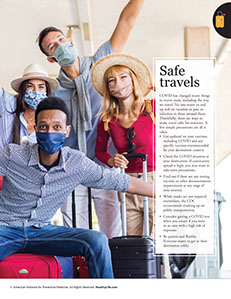
    Group of friends with luggage, wearing face masks, ready to travel.

    COVID has changed many things in recent years, including the way we travel. No one wants to end up sick on vacation or pass an infection to those around them. Thankfully, there are ways to make travel safer for everyone. A few simple precautions are all it takes.

    *  Get updated on your vaccines, including COVID and any specific vaccines recommended by your destination country.

    *  Check the COVID situation at your destination. If community spread is high, you may want to take extra precautions.

    *  Find out if there are any testing, vaccine, or other documentation requirements at any stage of your journey.

    *  While masks are not required everywhere, the CDC recommends masking up on public transportation.

    *  Consider getting a COVID test when you return if you were in an area with a high risk of exposure.

    *  Be patient and flexible. Everyone wants to get to their destination safely.

    © American Institute for Preventive Medicine

  • Make A Fire Escape Plan

    Home Safety

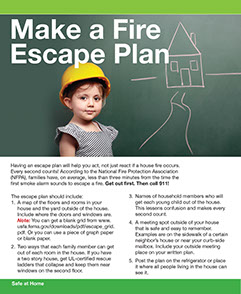
    Image of child with a hard hat on an a drawing of a house.

    Having an escape plan will help you act, not just react if a house fire occurs. Every second counts! According to the National Fire Protection Association (NFPA), families have, on average, less than three minutes from the time the first smoke alarm sounds to escape a fire. Get out first. Then call 911!

    The escape plan should include:

    1.  A map of the floors and rooms in your house and the yard outside of the house. Include where the doors and windows are. Note: You can get a blank grid fromwww.usfa.fema.gov/downloads/pdf/escape_grid.pdf. Or you can use a piece of graph paper or blank paper.

    2.  Two ways that each family member can get out of each room in the house. If you have a two story house, get UL-certified rescue ladders that collapse and keep them near windows on the second floor.

    3.  Names of household members who will get each young child out of the house. This lessens confusion and makes every second count.

    4.  A meeting spot outside of your house that is safe and easy to remember. Examples are on the sidewalk of a certain neighbor’s house or near your curb-side mailbox. Include your outside meeting place on your written plan.

    5.  Post the plan on the refrigerator or place it where all people living in the house can see it.

    Practice Your Escape Plan

    1.  Do this twice a year with everyone who lives in the house, including children and adults who will need help to get out.

    2.  Gather everyone and discuss the escape plan. Tell school-age children that this is like a fire drill at school, but for  your house.

    3.  Have a smoke alarm go off so everyone knows what it sounds like.

    4.  Have each person practice getting out of the house according to the plan. Practice both exit plans.

    5.  Have children practice how to get out on their own in case you cannot help them. Show them how to get low to the floor and crawl along the perimeter of the room to the exit and how to keep their mouths covered.

    6.  Tell your child to feel a closed door with the back of his or her hand before opening it. If the door is hot, tell your child to use the second way out if there is one.

    7.  If you have a rescue ladder, learn how to use it and practice once to make sure it works well. Hold the child in front of you as you back out of the window onto the ladder. Hold the child one rung above you. Keep the child between the ladder and your body as you climb down together.

    8.  Go to your meeting place and call 911!

    9.  Never go back into a house that is on fire. Tell firefighters if anyone or any pets have not yet gotten out.

    10. Remember to practice your fire escape plan every 6 months. Practice once during the day and another time at night.

    Safe at Home - Do This, Not That Book. Published by the American Institute for Preventive Medicine. www.HealthyLife.com. All rights reserved.

    © American Institute for Preventive Medicine

  • How To Save Your Life In A House Fire

    Home Safety

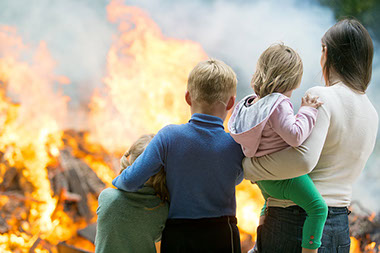
    Image of mother and children in front of a house fire.

    Knowing how to react fast in a house fire can save your life and the lives of those you love. Here are some guidelines to follow.

    *  Keep the phone number of your local fire department clearly posted near all telephones in the house. (Try to memorize the number, in case you have to use a neighbor’s phone.) Use 911! where the service is available.

    *  Prearrange a plan for family members to follow in case of fire. Conduct fire drills using your escape route.

    *  If you live in a two-story house, purchase and install an emergency escape ladder and practice using it.

    *  If a fire breaks out, don’t stop to collect personal possessions. Get people out of the house!

    *  If you can’t get to within 10 to 12 feet of a fire, you can assume it’s too big to handle on your own. Call the fire department immediately. (Call them for small fires, too.)

    *  If you try to put out the fire, make sure you can get to an exit. Don’t back yourself into a corner.

    *  Smother a fire thoroughly and keep it covered so it doesn’t ignite again. The fire department will determine if the fire has been contained or if it has spread.

    *  If you fail to extinguish the fire and smoke is accumulating, get out of the house quickly!

    Poisonous gases and smoke are often more dangerous than flames. (Smoke rises, so remember to “stay low and go.” Crawl if you must. And if you can, place a wet towel over your face to filter out smoke and fumes.)

    A Year of Health Hints book by the American Institute for Preventive Medicine. www.HealthyLife.com. All rights reserved.

    © American Institute for Preventive Medicine

  • 4 Tips For Lunchtime Walking

    WORK LIFE

    Coworkers walking outside.

    Sometimes lunchtime is the only time you have to exercise. That’s OK! Walking at lunch can boost your health. Here’s how to succeed:

    1.  Keep walking shoes and clothes at work. Then you don’t have to remember them each day.

    2.  Ask others to go with you. Having a friend can make walking more fun.

    3.  Put it in your calendar. If it’s scheduled, you may be more likely to do it.

    4.  Pack a lunch each day. Have healthy food ready to eat when you’re done.

    Source: American Heart Association

    © American Institute for Preventive Medicine