Tag: rules

  • Bike Safety

    BE FIT

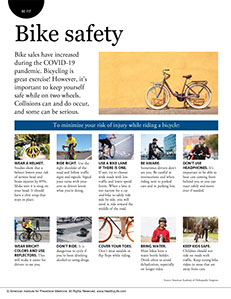
    Bike up against a yellow wall.

    Bike sales have increased during the COVID-19 pandemic. Bicycling is great exercise! However, it’s important to keep yourself safe while on two wheels. Collisions can and do occur, and some can be serious.

    To minimize your risk of injury while riding a bicycle:

    *Wear a helmet.Studies show that a helmet lowers your risk of serious head and brain injuries by 85%. Make sure it is snug on your head. It should have a chin strap that stays in place.

    *Ride right.Use the right shoulder of the road and follow traffic signs and signals. Signal your turns with your arm so drivers know what you’re doing.

    *Use a bike lane if there is one.If not, try to choose wide roads with less traffic and lower speed limits. When a lane is too narrow for a car and bike to safely ride side by side, you will need to ride toward the middle of the road.

    *Be aware.Sometimes drivers don’t see you. Be careful at intersections and when riding next to parked cars and in parking lots.

    *Don’t use headphones.It’s important to be able to hear cars coming from behind you so you can react safely and move over if needed.

    *Wear bright colors and use reflectors.This will make it easier for drivers to see you.

    *Don’t ride.It is dangerous to cycle if you’ve been drinking alcohol or using drugs.

    *Cover your toes.Don’t wear sandals or flip flops while riding.

    *Bring water.Most bikes have a water bottle holder. Drink often to avoid dehydration, especially on longer rides.

    *Keep kids safe.Children should not ride on roads with traffic. Keep young bike riders in areas that are away from cars.

    Source: American Academy of Orthopaedic Surgeons
    © American Institute for Preventive Medicine
  • Be A Good Sport

    BE FIT

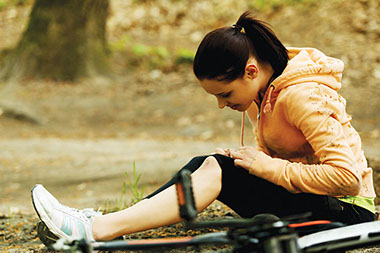
    Image of women with knee injury from riding a bike.

    Whether you’ve never had a sports injury and you’re trying to keep it that way or you’ve had an injury and don’t want another, the following tips from the National Institute of Arthritis and Musculoskeletal and Skin Diseases can help:

    *  Avoid bending knees past 90 degrees when doing half knee bends.

    *  Avoid twisting knees by keeping feet as flat as possible during stretches.

    *  When jumping, land with your knees bent.

    *  Do warm-up exercises not just before vigorous activities like running, but also before less vigorous ones such as golf.

    *  Don’t overdo.

    *  Do warm-up stretches before activity. Stretch the Achilles tendon, hamstring, and quadriceps areas and hold the positions. Don’t bounce.

    *  Cool down following vigorous sports. For example, after a race, walk or walk/jog for 5 minutes so your pulse comes down gradually.

    *  Wear properly fitting shoes that provide shock absorption and stability.

    *  Use the softest exercise surface available, and avoid running on hard surfaces like asphalt and concrete. Run on flat surfaces. Running uphill may increase the stress on the Achilles tendon and the leg itself.

    © American Institute for Preventive Medicine

  • Safe On 2 Wheels

    BE FIT

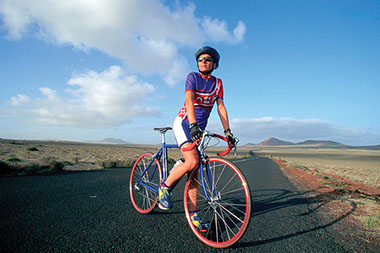
    Image of women on bike.

    Cycling is a good form of exercise. But with more than 1.4 million injuries reported in 2012 according to the Consumer Product Safety Commission, riders need to be safety conscious before hitting the pavement (literally).

    The American Academy of Orthopaedic Surgeons offers cycling safety rules:

    *  Use a bicycle that is the proper size.

    *  Make sure you are fit enough to ride before you  start pedaling.

    *  Change riding positions to reduce stress on pressure points on your body and avoid overstressing muscles.

    *  Always wear a helmet approved by the American National Standards Institute (ANSI). It should fit  snugly but comfortably and not obstruct vision.

    *  Check your bicycle’s mechanical components regularly (brakes, tires, gears).

    *  Follow traffic signs and lights. Signal your turns   so drivers can anticipate your actions.

    *  Ride in the direction of traffic. Be aware of all surroundings.

    *  Use caution on uneven or slippery surfaces.

    *  Do not listen to music with head phones, talk on  your phone, text or do anything else that can   obstruct your hearing and vision.

    *  Avoid loose clothing. Wear padded gloves and appropriate footwear. Never wear flip flops. Use padded cycling shorts for longer rides.

    *  At night, wear bright fluorescent colors; make sure to have rear reflectors. Both a working tail light and headlight should be visible from 500 feet away.

    © American Institute for Preventive Medicine