Tag: scams

  • Be A Wary Weight Loss Consumer

    Healthylife® Weigh

    Part 7

    Pills in glasses with tape measure.

    Be wary of miracle pills and quick fixes, even if offered by a “doctor” or someone claiming to be an expert. At many commercial weight loss centers, the staff may not have medical credentials or any advanced training in nutrition. They are often salespeople calling themselves “counselors,” without any medical training. Be wary of any center that pushes products and supplements over real food.

    Avoid injections or pills that advertise being able to block certain nutrients, like fat or carbohydrates. Avoid “fat burners” and anything claiming to target specific parts of your body for fat loss. These are likely a waste of money and can be dangerous.

    Having someone create your meal plan for you may help you get started, but be sure to learn how to do it yourself. Learn to make your own healthy choices. Avoid weight loss programs and schemes that encourage dependence on special products.

    © American Institute for Preventive Medicine

  • Shopping Online Safely

    FINANCIAL HEALTH

    Image of couple shopping online.

    Using your computer, tablet or smartphone to shop can be quick and convenient. But, the internet is full of websites that aren’t trusted places to shop. To keep your personal information and money safe, follow these steps before you shop online:

    *Use major companies that you know.Look for a company address, phone number, and email. Read online reviews before buying.

    *Research the return policy.Can you get a full refund if you aren’t satisfied? What does it cost to send it back?

    *Know what shipping will cost.Be sure you know what the cost will be before you place the order. Shipping costs should be clearly listed on the website.

    *Never use cash.If you pay by credit card, your purchase is protected by the Fair Credit Billing Act. This means you can dispute charges you didn’t make. You may also be protected from having to pay for unauthorized charges if your card number is stolen.

    *Compare your credit card statement and your online receipt.Be sure the costs match.

    *Don’t use email for sending financial information.Email isn’t secure and someone could steal your information this way.

    Beware of fake online reviews

    You see a product online that has hundreds of glowing reviews. It must be great, right? Not necessarily. In fact, some companies have been sued by the FTC for providing fake online reviews. Some companies even pay people to write great reviews for their products, or delete negative reviews on their site.

    Take any online reviews with a grain of salt. If they seem too good to be true, they probably are. Almost any product will have some positive, neutral and negative opinions. If it doesn’t, this may be a red flag for a scam.

    Source: Federal Trade Commission

    © American Institute for Preventive Medicine

  • Stay Safe When Holiday Shopping

    FINANCIAL HEALTH

    Image of female on laptop with credit card in hand.

    The holidays are often a time for celebrations, get-togethers, and lots of shopping for gifts. Unfortunately, theft can happen any time of year, including during the holiday season. To keep yourself and loved ones safe when holiday shopping, consider these tips from the National Crime Prevention Council (NCPC):

    At malls and stores:

    *  To keep your money safe, carry your purse close to your body. Wallets are better kept in a front pocket, where they are harder to pickpocket.

    *  Have your keys ready when walking to your vehicle. Glance at the back seat and be aware of your surroundings before getting in.

    *  Don’t leave packages or valuables in your car where they can be seen. Take them home immediately, if possible, or keep them in the trunk.

    *  When shopping with children, teach them to go to a meeting place in case you get separated. Talk to them about finding store security guards or employees to help, if needed.

    When online shopping:

    *  Be sure you update anti-virus and anti-spyware software on your computer. Visitwww.bytecrime.org.

    *  Never give out your password or credit card information in response to emails. Valid companies will never ask for this type of information.

    *  Make sure the website is secure: look for a locked padlock at the bottom of the screen or “https” in the address at the top.

    *  Use secure payment methods, such as PayPal or Apple Pay, whenever possible. If using a credit card, check your transactions regularly and alert your bank if you notice anything suspicious.

    *  Check reviews of online stores to ensure the company is credible.

    Warm-up thefts are in season

    During the winter months, many people start their cars and let them warm up while they wait inside. This can be a prime opportunity for someone to steal your vehicle or items inside it, according to the NCPC. Here’s how to avoid these situations:

    *  Never leave your car running or keys in the ignition if you’re not in it, even for a minute.

    *  Always keep your car locked, and use anti-theft or alarm devices if you have them.

    *  Keep valuables out of sight (and preferably out of your car), such as phones, purses and electronics.

    © American Institute for Preventive Medicine

  • Avoid Dubious Debt Collectors

    FINANCIAL HEALTH

    Wife on phone while husband sits besides her.

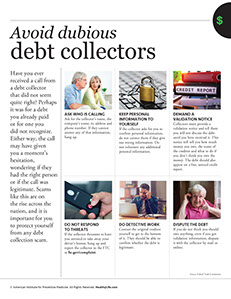
    Have you ever received a call from a debt collector that did not seem quite right? Perhaps it was for a debt you already paid or for one you did not recognize. Either way, the call may have given you a moment’s hesitation, wondering if they had the right person or if the call was legitimate. Scams like this are on the rise across the nation, and it is important for you to protect yourself from any debt collection scam.

    Ask who is calling

    Ask for the collector’s name, the company’s name, its address and phone number. If they cannot answer any of that information, hang up.

    Keep personal information to yourself

    If the collector asks for you to confirm personal information, do not correct them if they give out wrong information. Do not volunteer any additional personal information.

    Demand a validation notice

    Collectors must provide a validation notice and tell them you will not discuss the debt until you have received it. This notice will tell you how much money you owe, the name of the creditor and what to do if you don’t think you owe the money. The debt should also appear on a free, annual credit report.

    Do not respond to threats

    If the collector threatens to have you arrested or take away your driver’s license, hang up and report the collector to the FTC atftc.gov/complaint.

    Do detective work

    Contact the original creditor yourself to get to the bottom of it. They should be able to confirm whether the debt is legitimate.

    Dispute the debt

    If you do not think you should owe anything, even if you got validation information, dispute it with the collector by mail or online.

    Source: Federal Trade Commission

    © American Institute for Preventive Medicine