Tag: Screening & Preventive Care

  • A Routine Checkup

    Medical Exams

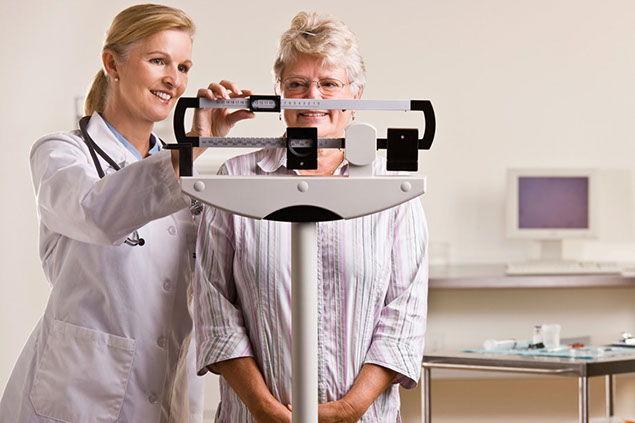
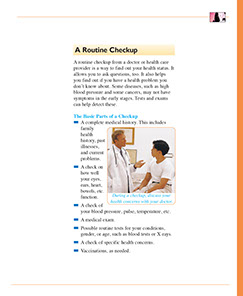
    A routine checkup from a doctor or health care provider is a way to find out your health status. It allows you to ask questions, too. It also helps you find out if you have a health problem you don’t know about. Some diseases, such as high blood pressure and some cancers, may not have symptoms in the early stages. Tests and exams can help detect these.

    The Basic Parts of a Checkup

    *  A complete medical history. This includes family health history, past illnesses, and current problems.

    *  A check on how well your eyes, ears, heart, bowels, etc. function.

    *  A check of your blood pressure, pulse, temperature, etc.

    *  A medical exam.

    *  Possible routine tests for your conditions, gender, or age, such as blood tests or X-rays.

    *  A check of specific health concerns.

    *  Vaccinations, as needed.

    Page from the Healthier at Home book by the American Institute for Preventive Medicine. www.HealthyLife.com. All rights reserved.

    © American Institute for Preventive Medicine

  • The Id Card That Can Save Your Life

    Medical Care

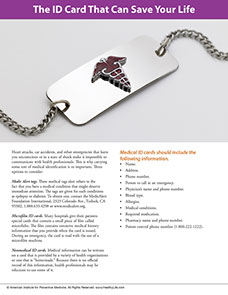
    Image of a medical alert tag.

    Heart attacks, car accidents, and other emergencies that leave you unconscious or in a state of shock make it impossible to communicate with health professionals. This is why carrying some sort of medical identification is so important. Three options to consider:

    *  Medic Alert tags. These medical tags alert others to the fact that you have a medical condition that might deserve immediate attention. The tags are given for such conditions as epilepsy or diabetes. To obtain one, contact the MedicAlert Foundation International, 2323 Colorado Ave., Turlock, CA 95382, 1.888.633.4298 orwww.medicalert.org.

    *  Microfilm ID cards. Many hospitals give their patients special cards that contain a small piece of film called microfiche. The film contains extensive medical history information that you provide when the card is issued. During an emergency, the card is read with the use of a microfilm machine.

    *  Nonmedical ID cards. Medical information can be written on a card that is provided by a variety of health organizations or one that is “homemade.” Because there is no official record of this information, health professionals may be reluctant to use some of it.

    Medical ID cards should include the following information.

    *  Name.

    *  Address.

    *  Phone number.

    *  Person to call in an emergency.

    *  Physician’s name and phone number.

    *  Blood type.

    *  Allergies.

    *  Medical conditions.

    *  Required medication.

    *  Pharmacy name and phone number.

    *  Poison control phone number (1.800.222.1222).

    Page from A Year of Health Hints book by the American Institute for Preventive Medicine. www.HealthyLife.com. All rights reserved.

    © American Institute for Preventive Medicine

  • Do Genetic Tests Really Work?

    MEDICAL NEWS

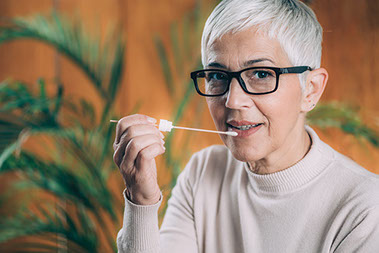
    Women holding a swab near her mouth.

    You may have seen ads for genetic tests. These tests claim to tell you about your health. They might tell you if you’re at risk for a certain disease or if you should eat a certain diet.

    Big promises from companies

    At-home genetic tests may sound exciting, and companies advertise them as “the answer” to many health issues. But the Food and Drug Administration (FDA) and the Centers for Disease Control and Prevention (CDC) say you should be careful about using these tests.

    Before you spend a lot of money on one, keep in mind that the test may not have any science to back up its claims. Others may give you some good information, but the information is only useful if you also have a complete medical exam.

    The FDA and CDC say that genetic tests are complex. They say that the results can be hard to understand without having appropriate medical knowledge.

    Just a snapshot

    Many genetic tests look at a few of your body’s genes. But you have more than 20,000 genes in your body. If you get a “positive result” for certain genes, it could mean:

    *  You have a certain disease.

    *  You have a higher risk of getting certain diseases.

    *  You are a carrier for a certain disease.

    But even a positive result doesn’t tell the whole story. You may never get the disease that comes back “positive.” Or if you do, it may not be severe enough to cause any serious health problems.

    A negative result means the lab didn’t find any unusual changes in your genes. While this can be good news for certain diseases, it’s not foolproof. It doesn’t mean you’ll never get a disease or have health problems. It’s also possible that the test didn’t look at other genes that could be important.

    Many factors at play

    Genes are only one piece of each person’s health story. Your environment and your lifestyle also play huge parts in your physical and mental health. Don’t rely on genetic tests to make any health promises. Instead, see your doctor regularly and follow a healthy lifestyle. That can mean more than a few genes.

    When genetic tests are part of a medical exam, they can be helpful. Your doctor can help you decide if you need genetic tests. If you do need them, make sure a medical professional reads your results.

    Source: Federal Trade Commission
    © American Institute for Preventive Medicine

  • Advance Directives

    Medical Care

    Hospitals and nursing homes are required to give you information about your rights as a patient under their care. Advance directives are a legal way for you to declare your wishes to choose or refuse medical treatment.

    {Note: If you live in or get medical care in more than one state, have advance directives for all states involved.}

    Two Types of Advance Directives

    *  Living Will. This written document states what medical treatment you would want or not want if you were unable to state it yourself. A living will applies when you can’t express your wishes on your own and you have a terminal illness or condition from which you aren’t expected to survive. In writing, you may choose or refuse:

    – Measures to Support Life, such as a respirator (a machine to breathe for you).

    – Measures to Sustain Life, such as tube feedings and kidney dialysis (a machine that does the work of your kidneys).

    – Measures to Enhance Life. These keep you comfortable, but don’t prolong life. Examples are pain medications and hospice care.

    *  Durable Power of Attorney for Health Care. This written document names a person who would make treatment decisions for you if you are not able to make them yourself. This person would state your wishes. Your condition does not have to be terminal or irreversible to have someone speak on your behalf.

    Each state has its own laws on advance directives. Get forms for them from your lawyer, local hospital or library, or from your state’s Web site. Other places for forms and information:

    *  Caring Connection:www.caringinfo.org– Click on “Planning Ahead” and “State-Specific Advance Directives.”

    *  U.S. Living Will Registry:www.uslivingwillregistry.com

    After you complete advance directives, discuss them with your family and close friend(s). Give your doctor a copy, too.

    Page from the Healthier at Home book by the American Institute for Preventive Medicine. www.HealthyLife.com. All rights reserved.

    © American Institute for Preventive Medicine

  • Choosing A Doctor Or Health Care Provider

    Medical Care

    Finding the right doctor or health care provider for you is a big part of your medical care. Don’t wait until you get sick to find one. When you look for or change doctors, follow these tips:

    *  Look for one who accepts your health plan. Check with the plan. Ask the person at work who handles employee benefits.

    *  If you belong to a managed care plan, get a list of providers who work with the plan. Health Maintenance Organizations (HMOs) and Preferred Provider Organizations (PPOs) are two types of managed care plans. The doctor(s) you see now may be on your HMO or PPO list.

    *  Ask relatives and friends for doctors they trust and have given them good medical care.

    *  Find out if a doctor is taking new patients. Check with your health plan. Call the doctor’s office.

    *  Look for a doctor you can relate to. How do you want medical decisions to be made? The doctor alone? You and the doctor together? Find one that meets your needs.

    *  Ask about office hours and staffing. Ask how many patients are scheduled to be seen in an hour and how long they usually wait to see the doctor.

    *  Ask how payment is handled. Must you pay at the time of your visit or can you be billed?

    *  Find out what other providers serve as backups when the doctor is away. Ask what you should do at non-office hour times.

    *  Find out which hospital(s) the doctor or provider sends patients to.

    *  Look for a doctor who is competent and can care for all your general health needs. Ask if and who the doctor will refer you to for any special health needs.

    Resources

    American Board of Medical Specialties (ABMS)

    866.ASK.ABMS (275.2267)

    www.abms.org

    Federation of State Medical Boards

    888.ASK.FCVS (275.3287)

    www.fsmb.org

    Health Grades

    www.healthgrades.com

    U.S. Department of Health & Human Services

    www.healthfinder.gov

    Page from the Healthier at Home book by the American Institute for Preventive Medicine. www.HealthyLife.com. All rights reserved.

    © American Institute for Preventive Medicine

  • Gather Facts

    Medical Care

    Image of 4 people sitting and talking.

    Decisions you make about your health can affect the length and quality of your life. Choose wisely. To do this, you need to gather facts. Use these sources:

    *  You. You know more about you than anyone else. Be in touch with how you feel, physically and emotionally. Keep track of past and present health concerns.

    *  Your doctor. Ask for his or her advice. Your doctor may also have written materials on your condition.

    *  Medical resources. These include:

    – The Internet’s world wide web. Look for credible sites, such aswww.medlineplus.gov,www.healthfinder.gov, and other Web sites which end in .gov. Other credible sites are ones from hospitals, medical centers, and medical associations. Most often, these sites end in .edu and .org. Beware of Web sites that promote health fraud and quackery. Accesshttp://quackwatch.orgfor information. Also, check with your doctor before you follow advice from a Web site. The advice may not be right for your needs.

    – Not-for-profit groups. These include the American Cancer Society, the American Heart Association, and the American Diabetes Association. To get information, call their toll-free numbers or access their Web sites.

    – Government agencies. One is the National Heart, Lung, and Blood Institute (NHLBI). Accesswww.nhlbi.nih.gov.

    – Support groups for conditions, such as breast cancer. Check local hospitals for lists of support groups near you. Also, contact the American Self-Help Group Clearinghouse Self-Help Group Sourcebook Online atwww.mentalhelp.net/selfhelp.

    Your job is to gather facts. Once you have the facts, you and your doctor can make the medical decision(s) best suited to your needs.

    Page from the Healthier at Home book by the American Institute for Preventive Medicine. www.HealthyLife.com. All rights reserved.

    © American Institute for Preventive Medicine

  • Health Screenings Can Save Lives

    Medical Exams

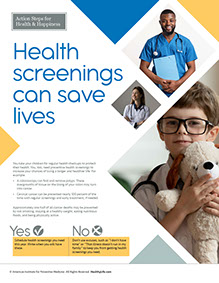
    Smiling doctor.

    You take your children for regular health checkups to protect their health. You, too, need preventive health screenings to increase your chances of living a longer and healthier life. For example:

    *  A colonoscopy can find and remove polyps. These overgrowths of tissue on the lining of your colon may turn into cancer.

    *  Cervical cancer can be prevented nearly 100 percent of the time with regular screenings and early treatment, if needed.

    *  Schedule health screenings you need this year. Write when you will have these.

    *  Don’t use excuses, such as “I don’t have time” or “That illness doesn’t run in my family” to keep you from getting health screenings you need.

    Approximately one half of all cancer deaths may be prevented by not smoking, staying at a healthy weight, eating nutritious foods, and being physically active.

    ays to Well-Being book by the American Institute for Preventive Medicine. www.HealthyLife.com. All rights reserved.

    © American Institute for Preventive Medicine

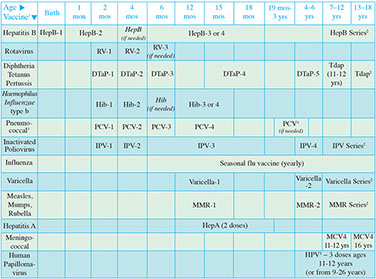
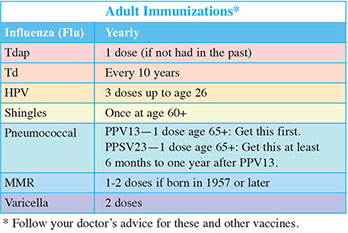
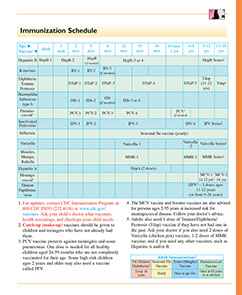
  • Immunization Schedule

    Medical Exams

    1.  For updates, contact CDC Immunization Program at 800.CDC.INFO (232.4636) orwww.cdc.gov/vaccines. Ask your child’s doctor what vaccines, health screenings, and checkups your child needs.

    2.  Catch-up vaccines should be given to children and teenagers who have not already had them.

    3.  PCV vaccine protects against meningitis and some pneumonias. One dose is needed for all healthy children aged 24-59 months who are not completely vaccinated for their age.

    Vaccines for Traveling Abroad

    Before you travel to other countries, find out if you need certain vaccines. Get information from the CDC Travelers’ Information Line. Call 800.CDC.INFO (232.4636) or use thewww.cdc.gov/travelWeb site. Discuss your needs with your doctor.

    Page from the Healthier at Home book by the American Institute for Preventive Medicine. www.HealthyLife.com. All rights reserved.

    © American Institute for Preventive Medicine

  • Immunize Or Your Health Care Costs Could Rise

    Medical Exams

    Women wearing face mask, smiling, showing bandage on arm where she got a vaccine.

    Vaccines prevent many diseases that could have a costly impact, resulting in doctor’s visits, hospitalizations, and premature deaths. Sick children can also cause parents to lose time from work.

    *  Learn about vaccines you and your children need fromcdc.gov/vaccines.

    *  Find if and which vaccines are covered benefits of your health plan.

    *  Contact your local health department about its vaccine services.

    *  Find out about free or low-cost vaccines for kids from the Vaccines for Children (VFC) Program atcdc.gov/vaccines/programs/vfc/index.html.

    *  Beginning in early fall, read local papers and store ads to find out where flu shots will be given. Find out if and when flu shots will be given at work.

    ays to Well-Being book by the American Institute for Preventive Medicine. www.HealthyLife.com. All rights reserved.

    © American Institute for Preventive Medicine

  • Informed Consent

    Medical Care

    Image of person filling out forms.

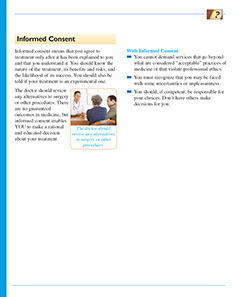
    Informed consent means that you agree to treatment only after it has been explained to you and that you understand it. You should know the nature of the treatment, its benefits and risks, and the likelihood of its success. You should also be told if your treatment is an experimental one.

    The doctor should review any alternatives to surgery or other procedures. There are no guaranteed outcomes in medicine, but informed consent enables YOU to make a rational and educated decision about your treatment.

    With Informed Consent

    *  You cannot demand services that go beyond what are considered “acceptable” practices of medicine or that violate professional ethics.

    *  You must recognize that you may be faced with some uncertainties or unpleasantness.

    *  You should, if competent, be responsible for your choices. Don’t have others make decisions for you.

    Page from the Healthier at Home book by the American Institute for Preventive Medicine. www.HealthyLife.com. All rights reserved.

    © American Institute for Preventive Medicine