Tag: screening

  • Know About Prostate Cancer

    MEDICAL NEWS

    Image of prostate cancer ribbon.

    Experts at Mount Sinai Medical Center offer this prostate cancer prevention advice:

    *Age is the strongest risk factor:Almost two-thirds of prostate cancers are found in men over the age of 65.

    *Family history can be important:Having a father or brother with prostate cancer more than doubles a man’s risk of developing this disease.

    *Race is a factor:Prostate cancer occurs more often in African-American men than in men of other races.

    *Follow a healthy diet:Eat more low-fat, high-fiber foods such as fruits and vegetables, and limit intake of red or processed meat.

    *Diagnose cancer early:Speak with your doctor about your risk for prostate cancer and the benefits of screening. For men at high risk, screening should be considered at age 40.

    Screening works

    Screenings consists of a PSA blood test, which measures the level of PSA, a protein that is produced by the prostate gland, and a digital rectal exam, which can uncover physical abnormalities of the prostate that may be a sign of cancer.

    NOTE:

    Prostate cancer screening guidelines vary with different health groups. Ask your doctor at what age you should discuss prostate cancer screening. Ask about the benefits and risks of PSA blood tests.

    © American Institute for Preventive Medicine

  • Glaucoma

    Eye Conditions

    Glaucoma is a group of eye diseases that damages the optic nerve and causes vision loss.

    Signs & Symptoms

    For Chronic (Open-Angle) Glaucoma

    This type takes place gradually, and causes no symptoms early on. Loss of side (peripheral) vision and blurred vision are the first signs.

    Later, symptoms include:

    *  Vision loss in side and central vision, usually in both eyes.

    *  Blind spots. Seeing halos around lights.

    *  Poor night vision.

    *  Blindness, if not treated early.

    For Acute (Angle-Closure) Glaucoma

    This type is a medical emergency! These symptoms occur suddenly:

    *  Severe eye pain and nausea.

    *  Blurred vision. Seeing halos around lights.

    *  Redness in the eye. Swollen upper eyelid.

    *  Severe headache that throbs.

    Causes

    Glaucoma occurs when the pressure of the liquid in the eye gets too high and causes damage to the optic nerve. Increased eye pressure without damage is not glaucoma, but increases the risk for it. Antihistamines and long-term corticosteroid use can trigger or worsen glaucoma.

    Risk Factors for Glaucoma

    *  Being over age 60, especially Mexican Americans.

    *  Being African American over age 40.

    *  Having a family history of glaucoma.

    *  Having diabetes.

    *  Being nearsighted.

    Treatment

    Treatments help with current vision. They do not improve sight already lost from glaucoma. Glaucoma may not be preventable, but the blindness that could result from it is. Get tested for glaucoma when you get regular vision exams. If pressure inside the eyeball is high, an eye doctor will prescribe treatment. This includes:

    Medicines used for acute glaucoma are prescribed for life. If medicines do not control the pressure, your doctor may advise:

    *  Laser beam surgery.

    *  Surgery that drains fluid from the eye.

    *  Medicines. These are the most common early form of treatment.

    – Prescribed eye drops or pills lower eye pressure, cause the eye to make less fluid, or help drain fluid from the eye.

    – Take medicines on a regular basis.

    – Let your eye doctor know of side effects.

    Questions to Ask

    Self-Care / Prevention

    *  Don’t smoke. If you smoke, quit.

    *  Do not take any medicine, including over-the-counter ones, without first checking with your doctor or pharmacist. Most cold medications and sleeping pills, for example, can cause the pupil in the eye to dilate. This can lead to increased eye pressure.

    *  If prescribed eye drops for glaucoma, use them as directed.

    *  Ask your eye doctor about low vision services and devices.

    *  Try not to get upset and fatigued. These can increase pressure in the eye.

    Resources

    National Eye Institute (NEI)

    www.nei.nih.gov

    Healthier at Home book by the American Institute for Preventive Medicine. www.HealthyLife.com. All rights reserved.

    © American Institute for Preventive Medicine

  • Men’S Health 2

    MEDICAL NEWS

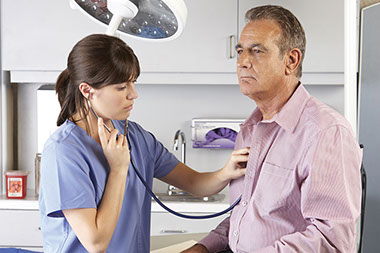
    Image of oler man at the doctor's office.

    Increasing awareness of health problems that can be prevented among men and encourage men and boys to get early detection and treatment of disease and injury.

    6 health tests men need

    Here are 6 essential screening tests all men should receive during their lifetime, according to pathologist and men’s health expert Dr. Thomas Wheeler, Baylor College of Medicine.

    1.Prostate cancer:The prostate specific antigen (PSA) test was developed to help detect prostate cancer in men, but experts now disagree about treating the cancer if detected. Men, starting at age 50, should speak with their docs about the pros and cons of screening. For those in high-risk categories, this conversation should begin at age 45 or earlier.

    2.Blood pressure:It’s a simple and painless test for the “silent killer.” Why? Because high blood pressure has no symptoms. Often, simple diet changes and regular exercise can lower blood pressure. If not, the medications to control blood pressure are well tolerated and do not cost a lot.

    3.Cholesterol:A cholesterol test also is a simple screening test and is advised for men at least every 5 years, or yearly if abnormal.

    4.Colon cancer:This is the third most common cancer in Americans. Beginning at age 50, men should be screened for precancerous polyps and colon cancer. Screening tests include the fecal occult blood test, flexible sigmoidoscopy and colonoscopy.

    5.Skin cancer:Limiting sun exposure and receiving regular check-ups can help men avoid this common cancer including melanoma – a potentially deadly form.

    6.Diabetes:Men 45 years and older should be tested for type 2 diabetes every 3 years. Common screening blood tests are fasting glucose and hemoglobin A1c. Diabetes can be detected early before complications of more advanced disease set in.

    © American Institute for Preventive Medicine

  • Help For Hearing Loss

    Mature Health: Over Age 50

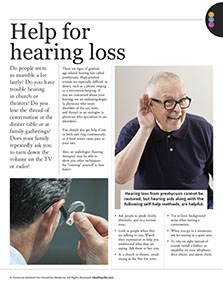
    Image of mature man with hand up to his ear trying to hear.

    Do people seem to mumble a lot lately? Do you have trouble hearing in church or theaters? Do you lose the thread of conversation at the dinner table or at family gatherings? Does your family repeatedly ask you to turn down the volume on the TV or radio?

    These are signs of gradual, age-related hearing loss called presbycusis. High-pitched sounds are especially difficult to discern. Another way to detect this problem is to hold a watch to your ear. If you can’t hear it ticking, see an otolaryngologist (a physician who treats disorders of the ear, nose, and throat) or an otologist (a physician who specializes in ear disorders).

    You should also get help if one or both ears ring continuously, or if loud noises cause pain in your ears.

    Hearing loss from presbycusis cannot be restored, but hearing aids. along with the following self-help methods, are helpful.

    *  Ask people to speak clearly, distinctly, and in a normal tone.

    *  Look at people when they are talking to you. Watch their expressions to help you understand what they are saying. Ask them to face you.

    *  Try to limit background noise when having a conversation.

    *  In a church or theater, sit near, but not in the front row. Sit in the third or fourth row with people sitting around you.

    *  To rely on sight instead of sound, install a buzzer, flasher, or amplifier on your telephone, door chime, and alarm clock.

    Also, an audiologist (hearing therapist) may be able to show you other techniques for “training” yourself to hear better.

    A Year of Health Hints book by the American Institute for Preventive Medicine. www.HealthyLife.com. All rights reserved.

    © American Institute for Preventive Medicine

  • Ovarian Cancer: Know The Signs

    MEDICAL NEWS

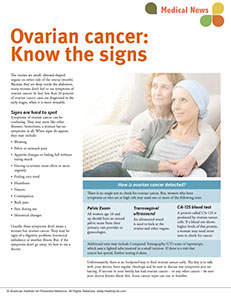
    Image of women holding cancer patient.

    The ovaries are small, almond-shaped organs on either side of the uterus (womb). Because they are deep inside the abdomen, many women don’t feel or see symptoms of ovarian cancer. In fact, less than 20 percent of ovarian cancer cases are diagnosed in the early stages, when it is more treatable.

    Signs are hard to spot

    Symptoms of ovarian cancer can be confusing. They may seem like other illnesses. Sometimes, a woman has no symptoms at all. When signs do appear, they may include:

    *  Bloating

    *  Pelvic or stomach pain

    *  Appetite changes or feeling full without eating much

    *  Having to urinate more often or more urgently

    *  Feeling very tired

    *  Heartburn

    *  Nausea

    *  Constipation

    *  Back pain

    *  Pain during sex

    *  Menstrual changes

    Usually, these symptoms don’t mean a woman has ovarian cancer. They may be signs of a digestive problem, hormonal imbalance or another illness. But, if the symptoms don’t go away, it’s best to see a doctor.

    How is ovarian cancer detected?

    There is no single test to check for ovarian cancer. But, women who have symptoms or who are at high risk may need one or more of the following tests:

    *  Pelvic Exam: All women age 18 and up should have an annual pelvic exam from their primary care provider or gynecologist.

    *  Transvaginal ultrasound: An ultrasound wand is used to look at the ovaries and other organs.

    *  CA-125 blood test: A protein called CA-125 is produced by ovarian cancer cells. If a blood test shows higher levels of this protein, a woman may need more tests to check for cancer.

    Additional tests may include Computed Tomography (CT) scans or laproscopy, which uses a lighted tube inserted in a small incision. If there is a risk that cancer has spread, further testing is done.

    Unfortunately, there is no foolproof way to find ovarian cancer early. The key is to talk with your doctor, have regular checkups and be sure to discuss any symptoms you are having. If anyone in your family has had ovarian cancer – or any other cancer – be sure your doctor knows about this. Some cancer types can run in families.

    © American Institute for Preventive Medicine

  • Hepatitis

    General Health Conditions

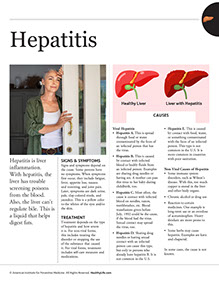
    Hepatitis is liver inflammation. With hepatitis, the liver has trouble screening poisons from the blood. Also, the liver can’t regulate bile. This is a liquid that helps digest fats.

    Signs & Symptoms

    Signs and symptoms depend on the cause. Some persons have no symptoms. When symptoms first occur, they include fatigue, fever, appetite loss, nausea and vomiting, and joint pain.

    Later, symptoms are dark urine, pale, clay-colored stools, and jaundice. This is a yellow color to the whites of the eyes and/or the skin.

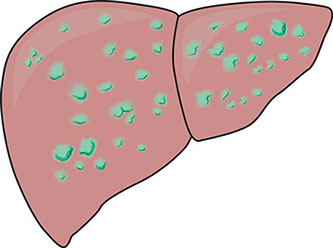
    Illustration of hepatitis in the liver.

    Hepatitis in the Liver

    Causes

    One or More Types of Viral Hepatitis

    *  Hepatitis A. This is spread through food or water contaminated by the feces of an infected person that has the virus.

    *  Hepatitis B. This is caused by contact with infected blood or bodily fluids from an infected person. Examples are sharing drug needles or having sex. A mother can pass this virus to her baby during childbirth, too.

    *  Hepatitis C. Most often, the cause is contact with infected blood on needles, razors, toothbrushes, etc. Blood transfusions given before July, 1992 could be the cause, if the blood had the virus. Sexual contact may spread the virus, too.

    *  Hepatitis D. Sharing drug needles or having sexual contact with an infected person can cause this type, but only in persons who already have hepatitis B. It is not common in the U.S.

    *  Hepatitis E. This is caused by contact with food, water, or something contaminated with the feces of an infected person. This type is not common in the U.S. It is more common in Africa and India.

    Non-Viral Causes of Hepatitis

    *  Some immune system disorders, such as Wilson’s disease. With this, too much copper is stored in the liver and other body organs.

    *  Chronic alcohol or drug use.

    *  Reaction to certain medicines. One example is long-term use or an overdose of acetaminophen. Heavy drinkers are more prone to this.

    *  Some herbs may cause hepatitis. Examples are kava and chaparral.

    In some cases, the cause is not known.

    Treatment

    Treatment depends on the type of hepatitis and how severe it is. For non- viral forms, this includes treating the disorder or stopping the use of the substance that caused it. For viral forms, treatment includes self-care measures and medications.

    Questions to Ask

    Self-Care / Prevention

    To Help Prevent Hepatitis A and E

    *  Get a hepatitis A vaccine if advised by your doctor or health department. There is no vaccine for hepatitis E.

    *  When you travel to countries where the virus is widespread, wash your hands often. Drink boiled water. Don’t eat unpeeled or uncooked fruits or foods rinsed with water. Don’t use ice.

    *  If exposed to hepatitis A, contact your doctor to get immune globulin (IG) within 2 weeks of exposure.

    To Help Prevent Hepatitis B, C, and D

    *  Get 3 doses of hepatitis B vaccine if advised by your doctor. There is no vaccine for hepatitis C.

    *  Practice Safer Sex.

    *  Don’t share IV drug needles.

    *  Don’t share razors or toothbrushes. See that sterilized items are used for ear piercing, etc.

    To Help Prevent Non-Viral Forms

    *  Use alcohol in moderation, if at all.

    *  Don’t combine alcohol and acetaminophen. Take products that contain acetaminophen, such as Tylenol, as directed. Heed warnings listed on the label.

    To Treat Hepatitis

    *  Follow your doctor’s advice for medicines, etc.

    *  Rest.

    *  Drink at least 8 glasses of fluids a day.

    *  Avoid alcohol and any drugs or medicines that affect the liver, such as acetaminophen.

    *  Follow a healthy diet. Take vitamins and minerals as advised by your doctor.

    Resources

    National Center for HIV/AIDS, Viral Hepatitis, STD, and TB Prevention

    800.CDC.INFO (232.4636)

    www.cdc.gov/nchhstp

    Healthier at Home book by the American Institute for Preventive Medicine. www.HealthyLife.com. All rights reserved.

    © American Institute for Preventive Medicine

  • Pap Smear Needed Even With Hpv Vaccine

    MEDICAL NEWS

    Image of women talking with her doctor.

    HPV (human papillomavirus) vaccines that are often recommended to help prevent infections related to cervical and other cancers should not discourage women from also getting a Pap smear, UT Southwestern Medical Center cancer experts said.

    “Women should continue to be screened even if they have undergone HPV vaccination. The vaccine does not target all types of HPV that cause cancer. It is intended to reduce the risk of cancer, but has not been proven to eliminate the need for screening,” explains Dr. Jayanthi Lea.

    Unless you have a history of precancerous lesions, cancer, immune deficiency, or other risks, testing every three years between ages 21 and 65 is sufficient, Dr. Lea said. “There is also the option of combining a Pap test with HPV testing for women over age 30. Screening this way is typically performed every five years.”

    © American Institute for Preventive Medicine