
Tag: seatbelt

  • Six Things You Should Never Do In Your Car

    Personal Safety

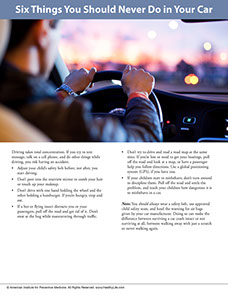
    Image of man driving.

    Driving takes total concentration. If you try to text message, talk on a cell phone, and do other things while driving, you risk having an accident.

    *  Adjust your child’s safety belt before, not after, you start driving.

    *  Don’t peer into the rearview mirror to comb your hair or touch up your makeup.

    *  Don’t drive with one hand holding the wheel and the other holding a hamburger. If you’re hungry, stop and eat.

    *  If a bee or flying insect distracts you or your passengers, pull off the road and get rid of it. Don’t swat at the bug while maneuvering through traffic.

    *  Don’t try to drive and read a road map at the same time. If you’re lost or need to get your bearings, pull off the road and look at a map, or have a passenger help you follow directions. Use a global positioning system (GPS), if you have one.

    *  If your children start to misbehave, don’t turn around to discipline them. Pull off the road and settle the problem, and teach your children how dangerous it is to misbehave in a car.

    Note: You should always wear a safety belt, use approved child safety seats, and heed the warning for air bags given by your car manufacturer. Doing so can make the difference between surviving a car crash intact or not surviving at all, between walking away with just a scratch or never walking again.
    A Year of Health Hints book by the American Institute for Preventive Medicine. www.HealthyLife.com. All rights reserved.

    © American Institute for Preventive Medicine
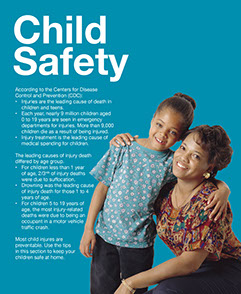
  • Child Safety

    Child Safety

    Do This, Not That

    According to the Centers for Disease Control and Prevention (CDC):

    *  Injuries are the leading cause of death in children and teens.

    *  Each year, nearly 9 million children aged 0 to 19 years are seen in emergency departments for injuries. More than 9,000 children die as a result of being injured.

    *  Injury treatment is the leading cause of medical spending for children.

    The leading causes of injury death differed by age group.

    *  For children less than 1 year of age, 2/3rds of injury deaths were due to suffocation.

    *  Drowning was the leading cause of injury death for those 1 to 4 years of age.

    *  For children 5 to 19 years of age, the most injury-related deaths were due to being an occupant in a motor vehicle traffic crash.

    Most child injures are preventable. Use the tips in this section to keep your children safe at home.

    General Guidelines

    Safe at Home - Do This, Not That Book. Published by the American Institute for Preventive Medicine. www.HealthyLife.com. All rights reserved.

    © American Institute for Preventive Medicine