Tag: smoking

  • Smokers: Use Matches Instead Of A Lighter

    Healthylife® QuitWell™

    Part 3

    A box of matches.

    If you smoke, use matches instead of a lighter to light your cigarettes. When you reach for your lighter and it isn’t there, you will interrupt your usual routine. This can be a reminder to wait 5 minutes or to question how strong that urge really is. Using a match is also more difficult and may change the taste of your cigarette. This can interrupt and weaken the routine even more.

    © American Institute for Preventive Medicine

  • Cleaning Up Mind Pollution

    Healthylife® QuitWell™

    Part 4

    Image of women relaxing while thinking.

    Start with changing how you react to minor annoyances, like traffic or a chatty co-worker. Work to reduce the number of things that push your buttons. It is not the event itself that determines your feelings-it is what you tell yourself about it. You may have some truly big, serious stressors in your life. Avoid piling the little things on top.

    “Men are not disturbed by things, but by the views they take of them.”  – Epictetus

    Let’s pretend you got stuck in a traffic jam on the way to work today. You feel angry and upset. But it is not the traffic jam that makes you upset. It is what you tell yourself that upsets you: “I’m going to be late for work.” “I have so much to do.” “This is such a waste of time.”

    You cannot change the fact that you are stuck in traffic. Getting angry serves no purpose. If you can look at the delay as a minor problem that you can’t control, rather than a major event, you will feel much better. When your mind stays calm, you may even see ways around the issue, like taking another route or using hands-free calling to join a meeting you’re running late for.

    Your outlook on quitting is also very important. If you tell yourself that quitting will be awful, chances are the process will be as bad as you think. If you accept the fact that you will have urges, but nothing you can’t handle, you will have an easier time quitting. Focus on what is gained from quitting, not on what is being lost or the minor discomfort along the way.

    Thinking Differently

    You can change how you think, feel, and react to any event. The ABCDE model can help you do this.

    Activating Event:An event that triggers thoughts and feelings. Example – “I am trying to quit smoking and this event is making me anxious.”

    Belief:What you think or say to yourself about the activating event. Examples – “I just can’t quit.” “I don’t have any willpower.”

    Consequence:How you feel in response to your beliefs. Examples – “I feel discouraged.” “I feel embarrassed and defeated.”

    Dispute:Question your earlier beliefs. Examples – “Wait a minute here, I can do hard things!” “I don’t need to rely on willpower to quit. I can apply skills I’m learning in QuitWell™.”

    Effect:How you feel after you dispute your earlier beliefs. Examples – “I can succeed.” “I feel my actions are within my control.” “I can handle this.”

    © American Institute for Preventive Medicine

  • Look Ahead

    Healthylife® QuitWell™

    Part 1

    Image of women thinking.

    It can be easy to stay in the day-to-day of our lives. Looking ahead can help you see further down the road at where you are headed. Think about how you picture the next year of your life and answer the questions below:

    *  Who are the important people in your life?

    *  Where do you live?

    *  What are you working on?

    *  What is the most important thing in your life?

    *  At the end of one year, will you be using tobacco/nicotine?

    Now, jump ahead 10 years. Ask yourself the same questions. Imagine how you want your life to be. Be realistic and think about where the things you are working on now may take you.

    *  Who are the important people in your life?

    *  Where do you live?

    *  What are you working on?

    *  What is the most important thing in your life?

    *  In 10 years, how will you think of tobacco/nicotine?

    © American Institute for Preventive Medicine

  • Positive Reinforcement

    Healthylife® QuitWell™

    Part 4

    Image of money in a jar.

    Anytime you are given a reward for something you do, chances are you will do it again. For example: If a person popped out and handed you a $100 bill each time you walked around the block, you would take a lot of walks.

    The more rewards you get for quitting (from yourself and others), the more likely you will be successful.

    Ciggy Bank

    Take a jar and place it next to your “Butt Bottle.” Each day put the amount of money you would have used to buy tobacco in the jar. Write a reward you might buy with the money. Past QuitWell™ participants have taken vacations with their family, bought tickets to sporting events and concerts, and even bought a boat with the savings from quitting.

    The Little Things

    Give yourself a reward each day that you are successful. Choose things and activities that bring you joy. They don’t have to cost money.

    *  Buy or pick flowers

    *  Picnic in the park

    *  Call an old friend

    *  Take your car to the carwash

    *  Rent or stream a movie

    © American Institute for Preventive Medicine

  • Wait 5 Minutes

    Healthylife® QuitWell™

    Part 3

    A clock showing 5 minutes.

    Over the next week, whenever you have an urge, wait 5 minutes before using your tobacco/nicotine product. If, after 5 minutes, the craving is still there, go ahead and have it. If the urge has gone down to the point where you can put it off further, try stretching that 5 minute “time out” to 10 or 15 minutes. You may find that, with time, the craving goes away on its own.

    Waiting 5 minutes is like adding a speedbump to your regular routine. When you approach a speedbump, you probably slow down before carefully going over it. Even if you aren’t ready to quit, this helps you flex your muscle of self-control and show yourself that you can put off tobacco if you really want to.

    © American Institute for Preventive Medicine

  • Creative Imagination

    Healthylife® QuitWell™

    Part 5

    Image of smiling women.

    Creative imagination is the acting out of an event or activity in your mind before it really happens. It allows you to work through the event or activity ahead of time so that you will be better prepared to deal with it. Many athletes practice an upcoming game in their heads before stepping onto the playing field.

    A study was done to compare “creative imagination” to actual practice with a group of basketball players. Three groups of students were used.

    *Group 1– Practiced making free throws every day for 20 days.

    *Group 2– Threw the ball on the 1st and 20th days, but did not practice in between.

    *Group 3– Threw free throws on the first day and then spent 20 minutes a day for the next 20 days imagining that they were throwing the ball. If they missed, they had to imagine changing their aim.

    On the 20th day:

    *  Group 1 – Improved their scores by 24%

    *  Group 2 – No improvement

    *  Group 3 – Improved their scores by 23% by using creative imagination

    Mental practice can help you change your feelings about day-to-day events. Picture yourself succeeding with your goals and getting through trigger situations. The power of your mind to change what you imagine to be real is vast; all it takes is a little thinking and practice.

    What would you like to imagine doing differently? Picture yourself doing things the way you want. Repeat this practice every day for at least 2 weeks.

    © American Institute for Preventive Medicine

  • Make The Connection

    Healthylife® QuitWell™

    Part 2

    Parents giving kids piggy-back rides, laughing and having fun.

    Keeping your motivation and values in mind is a great way to encourage yourself when quitting gets tough. Look for ways to connect your motivation and values to your attitude and actions.

    How do your attitudes and actions show what is important to you? If you feel there is a mismatch, it might be time for a new point of view!

    Old view:Quitting is going to be horrible. I like to do what I want, when I want.

    New view:I value time with my family and want to be a good role model for my kids. It will be awesome to enjoy family time without the interruption of smoke breaks. I can model healthy behavior for my kids.

    © American Institute for Preventive Medicine

  • Practice Change

    Healthylife® QuitWell™

    Part 4

    Image of hand refusing a cigarette.

    There are many ways to practice quitting before getting all the way there. You can improve your health even before you feel “all in”.

    *  Leave your pack, can, or vape pen home when you go out for short errands. Try leaving products home when you go to work one day.

    *  If you are a smoker, put a certain number of cigarettes in a pack for the day. Try to put one or two less in the pack than you’d normally smoke. If you usually smoke a full pack, take a few out at the beginning of the day so “finishing the pack” means smoking 18 instead of 20 cigarettes. After a few days, cut out one or two more.

    *  Put your cigarettes, can, or vape pen out of reach in your car. Maybe keep them in the trunk of your car, or in the backseat. When you want to have one, you will need to pull over to the side of the road to safely get it. When you do, just take one. This makes your habit a lot less convenient. Practice working through an urge while you are deciding if you want to pull over or keep going.

    What are some other ways you can practice change?

    © American Institute for Preventive Medicine

  • Wean Yourself Off Pipes Or Cigars

    Tobacco Cessation

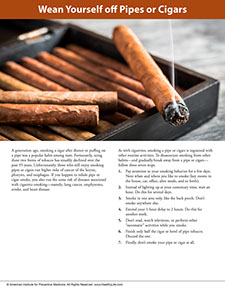
    Image of pipe with tobacco.

    A generation ago, smoking a cigar after dinner or puffing on a pipe was a popular habit among men. Fortunately, using these two forms of tobacco has steadily declined over the past 35 years. Unfortunately, those who still enjoy smoking pipes or cigars run higher risks of cancer of the larynx, pharynx, and esophagus. If you happen to inhale pipe or cigar smoke, you also run the same risk of diseases associated with cigarette smoking-namely, lung cancer, emphysema, stroke, and heart disease.

    As with cigarettes, smoking a pipe or cigars is ingrained with other routine activities. To disassociate smoking from other habits-and gradually break away from a pipe or cigars-follow these seven steps.

    1.  Pay attention to your smoking behavior for a few days. Note when and where you like to smoke (key rooms in the house, car, office, after meals, and so forth).

    2.  Instead of lighting up at your customary time, wait an hour. Do this for several days.

    3.  Smoke in one area only, like the back porch. Don’t smoke anywhere else.

    4.  Extend your 1-hour delay to 2 hours. Do this for another week.

    5.  Don’t read, watch television, or perform other “automatic” activities while you smoke.

    6.  Finish only half the cigar or bowl of pipe tobacco. Discard the rest.

    7.  Finally, don’t smoke your pipe or cigar at all.

    Page from A Year of Health Hints book by the American Institute for Preventive Medicine. www.HealthyLife.com. All rights reserved.

    © American Institute for Preventive Medicine

  • Cutting Back

    Healthylife® QuitWell™

    Part 4

    Women smiling with 2 thumbs up.

    While there is no healthy level of tobacco/nicotine use, it can be helpful to cut back before quitting completely. This allows you to:

    *  Reduce the amount of tobacco/nicotine your body must process every day, reducing the damage and toxic load on the body.

    *  Practice strategies without the pressure of quitting completely.

    *  Build confidence as you show yourself how strong and capable you are with making changes.

    *  Get used to going through different times of the day without a cigarette/dip/vape.

    *  Learn which strategies are going to work for different triggers.

    *  Gradually change habits and how you respond to triggers.

    Remember, every less cigarette, dip, or vape gives your body a break.

    Cutting back can be helpful for all stages of quitting.

    *  If you aren’t ready to quit completely, cutting back can still give you all the benefits listed above. You may find that the new tobacco/nicotine-free habits stick and you now are at a lower level of tobacco/nicotine. While it can be hard to stay at a low level for a long time, due to the addictive nature of nicotine, you are now more ready to quit in the future.

    *  If you are thinking about quitting but not fully ready, cutting back can get the ball rolling. As you see yourself succeed with small steps, you may be ready to take more small steps. Eventually, all those small steps take you to the finish line.

    *  If you are fully ready to quit, taking a week to cut back before your quit date can help you prepare for the triggers you may face. It gives you time to try the strategies in this guide and prepare your environment.

    © American Institute for Preventive Medicine