Tag: smoking

  • Creative Imagination

    Healthylife® QuitWell™

    Part 5

    Image of smiling women.

    Creative imagination is the acting out of an event or activity in your mind before it really happens. It allows you to work through the event or activity ahead of time so that you will be better prepared to deal with it. Many athletes practice an upcoming game in their heads before stepping onto the playing field.

    A study was done to compare “creative imagination” to actual practice with a group of basketball players. Three groups of students were used.

    *Group 1– Practiced making free throws every day for 20 days.

    *Group 2– Threw the ball on the 1st and 20th days, but did not practice in between.

    *Group 3– Threw free throws on the first day and then spent 20 minutes a day for the next 20 days imagining that they were throwing the ball. If they missed, they had to imagine changing their aim.

    On the 20th day:

    *  Group 1 – Improved their scores by 24%

    *  Group 2 – No improvement

    *  Group 3 – Improved their scores by 23% by using creative imagination

    Mental practice can help you change your feelings about day-to-day events. Picture yourself succeeding with your goals and getting through trigger situations. The power of your mind to change what you imagine to be real is vast; all it takes is a little thinking and practice.

    What would you like to imagine doing differently? Picture yourself doing things the way you want. Repeat this practice every day for at least 2 weeks.

    © American Institute for Preventive Medicine

  • Make The Connection

    Healthylife® QuitWell™

    Part 2

    Parents giving kids piggy-back rides, laughing and having fun.

    Keeping your motivation and values in mind is a great way to encourage yourself when quitting gets tough. Look for ways to connect your motivation and values to your attitude and actions.

    How do your attitudes and actions show what is important to you? If you feel there is a mismatch, it might be time for a new point of view!

    Old view:Quitting is going to be horrible. I like to do what I want, when I want.

    New view:I value time with my family and want to be a good role model for my kids. It will be awesome to enjoy family time without the interruption of smoke breaks. I can model healthy behavior for my kids.

    © American Institute for Preventive Medicine

  • Practice Change

    Healthylife® QuitWell™

    Part 4

    Image of hand refusing a cigarette.

    There are many ways to practice quitting before getting all the way there. You can improve your health even before you feel “all in”.

    *  Leave your pack, can, or vape pen home when you go out for short errands. Try leaving products home when you go to work one day.

    *  If you are a smoker, put a certain number of cigarettes in a pack for the day. Try to put one or two less in the pack than you’d normally smoke. If you usually smoke a full pack, take a few out at the beginning of the day so “finishing the pack” means smoking 18 instead of 20 cigarettes. After a few days, cut out one or two more.

    *  Put your cigarettes, can, or vape pen out of reach in your car. Maybe keep them in the trunk of your car, or in the backseat. When you want to have one, you will need to pull over to the side of the road to safely get it. When you do, just take one. This makes your habit a lot less convenient. Practice working through an urge while you are deciding if you want to pull over or keep going.

    What are some other ways you can practice change?

    © American Institute for Preventive Medicine

  • Wean Yourself Off Pipes Or Cigars

    Tobacco Cessation

    Image of pipe with tobacco.

    A generation ago, smoking a cigar after dinner or puffing on a pipe was a popular habit among men. Fortunately, using these two forms of tobacco has steadily declined over the past 35 years. Unfortunately, those who still enjoy smoking pipes or cigars run higher risks of cancer of the larynx, pharynx, and esophagus. If you happen to inhale pipe or cigar smoke, you also run the same risk of diseases associated with cigarette smoking-namely, lung cancer, emphysema, stroke, and heart disease.

    As with cigarettes, smoking a pipe or cigars is ingrained with other routine activities. To disassociate smoking from other habits-and gradually break away from a pipe or cigars-follow these seven steps.

    1.  Pay attention to your smoking behavior for a few days. Note when and where you like to smoke (key rooms in the house, car, office, after meals, and so forth).

    2.  Instead of lighting up at your customary time, wait an hour. Do this for several days.

    3.  Smoke in one area only, like the back porch. Don’t smoke anywhere else.

    4.  Extend your 1-hour delay to 2 hours. Do this for another week.

    5.  Don’t read, watch television, or perform other “automatic” activities while you smoke.

    6.  Finish only half the cigar or bowl of pipe tobacco. Discard the rest.

    7.  Finally, don’t smoke your pipe or cigar at all.

    Page from A Year of Health Hints book by the American Institute for Preventive Medicine. www.HealthyLife.com. All rights reserved.

    © American Institute for Preventive Medicine

  • Smoking Triggers And How To Beat Them

    MEDICAL NEWS

    Cigarettes and nicotine gum.

    Many people have tried to quit smoking but couldn’t. There are many reasons for this, but one of them is because of triggers. A trigger is something that makes you want to smoke.

    Emotional triggers

    When you have certain emotions, you may get the urge to smoke. They may include feeling stressed, nervous, depressed or even bored.

    You can help stop these triggers by dealing with your emotions in other healthy ways. Try meditation, deep breathing or exercise to help manage stress and anxiety. Exercise is also a great way to beat boredom and fight depression. Listen to calming music or talk to a friend who can encourage you to keep up your efforts to quit.

    Pattern triggers

    Sometimes you’re used to smoking when you do something else, such as drinking coffee or alcohol. This is known as a pattern trigger. You may also like to smoke after eating or during a work break.

    Change your routine to help avoid these patterns. Chew your favorite gum, suck on a hard candy or mint or go for a walk. Try brushing your teeth after meals, coloring in an adult coloring book or squeezing a stress relief ball.

    Social triggers

    Many people want to smoke at bars, parties or when they’re with people who smoke. These can be powerful triggers for you to smoke.

    It’s best to avoid these triggers if you’re trying to quit. Instead, surround yourself with people who don’t smoke or who want you to quit. Try taking a class or find a hobby, such as painting or cycling.

    Withdrawal triggers

    Your body will crave nicotine when you quit smoking. Nicotine is very addictive and you may go through withdrawal. Withdrawal triggers include:

    *  Cravings for cigarettes or e-cigarettes

    *  Feeling like you need to do something with your hands or mouth

    *  Feeling restless or uncomfortable

    Withdrawal can be very difficult to manage. As with other triggers, spend time with people who don’t smoke and who want you to quit. Find things to do that have nothing to do with smoking. Avoid places or situations where you might see or smell cigarettes or vaping.

    Quitting is hard. But if you have support from your doctor, family and friends, you can do it. Millions of people have quit and you can too!

    Source: Smokefree.gov

    © American Institute for Preventive Medicine

  • Cutting Back

    Healthylife® QuitWell™

    Part 4

    Women smiling with 2 thumbs up.

    While there is no healthy level of tobacco/nicotine use, it can be helpful to cut back before quitting completely. This allows you to:

    *  Reduce the amount of tobacco/nicotine your body must process every day, reducing the damage and toxic load on the body.

    *  Practice strategies without the pressure of quitting completely.

    *  Build confidence as you show yourself how strong and capable you are with making changes.

    *  Get used to going through different times of the day without a cigarette/dip/vape.

    *  Learn which strategies are going to work for different triggers.

    *  Gradually change habits and how you respond to triggers.

    Remember, every less cigarette, dip, or vape gives your body a break.

    Cutting back can be helpful for all stages of quitting.

    *  If you aren’t ready to quit completely, cutting back can still give you all the benefits listed above. You may find that the new tobacco/nicotine-free habits stick and you now are at a lower level of tobacco/nicotine. While it can be hard to stay at a low level for a long time, due to the addictive nature of nicotine, you are now more ready to quit in the future.

    *  If you are thinking about quitting but not fully ready, cutting back can get the ball rolling. As you see yourself succeed with small steps, you may be ready to take more small steps. Eventually, all those small steps take you to the finish line.

    *  If you are fully ready to quit, taking a week to cut back before your quit date can help you prepare for the triggers you may face. It gives you time to try the strategies in this guide and prepare your environment.

    © American Institute for Preventive Medicine

  • Managing Slip-Ups

    Healthylife® QuitWell™

    Part 5

    Close up of nicotine gum.

    Start to plan your response to slip-ups even before you have fully quit. Slip-ups are very common, especially in the first few weeks of trying to be tobacco/nicotine free. A slip-up is also called a ‘lapse’. The better you manage a lapse, the easier it will be to avoid full relapse. Relapse refers to going back to a regular habit of using tobacco/nicotine products.

    No one is perfect. Try not to view the slip-up as a failure of willpower or strength. Remember, you are so strong.

    Become hyper-aware of what just happened. It is important to understand the triggers related to a slip-up.

    *  Where are you? Is this place still a trigger for you? If possible, try to avoid this area for now. Or, make sure you have substitutes handy, like NRT gum or cinnamon candies.

    *  Who are you with? How can this person support you in the future?

    *  How are you feeling? Learn to separate your emotional response from situations and feelings. Smoking/chewing won’t change anything about the situation.

    What do you need to work on so that you can respond differently next time? Review the urge tamers, call your support person, or give your mind a quiet moment to really answer the question.

    How do you want this situation to go next time? Imagine responding differently to the trigger. Use the creative imagination exercise. See yourself doing what you want to do.

    © American Institute for Preventive Medicine

  • Recovery Signals

    Healthylife® QuitWell™

    Part 4

    Image of a couple dining out.

    Quitting may cause certain changes in your body due to the withdrawal of the many toxins found in tobacco. Some of these changes you may enjoy-food tastes and smells better. Some changes may be a little unpleasant. Everyone will have a different reaction. However, most people will only have a few signals, and these usually last less than a week.

    Some of these signals, of course, may be related to a health issue or illness. If you are concerned about how long a recovery signal is lasting or it feels more serious, contact your physician right away. You may be feeling that way because of something other than quitting.

    Increased Hunger

    The taste buds in the mouth become more keen when you quit and food tastes better.  You may find yourself eating more, which could add up to weight gain. Be mindful to increase physical activity, avoid emotional eating, and avoid snacks high in sugar and saturated fat. Choose crunchy vegetables or a high-protein snack instead.

    Irritability and anxiety

    Studies offer two reasons for this signal:

    1. Smoking, chewing, and other tobacco behaviors serve as a mild calming agent for some. Take it away and the body is very tense until it adjusts.

    2. Your whole life has been disrupted by quitting. Try a relaxation tool, take a hot shower, or call a close friend.

    Coughing

    The hair-like fibers (cilia) that line the bronchial tubes are starting to work to get rid of the mucus that tobacco produced. As the mucus loosens, you cough.

    Sweating

    One way the toxins leave the body is through the skin’s pores. This may show up as sweat. If this affects you, it should only last 3 to 4 days.

    Frequent Urination

    This may happen because of the extra liquids you’re drinking.

    Constipation

    The toxins in tobacco cause the release of the hormone adrenaline. For some, this helps in moving the bowels, so not smoking can lead to constipation. Eat high fiber foods, fruits, vegetables, bran, and whole grains. Drink plenty of water as well.

    Loss of Sleep

    Quitting may cause you to be restless at night. Increase your daytime activity to make you feel more tired. Try drinking a warm glass of milk before bed.

    Sleepiness

    For many people, tobacco provides a “lift.” Take that away and you feel more sleepy. Try to get as much sleep as you need.

    Dizziness

    With carbon monoxide no longer in the blood and the bronchial tubes clearing up, more oxygen may be entering the body. The result could be dizziness. Sit down and rest until it passes.

    Mouth Sores or Bad Taste

    Sores or bad tastes in the mouth may be due to the body chemicals that used to counteract the effects of the toxins in tobacco. Use an oral pain reliever for sores or see a doctor or dentist. Use mouthwash or breath mints for a fresher taste.

    Lack of Focus

    Turning your life around by quitting may make it harder for you to focus. A short walk is helpful.

    Dreaming of Using Tobacco

    Many people find they dream about using as they are trying to quit.

    Sense of Loss

    Quitting an activity that has been a major part of your life can make you feel very sad. There may be a feeling of missing something. This sense of loss will pass with time.

    Headache

    Your blood vessels open up due to withdrawal from nicotine. This could produce headaches during the first few days of quitting. Deep natural breathing, getting fresh air, and making sure you are eating healthy foods regularly can help.

    Notice the unpleasant recovery symptoms-and make sure they are going away over time (otherwise, see a doctor). Try not to focus on the unpleasant recovery symptoms. You might overlook the good recovery signals that are taking place. Blame all the unpleasant changes on tobacco/nicotine. Focus on the good changes that have happened because you no longer use this addictive, body-damaging product. Keep in mind, no one ever died from quitting.

    *  If you have quit, which of these recovery signals have you noticed so far? Have they started to go away yet?

    *  If you are still thinking about quitting, imagine welcoming these changes as a sign that positive changes are happening in your body.

    *  If you are cutting back (but haven’t quit yet), do you have any of these recovery signals already? While there is no healthy level of tobacco use, your body may begin to heal as you get close to quitting completely.

    © American Institute for Preventive Medicine

  • What Assertive Looks Like

    Healthylife® QuitWell™

    Part 5

    Warehouse worker smiling with good posture and eye contact.

    *Body Posture:Be relaxed and natural. Avoid slouching, putting your hands in your pockets, or facing away from the person you are speaking with.

    *Eye Contact:Good eye contact is vital to convey self-confidence and interest. Don’t stare at the other person-this comes across as a challenge.

    *Voice, Tone, and Quality:Use a strong, varied tone. Speak clearly and firmly. Don’t shout or speak too softly. Don’t whine.

    *Distance from the Person:Don’t position yourself too far or too close.

    *Facial Expression:Let your face convey the same message as what you are saying.

    *Content:Use short sentences. Be specific, clear, and firm.

    Practice First

    Plan or write down what you want to say. Have responses ready ahead of time to deal with questions and comments. Reinforce your remarks by saying what positive outcomes will occur for you and the other person. Practice in front of a mirror or with a friend.

    Benefits of Being Assertive:

    *  You can feel comfortable saying “no.”

    *  You have more confidence to ask others for help.

    *  You gain more respect from others.

    *  You feel less angry with yourself and with others.

    *  You feel justified to say what you want to say.

    *  You feel comfortable requesting clarification.

    *  You accept compliments graciously.

    *  You can change your mind without feeling guilty.

    © American Institute for Preventive Medicine

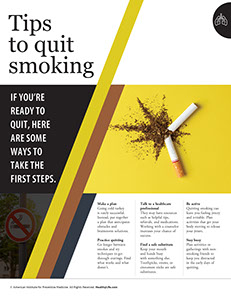
  • Tips To Quit Smoking

    WELL-BEING

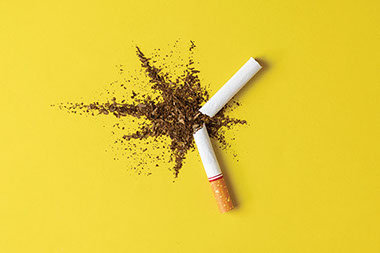
    Cigarette broken in half.

    If you’re ready to quit, here are some ways to take the first steps.

    Make a plan

    Going cold turkey is rarely successful. Instead, put together a plan that anticipates obstacles and brainstorm solutions.

    Practice quitting

    Go longer between smokes and try techniques to get through cravings. Find what works and what doesn’t.

    Talk to a healthcare professional

    They may have resources such as helpful tips, referrals, and medications. Working with a counselor increases your chance of success.

    Find a safe substitute

    Keep your mouth and hands busy with something else. Toothpicks, straws, or cinnamon sticks are safe substitutes.

    Be active

    Quitting smoking can leave you feeling jittery and irritable. Plan activities that get your body moving to release your jitters.

    Stay busy

    Plan activities or gatherings with non-smoking friends to keep you distracted in the early days of quitting.

    © American Institute for Preventive Medicine