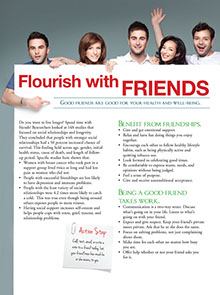
Good friends are good for your health and well-being.
Do you want to live longer? Spend time with friends! Researchers looked at 148 studies that focused on social relationships and longevity. They concluded that people with stronger social relationships had a 50 percent increased chance of survival. This finding held across age, gender, initial health status, cause of death, and length of follow-up period. Specific studies have shown that:
* Women with breast cancer who took part in a support group lived twice as long and had less pain as women who did not.
* People with successful friendships are less likely to have depression and immune problems.
* People with the least variety of social relationships were 4.2 times more likely to catch a cold. This was true even though being around others exposes people to more viruses.
* Having social support increases self-esteem and helps people cope with stress, grief, trauma, and relationship problems.
Benefit from friendships.
* Give and get emotional support.
* Relax and have fun doing things you enjoy together.
* Encourage each other to follow healthy lifestyle habits, such as being physically active and quitting tobacco use.
* Look forward to celebrating good times.
* Be comfortable to express wants, needs, and opinions without being judged.
* Feel a sense of purpose.
* Give and receive unconditional acceptance.
Being a good friend takes work.
* Communication is a two-way street. Discuss what’s going on in your life. Listen to what’s going on with your friend.
* Expect and give respect. Keep your friend’s private issues private. Ask that he or she does the same.
* Focus on solving problems, not just complaining about them.
* Make time for each other no matter how busy you are.
* Offer help whether or not your friend asks you for it.
Action Step
Call, text, email, or write a note to a friend today. Let your friend know how much he or she means to you.