Tag: spectrum

  • Understanding Autism

    MEDICAL NEWS

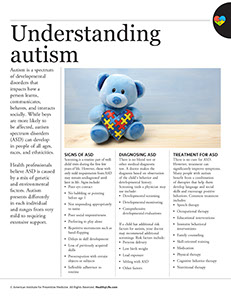
    Blue teddy bear holding heart with autism puzzle icon.

    Autism is a spectrum of developmental disorders that impacts how a person learns, communicates, behaves, and interacts socially. While boys are more likely to be affected, autism spectrum disorders (ASD) can develop in people of all ages, races, and ethnicities.

    Health professionals believe ASD is caused by a mix of genetic and environmental factors. Autism presents differently in each individual and ranges from very mild to requiring extensive support.

    Signs of ASD

    Screening is a routine part of well-child visits during the first few years of life. However, those with only mild impairments from ASD may remain undiagnosed until later in life. Signs include:

    *  Poor eye contact

    *  No babbling or pointing before age 1

    *  Not responding appropriately to name

    *  Poor social responsiveness

    *  Preferring to play alone

    *  Repetitive movements such as hand-flapping

    *  Delays in skill development

    *  Loss of previously acquired skills

    *  Preoccupation with certain objects or subjects

    *  Inflexible adherence to routine

    Diagnosing ASD

    There is no blood test or other medical diagnostic test. A doctor makes the diagnosis based on observation of the child’s behavior and developmental history. Screening tools a physician may use include:

    *  Developmental screening

    *  Developmental monitoring

    *  Comprehensive developmental evaluations

    If a child has additional risk factors for autism, your doctor may recommend additional screenings. Risk factors include:

    *  Preterm delivery

    *  Low birth weight

    *  Lead exposure

    *  Sibling with ASD

    *  Other factors

    Treatment for ASD

    There is no cure for ASD. However, treatment can significantly improve symptoms. Many people with autism benefit from a combination of therapies that help them develop language and social skills and encourage positive behaviors. Common treatment includes:

    *  Speech therapy

    *  Occupational therapy

    *  Educational interventions

    *  Intensive behavioral interventions

    *  Family counseling

    *  Skill-oriented training

    *  Medication

    *  Physical therapy

    *  Cognitive behavior therapy

    *  Nutritional therapy
    © American Institute for Preventive Medicine

  • Banish Black & White Thoughts

    Healthylife® Weigh

    Part 4

    Three friends enjoying lunch at rooftop restaurant.

    Consider a thought that you tend to see as black and white. Consider some alternative thoughts or ideas you could have instead. Or, when one comes to mind, return to this page and complete the following chart to practice banishing black and white thinking.

    Black & White Thought

    Example: I can’t go to restaurants because I always overeat and ignore my healthy goals.

    Alternative Thoughts

    I can choose restaurants that have healthy choices that I find tasty. I can have a healthy snack before I go out to eat to help prevent overeating at the restaurant.

    As you make changes to your way of thinking, be self-kind, not self-critical. Thinking rationally is like putting on a new, clear pair of glasses. What looked blurry or confusing before may seem more clear. New solutions to a challenge may appear once you look at it differently.

    © American Institute for Preventive Medicine
  • Eat The Rainbow!

    Healthylife® Weigh

    Part 2

    Rainbow spectrum of healthy fresh fruit and vegetables.

    Choose a variety of colors when selecting fruits and vegetables. Different colors represent different phytonutrients. Phytonutrients are plant chemicals that have antioxidant and anti-inflammatory qualities. Every time you eat is an opportunity to strengthen your body and prevent disease.

    Red

    *  Improved memory

    *  A healthy heart

    *  Improved digestion

    *  Examples

    –  Tomatoes

    –  Beets

    –  Radishes

    –  Red peppers

    –  Red onions

    –  Rhubarb

    –  Cherries

    –  Red apples

    –  Red grapes

    –  Red pears

    –  Raspberries

    –  Strawberries

    –  Watermelon

    Orange/Yellow

    *  Good vision in low light

    *  A healthy heart

    *  Strength to fight off colds & illness

    *  Healthy skin

    *  Improved circulation

    –  Apricots

    –  Cantaloupe

    –  Nectarines

    –  Peaches

    –  Yellow apples

    –  Yellow pears

    –  Carrots

    –  Sweet potatoes

    –  Yellow peppers

    –  Yellow potatoes

    –  Yellow summer squash

    –  Sweet corn

    –  Yellow tomatoes

    –  Butternut squash

    White

    *  A healthy heart

    *  Lower risk for stroke

    *  Lower risk for some cancers

    –  Brown pears

    –  White peaches

    –  Cauliflower

    –  Kohlrabi

    –  Onions

    –  Garlic

    –  Potatoes

    –  White corn

    –  White nectarines

    Green

    *  Good vision in low light

    *  Strong bones & teeth

    *  Organ health

    –  Green apples

    –  Green grapes

    –  Green pears

    –  Honeydew

    –  String beans

    –  Spinach

    –  Broccoli

    –  Sugar snap peas

    –  Brussels sprouts

    –  Green cabbage

    –  Green onions

    –  Green peppers

    –  Cucumbers

    –  Leafy greens

    –  Lettuce

    –  Peas

    –  Asparagus

    –  Zucchini

    Blue/Purple

    *  Improved memory

    *  Healthy aging

    –  Blackberries

    –  Blueberries

    –  Dried plums

    –  Pitted prunes

    –  Purple asparagus

    –  Purple cabbage

    –  Eggplant

    –  Plums

    © American Institute for Preventive Medicine