Tag: spending

  • Avoid Holiday Debt

    Financial Health

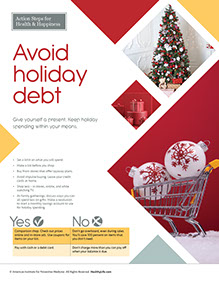
    Small, mini shopping cart with 2 ornaments inside cart.

    Give yourself a present. Keep holiday spending within your means.

    *  Set a limit on what you will spend.

    *  Make a list before you shop.

    *  Buy from stores that offer layaway plans.

    *  Avoid impulse buying. Leave your credit cards at home.

    *  Shop less – in stores, online, and while watching TV.

    *  At family gatherings, discuss ways you can all spend less on gifts. Make a resolution to start a monthly savings account to use for holiday spending.

    *  Comparison shop. Check out prices online and in-store ads. Use coupons for items on your list.

    *  Pay with cash or a debit card.

    *  Don’t go overboard, even during sales. You’ll save 100 percent on items that you don’t need.

    *  Don’t charge more than you can pay off when your balance is due.

    ays to Well-Being book by the American Institute for Preventive Medicine. www.HealthyLife.com. All rights reserved.

    © American Institute for Preventive Medicine

  • Declare Your Independence From Credit Card Overuse

    Financial Health

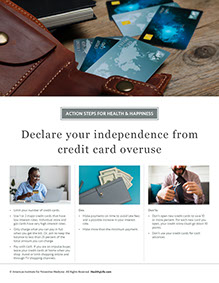
    Credit cards fanned out on table.

    *  Limit your number of credit cards.

    *  Use 1 or 2 major credit cards that have low interest rates. Individual store and gas cards have very high interest rates.

    *  Only charge what you can pay in full when you get the bill. Or, aim to keep the balance to less than 25 percent of the total amount you can charge.

    *  Pay with cash. If you are an impulse buyer, leave your credit cards at home when you shop. Avoid or limit shopping online and through TV shopping channels.

    Dos

    *  Make payments on time to avoid late fees and a possible increase in your interest rate.

    *  Make more than the minimum payment.

    Don’ts

    *  Don’t open new credit cards to save 10 or more percent. For each new card you open, your credit score could go down 10 points.

    *  Don’t use your credit cards for cash advances.

    ays to Well-Being book by the American Institute for Preventive Medicine. www.HealthyLife.com. All rights reserved.

    © American Institute for Preventive Medicine

  • Mend Your Spending

    Financial Health

    Use your money wisely.

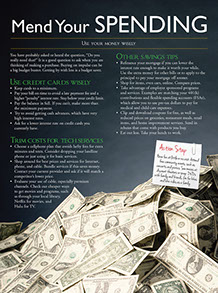
    You have probably asked or heard the question, “Do you really need that?” It is a good question to ask when you are thinking of making a purchase. Buying on impulse can be a big budget buster. Getting by with less is a budget saver.

    Use credit cards wisely:

    *  Keep cards to a minimum.

    *  Pay your bill on time to avoid a late payment fee and a higher “penalty” interest rate. Stay below your credit limit.

    *  Pay the balance in full. If you can’t, make more than the minimum payment.

    *  Try to avoid getting cash advances, which have very high interest rates.

    *  Ask for a lower interest rate on credit cards you currently have.

    Trim costs for tech services:

    *  Choose a cellphone plan that avoids hefty fees for extra minutes and texts. Consider dropping your landline phone or just using it for basic services.

    *  Shop around for best prices and services for Internet, phone, and cable. Bundle services if this saves money. Contact your current provider and ask if it will match a competitor’s lower price.

    *  Evaluate your use of cable, especially premium channels. Check out cheaper ways to get movies and programs, such as through your local library, Netflix for movies, and Hulu for TV.

    Other savings tips:

    *  Refinance your mortgage if you can lower the interest rate enough to make it worth your while. Use the extra money for other bills or to apply to the principal to pay your mortgage off sooner.

    *  Shop for items, even cars, online. Compare prices.

    *  Take advantage of employer sponsored programs and services. Examples are matching your 401(k) contributions and flexible spending accounts (FSAs), which allow you to use pre-tax dollars to pay for medical and child care expenses.

    *  Clip and download coupons for free, as well as reduced prices on groceries, restaurant meals, retail items, and home improvement services. Send in rebates that come with products you buy.

    *  Eat out less. Take your lunch to work.

    Action Step

    Have fun at little or no cost. Attend free community events, such as concerts and picnics. See movies at discount theaters or swap DVDs with family and friends. Go for hikes and bike rides as a family.

    Ways to Well-Being book by the American Institute for Preventive Medicine. www.HealthyLife.com. All rights reserved.

    © American Institute for Preventive Medicine

  • Reevaluate Your Budget

    FINANCIAL HEALTH

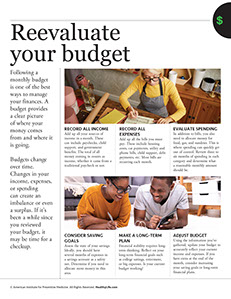
    Women working on a budget.

    Following a monthly budget is one of the best ways to manage your finances. A budget provides a clear picture of where your money comes from and where it is going.

    Budgets change over time. Changes in your income, expenses, or spending can create an imbalance or even a surplus. If it’s been a while since you reviewed your budget, it may be time for a checkup.

    Record all income

    Add up all your sources of income in a month. These can include paychecks, child support, and government benefits. The total of all money coming in counts as income, whether it came from a traditional paycheck or not.

    Record all expenses

    Add up all the bills you must pay. These include housing costs, car payments, utility and phone bills, child support, debt payments, etc. Most bills are recurring each month.

    Evaluate spending

    In addition to bills, you also need to allocate money for food, gas, and sundries. This is where spending can quickly get out of control. Review three to six months of spending in each category and determine what a reasonable monthly amount should be.

    Consider saving goals

    Assess the state of your savings. Ideally, you should have several months of expenses in a savings account as a safety net. Determine if you need to allocate more money in this area.

    Make a long-term plan

    Financial stability requires long-term thinking. Reflect on your long-term financial goals such as college savings, retirement, or big expenses. Is your current budget working?

    Adjust budget

    Using the information you’ve gathered, update your budget to accurately reflect your current income and expenses. If you have extra at the end of the month, consider increasing your saving goals or long-term financial plans.

    © American Institute for Preventive Medicine

  • 4 Behaviors For A Healthy Wallet

    FINANCIAL HEALTH

    Concept image of growing leaf with stacked coins.

    1. Make a budget and stick to it.

    Many money experts will tell you that you need to know where your money is going each month. Creating a budget helps to see how much you spend on certain things and where you can cut back to save even more.

    2. Check your credit report each year.

    You are entitled to a free credit report once per year. This is an important step to help spot identity theft early. Your credit report can affect your mortgage rate and ability to get a loan.

    3. Shop around for a good APR on your next loan.

    The annual percentage rate (APR) on a loan is an important number. This is the total cost, including fees and interest, described as a yearly rate. The APR can vary widely between banks or lenders. It pays to take some extra time to find the best rate. Make sure you understand exactly what you will pay.

    4. Put money away for an emergency fund.

    Having an emergency fund offers peace of mind and protection from unexpected costs. Even a few dollars a week can add up, so save what you can.

    Paycheck checkup

    The Internal Revenue Service (IRS) says employees should look at their paycheck withholdings each year. Withholdings are taxes that are taken out of your paycheck.

    It’s especially important to check your withholdings in 2018, the IRS says. The Tax Cuts and Jobs Act, signed in December 2017, may change how much you want withheld.

    The IRS has a withholding calculator on their website at:apps.irs.gov/app/withholdingcalculator. This calculator can help you be sure that you aren’t having too much or too little tax withheld from your paychecks.

    © American Institute for Preventive Medicine

  • Are You Addicted To Shopping?

    WELL-BEING

    Image of couple holding shopping bags.

    Whether you like to look at clothing, housewares, tools, or electronics, shopping is a favorite pastime for many people. As the holidays approach, shopping becomes even more popular. Big sales, special deals, and promotions all seek to get more people to buy, buy, buy.

    But for some people, shopping is more than just fun around the holidays. It can actually be an addiction, according to the National Institute on Alcohol Abuse and Alcoholism.

    Signs of Shopping Addiction

    Many people think addiction is only for drugs and alcohol. But many behaviors including shopping can become an addiction. Access to online shopping can make the problem worse. You can buy whatever you want from the privacy of your home and just a few mouse clicks.

    It can be difficult to know if you just like to shop, or if it’s really a problem. If three or more of these statements apply to you, you may be addicted to shopping:

    *  You frequently buy things you don’t need.

    *  You have many unopened packages of items or clothing with the tags still on.

    *  You purchase things you can’t afford by using credit cards.

    *  You hide your purchases from your spouse or family.

    *  You feel a strong need to shop when you’re sad, angry, or anxious.

    *  You have secret credit cards or open new cards when others ones are maxed out.

    *  You think obsessively about shopping and money.

    *  You buy much more than planned, and feel guilty or ashamed afterward.

    *  Your relationships with family or friends have been affected by your shopping.

    © American Institute for Preventive Medicine

  • How To Stop Impulse Buying

    FINANCIAL HEALTH

    Image of women looking at jeans.

    Many people have bought something at the store that they didn’t plan to get. If you buy something simply because you see it and want it, this is called an impulse buy.

    Some estimates show that the average American spends a few thousand dollars a year on impulse buys. These purchases can add up to big spending.

    If you’re trying to save money, take a look at your buying habits. It’s possible that your unplanned impulse purchases are standing in the way of a healthy budget and your long-term financial goals.

    Try not to dwell on past impulse purchases. Instead, look to the future and decide that you will resist the urge to buy things you don’t need.

    Why we impulse buy

    Stores use certain tricks and techniques to make impulse buys happen. Plus, specific things happen in our brains while shopping that can lead to an impulse buy. Some of the reasons we buy things on impulse:

    1.  A love of shopping and new things. Shopping can release feel-good chemicals in the brain. Once we experience this kind of pleasure, it can become a habit that is hard to break.

    2.  Fear of missing a deal. Our desire to save money can lead to impulse buying. We see a deal on something and wonder if we will regret not buying it later.

    3.  Hope that having this item will make our life better. For example, someone may think that buying a new blender means they will make a vegetable smoothie every day. Or, if someone is feeling depressed or angry, they may think this new item will fix their problem.

    How to stop impulse purchases

    If you think impulse buying is affecting you, there are ways to stop. Keep these things in mind when you go shopping:

    *  Stop and think about the price. Ask yourself whether that item is truly worth what it costs. Think about how many hours you would have to work to pay off that item. Is it really worth buying?

    *  Bring a list. Make your shopping list in advance and buy only those items.

    *  Don’t use credit cards. If possible, only shop with cash or a debit card. This means you won’t have seemingly unlimited funds. If that’s not possible, picture next month’s bill with that item on it. That number on your statement may make the item less appealing.

    *  Don’t shop when you’re hungry, stressed, angry or sad. These emotions can prompt you to buy unwanted things.

    © American Institute for Preventive Medicine

  • Piggy Bank Smarts

    FINANCIAL HEALTH

    Image of hand placing a dollar bill into a piggy bank.

    Smart money management begins at home. Washington University researcher Michal Grinstein-Weiss found that teaching kids about money in childhood helps them better manage their mortgage loans as adults. The study was in Social Work Research.

    The professor offers 5 ways parents can teach their kids financial literacy:

    1. Discuss and explain basic finances around the dinner table, especially the difference between needs and wants.

    2. Teach kids how to save and set short-term goals (a new toy) and long-term goals (college). Kids will follow by example if they see you saving for something such as a family vacation.

    3. Open a savings account for your child as early as possible. Even if you bank online, visit the bank with your child to make a deposit because actions reinforce behaviors. Review monthly statements together.

    4. Teach kids budgeting and money-management skills. Help your child figure out how much money to save for how long to reach a goal amount.

    5. Get kids involved in daily activities and decisions about spending. Take them grocery shopping and have them compare prices of different brands. Count out the cash during a sale.

    © American Institute for Preventive Medicine

  • Save More, Spend Less

    FINANCIAL HEALTH

    Image of women at kitchen counter with groceries and placing money in a piggy bank.

    According to the American Psychological Association, finances are the number one cause of stress in America. Whether it’s meeting the monthly bills or trying to build a retirement fund, financial worries can be difficult to deal with.

    If you’re looking for ways to stretch your monthly budget, the Federal Trade Commission offers some tips that may help you save more and spend less without feeling the pinch.

    Start with a budget.

    This may not be fun, but it doesn’t have to be long and difficult. You can use something as simple as a two-column sheet of paper. In one column, write your net income for the month. In the other column, record all your expenses: basic monthly bills (mortgage, food, transportation), lifestyle choices (entertainment, eating out, personal care, pets), and other expenses. This will give you a clear idea of how much you need to save or cut back on spending. The FTC website offers a free budget worksheet atwww.consumer.ftc.gov/articles/pdf-1020-make-budget-worksheet.pdf.

    Consider direct deposits into savings accounts.

    Have part of your paycheck go directly into a 401 savings or other type of retirement account. Have additional money put into another savings account for an emergency fund and major expenses as needed.

    Pack lunches.

    A daily $6 spent on lunch adds up to $800 a year. Instead, make extra food for dinner and take leftovers or make your own sandwich. Or, purchase healthy frozen meals when they’re on sale.

    Use free community services.

    Most cities have well-stocked libraries that have books, magazines, music, games, and movies. You can check these items out for free.

    Know that every little bit helps.

    Make small, manageable goals to help you save. Even just $1,000 less on your credit card bill could save you hundreds of dollars in interest each year. Eating out one fewer time each week adds up to big savings in a few months. Rather than being discouraged by a goal that seems impossible, look for small, doable ways to save a few dollars here and there.

    © American Institute for Preventive Medicine