Tag: spotting

  • Bleeding

    Pregnancy & Prenatal Care

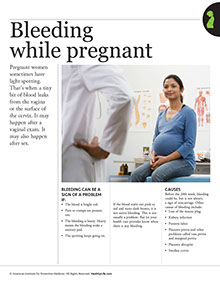
    Pregnant women sometimes have light spotting. That’s when a tiny bit of blood leaks from the vagina or the surface of the cervix. It may happen after a vaginal exam. It may also happen after sex. If the blood starts out pink or red and turns dark brown, it is not active bleeding. This is not usually a problem. But let your health care provider know when there is any bleeding. He or she will decide what to do. Bleeding can be a sign of a problem if:

    *  The blood is bright red.

    *  Pain or cramps are present, too.

    *  The bleeding is heavy. Heavy means the bleeding soaks a sanitary pad.

    *  The spotting keeps going on.

    Causes

    Before the 20th week, bleeding could be, but is not always, a sign of miscarriage. Other causes of bleeding include:

    *  Loss of the mucus plug

    *  Kidney infection

    *  Preterm labor

    *  Placenta previa and other problems called vasa previa and marginal previa

    *  Placenta abruptio

    *  Swollen cervix

    Placenta Previa

    The placenta carries oxygen and food to the baby. In most pregnancies, the placenta attaches high in the uterus. In placenta previa, it attaches low, over the cervix. The lower uterus stretches during late pregnancy. Parts of the placenta tear from the wall. That causes bleeding.

    Placenta previa is rare. It happens in only 1 in 200 pregnancies. Its cause is not known. Falls and injuries are not factors. Symptoms of placenta previa are:

    *  Bright red vaginal bleeding. This could start as early as the 24th week. Often, it starts during the 34th or 35th week.

    *  Usually, there is no pain or cramping.

    A woman may not know that she has placenta previa until bleeding happens. Then an ultrasound test can show the problem.

    Women with placenta previa have to spend a lot of time in bed. Bed rest may last late into the pregnancy. Bed rest gives the baby time to grow. It prevents stress to the uterus. The goal is to keep blood loss down. A lot of blood loss means danger for both mother and baby. In severe cases, the mother may have to go to the hospital for treatment.

    In some cases, the bleeding stops, but the placenta blocks the cervix. The mother will need a Cesarean section (C-section) delivery if the placenta completely blocks the cervix. The mother may need a C-section if the placenta only partly blocks the cervix. When this happens, the mother may have more bleeding after she delivers the baby.

    {Note: Some pregnant women may have a “low lying placenta.” This means the placenta lies at the bottom of the uterus (not higher where it should be). An ultrasound can show a “low lying” placenta. If it is found before the 24th week, the placenta can move upward and out of the way of the cervix. If so, there is no longer a problem.}

    Placenta Abruptio

    There is a right time for delivery of the placenta. That’s after the baby is born. But sometimes it happens another way. The placenta starts to leave the wall of the uterus too early. It starts before the baby is born. This can happen whether the placenta is attached high or low.

    Placenta abruptio happens in about 1 in 200 pregnancies. Some cases are more serious than others. Causes might be high blood pressure or a serious blow to the belly. An older mother may be more apt to have placenta abruptio. So are women who use cocaine during pregnancy. Symptoms of placenta abruptio are:

    *  Bright red vaginal bleeding

    *  Severe pain in the abdomen. The pain lasts. It doesn’t come and go.

    There are no tests for placenta abruptio. Even ultrasound may not show it. Regular prenatal visits help. The health care provider looks for blood in the mother’s vagina. The provider finds out if the uterus is tender.

    Women with placenta abruptio need to go to the hospital right away. Some women can have a vaginal delivery. That’s if labor begins on its own and the baby is healthy. Otherwise, a C-section is done. The mother may be given blood.

    Questions to Ask

    Self-Care / Prevention

    *  Watch closely for bleeding. If you see any, call your health care provider.

    *  Rest in bed for light bleeding.

    *  Avoid doing things that could injure you. Examples: heavy lifting, hard exercise. Don’t do work, sports, or exercises that could give you a blow to the belly.

    *  Wear a special seat belt when you drive. You can get one that protects a pregnant woman’s belly.

    *  Don’t smoke.

    *  Don’t be exposed to other people’s smoke.

    *  Follow your health care provider’s advice about sex. You may be told to:

    – Avoid sex.

    – Use extra caution during sex:

    – Your partner can focus on more gentle touching.

    – Limit how deeply the penis enters the vagina. Use positions that help control the depth.
    Prenatal Self-Care book by the American Institute for Preventive Medicine. www.HealthyLife.com. All rights reserved.

    © American Institute for Preventive Medicine
  • Bleeding 2

    First Aid

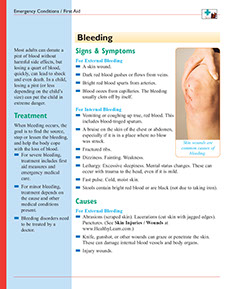
    Most adults can donate a pint of blood without harmful side effects, but losing a quart of blood, quickly, can lead to shock and even death. In a child, losing a pint (or less depending on the child’s size) can put the child in extreme danger.

    Signs & Symptoms

    For External Bleeding

    *  A skin wound.

    *  Dark red blood gushes or flows from veins.

    *  Bright red blood spurts from arteries.

    *  Blood oozes from capillaries. The bleeding usually clots off by itself.

    For Internal Bleeding

    *  Vomiting or coughing up true, red blood. This includes blood-tinged sputum.

    *  A bruise on the skin of the chest or abdomen, especially if it is in a place where no blow was struck.

    *  Fractured ribs.

    *  Dizziness. Fainting. Weakness.

    *  Lethargy. Excessive sleepiness. Mental status changes. These can occur with trauma to the head, even if it is mild.

    *  Fast pulse. Cold, moist skin.

    *  Stools contain bright red blood or are black (not due to taking iron).

    Causes

    For External Bleeding

    *  Abrasions (scraped skin). Lacerations (cut skin with jagged edges). Punctures.

    *  Knife, gunshot, or other wounds can graze or penetrate the skin. These can damage internal blood vessels and body organs.

    *  Injury wounds.

    For Internal Bleeding

    *  A bruise. This is bleeding from and damage to tissues beneath the skin.

    *  Damage to blood vessels and/or internal structures. This includes a blunt injury that does not break the skin, a bleeding ulcer, and an aneurysm.

    *  Bleeding disorders.

    Taking blood-thinning drugs can result in both internal and external bleeding.

    Treatment

    When bleeding occurs, the goal is to find the source, stop or lessen the bleeding, and help the body cope with the loss of blood.

    *  For severe bleeding, treatment includes first aid measures and emergency medical care.

    *  For minor bleeding, treatment depends on the cause and other medical conditions present.

    *  Bleeding disorders need to be treated by a doctor.

    Questions to Ask

    Self-Care / First Aid

    For Severe Bleeding

    *  Without delay, apply direct pressure to the wound using a sterile dressing or clean cloths. {Note: If the cut is large and the edges of it gape open, pinch the edges of the wound while you apply pressure.}

    *  Call 9-1-1 or take the person to nearest hospital emergency department.

    *  Do not remove an object that is stuck in a wound. Pack it in place with padding. Put tape around the padding so it doesn’t move.

    *  If bleeding continues before getting medical help, put extra cloths, etc. on top of existing ones. Keep putting pressure on the wound until bleeding stops or until medical help takes over.

    *  The most important thing to do is to apply direct pressure on the bleeding site. Some health experts advise to do these things, too, if needed:

    – Elevate the wounded area higher than heart level while applying pressure. Do this if no bone is broken.

    – Apply pressure to a “pressure point” if bleeding still continues after 15 to 20 minutes of direct pressure. Use the pressure point closest to the bleeding site that is between the wound and the heart. (See Pressure Points.)

    *  Don’t apply a tourniquet except to save a life.

    *  While giving first aid for bleeding, keep looking for signs of shock.

    For an Amputation

    *  Control bleeding.

    *  Wrap the severed part in a clean, dry (not wet) cloth or sterile gauze. Place the wrapped part in a plastic bag or other waterproof container. Put these on a bed of ice. Do not submerge the severed part in cold water or ice.

    For Bleeding from the Scalp

    *  Use a ring pad to apply pressure around the edges of the wound, not on the wound. Make a ring pad (shaped like a doughnut) with a bandage of narrow, long strips of cloth. Start with one end of the narrow bandage and wrap it around all four fingers on one hand until you form a loop. Leave a long strip of the bandage material to weave in and around the loop so it doesn’t unravel.

    Healthier at Home book by the American Institute for Preventive Medicine. www.HealthyLife.com. All rights reserved.

    © American Institute for Preventive Medicine

  • A Shoulder To Lean On

    BE FIT

    Image of women and trainer exercising the shoulders.

    Shoulder injuries are common. Why? Because of improper exercise technique, say exercise experts at the American Council on Exercise (ACE), and because people commonly over-train one or two deltoid muscles while neglecting others.

    Strength-training routines are typically dominated by exercises that train only the front of the shoulder, which is actually comprised of three distinct muscles. So ACE looked into the most effective exercises for strengthening the overall shoulder and preventing injury.

    The result? Researchers from the University of Wisconsin, LaCrosse shrugged their shoulders when asked to pick the top exercise. Results showed there is not one best exercise that completely works all muscles of the shoulders.

    Instead, for best results, exercisers should perform the dumbbell shoulder press to target the front, and either the 45-degree incline row or the seated rear lateral raise for the rear. Ask your gym’s expert to show you these techniques.

    69% of people will experience a shoulder injury at some point in their lives, according to the NIH.

    © American Institute for Preventive Medicine