Tag: steps

  • Step Up To A Longer Life

    WELL-BEING

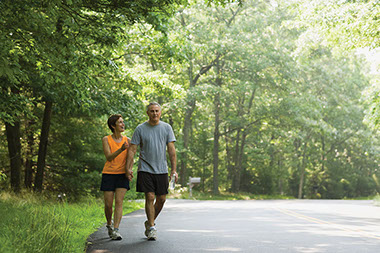
    Elderly couple walking.

    Could something as simple as walking help you live longer? Some recent research says it’s possible. Here’s what to know:

    1.  Researchers had 17,000 older women wear a device each day to count their steps.

    2.  They tracked the women for four years.

    3.  Those who took between 4,400 and 7,500 steps each day were less likely to die during those four years.

    4.  Walking more than 7,500 steps is also good for your health!

    Researchers said this is helpful for people who may think that 10,000 steps is overwhelming. Try to walk 4,400 steps or more each day, and you could see some important health benefits.

    Sources: Journal of the American Medical Association, National Institutes of Health

    © American Institute for Preventive Medicine

  • Start A Walking Group

    BE FIT

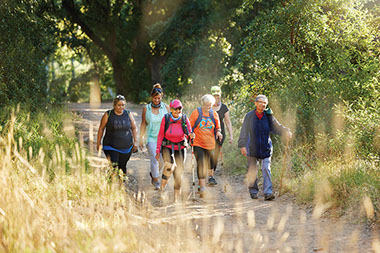
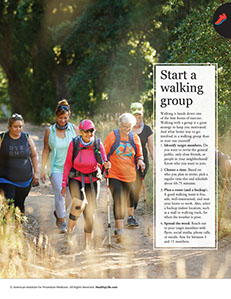
    Group of friends walking on a trail.

    Walking is hands down one of the best forms of exercise. Walking with a group is a great strategy to keep you motivated. And what better way to get involved in a walking group than to start one yourself!

    1. Identify target members. Do you want to invite the general public, only close friends, or people in your neighborhood? Know who you want to join.

    2. Choose a time. Based on who you plan to invite, pick a regular time slot and schedule about 60-75 minutes.

    3. Plan a route (and a backup). A good walking route is free, safe, well-maintained, and near your home or work. Also, select a backup indoor location, such as a mall or walking track, for when the weather is poor.

    4. Spread the word. Reach out to your target members with flyers, social media, phone calls, or emails. Aim for between 5 and 15 members.

    © American Institute for Preventive Medicine

  • Walk For Well-Being

    Fitness

    Mother and daughter walking.

    You already know that walking and other physical activities help prevent and manage arthritis, diabetes, heart disease, and high blood pressure. Get these benefits from walking, too:

    *  Relieve tension and stress.

    *  Get more energy.

    *  Improve balance and lower the risk for falling.

    *  Get better sleep.

    *  Boost you overall mood.

    Walking briskly at 3 miles per hour is a great way for adults to get 150 minutes of moderate-intensity physical activity a week (30 minutes a day). Children need 60 minutes of physical activity a day.

    *  Plan walking into your daily / weekly schedules. Split 30 minutes into two 15-minute or three 10-minute sessions.

    *  Wear a good pair of walking shoes that fit well and absorb shock. Look straight ahead when you walk.

    *  Don’t make the excuse that you have no time to exercise.

    *  Don’t text while you are walking. Don’t listen to music if it hinders hearing sounds around you.

    Page from HealthyLife Weigh book by the American Institute for Preventive Medicine. www.HealthyLife.com. All rights reserved.

    © American Institute for Preventive Medicine

  • Walk Your Way To Fitness

    Fitness

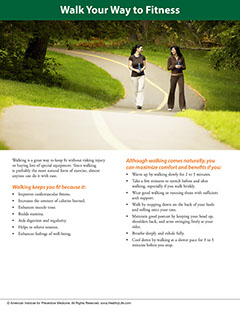
    Image of couple power walking.

    Walking is a great way to keep fit without risking injury or buying lots of special equipment. Since walking is probably the most natural form of exercise, almost anyone can do it with ease.

    Walking keeps you fit because it:

    *  Improves cardiovascular fitness.

    *  Increases the amount of calories burned.

    *  Enhances muscle tone.

    *  Builds stamina.

    *  Aids digestion and regularity.

    *  Helps to relieve tension.

    *  Enhances feelings of well-being.

    Although walking comes naturally, you can maximize comfort and benefits if you:

    *  Warm up by walking slowly for 2 to 3 minutes.

    *  Take a few minutes to stretch before and after walking, especially if you walk briskly.

    *  Wear good walking or running shoes with sufficient arch support.

    *  Walk by stepping down on the back of your heels and rolling onto your toes.

    *  Maintain good posture by keeping your head up, shoulders back, and arms swinging freely at your sides.

    *  Breathe deeply and exhale fully.

    *  Cool down by walking at a slower pace for 3 to 5 minutes before you stop.

    Page image from A Year of Health Hints book by the American Institute for Preventive Medicine. www.HealthyLife.com. All rights reserved.

    © American Institute for Preventive Medicine

  • Plan Problem-Solving 2

    Healthylife® QuitWell™

    Part 2

    Image of smiling women at desk.

    Your worries and concerns take up time in your day. Many issues cannot simply be ignored or brushed aside. To avoid letting these thoughts trigger smoking or chewing habits, plan time to address them.

    Steps to Address Your Worries

    1. Write a worry at the top of a piece of paper. It may seem old-fashioned to write this down on paper, when so much is done on the computer or a smartphone. However, writing things down can be powerful.

    2. Divide the paper into three columns:

    a. What I can’t do. Recognize what is out of your control.

    b. What I can do. List possible actions that are within your control. Write things you know how to do and that are realistic actions for you to take.

    c. What I will do and when. Decide which action you are ready to take first. This action may not solve every part of the problem, but it is a small step toward a solution. Write when you will do this.

    3. After you have taken an action towards a solution, repeat this process the next day or when you are ready to take another step.

    © American Institute for Preventive Medicine

  • Use The L.A.D.D.E.R. Technique 2

    Healthylife® QuitWell™

    Part 5

    Image of two friends talking.

    This is a step-by-step way to become more assertive.

    L:Look at your needs, wants, rights, and feelings about the situation.

    A:Arrange a meeting that is convenient for you and the other person to talk.

    D:Define the problem clearly to the other person.

    D:Describe your feelings using “I messages.” I message statements let you take charge of your feelings. The other person is less likely to get defensive.

    E:Express your needs and desires in an assertive manner using a few clear sentences. Be aware of your eye contact, hand gestures, posture, voice, and facial expression.

    R:Reinforce your remarks by saying what positive outcomes will occur for you and the other person.

    Example:

    L:I could use support from my close co-worker while I’m quitting vaping and I don’t want him to give me a hard time.

    A:I’ll arrange to speak to him first thing tomorrow.

    D:“Jack, I’m trying to quit and can really benefit from your support. I want to be able to take breaks with you, but it’s tough for me to do that if you offer me your vape.”

    D:“I feel like I could really achieve my goal with your help. Quitting is really important to me.”

    E:“I would like to take a walk with you instead of vaping, if you will join me. Or, we’ll have to catch up after work. Standing next to you while you vape is tough for me right now.”

    R:“I love getting away from hectic stuff at work by taking a break with you. I think taking a walk will help us both clear our heads and feel more ready to tackle the rest of the day.”

    © American Institute for Preventive Medicine

  • How Walking Can Change Your Life

    BE FIT

    Image of couple and pet dog walking along beach.

    Many people don’t exercise because they believe it takes too much time or money. They may think they need to spend an hour at the gym each day to get healthier. These myths could be standing in the way of a healthier life.

    Exercise is a universal way to improve health. We know that physical activity can reduce the risk of heart disease, diabetes and even cancer. It also boosts energy levels and can help you sleep better. But there’s another benefit to exercise that many people may not know about: better mental health.

    If you are thinking about being more active, a walking program is a tried and true favorite form of physical activity. As an exercise, walking is easy to begin and maintain. Plus, it needs no special skills or expensive equipment, and can be done year-round, outdoors and indoors.

    For those who thought they didn’t have time to walk or exercise, there’s good health news. Even a small amount of exercise can help you feel better mentally by reducing feelings of depression and anxiety, and improving cognition.

    Getting a treadmill: Questions to ask

    Treadmills have been a mainstay in gyms for years. Many people also get one for their homes. They’re simple to use and can adjust to your fitness level. But should you buy one? Here’s what to consider:

    How much money do you want to spend?

    A new treadmill can cost hundreds – or even thousands – of dollars. But many people can get used treadmills for a fraction of the cost. If you buy a used one, make sure to test it first to be sure it works. Ask the seller if they have the instruction manual.

    Can you do other indoor exercise?

    You don’t need a treadmill to get a good workout inside. You can turn on music and dance or use a fitness video or interactive game. Consider how many days per year you would need the treadmill because of bad weather. Then, weigh that against the cost.

    Will it “work”  for you?

    Do your research before making the investment. Check out online reviews of the exact treadmill you’re considering. Find out if it’s good for running, walking or both. Will it work with your height? Taller people often need a longer treadmill belt.

    Source: Centers for Disease Control and Prevention

    © American Institute for Preventive Medicine

  • Plan Problem-Solving

    Healthylife® Weigh

    Part 6

    Problem, think, idea, solution diagram.

    Your worries and concerns take up time in your day. Many issues cannot simply be ignored or brushed aside. To avoid letting these thoughts trigger unhealthy eating habits, plan time to address them.

    Steps to Address Your Worries

    1. Write a worry at the top of a piece of paper.

    2. Divide the paper into three columns:

    a. What I can’t do. Recognize what is out of your control.

    b. What I can do. List possible actions that are within your control. Write things you know how to do and that are realistic actions for you to take.

    c. What I will do. Decide which action you are ready to take first. This action may not solve every part of the problem, but is a small step toward a solution. Write when you will do this.

    Mind Dump

    Use this tool when you feel you have too many thoughts to juggle and aren’t sure where to start. Use small pieces of paper or index cards to “mind dump” thoughts that come to mind. Write down concerns, ideas, and things you need to remember. Pull one card and use the steps above to address this worry. Don’t pull another card until you are satisfied with your plan to deal with the first worry.

    © American Institute for Preventive Medicine

  • Use The L.A.D.D.E.R. Technique

    Healthylife® Weigh

    Part 4

    Group of friends enjoying a meal outdoors.

    This is a step-by-step way to become more assertive.

    L – Look at your needs, wants, rights, and feelings about the situation.

    A – Arrange a meeting that is convenient for you and the other person to talk.

    D – Define the problem clearly to the other person.

    D – Describe your feelings using “I messages.” I message statements let you take charge of your feelings.

    E – Express your needs and desires in an assertive manner using a few clear sentences. Be aware of your eye contact, hand gestures, posture, voice, and facial expression.

    R – Reinforce your remarks by saying what positive outcomes will occur for you and the other person.

    Example:

    L – I wish my partner would stop stocking the pantry with a food I tend to over-eat when it is available.

    A – I’ll plan to talk with him or her after dinner tomorrow.

    D – Tell your partner, “When cookies are in the pantry, it is hard for me to have just one. I appreciate the treat, but this makes it harder for me to stick with my goal.”

    D – “I feel I could stick with my goals with your help.”

    E – “Let’s keep cookies off the grocery list. I am starting to enjoy fruit as a sweet treat. Let’s get that instead! Also, a hug would be a wonderful treat from you!”

    R – “This change would help me to reach my goal. As I lose weight, I am able to do more physical activity comfortably. Let’s plan a hike together this weekend!”

    © American Institute for Preventive Medicine

  • 13 Reasons Why Walking Works

    BE FIT

    Image of middle-age couple walking.

    1. Safest exercise on earth

    2. Simple exercise for people who haven’t been exercising

    3. Families can walk together

    4. Social interaction is possible (walk and talk)

    5. Sparks creativity (take along a notebook and pen or a camera)

    6. Improves endurance

    7. Ideal for weight loss

    8. Strengthens bones

    9. Tones legs

    10. Perfect for exploring

    11. Reduces stress

    12. Very inexpensive (no special equipment required, just shoes)

    13. Can be done anytime, anywhere, and for life! Your life!

    From Walk the Four Seasons by walking guru Robert Sweetgall, Creative Walking, Inc.,www.creativewalking.com, who has walked across the USA 7 times.

    © American Institute for Preventive Medicine