Tag: strain

  • Prevent Musculoskeletal Disorders

    Work Life

    Musculoskeletal Disorders (MSDs) affect muscles, tendons, nerves, joints, ligaments, cartilage, and discs in the spine. They do not result from slips, falls, or similar accidents. Common Work-Related Musculoskeletal Disorders (WMSDs) are low back pain, carpal tunnel syndrome, and tendonitis. These are caused by:

    *  Repeating the same motion. This can result in Repetitive Motion Injuries.

    *  Awkward or static postures

    *  Using a great deal of force to do a job

    *  Vibration

    WMSDs can be prevented or reduced using ergonomics. This is the science of fitting the job to the worker.

    One way to prevent and deal with WMSDs is to use proper workstation positions.

    Other Workstation Proper Positions

    *  Keep your head upright and your ears, shoulders, and hips in a straight line.

    *  Keep your work within reach without having to stretch or strain your arms, shoulders, or back. Don’t stretch to reach items on an assembly line. Wait for the items to reach you.

    *  Change positions or tasks often. This avoids repeated stress on a single body part.

    *  Use the proper tools for the job. Use tools made to reduce vibration and/or pressure, if needed.

    Healthier at Home book by the American Institute for Preventive Medicine. www.HealthyLife.com. All rights reserved.

    © American Institute for Preventive Medicine

  • Eye Health At Work

    Eye Conditions

    Man wearing protective eye and hearing gear while using machinery.

    Follow your workplace’s safety rules to protect your eyes. Wear safety glasses, goggles, face shields, etc. Keep your safety eyewear clean and in good condition.

    More than 700,000 persons in the U.S. have eye injuries at work a year. Most of these could have been prevented.

    Find out if and what type of eyewear is required for your job. Ask loved ones if they wear required safety eyewear at work.

    Persons who walk through work areas that have eye hazard areas need to wear protective eyewear.

    When you visit a worksite that poses a risk of eye injuries, ask for protective eyewear if it is not provided.

    Glasses and contact lenses used for other activities may not be effective when working with computer screens.

    Let your eye doctor know if you work at a computer so they can prescribe the proper eyewear for you to use.

    Health at Home Lifetime book by the American Institute for Preventive Medicine. www.HealthyLife.com. All rights reserved.

    © American Institute for Preventive Medicine

  • Hernias

    Abdominal & Urinary Conditions

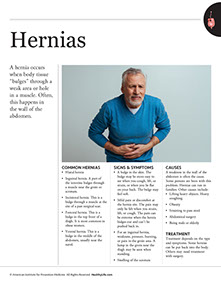
    A hernia occurs when body tissue “bulges” through a weak area or hole in a muscle. Often, this happens in the wall of the abdomen.

    Signs & Symptoms

    *  A bulge in the skin. The bulge may be more easy to see when you cough, lift, or strain, or when you lie flat on your back. The bulge may feel soft.

    *  Mild pain or discomfort at the hernia site. The pain may only be felt when you strain, lift, or cough. The pain can be extreme when the hernia bulges out and can’t be pushed back in.

    *  For an inguinal hernia, weakness, pressure, burning, or pain in the groin area. A lump in the groin near the thigh may be seen when standing.

    *  Swelling of the scrotum.

    Causes

    A weakness in the wall of the abdomen is often the cause. Some persons are born with this problem. Hernias can run in families. Other causes include:

    *  Lifting heavy objects. Heavy coughing.

    *  Obesity.

    *  Straining to pass stool.

    *  Abdominal surgery.

    *  Being male or elderly.

    Treatment

    Treatment depends on the type and symptoms. Some hernias can be put back into the body. Others may need treatment with surgery.

    Questions to Ask

    Self-Care / Prevention

    *  Don’t smoke. If you smoke, quit. Avoid secondhand smoke.

    *  Maintain a healthy diet. Lose weight if you are overweight.

    *  Avoid constipation. Don’t strain to pass stool.

    *  Exercise to keep abdominal muscles strong. Follow your doctor’s advice.

    *  When you do sit ups, keep your knees bent and your feet flat on the floor.

    *  Follow proper lifting techniques.

    *  Wear a weight lifting belt to support the back when lifting.

    *  Wear a truss. This is a device that holds a hernia in place.

    *  For mild pain, take an over-the-counter medicine for pain. If even mild pain lasts longer than a week, see your doctor.

    Common Hernias Include

    *  Hiatal hernia.

    *  Inguinal hernia. A part of the intestine bulges through a muscle near the groin or scrotum.

    *  Incisional hernia. This is a bulge through a muscle at the site of a past surgical scar.

    *  Femoral hernia. This is a bulge in the top front of a thigh. It is most common in obese women.

    *  Ventral hernia. This is a bulge in the middle of the abdomen, usually near the navel.

    Healthier at Home book by the American Institute for Preventive Medicine. www.HealthyLife.com. All rights reserved.

    © American Institute for Preventive Medicine

  • Repetitive Motion Injuries

    Bone & Muscle Problems

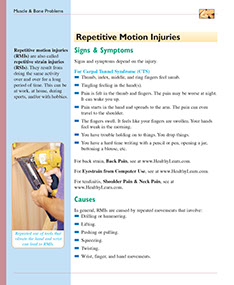
    Repetitive motion injuries (RMIs) are also called repetitive strain injuries (RSIs). They result from doing the same activity over and over for a long period of time. This can be at work, at home, during sports, and/or with hobbies.

    Signs & Symptoms

    Signs and symptoms depend on the injury.

    For Carpal Tunnel Syndrome (CTS)

    *  Thumb, index, middle, and ring fingers feel numb.

    *  Tingling feeling in the hand(s).

    *  Pain is felt in the thumb and fingers. The pain may be worse at night. It can wake you up.

    *  Pain starts in the hand and spreads to the arm. The pain can even travel to the shoulder.

    *  The fingers swell. It feels like your fingers are swollen. Your hands feel weak in the morning.

    *  You have trouble holding on to things. You drop things.

    *  You have a hard time writing with a pencil or pen, opening a jar, buttoning a blouse, etc.

    Causes

    In general, RMIs are caused by repeated movements that involve:

    *  Drilling or hammering.

    *  Lifting.

    *  Pushing or pulling.

    *  Squeezing.

    *  Twisting.

    *  Wrist, finger, and hand movements.

    For Carpal Tunnel Syndrome (CTS)

    Repeated motions, typing vibrations, etc. cause swelling of the tendons inside the carpal tunnel. This is the narrow tunnel in the wrist. The swelling puts pressure on the nearby nerves.

    Treatment

    For Carpal Tunnel Syndrome (CTS)

    This is easier to treat and less likely to cause future problems if it is found early. Women are more likely to get CTS than men, because their carpal tunnel is usually smaller. Once diagnosed, CTS can be treated with:

    *  Preventing further damage.

    *  Wearing a wrist brace, splint, etc. as advised. It may need to be worn while you sleep and during the day.

    *  Over-the- counter medicines to reduce pain and swelling. Examples are aspirin, ibuprofen, and naproxen sodium.

    *  Physical therapy.

    *  Occupational therapy.

    *  Cortisone shots in the wrist area.

    *  Surgery, if needed.

    Questions to Ask

    Self-Care / Prevention

    For Preventing Wrist and Hand Injuries

    Whenever your hands and wrists do the same activity time and again, you increase your risk for CTS and tendinitis. Change how you do a task and you may avoid some of these injuries.

    *  Do not hold an object in the same position for a long time. Even simple tasks, such as hammering nails, can cause injury when done over a period of time.

    *  Give your hands a break. Rest them for a few minutes each hour.

    *  Lift objects with your whole hand or with both hands. Gripping or lifting with the thumb and index finger puts stress on your wrist.

    *  If your line of work causes pain in your hands and wrists, alternate the stressful tasks with other work.

    *  Exercise your hands and wrists as often as you can. Here are two examples:

    – Place your hands in front of you. Spread your fingers as far apart as possible. Hold for 5 seconds. Relax. Repeat 5 times with each hand.

    – Turn your wrists in a circle, palms up and then palms down. Relax your fingers and keep your elbows still. Repeat 5 times.

    For Carpal Tunnel Syndrome

    *  Lose weight. CTS is linked to obesity.

    *  Take an over-the-counter medicine to reduce the pain and swelling as directed.

    *  Use a wrist splint. Many drug and medical supply stores carry splints that keep the wrist angled slightly back with the thumb parallel to the forearm. This position helps to keep the carpal tunnel open.

    Other Tips

    *  Keep your head upright and your ears, shoulders, and hips in a straight line.

    *  Keep your work within reach without having to stretch or strain your arms, shoulders, or back. Don’t stretch to reach items on an assembly line. Wait for the items to reach you.

    *  Change positions or tasks often. This avoids repeated stress on a single body part.

    *  Use the proper tools for the job. Use tools made to reduce vibration and/or pressure, if needed.

    Resources

    National Institute of Arthritis and Musculoskeletal and Skin Diseases (NIAMS)

    877.22.NIAMS (226.4267)

    www.niams.nih.gov
    Healthier at Home book by the American Institute for Preventive Medicine. www.HealthyLife.com. All rights reserved.

    © American Institute for Preventive Medicine

  • Shoulder Pain & Neck Pain

    Bone & Muscle Problems

    Signs & Symptoms

    *  The pain can be mild to severe. It can be felt in one spot, in a large area, or travel to another area. Movement can cause the pain or make it worse.

    *  Stiffness and/or swelling may occur.

    Causes

    *  Overuse and wear and tear on neck and shoulder muscles and joints.

    *  Strains. Broken or dislocated shoulder.

    *  Poor posture. Awkward sleeping positions. Sleeping on a soft mattress.

    *  Pinched nerve. Pain from a pinched nerve usually runs down one side of the arm.

    *  Frozen shoulder. This can result from lack of use due to pain from an injury. At first, pain occurs with movement. Over time, the pain gets better, but stiffness remains.

    *  Torn rotator cuff. This is a tear in a ligament that holds the shoulder in place. Symptoms are pain at the top and outer sides of the shoulders, especially when you raise or extend your arm. You may also feel or hear a click when the shoulder is moved.

    *  Tendinitis. This is swelling of a tendon (tissue that connects a muscle to bone). Left untreated, tendinitis can turn into “frozen shoulder.” “Wry” neck is a similar problem.

    *  Bursitis. This is swelling of the sac (bursa) that surrounds the shoulder joint. Bursitis can be caused by injury, infection, overuse, arthritis, or gout.

    *  A whiplash injury.

    *  Osteoarthritis.

    *  Infections that cause swollen lymph nodes in the neck.

    Treatment

    Treatment for shoulder pain and/or neck pain depends on the cause. Emergency medical care is needed for:

    *  A serious injury.

    *  A broken bone.

    *  A heart attack.

    *  Meningitis. This is an infection of the membranes that surround the brain.

    Self-care can treat less serious causes of shoulder pain and/or neck pain.

    Questions to Ask

    Self-Care / Prevention

    For Pain

    *  Take an over-the-counter medicine for pain and/or swelling.

    *  To relieve tension and improve circulation, take walks. Start with 3 to 5 walks a day, each lasting 5 to 10 minutes. Gradually increase walking times.

    For Bursitis, Tendinitis, or an Injury That Does Not Appear Serious

    *  Use R.I.C.E.

    *  Try liniments and balms. These provide a cooling or warming sensation, but only mask the pain. They do not promote healing.

    To Treat Neck Pain from a Whiplash Injury or Pinched Nerve

    See a doctor anytime your motor vehicle is hit from the rear because the accident can cause a whiplash injury. After first checking with your doctor, do these things to ease neck discomfort:

    *  Rest as much as you can by lying on your back.

    *  Use cold and hot packs.

    *  Improve your posture. When you sit, use a chair with a straight back. Make sure your buttocks go all the way to the chair’s back. When you stand, pull in your chin and stomach.

    *  Use a cervical (neck) pillow or a rolled hand towel under your neck.

    *  Avoid activities that may aggravate your injury.

    *  Cover your neck with a scarf if you go outside when the weather is cold.

    Ways to Prevent Shoulder Pain & Neck Pain

    *  Avoid repeated activities that twist or put strain on the neck and shoulders. When you do repeated tasks, use proper posture, equipment, and techniques.

    *  Wear seat belts in vehicles. Use protective gear when you take part in sporting events.

    *  If you are out of condition, strengthen your muscles gradually.

    *  Don’t sleep on your stomach. You may twist your neck in this position. Use a firm polyester pillow, a neck (cervical) pillow, or a rolled towel under your neck.

    *  Practice good posture. Stand straight. Don’t let your shoulders slump, your head droop, or your lower back slouch.

    *  When you carry things, such as a shoulder bag, switch from one shoulder to the other.

    *  Don’t prop a telephone between your ear and shoulder.

    *  Stretch and warm up before activities that require joint movement, such as sports.

    *  Do stretching and strengthening exercises to keep your shoulder, neck, and arm muscles strong and flexible.

    – Shoulder Stretch: Reach your right arm across your chest. With your left hand, grasp your arm just above the elbow. Gently pull your arm farther across your body until you feel a stretch in the back of your shoulder. Hold for 30 seconds. Rest and repeat. Do the same with your left arm.

    – Neck and Shoulder Stretch: Tilt your head forward and let it hang. Relax your neck and shoulders. Slowly, roll your head to one side then back to the front and then slowly roll it to the other side. (Do not roll your neck backward.) Repeat 10 times.

    Resources

    National Institute of Arthritis and Musculoskeletal and Skin Diseases (NIAMS)

    877.22.NIAMS (226.4267)

    www.niams.nih.gov

    Healthier at Home book by the American Institute for Preventive Medicine. www.HealthyLife.com. All rights reserved.

    © American Institute for Preventive Medicine

  • Cold Hearts (Why Shoveling Snow Is Extra Dangerous)

    WELL-BEING

    Image of person shoveling snow from the driveway.

    While you may be used to battling frigid temperatures and the inevitable snowstorms that arrive every winter, are you aware of the dangers these pose to your heart?

    “When the temperature outside drops, our blood vessels narrow to prevent our bodies from losing heat. This is a natural response that can also put people with heart conditions and those involved in strenuous exercise at greater risk of having a heart attack,” says Dr. Holly Andersen of the Perelman Heart Institute at NewYork-Presbyterian Hospital/Weill Cornell Medical Center.

    Shoveling snow is one of the most strenuous and dangerous winter exercise activities. It can raise blood pressure, and coupled with the effects of colder temperatures, shoveling can increase heart attack risk drastically. Take these precautions:

    *Warm up.Warm up with stretching and light activity before shoveling, exercising or beginning more strenuous physical activities.

    *Bundle up.When going out to shovel, always wear a scarf over your mouth and nose to warm the air before you breathe in, and dress in layers. Layering clothes underneath a windproof and waterproof outer shell helps maintain body heat.

    *Push the shovel.It is less strenuous to push the snow rather than lifting it, and this reduces the risk of overexerting yourself.

    *Take breaks.You should take frequent breaks while shoveling to give your muscles, especially your heart muscle, a chance to relax. You may also consider sharing the work with a friend to make the workload lighter and ensure that you are not alone in the event of an emergency.

    *Consult a doctor.If you are over the age of 50, overweight, out of shape or have suffered a heart attack, you should consult a doctor before shoveling snow or starting any exercise routine.

    © American Institute for Preventive Medicine

  • Eye-Popping Facts

    WELL-BEING

    Image of 2 young brothers using a tablet at bedtime.

    Kids (and adults) are spending hours using electronics such as iPads, video games, computers, and smartphones. How much is too much for your eyes when it comes to digital device use?

    Eye strain or Computer Vision Syndrome (CVS) is a serious condition that can cause back and neck pain, dry eye, and even headaches. Statistics show that 80% of what we learn is through our eyes, which means that digital eyestrain and CVS can have a major impact on productivity and success.

    VSP optometrist, Dr. Nate Bonilla-Warford suggests these eye-easing ways to avoid digital eye strain:

    *Blink often:When looking at a computer or hand-held digital device, it’s common for you to blink 2 to 3 times less than you normally would. This can lead to “dry eye.” Blinking bathes your eyes in tears, and tears are naturally helpful for the eyes.

    *Follow the 20/20/20 rule:When spending long periods in front of a digital device, every 20 minutes, spend 20 seconds looking at something 20 feet away to allow your eyes to rest.

    *Ensure proper lighting:Poor lighting often causes eye strain. To help ease the strain on your eyes, keep bright lighting overhead to a minimum and position your desk lamp to shine on your desk, and not at you.

    *Wear it:If you or your child wears prescription glasses-for digital use or otherwise-make sure to have them on.

    © American Institute for Preventive Medicine

  • Ipad Pain

    WELL-BEING

    Image of man using a tablet.

    When your iPad or other tablet causes pain in the neck and shoulders –

    *  Use a case that positions the device at a comfortable viewing angle.

    *  Routinely shift hands and weight. Stand up if seated, or sit down if standing.

    When using a laptop or desktop computer, follow the same tips for a tablet plus:

    *  Use an external keyboard.

    *  Keep shoulders relaxed and elbows close to the body.

    *  Keep hands, wrists, forearms, and thighs parallel to the floor.

    *  Take a break and change position every 15 minutes.

    Holding a tablet computer too low, say on the lap, forces the neck to bend forward too much, straining and possibly even injuring muscles, nerves, tendons, ligaments, or spinal discs. Simply placing a tablet on a table propped at an angle in a tablet case can reduce neck strain and potential pain, according to research conducted at the Harvard School of Public Health.

    © American Institute for Preventive Medicine

  • Is 3D As Dangerous As The Warnings?

    WELL-BEING

    Illustration of a TV with wild animlas appearing to come out of the television set.

    Have you read the warnings on a 3D TV or gaming system? Can 3D actually cause altered vision, lightheadedness, twitching, nausea, disorientation, especially for children and the elderly?

    Through these disclaimers, companies may have been scaring away the customers they seek, but medical evidence does not back up the claims.

    Professional eye photographer Timothy Bennett of Penn State Hershey Eye Center said there are no health issues associated with 3D imaging. Some people experience headaches or dizziness, but these are temporary. The images may be disorienting, but as soon as you stop looking at 3D, the feelings clear up.

    He recommends sitting far from the screen, especially if you are sensitive, and take breaks from gaming or watching 3D TV.

    Some people experience headaches or dizziness, but these are temporary.

    © American Institute for Preventive Medicine

  • Is Your Job A Pain In The Neck?

    WORK LIFE

    Image of business man holding his neck.

    No, really, if you sit all day in front of a computer at work, your computer workstation may be the cause of your nagging neck and shoulder pain. And not surprising, said Dr. Vincent Fortanasce, a rehab specialist and author of End Back & Neck Pain, “The setup of your computer workstation can play a large factor in your ability to stay symptom free.” He and his coauthors point out 3 common workstation mistakes people make that lead to pain.

    *  Overreaching injuries occur because items on your desktop such as your keyboard or mouse, phone, documents, and other desk items are not on the same level surface. So you reach to grab that stapler or strain to pick up files.The solution: rearrange the desktop, adjust your chair, put the keyboard and mouse on the same surface, put things you use the most closest to you.

    *  Use of incorrect heights refers to the up and down motions and placement of items. Incorrect height occurs as a result of the positioning of the chair, including the armrests, seat back, seat pan, desktop where work is placed, monitor, and the surface holding the keyboard and mouse. Incorrect height may also refer to furniture and features of the work area that are not adjustable.The solution: a proper chair is of critical importance. Can you adjust it? Do you have to reach above your head to get items in shelves above your desk? Is the top line of the text displayed on your monitor at eye level?

    * Unbalanced work area refers to twisting motion you do to reach items. If you’re right handed, and you use your right hand for all desktop activities such as answering the phone, you may have pain on your right side. Do you twist to see your monitor?The solution: Place your monitor right in front of you. Are items you use directly ahead of you?

    Back, neck, and arm pain are often the result of repeated actions, over and over, over time. Assess what’s causing your pain and adjust your workstation.

    © American Institute for Preventive Medicine