Tag: strategy

  • Plan Problem-Solving 2

    Healthylife® QuitWell™

    Part 2

    Image of smiling women at desk.

    Your worries and concerns take up time in your day. Many issues cannot simply be ignored or brushed aside. To avoid letting these thoughts trigger smoking or chewing habits, plan time to address them.

    Steps to Address Your Worries

    1. Write a worry at the top of a piece of paper. It may seem old-fashioned to write this down on paper, when so much is done on the computer or a smartphone. However, writing things down can be powerful.

    2. Divide the paper into three columns:

    a. What I can’t do. Recognize what is out of your control.

    b. What I can do. List possible actions that are within your control. Write things you know how to do and that are realistic actions for you to take.

    c. What I will do and when. Decide which action you are ready to take first. This action may not solve every part of the problem, but it is a small step toward a solution. Write when you will do this.

    3. After you have taken an action towards a solution, repeat this process the next day or when you are ready to take another step.

    © American Institute for Preventive Medicine

  • Use The L.A.D.D.E.R. Technique 2

    Healthylife® QuitWell™

    Part 5

    Image of two friends talking.

    This is a step-by-step way to become more assertive.

    L:Look at your needs, wants, rights, and feelings about the situation.

    A:Arrange a meeting that is convenient for you and the other person to talk.

    D:Define the problem clearly to the other person.

    D:Describe your feelings using “I messages.” I message statements let you take charge of your feelings. The other person is less likely to get defensive.

    E:Express your needs and desires in an assertive manner using a few clear sentences. Be aware of your eye contact, hand gestures, posture, voice, and facial expression.

    R:Reinforce your remarks by saying what positive outcomes will occur for you and the other person.

    Example:

    L:I could use support from my close co-worker while I’m quitting vaping and I don’t want him to give me a hard time.

    A:I’ll arrange to speak to him first thing tomorrow.

    D:“Jack, I’m trying to quit and can really benefit from your support. I want to be able to take breaks with you, but it’s tough for me to do that if you offer me your vape.”

    D:“I feel like I could really achieve my goal with your help. Quitting is really important to me.”

    E:“I would like to take a walk with you instead of vaping, if you will join me. Or, we’ll have to catch up after work. Standing next to you while you vape is tough for me right now.”

    R:“I love getting away from hectic stuff at work by taking a break with you. I think taking a walk will help us both clear our heads and feel more ready to tackle the rest of the day.”

    © American Institute for Preventive Medicine
  • Plan Problem-Solving

    Healthylife® Weigh

    Part 6

    Problem, think, idea, solution diagram.

    Your worries and concerns take up time in your day. Many issues cannot simply be ignored or brushed aside. To avoid letting these thoughts trigger unhealthy eating habits, plan time to address them.

    Steps to Address Your Worries

    1. Write a worry at the top of a piece of paper.

    2. Divide the paper into three columns:

    a. What I can’t do. Recognize what is out of your control.

    b. What I can do. List possible actions that are within your control. Write things you know how to do and that are realistic actions for you to take.

    c. What I will do. Decide which action you are ready to take first. This action may not solve every part of the problem, but is a small step toward a solution. Write when you will do this.

    Mind Dump

    Use this tool when you feel you have too many thoughts to juggle and aren’t sure where to start. Use small pieces of paper or index cards to “mind dump” thoughts that come to mind. Write down concerns, ideas, and things you need to remember. Pull one card and use the steps above to address this worry. Don’t pull another card until you are satisfied with your plan to deal with the first worry.

    © American Institute for Preventive Medicine

  • Set Yourself Up For Success

    Healthylife® Weigh

    Part 5

    Man running along hiking trail.

    Create a consistent routine for yourself. Reduce the number of excuses you can make. Tips for creating an exercise habit:

    *Seize your moment.Be aware of when your motivation to exercise is high. You may prefer mornings over evenings. Or, the opposite. Plan to exercise when you are more likely to be physically and mentally on board with it.

    *Get ready ahead of time.Pack a bag with clothes, shoes, deodorant, hair ties, a water bottle, a small towel, and other supplies you’ll need. When exercise comes up on your calendar, all you have to do is grab the bag.

    *Get ready for round 2 ahead of time.Have several days’ worth of workout clothes clean and ready to go. Store workout clothes together so it is easy to re-fill your gym bag. Make it easier to repeat your habit.

    *Commit to repeating your routine.Join a recreational sports team, sign up for a class, or pay for a personal training package. Even if you are not feeling up to it one day, having it on the schedule may get you there.

    *Be accountable to someone.Commit to meeting a friend for exercise at a certain time. Get a workout buddy and swap shoes. If you don’t show up, they won’t be able to work out either! Or, commit to logging your workout on social media or with a friend.

    *Be patient.It may take time to find an activity you like. It may take even longer to feel like it is a normal part of your day to exercise. Keep going. You’ll get there!

    © American Institute for Preventive Medicine
  • Use The L.A.D.D.E.R. Technique

    Healthylife® Weigh

    Part 4

    Group of friends enjoying a meal outdoors.

    This is a step-by-step way to become more assertive.

    L – Look at your needs, wants, rights, and feelings about the situation.

    A – Arrange a meeting that is convenient for you and the other person to talk.

    D – Define the problem clearly to the other person.

    D – Describe your feelings using “I messages.” I message statements let you take charge of your feelings.

    E – Express your needs and desires in an assertive manner using a few clear sentences. Be aware of your eye contact, hand gestures, posture, voice, and facial expression.

    R – Reinforce your remarks by saying what positive outcomes will occur for you and the other person.

    Example:

    L – I wish my partner would stop stocking the pantry with a food I tend to over-eat when it is available.

    A – I’ll plan to talk with him or her after dinner tomorrow.

    D – Tell your partner, “When cookies are in the pantry, it is hard for me to have just one. I appreciate the treat, but this makes it harder for me to stick with my goal.”

    D – “I feel I could stick with my goals with your help.”

    E – “Let’s keep cookies off the grocery list. I am starting to enjoy fruit as a sweet treat. Let’s get that instead! Also, a hug would be a wonderful treat from you!”

    R – “This change would help me to reach my goal. As I lose weight, I am able to do more physical activity comfortably. Let’s plan a hike together this weekend!”

    © American Institute for Preventive Medicine

  • How To Eat Healthy At Holiday Parties

    HEALTHY EATING

    Image of holiday treat on small plate.

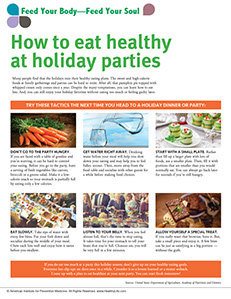
    Many people find that the holidays ruin their healthy eating plans. The sweet and high-calorie foods at family gatherings and parties can be hard to resist. After all, that pumpkin pie topped with whipped cream only comes once a year. Despite the many temptations, you can learn how to eat less. And, you can still enjoy your holiday favorites without eating too much or feeling guilty later.

    Try these tactics the next time you head to a holiday dinner or party:

    Don’t go to the party hungry.If you are faced with a table of goodies and you’re starving, it can be hard to control your eating. Before you go to the party, have a serving of fresh vegetables like carrots, broccoli or a greens salad. Make it a low-calorie snack so your stomach is partially full by eating only a few calories.

    Get water right away.Drinking water before your meal will help you slow down your eating and may help you to feel fuller, sooner. Then, move away from the food table and socialize with other guests for a while before making food choices.

    Start with a small plate.Rather than fill up a larger plate with lots of foods, use a smaller plate. Then, fill it with portions that are smaller than you would normally eat. You can always go back later for seconds if you’re still hungry.

    Eat slowly.Take sips of water with every few bites. Put your fork down and socialize during the middle of your meal. Chew each bite well and enjoy how it tastes before you swallow.

    Listen to your belly.When you feel almost full, that’s the time to stop eating. It takes time for your stomach to tell your brain that you’re full. Chances are, you will be very full in a few minutes.

    Allow yourself a special treat. If you really want that brownie, have it. But, take a small piece and enjoy it. A few bites can be just as satisfying as a big portion – without the guilt.

    If you do eat too much at a party this holiday season, don’t give up on your healthy eating goals. Everyone has slip-ups on diets once in a while. Consider it as a lesson learned or a minor setback. Come up with a plan to eat healthier at your next party. You can start fresh tomorrow!

    Sources: United States Department of Agriculture, Academy of Nutrition and Dietetics

    © American Institute for Preventive Medicine
  • Avalanche Your Debt

    FINANCIAL HEALTH

    Four credit cards layed on top of eachother.

    If you carry multiple credit card balances, reducing your debt can feel overwhelming. But there are many techniques to help you tackle your debt. One strategy is to create a debt avalanche.

    Here’s how it works:

    *  Make a list of your credit cards, their balances, interest rates, and minimum payments.

    *  Evaluate your budget to determine how much money you have available to pay toward your debts.

    *  If you don’t have much extra beyond your minimum debt payments, consider ways to bring in extra money to get your avalanche started.

    *  Identify the credit card with the highest interest rate. This is the one to pay off first.

    *  Each month pay the minimum balance on ALL your cards.

    *  Use any extra from your budget to pay more on your highest interest rate card.

    *  Once that card is paid off, move on to the card with the next highest interest rate while continuing to make minimum payments on all other cards.

    *  Each time you pay off a card, the amount of extra you can put towards your highest interest rate card goes up, creating a debt-paying avalanche.

    *  Your avalanche will pick up speed over time until you are credit card debt-free.

    *  Put away your cards, and don’t use credit unless you know you have the money to pay the bill in full.

    © American Institute for Preventive Medicine