Stress Management
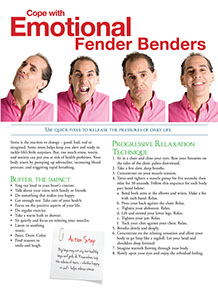
Use quick fixes to release the pressures of daily life.
Stress is the reaction to change – good, bad, real or imagined. Some stress helps keep you alert and ready to tackle life’s little surprises. But, too much stress, worry, and anxiety can put you at risk of health problems. Your body reacts by pumping up adrenaline, increasing blood pressure, and triggering rapid breathing.
Progressive Relaxation Technique:
1. Sit in a chair and close your eyes. Rest your forearms on the sides of the chair, palms downward.
2. Take a few slow, deep breaths.
3. Concentrate on your muscle tension.
4. Tense and tighten a muscle group for five seconds; then relax for 30 seconds. Follow this sequence for each body part listed below:
a. Bend both arms at the elbows and wrists. Make a fist with each hand. Relax.
b. Press your back against the chair. Relax.
c. Tighten your abdomen. Relax.
d. Lift and extend your lower legs. Relax.
e. Tighten your jaw. Relax.
f. Tuck your chin against your chest. Relax.
5. Breathe slowly and deeply.
6. Concentrate on the relaxing sensation and allow your body to go limp like a ragdoll. Let your head and shoulders drop forward.
7. Imagine warmth flowing through your body.
8. Slowly open your eyes and enjoy the refreshed feeling.
Buffer the impact:
* Sing out loud to your heart’s content.
* Talk about your stress with family or friends.
* Do something that makes you happy.
* Get enough rest. Take care of your health.
* Focus on the positive aspects of your life.
* Do regular exercise.
* Take a warm bath or shower.
* Sit quietly and focus on relaxing your muscles.
* Listen to soothing music.
* Paint. Draw. Color.
* Find reasons to smile and laugh.
Action Step
Big boys may not cry, but healthy boys and girls do. Researchers say the release of tears – whether happy or sad – helps release stress.
© American Institute for Preventive Medicine