Tag: Student Health Conditions

  • Suicidal Thoughts 2

    Mental Health

    Signs & Symptoms

    *  Writing a suicide note.

    *  Suicidal threats, gestures, or attempts.

    *  Thoughts of suicide that don’t go away or occur often.

    Causes

    *  Depression.

    *  Bipolar disorder.

    *  Schizophrenia.

    *  Grief. Loss of a loved one.

    *  A side effect of some medicines. One is isotretinoin. This is prescribed for severe acne. Some antidepressants have this effect, too. This is more of a risk in the first days to the first month they are taken.

    *  A family history of suicide or depression.

    *  Money and relationship problems.

    *  Increasing use of alcohol and/or drugs.

    *  Withdrawing from others.

    *  Showing rage or seeking revenge.

    *  Behaving recklessly.

    *  Talking about feeling trapped, hopeless, or in unbearable pain.

    Treatment

    *  Emergency care.

    *  Treating the mental and/or physical problems that lead to thoughts and attempts of suicide. Examples are bipolar disorder and depression.

    *  Counseling.

    *  Talking with family and friends often.

    Questions to Ask

    Self-Care / Prevention

    For Suicidal Thoughts

    *  Call the National Suicide Prevention Lifeline at 800.273.8255.

    *  Let someone know. Talk to your doctor, a trusted family member, friend, or teacher. If it is hard for you to talk to someone, write your thoughts down. Let someone else read them.

    To Help Prevent a Suicide

    *  Keep firearms, drugs, etc., away from persons at risk.

    *  Take courses that teach problem solving, coping skills, and suicide awareness.

    *  If you think the person is serious about suicide, get help. Watch and protect him or her until you get help. Keep the person talking. Ask questions such as, “Are you thinking about hurting or killing yourself?”

    *  Urge the person to call for help (e.g., his or her health care provider, a suicide prevention hotline, EMS, etc.) Make the call yourself if the person can’t or won’t.

    *  Express concern. The person needs to know that someone cares. Most suicidal persons feel alone. Tell the person how much he or she means to you and others. Talk about reasons to stay alive. Don’t judge. The person needs someone to listen, not preach moral values.

    *  Tell the person that depression and thinking about suicide can be treated. Urge him or her to get professional care. Offer help in seeking care.

    Resources

    Mental Health America (MHA)

    800.969.6642

    mentalhealthamerica.net

    National Suicide Prevention Lifeline

    800.273.TALK (273.8255)

    suicidepreventionlifeline.org

    Healthier at Home book by the American Institute for Preventive Medicine. www.HealthyLife.com. All rights reserved.

    © American Institute for Preventive Medicine

  • Abdominal Pain

    Abdominal & Urinary Conditions

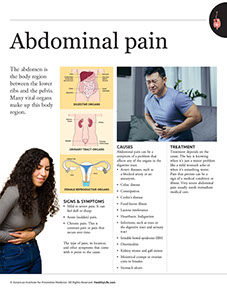
    The abdomen is the body region between the lower ribs and the pelvis. Many vital organs make up this body region.

    Signs & Symptoms

    The type of pain, its location, and other symptoms that come with it point to the cause.

    *  Mild to severe pain. It can feel dull or sharp.

    *  Acute (sudden) pain.

    *  Chronic pain. This is constant pain or pain that recurs over time.

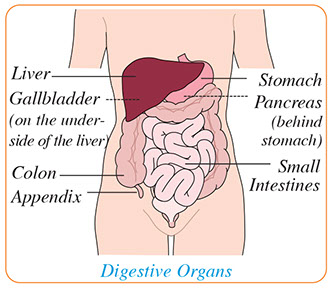
    Illustration of digestive organs.
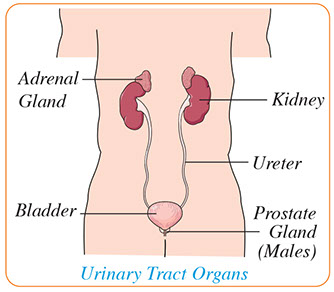
    Illustraion of urinary tract organs.
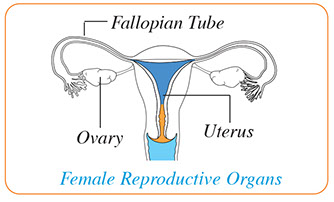
    Illustration of female reproductive organs.

    Causes

    Abdominal pain can be a symptom of a problem that affects any of the organs. Causes of abdominal pain include:

    *  Artery diseases, such as a blocked artery or an aneurysm.

    *  Celiac disease.

    *  Constipation.

    *  Crohn’s disease.

    *  Food poisoning.

    *  Gallstones.

    *  Heartburn. Indigestion.

    *  Infections, such as ones in the digestive tract and urinary tract.

    *  Irritable bowel syndrome (IBS).

    *  Kidney stones.

    *  Menstrual cramps or ovarian cysts in females.

    *  Reflux.

    *  Stomach ulcers.

    Treatment

    Treatment depends on the cause. The key is knowing when it’s just a minor problem like a mild stomach ache or when it’s something worse. Pain that persists can be a sign of a medical condition or illness. Very severe abdominal pain usually needs immediate medical care.

    Questions to Ask

    Self-Care / Prevention

    *  Find a comfortable position. Relax.

    *  Take an over-the-counter pain medicine as directed on the label.

    *  Apply a heating pad set on low (adults only).

    *  Don’t wear clothes that fit tight.

    *  Don’t exercise too hard.

    *  Use a hot water bottle on the area that aches.

    Crohn’s Disease

    Crohn’s Disease is a chronic problem that can cause abdominal pain and diarrhea. Other symptoms are fever, fatigue, and, at times, rectal bleeding or drainage. Symptoms occur when the disease flares up. This is followed by periods when symptoms go away or lessen.

    With Crohn’s disease, any part of the GI tract, from the mouth to the anus, can be inflamed. Usually, the colon and the last part of the small intestine, the ileum, are affected.

    Treatment for Crohn’s disease includes medicines, nutrition supplements, and surgery.

    Resources

    Crohn’s & Colitis Foundation of America

    www.ccfa.org

    Healthier at Home book by the American Institute for Preventive Medicine. www.HealthyLife.com. All rights reserved.

    © American Institute for Preventive Medicine

  • Acne

    Skin Conditions

    Acne is a common skin condition. It occurs most often in teenagers and young adults, but can persist into adulthood.

    Signs & Symptoms

    *  Whiteheads and/or blackheads.

    *  Red and painful pimples.

    *  Deeper lumps (cysts or nodules).

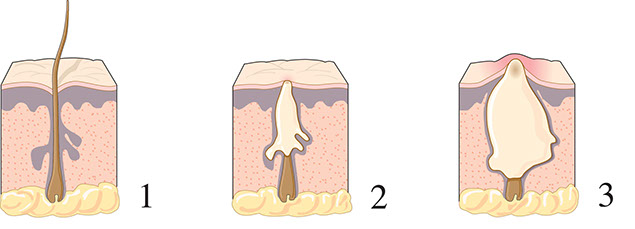
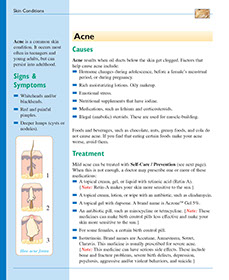
    How acne forms.

    Illustration of acne forming.

    Causes

    Foods and beverages, such as chocolate, nuts, greasy foods, and cola do not cause acne. If you find that eating certain foods make your acne worse, avoid them.

    Acne results when oil ducts below the skin get clogged. Factors that help cause acne include:

    *  Hormone changes during adolescence, before a female’s menstrual period, or during pregnancy.

    *  Rich moisturizing lotions. Oily makeup.

    *  Emotional stress.

    *  Nutritional supplements that have iodine.

    *  Medications, such as lithium and corticosteroids.

    *  Illegal (anabolic) steroids. These are used for muscle-building.

    Treatment

    Mild acne can be treated with Self-Care / Prevention. When this is not enough, a doctor may prescribe one or more of these 1 medications:

    *  A topical cream, gel, or liquid with retinoic acid (Retin-A). {Note: Retin-A makes your skin more sensitive to the sun.}

    *  A topical cream, lotion, or wipe with an antibiotic, such as clindamycin.

    *  A topical gel with dapsone. A brand name is AczoneTM Gel 5%.

    *  An antibiotic pill, such as minocycline or tetracycline. {Note: These medicines can make birth control pills less effective and make your skin more sensitive to the sun.}

    *  For some females, a certain birth control pill.

    *  Isotretinoin. Brand names are Accutane, Amnesteem, Sotret, Claravis. This medicine is usually prescribed for severe acne. {Note: This medicine can have serious side effects. These include bone and fracture problems, severe birth defects, depression, psychosis, aggressive and/or violent behaviors, and suicide.}

    Treatments Other Than Medications

    *  Chemical peels.

    *  Laser treatments.

    *  Surgery for acne scarring.

    Questions to Ask

    Self-Care / Prevention

    *  Keep your skin clean. Gently wash your skin, where the acne appears, twice a day. Use a mild soap, such as Neutrogena. Use a clean washcloth every time. Work the soap into your skin gently for 1 to 2 minutes and rinse well. Don’t scrub.

    *  Don’t squeeze, scratch, or poke at pimples. They can get infected and leave scars.

    *  Wash after you exercise or sweat.

    *  Use an over-the- counter lotion or cream that has benzoyl peroxide. (Some people are allergic to benzoyl peroxide. Try a little on your arm first to make sure it doesn’t hurt your skin.) Follow the directions as listed.

    *  Use only oil-free and water-based makeups. Don’t use greasy or oil-based creams, lotions, or makeups.

    *  For males, wrap a warm towel around your face before you shave. Shave along the natural grain of the beard.

    *  Don’t spend too much time in the sun especially if you take antibiotics for acne. Don’t use sun lamps.

    Resources

    American Academy of Dermatology

    866.503.SKIN (503.7546)

    www.aad.org

    National Institute of Arthritis and Musculoskeletal and Skin Diseases (NIAMS)

    www.niams.nih.gov

    Healthier at Home book by the American Institute for Preventive Medicine. www.HealthyLife.com. All rights reserved.

    © American Institute for Preventive Medicine

  • Colds & Flu

    Children’s Health

    Colds and flu are infections of the nose and throat. Both are caused by viruses.

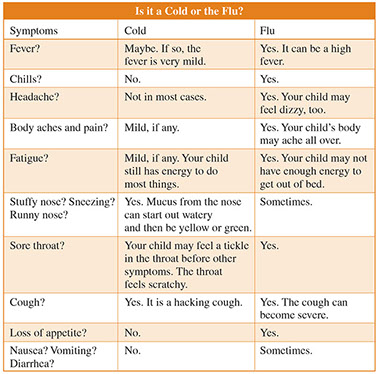
    It can be hard to tell if your child has a cold or the flu. Why? They both have the same type of symptoms. But symptoms for the flu are worse than ones for a cold. Flu symptoms come on fast. Ones for a cold come on slower.

    Signs & Symptoms

    Chart showing symptoms of a cold vs a flu.

    Prevention

    Antibiotics do not treat colds and flu. Most colds clear up in about a week. Sometimes, a cold lasts up to 2 weeks.

    Fever and most flu symptoms usually go away after 5 days, but coughing and feeling weak can last up to 2 weeks.

    To Help Prevent Colds and Flu

    *  Take your child for a yearly flu vaccine as advised.

    *  Don’t smoke or let your child smoke.

    *  Keep your child away from persons who have the flu or a cold.

    *  See that your child eats and sleeps well and gets lots of exercise.

    Tell your child to do these things:

    *  Wash your hands often. Keep them away from your nose, eyes, and mouth.

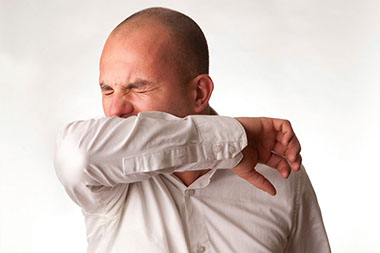
    *  Cover your nose when you sneeze. Use a handkerchief or tissues when you sneeze, cough, or blow your nose. This helps prevent passing germs to others.

    Questions to Ask

    Self-Care

    Have your child do these things:

    *  Rest.

    *  Drink lots of liquids. They help clear out the respiratory tract. This can help prevent other problems, like bronchitis.

    *  Eat chicken soup. It helps clear out mucus.

    If your child’s throat is sore, have him or her do these things:

    *  Gargle every few hours with 1/4 teaspoon of salt in 1/2 cup of warm water, if able to. (A child can usually do this starting at age 6.)

    *  Suck on a piece of hard candy or cough drop once in a while. (Don’t  give these to children under 5 years old.)

    Things you can do:

    *  Try to clear your child’s nose. This is very important in babies under 6 months old, because some can’t breathe through their mouths yet. Also, they can’t breast or bottle-feed if they can’t breathe through the nose. To clear your child’s nose:

    – Use an over-the-counter spray or drops for the nose made of salt and water. An example is Ocean® brand. Follow the label’s advice or that of your child’s doctor.

    – For a baby who can’t blow his or her nose, leave the salt drops in for 1 minute. Then use a soft rubber suction bulb to draw out the mucus. Lie the baby on his or her back. Aim the bulb straight down, not at an angle! (You can get a suction bulb at the drug store.) Or use a cotton swab to wipe the mucus out. Don’t put the suction bulb or cotton swab too far into the nose. You could cause a nosebleed.

    – For a child who can blow his or her own nose, have the child do it 1 minute after the salt drops are in.

    *  Put a cool-mist vaporizer or humidifier in your child’s room. Use distilled (not tap) water. Clean it every day.

    *  For fever and muscle aches, give your child acetaminophen or ibuprofen. Make sure you give the right kind and dose for your child’s weight. (Note: Do not give aspirin. Aspirin and other medicines that have salicylates have been linked to Reye’s Syndrome.

    *  Check with your child’s doctor about using over-the-counter medicines for colds and flu for children under  age 2.

    *  Call your child’s doctor if he or she gets a fever after a cold or after the flu has gone away.

    *  Washing the hands often helps stop spreading the flu. Have your child wash his or her hands:

    – After playing with others.

    – When he or she gets home from school.

    – After blowing his or her nose.

    – After touching toys or other people’s things.

    Signs of Reye’s Syndrome

    Be on the lookout for Reye’s Syndrome after the flu or chickenpox. Reye’s Syndrome does not happen very often. But you should know about it. Look for these signs:

    *  Vomiting over and over again. Or vomiting that does not stop.

    *  Loss of pep and energy.

    *  Acting very, very sleepy.

    *  Acting very, very cranky.

    *  Striking out at others.

    *  Acting strange.

    *  Convulsions.

    (Note: If your child shows signs of Reye’s Syndrome, get medical care fast!)

    Children's Self-Care book by the American Institute for Preventive Medicine. www.HealthyLife.com. All rights reserved.

    © American Institute for Preventive Medicine

  • Coughs

    Respiratory conditions

    Image of man coughing into elbow.

    A cough is a reflex action. It clears the lungs and airways of irritants, mucus, a foreign body, etc.

    Signs & Symptoms

    There are 3 kinds of Coughs

    *  Productive. This cough brings up mucus or phlegm.

    *  Nonproductive. This cough is dry. It doesn’t bring up any mucus.

    *  Reflex. This cough is from a problem somewhere else like the ear or stomach.

    Causes

    *  Tobacco smoke. Dry air.

    *  Asthma.

    *  An allergy or an infection.

    *  Acid reflux from the stomach.

    *  Certain medications, like ACE inhibitors for high blood pressure.

    *  Something stuck in the windpipe.

    *  A collapsed lung.

    *  A growth or tumor in the bronchial tubes or lungs.

    Treatment

    How to treat a cough depends on what kind it is, what caused it, and other symptoms. Treat the cause and soothe the irritation. Self-care can treat most coughs. If the cause is due to a medical condition, treatment for that condition is needed.

    Questions to Ask

    Self-Care / Prevention

    For Coughs that Bring Up Mucus

    *  Drink plenty of liquids.

    *  Don’t smoke. Avoid secondhand smoke.

    *  Use a cool-mist vaporizer, especially in the bedroom. Put a humidifier on the furnace.

    *  Take a shower. The steam helps thin mucus.

    *  Use an over-the-counter expectorant medicine, as directed. This helps you spit out phlegm or mucus. Try a decongestant for postnasal drip.

    For Coughs that Are Dry

    *  Drink lots of liquids. Hot drinks like tea with lemon and honey soothe the throat.

    *  Suck on cough drops or hard candy. (Don’t give these to children under age 5.)

    *  Take an over-the-counter cough medicine that has dextromethorphan.

    *  Make your own cough medicine. Mix 1 part lemon juice and 2 parts honey. (Don’t give this to children less than 1 year old.)

    Other Tips

    *  Don’t smoke. Avoid secondhand smoke. Avoid chemical gases that can hurt your lungs.

    *  Don’t give children under age 5 small objects that can easily get caught in the throat or windpipe. Examples are buttons, balloons, peanuts, and popcorn. Even adults should be careful to chew and swallow foods slowly so they don’t “go down the wrong way.”

    *  If you cough and have heartburn symptoms when you lie down, try a liquid antacid. Don’t lie down for 2 to 3 hours after you eat.

    Resources

    American Lung Association

    800.LUNG.USA (586.4872)

    www.lungusa.org

    Healthier at Home book by the American Institute for Preventive Medicine. www.HealthyLife.com. All rights reserved.

    © American Institute for Preventive Medicine

  • Fever

    General Health Conditions

    The average normal temperature is about 98.6°F (37°C).

    Signs & Symptoms

    A fever means that body temperature is higher than:

    *  99°F (37.2°C) under the arm.

    *  99.5°F (37.5°C) by mouth or ear.

    *  100.4°F (38°C) by rectum. Rectal temperatures are advised for infants.

    Don’t use a glass mercury thermometer. If it breaks, droplets of toxic mercury can be released. If this happens, don’t use a vacuum or broom to clean up the mercury. Call your local health or fire department to find out what to do.

    Causes

    Fever is usually a sign of another problem, such as an infection.

    Body temperature changes during the day. It is usually lowest in the morning and highest in the late afternoon and evening. Other factors can increase body temperature. These include:

    *  Wearing too much clothing.

    *  Exercise.

    *  Hot, humid weather.

    *  Taking a temperature by mouth after drinking a hot liquid, like tea.

    Treatment

    Treatment includes self-care measures and treating the cause.

    Questions to Ask

    Self-Care / Prevention

    *  Drink lots of fluids, such as fruit juice, water, etc.

    *  Take a sponge bath with warm (about 70ºF) water. Don’t use cold or cool water. Don’t use rubbing alcohol.

    *  Take the right dose of an over-the-counter medicine to reduce fever, as directed.

    *  Rest.

    *  Don’t do heavy exercise.

    *  Don’t wear too many clothes. Don’t use too many blankets.

    Healthier at Home book by the American Institute for Preventive Medicine. www.HealthyLife.com. All rights reserved.

    © American Institute for Preventive Medicine

  • Sore Throats

    Ear, Nose & Throat Conditions

    Signs & Symptoms

    *  Dry, irritated throat.

    *  Soreness or pain in the throat, especially when you talk or swallow. Swollen neck glands.

    *  The back of the throat and/or the tonsils look bright red or have pus deposits or white spots.

    *  Enlarged tonsils that feel tender (tonsillitis).

    Fatigue, fever, postnasal drip, bad breath, headache, and/or earache can also occur.

    Causes

    *  Smoking

    *  Dry air

    *  Postnasal drip

    *  Cough

    *  Allergies

    *  Viruses, such as with a cold or the flu.

    *  Infection from bacteria, such as strep throat.

    Treatment

    Self-care treats most sore throats. Your doctor may take a throat culture to see if strep or another type of bacteria is the cause. If so, an antibiotic may be prescribed. Strep throat needs medical care to prevent other health problems. Sore throats caused by viruses do not need an antibiotic.

    Questions to Ask

    Self-Care / Prevention

    *  Don’t smoke. Avoid secondhand smoke.

    *  Gargle every few hours with a solution of 1/4 teaspoon of salt dissolved in 1 cup of warm water. Don’t eat spicy foods.

    *  Drink plenty of fluids like warm tea. For strep throat, have cold foods and liquids.

    *  Sit in the bathroom while hot water runs in the shower. Use a cool-mist vaporizer in the room where you spend most of your time.

    *  Suck on a piece of hard candy or throat lozenge every so often. (Don’t give to children under age 5.) Rest your voice, if this helps.

    *  Take an over-the-counter (OTC) medicine for pain as directed on the label. Take an OTC decongestant for postnasal drip, if okay with your doctor.

    Healthier at Home book by the American Institute for Preventive Medicine. www.HealthyLife.com. All rights reserved.

    © American Institute for Preventive Medicine

  • Suicidal Thoughts

    Student Health

    For persons 15 to 24 years old, suicide is the third leading cause of death, behind unintentional injury and homicide. More teenagers and young adults die from suicide than from cancer, heart disease, AIDS, birth defects, stroke, pneumonia, influenza, and chronic lung disease combined. Young women attempt suicide 4 to 8 times more often than young men, but males are 4 times more likely than females to die from suicide.

    Signs & Symptoms

    A lot of people think about suicide or say things like, “I wish I was dead,” at times of great stress. For most people, these thoughts are a way to express anger and other emotions. They may not, in and of themselves, be a sign of a problem. The signs and symptoms that follow need medical care.

    *  Writing a suicide note.

    *  Suicidal threats, gestures, or attempts.

    *  Thoughts of suicide that don’t go away or that occur often.

    (Note: In some suicides, no warning signs are shown or noticed.)

    Causes

    *  Depression.

    *  Bipolar disorder.

    *  Schizophrenia.

    *  Grief. Loss of a loved one.

    *  A side effect of some medicines. One is isotretinoin. This is prescribed for severe acne. Some antidepressant medicines can increase the risk for suicidal thoughts and behaviors, too. This is especially noted in children and adolescents. This risk may be higher within the first days to a month after starting the medicine. Persons who take antidepressants should be closely monitored.

    *  A family history of suicide or depression.

    *  Money and relationship problems.

    Treatment

    Suicidal threats and attempts are a person’s way of letting others know that he or she needs help. They should never be taken lightly or taken only as a “bluff.” Most people who threaten and/or attempt suicide more than once usually succeed if they are not stopped. Emergency care and hospitalization are necessary after an attempted suicide. Persons with suicidal thoughts should seek medical treatment.

    Questions to Ask

    Self-Care / Prevention

    If You Are Having Thoughts of Suicide

    *  Let someone know. Talk to a trusted family member, friend, or teacher. If it is hard for you to talk directly to someone, write your thoughts down and let someone else read them.

    *  Call your school’s Mental Health Service, your local Crisis Intervention Center or the National Suicide Prevention Lifeline at 800.273.8255. Follow up with a visit to your health care provider or your school’s Mental Health Service.

    How to Help a Friend Who May Be Suicidal

    *  Take him or her seriously. If your friend informs you of suicidal intentions, believe the threats.

    *  Keep firearms, drugs, etc. away from persons at risk.

    *  Take courses that teach problem solving, coping skills, and suicide awareness.

    *  If you think the person is serious about suicide, get help. Watch and protect him or her until you get help. Keep the person talking. Ask questions, such as, “Are you thinking about hurting or killing yourself?”

    *  Urge the person to call for help. If he or she is already under the care of a health care provider, have the person contact that provider first. If not, other places to contact are listed in the box below. Make the call yourself if the person can’t or won’t.

    *  Express concern. The person needs to know that someone cares. Most suicidal persons feel alone. Tell the person how much he or she means to you and others. Talk about reasons to stay alive. Don’t judge. The person needs someone to listen, not to preach moral values.

    *  Tell the person that depression and suicidal tendencies can be treated. Urge him or her to get professional care. Offer help in seeking care.

    Resources

    Your school’s Student Counseling or Mental Health Service or Student Health Service

    American Foundation for Suicide Prevention

    888.333.AFSP (2377)

    www.afsp.org

    (This is not a crisis hotline.)

    Metanoia Communications

    www.metanoia.org/suicide

    National Suicide Prevention Lifeline

    800.273.TALK (273.8255)

    www.suicidepreventionlifeline.org

    Student Self-Care book by the American Institute for Preventive Medicine. www.HealthyLife.com. All rights reserved.

    © American Institute for Preventive Medicine

  • Vaginal Problems

    Women’s Health

    A number of vaginal problems occur in women over age 50. Often, the problems are due to changes in the vagina that come with menopause. These include:

    *  Vaginal dryness

    *  Thinning of the walls of the vagina

    *  Loss of elasticity in the muscles in the vagina

    *  Shrinkage of the labia (external genitals that cover and protect the opening of the vagina)

    These changes can lead to common vaginal problems, such as:

    *  Pain during and after intercourse

    *  Vaginitis – vaginal swelling, irritation, and/or infections.

    Less common vaginal problems in women over 50 are:

    *  Sexually transmitted infections (STIs).

    *  Cancer of the vagina, which is rare.

    *  Abnormal vaginal bleeding (unless still menstruating or on hormone therapy (HT)

    It is common for menstrual periods to be irregular for several years before menopause. This is normal vaginal bleeding. For premenopausal women, the most common causes of abnormal vaginal bleeding, in this order, are: Not ovulating; malignancy; pregnancy; endometriosis; and benign tumors. The most common cause after menopause is malignancy.

    The chart below lists signs and symptoms of vaginal problems and what to do about them. {Note: All vaginal bleeding that occurs after menstruation has stopped should be evaluated by your doctor.}

    Hemorrhage

    Signs & Symptoms

    Vaginal bleeding with:

    *  A known bleeding disorder and you also have blood in your urine or stool

    *  Heavy vaginal bleeding after taking a clot dissolving drug for a heart attack or stroke

    What to Do

    Get immediate care.

    Internal Injury

    Signs & Symptoms

    Vaginal bleeding after trauma to the abdomen, pelvis, or vagina or vaginal bleeding with any of these problems:

    *  Dizziness and very heavy bleeding (you saturate more than 1 full sized pad in an hour’s time)

    *  Pale and moist skin and a decreased level of consciousness

    *  Extreme shortness of breath or a very hard time breathing

    *  Severe abdominal pain

    What to Do

    Get immediate care.

    Pelvic Inflammatory Disease (PID)

    This is an infection of the uterus, fallopian tubes, and/or ovaries.

    Signs & Symptoms

    Vaginal bleeding with 2 or more of these problems:

    *  Abdominal tenderness and/or bloating

    *  Pain in the pelvis or back

    *  Pain during intercourse

    *  Skin on your abdomen feels sensitive

    *  Vaginal discharge with abnormal color or odor

    *  Change in menstrual flow, if still menstruating

    *  Fever, chills

    What to Do

    Contact doctor.

    Infection of the cervix, uterus, or vagina

    Cervical, uterine, or vaginal cancer.

    Signs & Symptoms

    Vaginal bleeding after menopause, unless on estrogen therapy (ET).

    What to Do

    Contact doctor.

    Gonorrhea or similar sexually transmitted infection (STI)

    Signs & Symptoms

    Abnormal vaginal bleeding with:

    *  Mild itching and burning around the vagina

    *  Burning or pain when urinating or urinating more often

    *  A vaginal discharge with abnormal color

    *  Abdominal discomfort

    What to Do

    Contact doctor.

    Genital Herpes

    Signs & Symptoms

    Sores and/or painful blisters in the genital area and sometimes on the thighs or buttocks

    What to Do

    Contact doctor.

    Trichomoniasis

    Signs & Symptoms

    *  Vaginal itching, burning, and redness

    *  Greenish-yellow vaginal discharge

    *  Burning or pain when urinating

    What to Do

    Contact doctor.

    Bacterial Vaginosis

    This is an infection from one or more types of bacteria that may or may not be sexually transmitted.

    Signs & Symptoms

    *  Mild vaginal irritation or burning

    *  A thin, gray, or milky white vaginal discharge. This has a fishy odor, which is noticed more after sex. (About half of females have no symptoms.)

    What to Do

    Contact doctor.

    Atrophic Vaginitis

    This is caused by a decrease in estrogen.

    Signs & Symptoms

    Vaginal dryness, irritation, itching, and burning

    What to Do

    Contact doctor.

    Vaginal Yeast Infection

    Signs & Symptoms

    *  Itching, irritation, and redness around the vagina

    *  Thick, white vaginal discharge that looks like cottage cheese and may smell like yeast

    *  Burning and/or pain when urinating or with sex

    What to Do

    Use self-care.

    Vaginitis from Contact Dermatitis

    Signs & Symptoms

    Itching and redness in the outer genital area without other symptoms

    What to Do

    Use self-care.

    Care

    Medical treatment depends on the cause.

    For Atrophic Vaginitis:

    Use a prescribed estrogen cream or prescribed estrogen pills.

    For Bacterial Vaginosis:

    Use a prescribed antibiotic cream or gel or prescribed antibiotic pills.

    For a Vaginal Yeast Infection:

    It is important, though, to make sure that you have the right problem diagnosed. A burning sensation could be a symptom of a urinary tract infection caused by bacteria, which requires an antibiotic. Antibiotics will not help yeast infections. They make them worse. Trichomoniasis mimics yeast infections, too.

    Chronic vaginal infections can be one of the first signs of diabetes, sexually transmitted diseases, or HIV in women.

    Self-care measures treat most vaginal yeast infections. Your doctor can prescribe a vaginal cream or suppositories or an oral antifungal medicine, such as Diflucan.

    For a Severe Case of Contact Dermatitis in the Vaginal Area:

    Use an ointment prescribed by your doctor.

    Other medical treatments are treating the specific cause, such as STIs, cervical cancer, and uterine cancer.

    Self-Care / Prevention

    For a Vaginal Yeast Infection or Bacterial Vaginosis:

    *  Bathe or shower often. Clean the inside folds of the vulva. Dry the vaginal area well.

    *  Wipe from front to back after using the toilet.

    *  Wear all-cotton underwear.

    *  Don’t wear garments that are tight in the crotch.

    *  Change underwear and workout clothes right away after sweating.

    *  If you still menstruate, use unscented tampons or sanitary pads and change them often.

    *  Don’t use bath oils, bubble baths, feminine hygiene sprays, or perfumed or deodorant soaps.

    *  Don’t sit around in a wet bathing suit.

    *  Shower after you swim in a pool to remove the chlorine from your skin. Dry the vaginal area well.

    *  Eat well. Include foods that contain live cultures of “lactobacillus acidophilus,” such as yogurt. If you can’t tolerate yogurt, take an over- the-counter product that contains lactobacillus acidophilus.

    *  Let your doctor know if you tend to get yeast infections whenever you take an antibiotic. He or she may have you also take a vaginal antifungal agent.

    When You Have a Vaginal Yeast Infection:

    *  Use an over-the-counter product for vaginal yeast infections, such as Monistat, Gyne-Lotrimin, etc.

    *  Douche with a mild solution of 1 to 3 tablespoons of vinegar mixed in 1 quart of warm water. Repeat only once a day (up to 7 days) until the symptoms subside. Don’t do this if you are pregnant or if you have a sexually transmitted disease.

    *  Limit sugar and foods with sugar.

    For Vaginal Dryness and Painful Intercourse:

    *  Don’t use deodorant soaps or scented products in the vaginal area.

    *  Use a water soluble lubricant, such as K-Y Jelly, Replens, etc. Avoid oils or petroleum-based products.

    *  Use an estrogen cream for the vagina. Your doctor needs to prescribe this.

    *  Keep sexually active.

    *  Don’t use antihistamines unless truly needed.

    For Contact Dermatitis in the Vaginal Area:

    *  Avoid products that cause the problem (scented items, douches, etc.).

    *  Apply an over-the-counter hydrocortisone cream to the affected area. Use this infrequently, though. Hydrocortisone can, itself, lead to thinning of the vaginal tissue. Follow package directions.

    *  Put a cool compress on the affected area.

    *  Wash your underwear in a gentle detergent. Rinse it twice. Use only plain water for the second rinse. Don’t use a fabric softener.
    Health at Home Lifetime book by the American Institute for Preventive Medicine. www.HealthyLife.com. All rights reserved.

    © American Institute for Preventive Medicine

  • Vomiting & Nausea

    Abdominal & Urinary Conditions

    Signs & Symptoms

    *  Vomiting is throwing up the stomach’s contents. Dry heaves may precede or follow vomiting.

    *  Nausea is when you feel like you’re going to throw up.

    Causes

    *  Viruses in the intestines. Eating spoiled food or eating or drinking too much.

    *  A side effect of some medications, such as certain antibiotics.

    *  Motion sickness. Morning sickness in pregnant females.

    *  Labyrinthitis. This is inflammation of an area in the ear. Often, a respiratory infection causes this.

    *  Migraine headaches.

    *  Acute glaucoma.

    *  Stomach ulcers.

    *  A blockage in the small or large intestine (bowel).

    *  A concussion from a head injury.

    *  Hepatitis.

    *  Meningitis. This is inflammation of membranes that cover the brain and spinal cord.

    Questions to Ask

    Self-Care / Prevention

    For Vomiting

    *  Don’t smoke, drink alcohol, or take aspirin.

    *  Don’t eat solid foods. Don’t drink milk.

    *  Drink clear liquids at room temperature (not too hot or cold). Good examples are water; sport drinks, such as Gatorade; diluted fruit juices; ginger ale, etc. Take small sips. Drink only 1 to 2 ounces at a time. Stir carbonated beverages to get all the bubbles out before you sip them. Suck on ice chips if nothing else will stay down. {Note: For children, contact your child’s doctor about using over- the-counter (OTC) mixtures, such as Pedialyte.}

    *  Gradually return to a regular diet, but wait about 8 hours from the last time you vomited. Start with foods like dry toast, crackers, rice, and other foods that are easy to digest. Or, eat foods as tolerated. Avoid greasy or fatty foods.

    For Nausea Without Vomiting

    *  Drink clear liquids. Eat small amounts of dry foods, such as soda crackers, if they help.

    *  Avoid things that irritate the stomach, such as alcohol and aspirin.

    *  For motion sickness, use an over-the-counter medicine, such as Dramamine. You could also try Sea-Bands, a wrist band product that uses acupressure on a certain point on the wrist to control motion sickness. Sporting goods stores and drugstores sell Sea-Bands.

    Resources

    Foodsafety.gov

    www.foodsafety.gov

    Healthier at Home book by the American Institute for Preventive Medicine. www.HealthyLife.com. All rights reserved.

    © American Institute for Preventive Medicine