
Tag: study skills

  • Helping Your Child Succeed At School

    FAMILY LIFE

    Image of school children with backpacks.

    Although learning may be easier for some children than others, any child can find success at school with some extra help from their family. The American Academy of Pediatrics recommends these tips to help your child get a great education.

    Make reading a priority.

    Reading to your child helps them become a better learner. When they’re old enough, let them read to you. Don’t let reading be a chore. Make it a fun time for them by allowing them to choose books they enjoy. If they have difficulty reading aloud, offer to take turns reading to give them a break.

    Be involved.

    Ask your child about their class, their friends, and what they like about school. Attend parent-teacher conferences. If you’re concerned about how your child is doing, ask the teacher how you can help.

    Get them to bed on time.

    Children need the right amount of sleep for learning and good health. Lack of sleep affects the immune system, brain, and emotional control. To find out how much sleep your child needs, visitsleep.org/articles/how-much-sleep-children.

    Power their bodies with healthy food.

    Be sure your child eats a healthy breakfast each morning. Pack their favorite fresh fruits and vegetables in their lunches. Avoid soda and sugary drinks. A healthy diet can boost energy levels and help them stay alert.

    When a child is too sick for school

    Your child gets up in the morning and says she doesn’t feel well. It can be difficult to decide when your child truly needs to stay home, especially if  she doesn’t appear sick. In general, a child should stay home if she:

    *  Has a fever greater than 99.5 degrees

    *  Isn’t feeling well enough to participate in activities

    *  Has an illness that could spread to other children

    *  Has no appetite

    *  Has diarrhea, vomiting or nausea

    Often, you’ll have to use your best judgment to decide if your child should go to school. If he seems “not like himself” or you’re concerned about any symptoms, it’s usually best to play it safe and keep him home.

    © American Institute for Preventive Medicine
  • Solve The Homework Hassle

    FAMILY LIFE

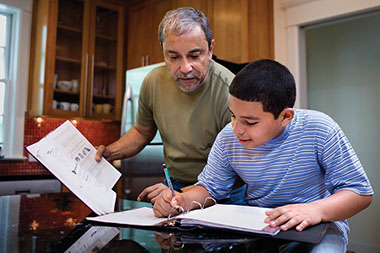
    Image of father helping son with homework.

    Do you dread those long nights of homework hassle-for parents and students? Homework does not have to be a time of great stress for families, according to Paula Kramer, chair and professor of occupational therapy at University of the Sciences. Dr. Kramer suggests the following ways to help avoid arguments over turning off the TV and hitting the books:

    *  Come to an understanding with your child that homework is a necessity-and must be done every day.

    *  Communicate (in person and by email) with the teachers and find out how much time the student is expected to devote to homework each night. Setting expectations and time limits will make the child more productive.

    *  Allow for active playtime before homework. If the child does not have an after-school activity such as a sport or dance class, provide 45 minutes to an hour for the child to engage in active behavior prior to homework. The physical activity will help the child burn off energy, settle the nervous system, and refocus mentally for homework.

    *  Create a designated area for homework and studying-desk in a bedroom or the kitchen table. Just keep the homework spot the same, quiet, and free from distractions.

    *  Create charts to track homework progress. The chart will not only set a schedule that visibly shows that homework needs to be done every night, but will also allow the child to track progress. Rewards can be given for homework completed successfully a few nights in a row.

    *  Use positive praise to encourage good homework and study habits.

    *  Be a role model for the child. School cannot teach everything. Responsibility for successful behavior also lies at home. Parents need to take an active role in their child’s education and should check in on the child during homework to make sure it is completed properly.

    © American Institute for Preventive Medicine