Tag: Substance Use & Abuse

  • Friends Help Friends Through Addiction

    Substance Use & Abuse

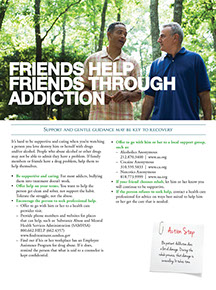
    Image of 2 friends walking and talking.

    Support and gentle guidance may be key to recovery.

    It’s hard to be supportive and caring when you’re watching a person you love destroy him or herself with drugs  and/or alcohol. People who abuse alcohol or other drugs may not be able to admit they have a problem. If family members or friends have a drug problem, help them to help themselves.

    Be supportive and caring.

    For most addicts, bullying them into treatment doesn’t work.

    Offer help on your terms.

    You want to help the person get clean and sober, not support the habit. Tolerate the struggle, not the abuse.

    Encourage the person to seek professional help.

    *  Offer to go with him or her to a health care provider visit.

    *  Provide phone numbers and websites for places that can help, such as: Substance Abuse and Mental Health Services Administration (SAMHSA) – 800.662.HELP (662.4357)www.findtreatment.samhsa.gov

    *  Find out if his or her workplace has an Employee Assistance Program for drug abuse. If it does, remind the person that what is said to a counselor is kept confidential.

    If your friend chooses rehab, let him or her know you will continue to be supportive. If the person refuses to seek help, contact a health care professional for advice on ways best suited to help him or her get the care that is needed.

    Offer to go with him or her to a local support group.

    Alcoholics Anonymous

    212.870.3400

    www.aa.org

    Cocaine Anonymous

    310.559.5833

    www.ca.org

    Narcotics Anonymous

    818.773.9999

    www.na.org

    Action Step

    Be patient. Addiction does a lot of damage. During the rehab process, that damage is unraveling. It takes time.
    Page from Ways to Well-Being book by the American Institute for Preventive Medicine. www.HealthyLife.com. All rights reserved.

    © American Institute for Preventive Medicine

  • Where To Get Help For A Drinking Problem

    Substance Use & Abuse

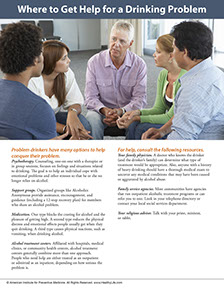
    Image of man seeking help.

    Problem drinkers have many options to help conquer their problem.

    *  Psychotherapy. Counseling, one-on-one with a therapist or in group sessions, focuses on feelings and situations related to drinking. The goal is to help an individual cope with emotional problems and other stresses so that he or she no longer relies on alcohol.

    *  Support groups. Organized groups like Alcoholics Anonymous provide assistance, encouragement, and guidance (including a 12-step recovery plan) for members who share an alcohol problem.

    *  Medication. One type blocks the craving for alcohol and the pleasure of getting high. A second type reduces the physical distress and emotional effects people usually get when they quit drinking. A third type causes physical reactions, such as vomiting, when drinking alcohol.

    *  Alcohol treatment centers. Affiliated with hospitals, medical clinics, or community health centers, alcohol treatment centers generally combine more than one approach. People who need help are either treated as an outpatient or admitted as an inpatient, depending on how serious the problem is.

    For help, consult the following resources.

    *  Your family physician. A doctor who knows the drinker (and the drinker’s family) can determine what type of treatment would be appropriate. Also, anyone with a history of heavy drinking should have a thorough medical exam to uncover any medical conditions that may have been caused or aggravated by alcohol abuse.

    *  Family service agencies. Most communities have agencies that run outpatient alcoholic treatment programs or can refer you to one. Look in your telephone directory or contact your local social services department.

    *  Your religious adviser. Talk with your priest, minister, or rabbi.

    Page from A Year of Health Hints book by the American Institute for Preventive Medicine. www.HealthyLife.com. All rights reserved.

    © American Institute for Preventive Medicine
  • Get Help For Addictive Behaviors

    Substance Use & Abuse

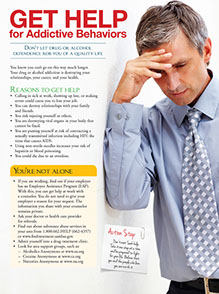
    Image of counseling group.

    Don’t let drug or alcohol dependence rob you of a quality life.

    You know you can’t go on this way much longer. Your drug or alcohol addiction is destroying your relationships, your career, and your health.

    Reasons to get help:

    *  Calling in sick at work, showing up late, or making errors could cause you to lose your job.

    *  You can destroy relationships with your family and friends.

    *  You risk injuring yourself or others.

    *  You are destroying vital organs in your body that cannot be fixed.

    *  You are putting yourself at risk of contracting a sexually transmitted infection including HIV, the virus that causes AIDS.

    *  Using non-sterile needles increases your risk of hepatitis or blood poisoning.

    *  You could die due to an overdose.

    You’re not alone

    *  If you are working, find out if your employer has an Employee Assistance Program (EAP). With this, you can get help at work with a counselor. You do not need to give your employer a reason for your request. The information you share with your counselor remains private.

    *  Ask your doctor or health care provider  for referrals.

    *  Find out about substance abuse services in your area from 1.800.662.HELP (662-4357) orwww.findtreatment.samhsa.gov.

    *  Admit yourself into a drug treatment clinic.

    *  Look for area support groups, such as:

    – Alcoholics Anonymous atwww.aa.org

    – Cocaine Anonymous atwww.ca.org

    – Narcotics Anonymous atwww.na.org

    Action Step

    Don’t wait. Seek help. Take it one step at a time and be prepared to fight for your life. Believe that you and the people who love you are worth it.

    Page from Ways to Well-Being book by the American Institute for Preventive Medicine. www.HealthyLife.com. All rights reserved.

    © American Institute for Preventive Medicine

  • If You Suspect A Narcotics Overdose, Act Fast

    Substance Use & Abuse

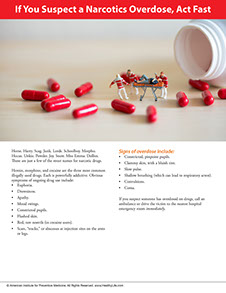
    Horse. Harry. Scag. Junk. Lords. Schoolboy. Morpho. Hocus. Unkie. Powder. Joy. Snow. Miss Emma. Dollies. These are just a few of the street names for narcotic drugs. Heroin, morphine, and cocaine are the three most common illegally used drugs. Each is powerfully addictive. Obvious symptoms of ongoing drug use include:

    *  Euphoria.

    *  Drowsiness.

    *  Apathy.

    *  Mood swings.

    *  Constricted pupils.

    *  Flushed skin.

    *  Red, raw nostrils (in cocaine users).

    *  Scars, “tracks,” or abscesses at injection sites on the arms or legs.

    Signs of overdose include:

    *  Constricted, pinpoint pupils.

    *  Clammy skin, with a bluish tint.

    *  Slow pulse.

    *  Shallow breathing (which can lead to respiratory arrest).

    *  Convulsions.

    *  Coma.

    If you suspect someone has overdosed on drugs, call an ambulance or drive the victim to the nearest hospital emergency room immediately.

    Page from A Year of Health Hints book by the American Institute for Preventive Medicine. www.HealthyLife.com. All rights reserved.

    © American Institute for Preventive Medicine
  • Smart Tips For Business Drinking

    Substance Use & Abuse

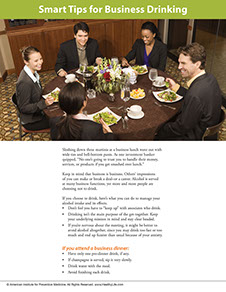
    Image of co-workers cheering with glasses of wine.

    Sloshing down three martinis at a business lunch went out with wide ties and bell-bottom pants. As one investment banker quipped, “No one’s going to trust you to handle their money, services, or products if you get smashed over lunch.”

    Keep in mind that business is business. Others’ impressions of you can make or break a deal-or a career. Alcohol is served at many business functions, yet more and more people are choosing not to drink.

    If you choose to drink, here’s what you can do to manage your alcohol intake and its effects.

    *  Don’t feel you have to “keep up” with associates who drink.

    *  Drinking isn’t the main purpose of the get-together. Keep your underlying mission in mind and stay clear headed.

    *  If you’re nervous about the meeting, it might be better to avoid alcohol altogether, since you may drink too fast or too much and end up fuzzier than usual because of your anxiety.

    If you attend a business dinner:

    *  Have only one pre-dinner drink, if any.

    *  If champagne is served, sip it very slowly.

    *  Drink water with the meal.

    *  Avoid finishing each drink.

    Page from A Year of Health Hints book by the American Institute for Preventive Medicine. www.HealthyLife.com. All rights reserved.

    © American Institute for Preventive Medicine
  • Teach Your Kids Not To Drink

    Substance Use & Abuse

    Underage drinking is a growing problem. All too often, teenage drinking leads to:

    *  Traffic accidents (many of them fatal).

    *  Destruction of property.

    *  Violent or antisocial behavior.

    *  Poor academic performance.

    *  Disciplinary problems.

    *  Withdrawal from social activities.

    *  Problems coping with stress.

    If you suspect (or know) your teenager drinks, don’t ignore it. To discourage or prevent underage drinking:

    *  Be a good role model. The best example you can set is to not drink. But if you choose to drink, drink responsibly. Children of alcoholics are four times as likely to develop a drinking problem as children of nonalcoholic parents.

    *  Show your children that you love them. Be affectionate, and show them you care and are interested in them.

    *  Make an effort to organize family activities. It may be hard to compete with your son’s or daughter’s peers for their attention at times, but make the effort anyway. Shared hobbies and sports can create bonds and strengthen a teen’s resistance to outside influences.

    *  Discuss the potential risks and consequences of alcohol use before it becomes a problem. Answer questions honestly and let your children know how you feel about them drinking before the situation arises.

    *  Tell your children to never get into a car with a drunk driver. Promise you’ll pick them up anytime, anywhere, no questions asked, if they call you instead of putting themselves at risk.

    Page from A Year of Health Hints book by the American Institute for Preventive Medicine. www.HealthyLife.com. All rights reserved.

    © American Institute for Preventive Medicine

  • Use Caution With Sleeping Pills

    Medication

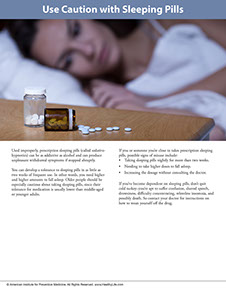
    Image of women trying to sleep with pills on her nightstand.

    Used improperly, prescription sleeping pills (called sedative-hypnotics) can be as addictive as alcohol and can produce unpleasant withdrawal symptoms if stopped abruptly.

    You can develop a tolerance to sleeping pills in as little as two weeks of frequent use. In other words, you need higher and higher amounts to fall asleep. Older people should be especially cautious about taking sleeping pills, since their tolerance for medication is usually lower than middle-aged or younger adults.

    If you or someone you’re close to takes prescription sleeping pills, possible signs of misuse include:

    *  Taking sleeping pills nightly for more than two weeks.

    *  Needing to take higher doses to fall asleep.

    *  Increasing the dosage without consulting the doctor.

    If you’ve become dependent on sleeping pills, don’t quit cold turkey-you’re apt to suffer confusion, slurred speech, drowsiness, difficulty concentrating, relentless insomnia, and possibly death. So contact your doctor for instructions on how to wean yourself off the drug.

    Page from A Year of Health Hints book by the American Institute for Preventive Medicine. www.HealthyLife.com. All rights reserved.

    © American Institute for Preventive Medicine
  • Importance Of A Drug-Free Workplace

    WORK LIFE

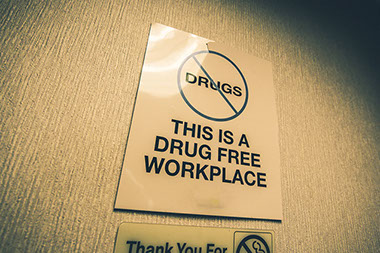
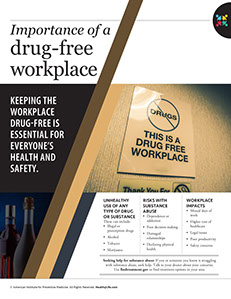
    Sign that says "This is a drug free workplace."

    Keeping the workplace drug-free is essential for everyone’s health and safety.

    Unhealthy use of any type of drug or substance

    These can include:

    *  Illegal or prescription drugs

    *  Alcohol

    *  Tobacco

    *  Marijuana

    Risks with substance abuse

    *  Dependence or addiction

    *  Poor decision making

    *  Damaged relationships

    *  Declining physical health

    Workplace impacts

    *  Missed days of work

    *  Higher cost of healthcare

    *  Legal issues

    *  Poor productivity

    *  Safety concerns

    Seeking help for substance abuse: If you or someone you know is struggling with substance abuse, seek help. Talk to your doctor about your concerns. Usefindtreatment.govto find treatment options in your area.

    © American Institute for Preventive Medicine
  • What To Know About Rainbow Fentanyl

    WELL-BEING

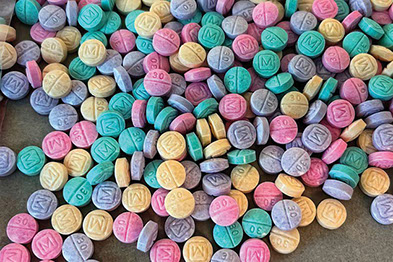
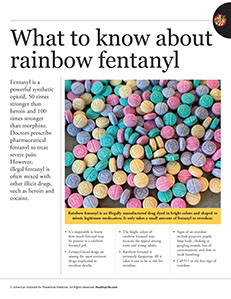
    Image of rainbow fentanyl.

    Fentanyl is a powerful synthetic opioid, 50 times stronger than heroin and 100 times stronger than morphine. Doctors prescribe pharmaceutical fentanyl to treat severe pain. However, illegal fentanyl is often mixed with other illicit drugs, such as heroin and cocaine.

    Rainbow fentanyl is an illegally manufactured drug dyed in bright colors and shaped to mimic legitimate medication. It only takes a small amount of fentanyl to overdose.

    *  It’s impossible to know how much fentanyl may be present in a rainbow fentanyl pill.

    *  Fentanyl-laced drugs are among the most common drugs implicated in overdose deaths.

    *  The bright colors of rainbow fentanyl may increase the appeal among teens and young adults.

    *  Rainbow fentanyl is extremely dangerous. All it takes is one to be at risk for overdose.

    *  Signs of an overdose include pinpoint pupils, limp body, choking or gurgling sounds, loss of consciousness, and slow or weak breathing.

    *  Call 911 at the first sign of overdose.

    © American Institute for Preventive Medicine

  • 5 Reasons To Limit Alcohol

    Substance Use & Abuse

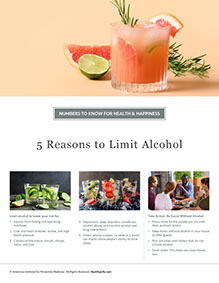
    Cocktail drink with slices of grapefruit and lime.

    Limit alcohol to lower your risk for:

    1.  Injuries from falling and operating machines

    2.  Liver and heart diseases, stroke, and high blood pressure

    3.  Cancers of the breast, mouth, throat, colon, and liver

    4.  Depression, sleep disorders, unsafe sex, alcohol abuse, and harmful alcohol and drug interactions

    5.  Motor vehicle crashes. As little as 2 drinks can impair some people’s ability to drive safely.

    Take Action: Be Social Without Alcohol

    *  Focus more on the people you are with than alcoholic drinks.

    *  Keep drinks without alcohol in your house to offer guests.

    *  Plan activities with others that do not include alcohol.

    *  Drink water. This helps you save money, too.

    Page from HealthyLife Weigh book by the American Institute for Preventive Medicine. www.HealthyLife.com. All rights reserved.

    © American Institute for Preventive Medicine