Tag: sugar

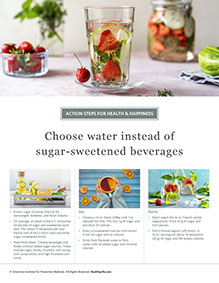
  • Choose Water Instead Of Sugar-Sweetened Beverages

    Nutrition

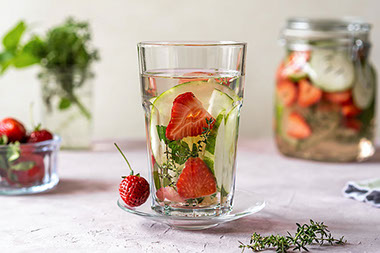
    Glass of water flavored with strawberries and cucumbers.

    *  Excess sugar increases the risk for overweight, diabetes, and heart disease.

    *  On average, an adult in the U.S. consumes 60 pounds of sugar and sweeteners each year. This about 17 teaspoons per day! Nearly half of this is from soda and other sugar-sweetened drinks.

    *  Read food labels. Choose beverages and foods without added sugar sources. These include sugar, honey, fructose, corn syrup, corn syrup solids, and high-fructose-corn syrup.

    Dos

    *  Choose a 16 oz. black coffee with 1 oz. reduced fat milk. This has 2 g of sugar and less than 25 calories.

    *  Enjoy unsweetened iced tea with lemon. It has no sugar and no calories.

    *  Drink fruit-flavored water or fizzy water with no added sugar and minimal calories.

    Don’ts

    *  Don’t select the 16 oz. French vanilla cappuccino. It has 42 g of sugar and 320 calories.

    *  Don’t choose regular soft drinks. A 12-oz. serving has about 10 teaspoons (38 g) of sugar and 150 empty calories.

    Page from HealthyLife Weigh book by the American Institute for Preventive Medicine. www.HealthyLife.com. All rights reserved.

    © American Institute for Preventive Medicine

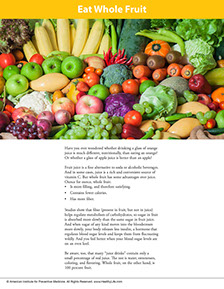
  • Eat Whole Fruit

    Nutrition

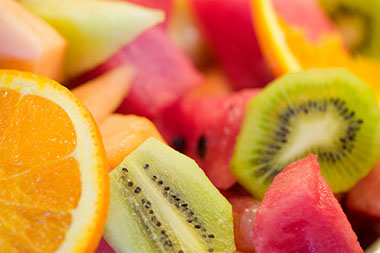
    Image of fresh fruit.

    Have you ever wondered whether drinking a glass of orange juice is much different, nutritionally, than eating an orange? Or whether a glass of apple juice is better than an apple?

    Fruit juice is a fine alternative to soda or alcoholic beverages. And in some cases, juice is a rich and convenient source of vitamin C. But whole fruit has some advantages over juice. Ounce for ounce, whole fruit:

    *  Is more filling, and therefore satisfying.

    *  Contains fewer calories.

    *  Has more fiber.

    Studies show that fiber (present in fruit, but not in juice) helps regulate metabolism of carbohydrates, so sugar in fruit is absorbed more slowly than the same sugar in fruit juice. And when sugar of any kind moves into the bloodstream more slowly, your body releases less insulin, a hormone that regulates blood sugar levels and keeps them from fluctuating wildly. And you feel better when your blood sugar levels are on an even keel.

    Be aware, too, that many “juice drinks” contain only a small percentage of real juice. The rest is water, sweeteners, coloring, and flavoring. Whole fruit, on the other hand, is 100 percent fruit.

    Page from A Year of Health Hints book by the American Institute for Preventive Medicine. www.HealthyLife.com. All rights reserved.

    © American Institute for Preventive Medicine

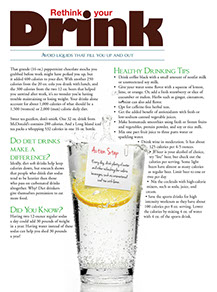
  • Rethink Your Drink

    Weight Control

    Avoid liquids that fill you up and out.

    That grande (16 oz.) peppermint chocolate mocha you grabbed before work might have perked you up, but it added 400 calories to your diet. With another 250 calories from the 20 oz. cola you drank with lunch, and the 300 calories from the two 12 oz. beers that helped you unwind after work, it’s no wonder you’re having trouble maintaining or losing weight. Your drinks alone account for about 1,000 calories of what should be a 1,500 (women) or 2,000 (men) calorie daily diet.

    Sweet tea guzzlers, don’t smirk. One 32 oz. drink from McDonald’s contains 280 calories. And a Long Island iced tea packs a whopping 532 calories in one 16 oz. bottle.

    Did You Know?

    Having two 12-ounce regular sodas a day could add 30 pounds of weight in a year. Having water instead of these sodas can help you shed 30 pounds a year!

    Healthy Drinking Tips

    *  Drink coffee black with a small amount of nonfat milk or unsweetened soy milk.

    *  Give your water some flavor with a squeeze of lemon, lime, or orange. Or, add a fresh strawberry or slice of cucumber or melon. Herbs such as ginger, cinnamon, or mint can also add flavor.

    *  Opt for caffeine-free herbal teas.

    *  Get the added benefit of antioxidants with fresh or low-sodium canned vegetable juices.

    *  Make homemade smoothies using fresh or frozen fruits and vegetables, protein powder, and soy or rice milk.

    *  Mix one part fruit juice to three parts water or sparkling water.

    *  Drink wine in moderation. It has about 125 calories per 4-5 ounces.

    *  If beer is your alcohol of choice, try “lite” beer, but check out the calories per serving. Some light beers have almost as many calories as regular beer. Limit beer to one or two per day.

    *  Nix the cocktails with high-calorie mixers, such as soda, juice, and cream.

    *  Save the sports drinks for high intensity workouts as they have about 100 calories per 8 oz. serving. Lower the calories by mixing 4 oz. of water with 4 oz. of the sports drink.

    Do diet drinks make a difference?

    Ideally, diet soft drinks help keep calories down, but research shows that people who drink diet sodas tend to be heavier than those who pass on carbonated drinks altogether. Why? Diet drinkers give themselves permission to eat more food.

    Action Step

    Every day, drink plenty of water and other refreshing low-calorie beverages, such as unsweetened iced tea with lemon.

    Page from Ways to Well-Being book by the American Institute for Preventive Medicine. www.HealthyLife.com. All rights reserved.

    © American Institute for Preventive Medicine

  • Diabetes Prevention

    Diabetes Education

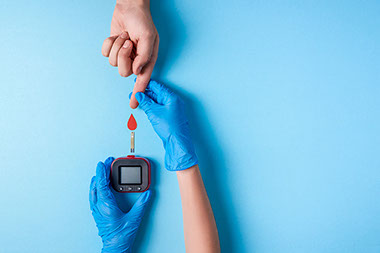
    Gloved hands, helping another hand check blood sugar level.

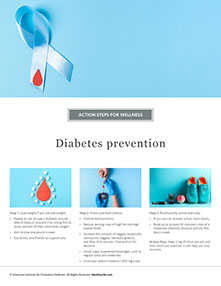
    Step 1: Lose weight if you are overweight.

    *  People at risk of type 2 diabetes may be able to delay or prevent it by losing five to seven percent of their total body weight.

    *  Aim to lose one pound a week.

    *  Ask family and friends to support you.

    Step 2: Make wise food choices.

    *  Control food portions.

    *  Reduce serving sizes of high fat and high calorie foods.

    *  Increase the amount of veggies (especially nonstarchy veggies, like leafy greens), and fiber that you eat. Choose fruit for desserts.

    *  Avoid sugar sweetened beverages, such as regular soda and sweet tea.

    *  Limit your sodium intake to 1,500 mg a day.

    Step 3: Be physically active every day.

    *  If you are not already active, start slowly.

    *  Build up to at least 30 minutes a day of a moderate-intensity physical activity five days a week.

    Action Step:Keep a log of what you eat and how much you exercise. It will help you stay on track.

    Health at Home Lifetime book by the American Institute for Preventive Medicine. www.HealthyLife.com. All rights reserved.

    © American Institute for Preventive Medicine

  • Sticky Snacks Spell Trouble

    Dental & Mouth Concerns

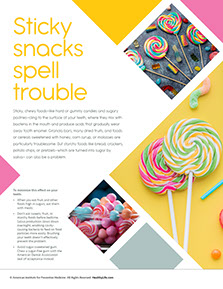
    Image of chewy candy.

    Sticky, chewy foods-like cough drops, hard candies, and sugary pastries-cling to the surface of your teeth, where they mix with bacteria in the mouth and produce acids that gradually wear away tooth enamel. Granola bars, many dried fruits, and foods or cereals sweetened with honey, corn syrup, or molasses are particularly troublesome. But starchy foods like bread, crackers, potato chips, or pretzels-which are turned into sugar by saliva-can also be a problem. To minimize this difficulty:

    *  If you eat fruit and other foods high in sugars, eat them with meals.  Finish a meal with foods that help buffer acid formation.

    *  Don’t eat sweets, fruit, or starchy foods before bedtime. Saliva production slows down overnight, enabling cavity-causing bacteria to feed on food particles more easily. Brushing your teeth doesn’t effectively prevent the problem.

    *  Avoid sugar-sweetened gum and beverages. Chew a sugar-free gum instead, especially one with the artificial sweetener xylitol.

    A Year of Health Hints book by the American Institute for Preventive Medicine. www.HealthyLife.com. All rights reserved.

    © American Institute for Preventive Medicine

  • Sweet Sips, A Healthier Way!

    Healthylife® Weigh

    Part 3

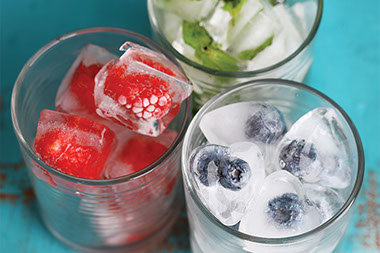
    Glasses of water with ice cubes that have berries frozen in them.

    Sugar-sweetened beverages can be a major source of added sugar. Cut back or eliminate these beverages from your everyday lifestyle. Save pop or soda for a once-in-a-while treat. As you reduce sugar in your diet, especially artificial sweeteners, you may find these drinks are too sweet for your new tastes!

    Make your own flavored water

    You can consume flavored beverages without added sugars AND get a few extra nutrients along the way! You will need:

    *  1-quart jars or a large pitcher

    *  Water

    *  Wooden spoon (or another long, sturdy spoon)

    Fruit and/or Fresh Herbs:

    You can start with just one cut-up fruit, but for a flavored water that will really pop, try combining at least two fruits or a fruit and an herb. Here are a few suggestions, but don’t be afraid to try your own combinations! For a single-serving, use less. For a whole pitcher, use more!

    Pineapple, Orange, & Ginger

    *  ½ cup cubed pineapple

    *  ½ an orange, sliced

    *  1 Tbsp. freshly-grated ginger

    Minty Cucumber Lime

    *  ½ a cucumber, sliced

    *  ½ a lime, sliced

    *  ¼ cup fresh mint leaves

    Orange and Blueberry

    *  1 Mandarin orange, broken into wedges

    *  Small handful of blueberries

    Strawberry, Lemon, & Basil

    *  ½ cup sliced strawberries

    *  ½ a lemon, sliced

    *  ¼ cup fresh basil leaves

    Watermelon Mint

    *  1 cup cubed watermelon

    *  ¼ cup fresh mint leaves

    Rosemary & Grapefruit

    *  ½ grapefruit (or ¼ grapefruit & ¼ orange)

    *  A few sprigs of rosemary

    Citrus with Cilantro or Mint

    *  2 large oranges, sliced

    *  1 lemon, sliced

    *  ½ large cucumber, sliced

    *  1 handful of fresh mint or cilantro

    Time to Build!

    1. Place the fruit, herbs, and any other ingredients in the bottom of a glass jar or pitcher. Or, using a wooden spoon, mash the ingredients to bring out the flavor. You can also scrunch the herbs in your hands before adding them to the jar. This helps bring out the flavor.

    2. Fill the jars with water and ice as desired. You can also add unsweetened carbonated/seltzer water if you are craving fizzy bubbles!

    3. The flavor will be more enhanced after the water sits for an hour. Or, refrigerate the water overnight. If you want to drink it right away, squeeze the fruit a little before you drop it in to help bring out the flavors faster.

    Other Sweet Beverage Ideas:

    Freeze ice cubes with fruit. Drop a few cubes of different colored fruits into a tall glass of cold water.

    Blend whole fruits in a smoothie with spinach, kale or other de-stemmed, leafy green vegetables.

    Diet or regular soda? Limit both.

    Most diet sodas contain artificial sweeteners. Studies have shown drinking diet soda is not any better at helping you manage your weight. Gradually cut back on soda.

    Even if you add a teaspoon of sugar to your coffee, this 4g of sugar is far less than the sugar found in the average soda. The average soda contains 39g of sugar in a 12-ounce can. In a 16-ounce bottle, a soda may contain 52g of sugar.
    © American Institute for Preventive Medicine

  • Easy Ways To Cut Back On Sugar

    HEALTHY EATING

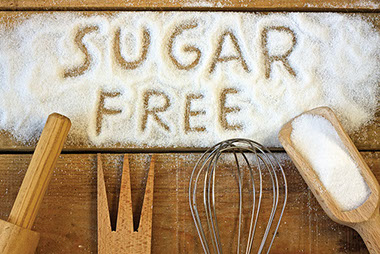
    Image of sugar spilled out on a table with the words "Sugar Free" spelled out.

    Lowering your sugar intake doesn’t have to be a struggle. Here are some tips:

    *  Keep your favorite fresh fruits ready-to-eat in the fridge or at work. Reach for these when you have a sugar craving.

    *  Get candy and sweet treats out of the house. Avoid vending machines at work. Out of sight, out of mind.

    *  Be selective about treats. Allow yourself a slice of grandma’s pumpkin pie if you really want it. Just make it a small piece and an occasional treat, not an  everyday habit.

    *  Drink water with lemon instead of soda, sports drinks, or juice. Or, make your own fruit water by putting your favorite fresh or frozen fruits in a large bottle, and fill the rest with ice water.

    *  Make a gradual change. Don’t try to cut out all sugar at once. Instead, try cutting a little here, and a little there, to get used to less of it.

    *  Decrease the sugar in recipes. When cooking or baking, try using about half the sugar you normally would. You may not notice a difference in taste.

    © American Institute for Preventive Medicine

  • Halloween Candy Control

    HEALTHY EATING

    Image of halloween treats.

    Despite all your work to help your kids eat healthy, holidays like Halloween can quickly throw your efforts off track. Candy in the stores and at school, and, of course, while trick-or-treating means your kids have plenty of access to junk food. It might be downright scary.

    While a little candy isn’t harmful, it can be easy to overdo it when junk food seems to be everywhere. And the health problems associated with sugary snacks and unhealthy foods are real:

    *  The Centers for Disease Control and Prevention says 1 in 5 school-aged children has obesity. While candy alone isn’t to blame, experts know that eating too many foods high in calories and low in nutrition (such as candy and sugary treats) are part of the problem.

    *  Sugary treats can cause cavities. The American Dental Association says some of the worst offenders are sticky treats that cling to teeth and those that sit in the mouth for a long time like hard candies and suckers. But, any high-sugar snack can spell trouble for someone’s dental health.

    The good news is, even health-conscious families can enjoy the fun of Halloween (and a few treats) if they have a plan in place before the spooky day arrives:

    *Don’t leave candy out where it can be grabbed any time.Kids (and adults) tend to reach for whatever is available, and may mindlessly eat whatever is sitting out. Put candy and other goodies in a hard-to-reach cupboard instead. This requires more effort to get to it, so it is “out of sight, out of mind.”

    *Teach kids moderation.If you make candy and sweets off-limits, kids may want the forbidden food even more. Instead, allow them a small treat after they’ve eaten a healthy dinner.

    *Lead by example.If you have a hard time avoiding sweet treats, now is a great time to make healthy eating a family effort. Reserve your candy and other treats for after dinner. Make it a small amount, such as one fun-sized candy bar.

    *Buy what you don’t like.If you like to grab a piece here and there while the trick-or-treaters visit your house, buy candy you won’t be tempted to eat.

    *Donate your candy!Teach kids to do good by giving their candy to soldiers and charitable causes, such as for kids who are in the hospital. A variety of organizations accept candy, but check first. Try your local food bank, Operation Gratitude, the Halloween Candy Buy Back and Ronald McDonald House.

    © American Institute for Preventive Medicine

  • How Sweet It Is

    HEALTHY EATING

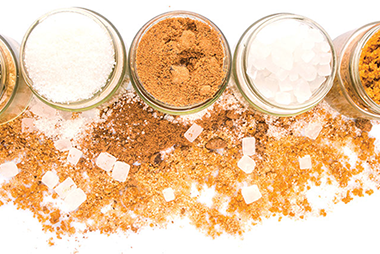
    Image of different types of sweeteners.

    Is sugar really bad for us? How about artificial or low-calorie sweeteners?

    Our bodies need one type of sugar, called glucose, to survive. “Glucose is the number one food for the brain, and it’s an extremely important source of fuel throughout the body,” said Dr. Kristina Rother, pediatrician with the National Institute on Health and expert on sweeteners.

    But there’s no need to add glucose to your diet, because your body can make the glucose it needs by breaking down food molecules like carbohydrates, proteins, and fats. Some sugars are found naturally in foods such as fruits, vegetables, and milk.

    Much of the sugar we eat isn’t found naturally in food but is added during processing or preparation.

    Although sugar itself isn’t bad, said Dr. Rother, “Sugar has a bad reputation that’s mostly deserved because we consume too much of it. It’s now in just about every food we eat.”

    You can cut down on added sugars. NIH in Health offers these suggestions:

    *  Choose water, fat-free milk, or unsweetened tea or coffee instead of sodas, sports drinks, energy drinks, and fruit drinks.

    *  Reduce sugar in recipes. If a recipe says 1 cup, use 2/3 cup.

    *  To enhance flavor, add vanilla, cinnamon, or nutmeg.

    *  Eat fresh, canned, frozen, and dried fruits without added sugar. Choose fruits canned in their own juice rather than in syrup.

    *  Use fruits to top foods like cereal and pancakes rather than sugars, syrups, or other sweet toppings.

    *  Read the ingredients list to pick food with little or no added sugar.

    © American Institute for Preventive Medicine

  • Sugar: Not So Sweet For Your Health

    HEALTHY EATING

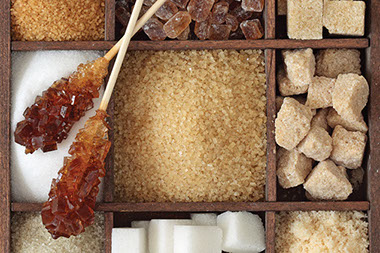
    Image of different types of sugars.

    Cookies, cake, and candy – we all know which foods are high in sugar. Or do we?

    The average American is consuming too much sugar today, and the American Heart Association says this is hurting us. Sugar is loaded with calories, which can cause weight gain and heart problems. A high-sugar diet can also be a factor in diabetes. Sugar can cause cavities and other dental problems.

    You might be surprised to find that many regular or even “healthy” foods have a lot of sugar in them. That’s why the FDA is proposing a change to the food Nutrition Facts label that would list “added sugar.”

    What is added sugar?

    Some healthy foods contain a certain amount of natural sugar. These include fruits, vegetables, dairy, and whole grains. The sugar (simple carbohydrate) naturally occurs in the food.

    On the other hand, many packaged and processed foods contain “added sugar.” This sugar has been added to improve the taste. Many things you wouldn’t suspect, like “diet” foods, soup, yogurt, crackers, and salad dressings can contain a lot of added sugar.

    How do I spot added sugar?

    Sugar can be listed by many different names in the ingredients. So, it’s hard to know how much added sugar you’re getting. Until the nutrition label change takes place, the best thing to do is look at the sugar listing on the Nutrition Facts. Keep track of how many grams are in each serving of food and add them up each day. The AHA recommends:

    *  No more than six teaspoons (25 grams) for women per day

    *  No more than nine teaspoons (37.5 grams) for men per day

    If you eat processed or packaged foods or drinks, look at the Nutrition Facts and see how much sugar each one contains. You may be surprised at how many grams of sugar you consume, even if you’ve been watching your diet. And drinks count too – fruit juice, sports drinks, and sodas are usually loaded with sugar. In fact, a 12- ounce serving of soda contains about 38 grams (nine to 10 teaspoons) of sugar.

    Many food labels don’t list the word “sugar” in the ingredients. In fact, there are more than 50 different names for sugar! These include sucrose, dextrose, maltose, corn syrup, corn syrup solids, dextrin and maltodextrin.

    © American Institute for Preventive Medicine