Tag: support

  • Kick Cigarettes Out Of Your House

    SELF-CARE CORNER

    Image of the word "Quit" spelled within a pile of tobacco with a crused cigarette.

    You know that smoking can cause health problems, including heart disease and cancer. But if you smoke inside your home, you could be hurting everyone who lives with you. Anyone who is around cigarette smoke is exposed to secondhand smoke.

    *  Secondhand smoke contains more than 4,000 chemicals. Many of these have been proven to cause cancer and irritate the lungs.

    *  Secondhand smoke can trigger asthma attacks and they happen more often and with more severity in children.

    *  Children whose parents smoke have more ear infections, bronchitis and pneumonia.

    You and your family can be healthier if you don’t allow any smoking in your home. And don’t allow guests to smoke in your home or around your children. If your children regularly visit another home, such as a child care provider, make sure no one smokes in that home.

    If you need help quitting, call 1-800-QUIT-NOW or visitsmokefree.govfor free resources.

    Source: Asthma and Allergy Foundation of America

    © American Institute for Preventive Medicine

  • Advocate Against Domestic Violence

    FAMILY LIFE

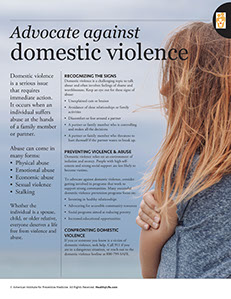
    Back of women, wind blowing her hair as she hugs herself.

    Domestic violence is a serious issue that requires immediate action. It occurs when an individual suffers abuse at the hands of a family member or partner.

    Abuse can come in many forms:

    *  Physical abuse

    *  Emotional abuse

    *  Economic abuse

    *  Sexual violence

    *  Stalking

    Whether the individual is a spouse, child, or older relative, everyone deserves a life free from violence and abuse.

    Recognizing the signs

    Domestic violence is a challenging topic to talk about and often involves feelings of shame and worthlessness. Keep an eye out for these signs of abuse:

    *  Unexplained cuts or bruises

    *  Avoidance of close relationships or family activities

    *  Discomfort or fear around a partner

    *  A partner or family member who is controlling and makes all the decisions

    *  A partner or family member who threatens to hurt themself if the partner wants to break up.

    Preventing violence & abuse

    Domestic violence relies on an environment of isolation and secrecy. People with high self-esteem and strong social support are less likely to become victims.

    To advocate against domestic violence, consider getting involved in programs that work to support strong communities. Many successful domestic violence prevention programs focus on:

    *  Investing in healthy relationships

    *  Advocating for accessible community resources

    *  Social programs aimed at reducing poverty

    *  Increased educational opportunities

    Confronting domestic violence

    If you or someone you know is a victim of domestic violence, seek help. Call 911 if you are in a dangerous situation, or reach out to the domestic violence hotline at 800-799-SAFE.

    © American Institute for Preventive Medicine

  • Cancer Awareness

    Cancer

    Smiling female going through cancer.

    Cancer is the 2nd leading cause of death in the U.S.

    Many cancers can be cured if detected and treated early. Along with avoiding tobacco products, a healthy weight, regular physical activity and eating a healthy diet greatly lowers cancer risk.

    Get screening tests for cancer (e.g., breast, colon, prostate, etc.) as advised by your doctor. Do cancer self-exams, too.

    Eat plenty of veggies, fruit, whole grains, beans, and lentils. Limit processed and sugary foods. Stay active and maintain a healthy weight.

    Avoid or limit alcohol.

    The most common type of cancer in the U.S. is skin cancer. To help prevent skin cancer, limit sun exposure and use a sunscreen with a sun protection factor (SPF) of 15 or higher.

    Learn about all types of cancer from the National Cancer Institute at 800.4.CANCER (422.6237) orcancer.gov.

    Health at Home Lifetime book by the American Institute for Preventive Medicine. www.HealthyLife.com. All rights reserved.

    © American Institute for Preventive Medicine

  • Breaking Bad Habits

    WELL-BEING

    Close-up image of a person breaking a cigarette in half.

    Bad habits may be hard to change, but it can be done. Smoking, for example, can be stopped. So can alcohol abuse.

    If you could only … but why don’t you? Scientists at the NIH study what happens in your brain as habits form. They come about through repetition. Brushing your teeth in the morning is a good habit. Reaching for a cigarette-bad habit.

    Habits trigger pleasure centers in your brain. First, focus on becoming more aware of your bad habits. Then try these strategies to counteract them:

    *  Avoid tempting situations. If you don’t buy candy bars, it won’t be as easy to eat one.

    *  Prepare mentally. Think about how you want to handle it and mentally practice what you plan.

    *  Enlist support. Ask friends, family, and coworkers to support your efforts to change.

    *  Replace unhealthy bad habits with healthy ones. Exercise or try a new hobby.

    *  Reward yourself for small steps.

    © American Institute for Preventive Medicine

  • Shin Splints Can Sidetrack Your Running Routine

    BE FIT

    Image of women holding her shin.

    If shin splints are keeping you from making the most of your runs this spring, you’re not alone. Shin splints-pain in the front of the lower legs-is common among those who exercise regularly. This ailment especially affects runners.

    According to Dr. Matthew Silvis, associate professor of family medicine and orthopedics at Penn State Hershey, shin splints are among the most common complaints in spring for people back on the road or trail after a long winter.

    The term shin splints generally refers to pain and soreness along the shinbone, or tibia, the largest bone of the lower leg. The pain comes from overuse of the muscles and tendons around the bone. Added or unusual stress on and around the shinbone causes it to become inflamed and sore.

    If you’re already dealing with shin splints, icing the area can help. So can taking an over-the-counter anti-inflammatory medicine if needed for pain. Wait to return to your activity until you’re pain-free for 2 weeks.

    The fix

    Give the body time to adjust when changing an exercise routine. Doing too much too soon can bring on shin splints. If untreated, a more serious injury-stress fracture-can result. Stress fractures-tiny cracks in the bone-usually come from overuse. To avoid this:

    *  Gradually increase the amount or intensity of a workout to avoid too much stress on the legs.

    *  Follow a regular, gentle stretching routine that includes the calves. Keeping the muscles around the shinbone flexible can help prevent  shin splints.

    *  Wear well-fitting, supportive athletic shoes. And replace them every 300 to 500 miles.

    *  Balance running workouts with other training that isn’t as stressful on the legs. Examples are cycling, cross-training, and swimming.

    © American Institute for Preventive Medicine

  • Balancing Work & Caregiving

    WORK LIFE

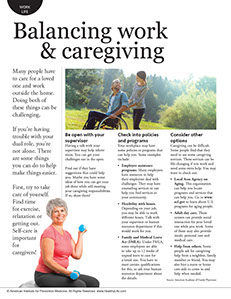
    Women pushing man in wheelchair through the lawn.

    Many people have to care for a loved one and work outside the home. Doing both of these things can be challenging. If you’re having trouble with your dual role, you’re not alone. There are some things you can do to help make things easier.

    First, try to take care of yourself. Find time for exercise, relaxation or getting out. Self-care is important for caregivers!

    Be open with your supervisor

    Having a talk with your supervisor may help relieve stress. You can get your challenges out in the open.

    Find out if they have suggestions that could help you. Maybe you have some ideas of how you can get your job done while still meeting your caregiving responsibilities. If so, share them!

    Check into policies and programs

    Your workplace may have some policies or programs that can help you. Some examples include:

    *Employee assistance programs.Many employers have resources to help their employees deal with challenges. They may have counseling services or can help you find services in your community.

    *Flexibility with hours.Depending on your job, you may be able to work different hours. Talk with your supervisor or human resources department if this would work for you.

    *Family and Medical Leave Act (FMLA).Under FMLA, some employees are able to take up to 12 weeks of unpaid leave to care for a loved one. You have to meet certain qualifications for this, so ask your human resources department about the details.

    Consider other options

    Caregiving can be difficult. Some people find that they need to use some caregiving services. These services can be life-changing if you work and need some extra help. You may want to check out:

    *Local Area Agency on Aging.This organization can help you locate programs and services that can help you. Go towww.acl.govto learn about U.S. programs for aging people.

    *Adult day care.These centers can provide social interaction for your loved one while you work. Some of them may also provide meals, personal care and medical care.

    *Help from others.Some people ask for caregiving help from a neighbor, family member or friend. You may also hire a nurse or home care aide to come in and help when needed.

    Source: American Academy of Family Physicians

    © American Institute for Preventive Medicine

  • Choosing Your Health Care Provider

    Pregnancy & Prenatal Care

    Read the options below. Discuss them with your health insurance carrier. Do this before you get pregnant. Who you choose will partly depend on:

    *  Your health insurance coverage.

    *  You may need to choose from a certain list. Find out who is on it. Ask if there is a waiting period for maternity coverage.

    *  The health care providers in your area

    Your personal wishes are important, too. For example, do you prefer a female or a male provider? Do you want a provider who works alone? Or do you want one in a group practice?

    Where You Can Give Birth

    Where do you want to have your baby? These are places to think about:

    *  Hospitals. There may also be choices within hospitals. These could be:

    – Regular delivery room. Your family may be able to be with you here.

    – Birthing center or birthing room. Your family can be with you here.

    – Special high-risk pregnancy section. Sometimes mothers and newborns need high-risk care. Some hospitals offer high-risk care. Find out what services local hospitals can offer.

    *  Birthing centers not inside hospitals. These are sometimes called alternative birthing centers. They are for low-risk pregnancies. Find out what hospital is used when special needs arise.

    {Note: Your special needs during pregnancy may determine where you can have your baby. Do not plan a home birth. It is not safe for you and your baby.}

    Types of Providers

    *  OB/GYN (obstetrician/gynecologist). This doctor gives prenatal and delivery care. That care ends 6 weeks after delivery. The OB/GYN treats women when they’re not pregnant, too. You may already have an OB/GYN. If you do, you could choose this provider for your pregnancy. Most women choose an OB/GYN. If you belong to an HMO, you may need a referral for an OB/GYN. A referral is when your primary care provider says you need a special doctor. You don’t need a referral if the OB/GYN is your primary care provider. You also don’t need a referral if your HMO lets you pick an OB/GYN plus a primary care provider.

    *  Family practice doctor. A family practice doctor can act as an OB/GYN, an internist, and a pediatrician. That means the provider can give you prenatal care and deliver your baby. You and your child can both go on seeing this same provider afterward. But if you need a cesarean section (c-section), you will need an OB/GYN.

    *  Maternal and fetal medicine specialist. This provider may be needed to help with high-risk pregnancies. Your primary care doctor or your OB/GYN would give you a referral if he or she can’t provide the care needed for your high-risk problems.

    *  Infertility specialist. This provider helps persons who want to get pregnant, but haven’t been able to after trying for a year. You may want to see this doctor if your regular OB/GYN cannot help you with your needs.

    *  Certified nurse-midwife. This provider cares for women with low-risk pregnancies. The nurse-midwife is trained to handle low-risk births. Be sure he or she works with a medical doctor. A lay midwife cannot provide total care. Find out if your insurance will pay for a nurse-midwife. Be sure the midwife is certified. Call the American Midwifery Certification Board (AMCB) at 866.366.9632 or go to its Web site:www.amcbmidwife.org.

    How to Find a Provider

    There are a lot of ways to find providers who might suit you:

    *  Look in the directory of providers from your health insurance carrier.

    *  Ask your regular doctor or specialist.

    *  Do you have any friends who had a baby recently? Are their ideas about having babies like yours? Ask them.

    *  Call information at the hospital you want. Ask for the name and phone number of the nurse in charge of the maternity section. Ask for the name and phone number of a resident in obstetrics who works at that hospital. A resident is a doctor who is in training. Ask for the “Physician Referral Service.” Call any or all of them and ask what doctor(s) they recommend.

    *  Call the medical school closest to you. Ask which obstetricians it recommends.

    *  Ask your county medical society.

    *  Look in the Directory of the American Medical Association. Ask for this at your doctor’s office or library.

    *  Look in the Directory of Medical Specialties for OB/GYNs. Your doctor’s office or library should have this, too.

    *  Look for a doctor who can take care of special needs you may have.

    *  Do you want a doctor with a high interest in prepared childbirth? Prepared childbirth is a special approach. The pregnant mother goes to classes. Her partner or other childbirth “coach” goes with her. They both learn ways of helping the birth happen, like special breathing. The doctor works with the mother in this approach to childbirth.

    How to Follow Up with a Provider

    Have you found some likely prospects? Now you can:

    *  Call the American Board of Medical Specialties at 866.275.2267 or go to its Web site:www.abms.org. Find out if the provider is properly trained and licensed.

    *  Ask yourself some questions.

    – Do you think you could work well with the provider?

    – Does the provider’s office seem to be managed well?

    *  Ask the provider some questions. You may be able to do this on the phone. (You may be charged an office visit for the phone call.) Or you may need to make a date to meet in person. Here are some questions to ask. You will think of others.

    – Does the provider accept your health insurance? What do services cost? How must payment be made? How much do you have to pay?

    – What hospital(s) does the provider use?

    – Is the hospital accredited? The Joint Commission on Accreditation of Healthcare Organizations (JCAHO) does this.

    – Does the hospital have a birthing center or birthing room?

    – Does it have a Level III neonatal intensive care unit (NICU)?

    – Can fathers and other persons be with you in the delivery room? In the operating room?

    – Will the provider be the one who delivers your baby?

    – Does the provider have partners who share the practice? If so, what would their roles be?

    – Would a resident deliver your baby? A resident is a doctor in training.

    – How would you reach your OB/GYN or health care provider? Would this differ at certain times of day or night? For emergencies?

    – Who would take care of you when your health care provider is away?

    – What is the provider’s Cesarean section (C-section) rate? If the rate is more than 35%, ask why.

    – For what reasons does the provider do a C-section?

    – Does the provider prefer a certain form of pain relief? If so, what and why?

    – At the place you will deliver, can you get anesthetics for an epidural any time of the day or night? An epidural is an anesthesia that can block most of the pain during labor and delivery.

    – What else can be given for pain?

    You can talk to two or more providers. Compare the answers you get. Then you can decide who will give you care and deliver your baby.

    Prenatal Self-Care book by the American Institute for Preventive Medicine. www.HealthyLife.com. All rights reserved.

    © American Institute for Preventive Medicine

  • Bullying: How To Take Action

    FAMILY LIFE

    Image of kids wispering and pointing towards a classmate whose head is down.

    Bullying can be hard to address, especially if it’s happening to your child. Knowing how to deal with bullying can help you support your child and stay calm about it. This is important because bullying can happen more than once.

    Dealing with bullying in the right way can help you (and your child) put a stop to it. If your child is being bullied, take the following steps:

    *  Talk to your child about what happened. Without interrupting or giving your opinion, let your child openly talk about what was said or done in the bullying situation. Be sure you understand the whole story. Support them as they talk by telling them you want to help, and by keeping your actions as calm as possible.

    *  Tell the child that bullying is not their fault. No one deserves to be bullied.

    *  When giving advice, use clear examples. Role playing can be very helpful in teaching a child what to do. Never tell them to fight back or use violence. This doesn’t help the situation and can get your child in trouble or hurt.

    *  Ask your child how you can help them feel safe again. Try not to single him or her out by making changes in their routine, such as switching classes or buses. Instead, try taking other steps, such as changing seating arrangements in school or on the bus.

    *  Talk with the school or organization. State your concerns and ask them how they feel it can be addressed. Remember that the school staff cannot “discipline” other kids. Even if you want to, avoid talking with the bullying child’s parents. School officials can talk with them and be a neutral moderator.

    *  Consider getting professional support for your child. Sometimes a school counselor or mental health expert can help a child who has been bullied.

    Bullying should never be ignored. Kids who are bullied may be at higher risk for health problems like:

    *  Depression

    *  Anxiety

    *  Sleep problems

    *  Loss of interest in activities

    Their grades may also suffer. Kids who are bullied are more likely to miss school or drop out.

    Source: Stopbullying.gov

    © American Institute for Preventive Medicine

  • Single Parents: Strategies For Success

    FAMILY LIFE

    Image of father and young daughter.

    Being a single parent can be stressful. After all, raising a child is tough work! Without someone else to share the load, things may feel twice as hard.

    The U.S. Census Bureau says 11 million households with kids under age 18 have a single parent. These tips can help you and your children lead happy and healthy lives, together:

    *  Let your kids talk. Have a family meal or some time each day to talk with your kids. Ask them about school and activities. Young children may appreciate some quiet playtime with you or reading a book together. Let them talk about their feelings, both positive and negative ones.

    *  Get support. Family, friends and support groups can be very helpful for single parents. Talking to other adults is a great way to get helpful advice and lower your stress level.

    *  Don’t worry about buying “things” for your kids. Most kids just want time with their parent. Your attention is one of the best gifts you can give them.

    *  Find good child care. You may need some time for yourself, away from your kids. A reliable babysitter or daycare is a great way to give you a break from caring for your kids. Try a new hobby, take a walk, or go out with a friend when you get the chance.

    *  Keep a schedule. As much as possible, keep each day close to the same schedule. A consistent bedtime, wake time and meal times can help kids feel secure. Kids like routine because they know what happens next.

    *  Don’t turn to your kids for support. It can be hard when you feel like you need to talk to someone about your feelings. You may be tempted to say things to your kids about work stress or your former spouse or partner. Avoid this, as it adds stress and worry to a child’s mind. Try to keep it to yourself and “vent” to an adult friend instead.

    *  Work on discipline with your former spouse or partner. Having the same rules and parenting strategy is important if kids spend time at more than one house. Try to talk with your child’s other parent about ways you can work together to raise healthy and confident kids.

    *  Keep an eye on your mental well-being. If you are feeling helpless or hopeless, or if you have anxiety or panic attacks, talk to your doctor. Your mental health is an important part of taking on the stress of being a single parent.

    Source: American Academy of Pediatrics

    © American Institute for Preventive Medicine

  • Getting Help For Violence And Abuse

    Women’s Health

    Violence uses force, power, or threats to cause physical or emotional harm on purpose.

    Abuse is one form of violence. It can be emotional, physical, financial, and/or sexual.

    It may not be easy to admit that you are the victim of abuse. You may be confused about what to do or how to find a way out.

    Time to Get Help When

    It is time to get help if the person you love, live with, or work with does any of these things:

    *  Puts you down in public.

    *  Criticizes you for little things.

    *  Keeps you from seeing or talking to family, friends, or co-workers.

    *  Monitors what you are doing all of the time.

    *  Keeps accusing you of being unfaithful.

    *  Destroys things you own or care about.

    *  Gets angry when he or she drinks alcohol or uses drugs.

    *  Blames you for his or her angry outbursts.

    *  Threatens to hurt you, children, or animals. Beats, chokes, hits, kicks, pushes, shoves, or slaps you or them, or hurts you in any way.

    *  Says it is your fault if he or she hurts you, then promises that it will not happen again.

    *  Threatens to or uses weapons against you.

    *  Forces you to have sex against your will. {The Department of Veterans Affairs uses the term military sexual trauma (MST) for sexual assault or repeated, threatening sexual harassment that occurred while a Veteran was in the service.}

    Causes

    Violence and abuse are ways to gain and keep control over others. Persons who commit violence or abuse come from all ethnic groups and backgrounds. Often, they have these problems:

    *  Poor skills to communicate.

    *  Past family violence. They may have been abused in the past. They may have seen one parent beat the other.

    *  Alcohol or drug problems.

    Regardless of the cause, no one deserves to be abused! Most often, persons who abuse others or commit violence, find it hard to change their behavior without expert help. If you are a victim of violence or abuse, get help and support.

    Getting Help

    *  If you are assaulted or threatened or need emergency help, call 911!

    *  If you are not in immediate danger, have a plan for times you feel unsafe or in danger or when you decide to leave the abusive setting.

    – Decide who you will call (e.g., police, neighbors, relatives, and a shelter). Make a list of these telephone numbers. Memorize the numbers, too.

    – Decide where you will go. If you have children, plan how you will take them with you. Have a plan for where they should go if you can’t get away. Practice these safety plans with your children. Plan how you will take your pets, too, if you can.

    *  To help recover from sexual assault or trauma, contact your doctor or health care provider for proper counseling and treatment. {Note: Veterans can receive free treatment for military sexual trauma (MST) at all VA health care facilities.}

    Be prepared to leave an abusive setting. Keep important items in a safe place (unknown to the person who is abusing you) until you are ready to leave or if you have to leave quickly. Get these items together ahead of time.

    *  Extra keys to your car, house, and safety deposit box.

    *  Cash. Credit cards and ATM card. Checkbook, bankbooks, and investment records or their account numbers.

    *  Jewelry or other small objects that you can sell in case you need money.

    *  Cell phone, a phone calling card, and phone numbers that you need.

    *  Personal papers for you and your children. These can be the original forms, copies of them, or information, such as numbers and dates written on paper. Items include:

    – Birth certificates and social security numbers.

    – Driver’s license, state ID, and passports.

    – Car registration, title, and insurance information.

    – Medical ID cards and medical records for you and your children.

    – Marriage license, divorce papers, legal papers for custody, restraining orders, etc.

    – House deed or lease agreement.

    Resources

    National Domestic Violence Hotline

    800.799.SAFE (799.7233)

    Rape, Abuse, and Incest National Network (RAINN)

    www.rainn.org

    National Sexual Assault Hotline

    800.656.HOPE (656.4673)

    National Sexual Assault Online Hotline

    https://ohl.rainn.org/online

    Women's Self-Care book by the American Institute for Preventive Medicine. www.HealthyLife.com. All rights reserved.

    © American Institute for Preventive Medicine