Tag: support

  • Care For The Caregiver

    FAMILY LIFE

    Image of caregiver.

    Stress, anxiety, and burnout are never far from the doorsteps of millions of Americans who are caregivers as they often juggle the responsibilities of providing daily care for a loved one with dementia or another condition with the added demands of working, maintaining a household, or raising children.

    Too often caregivers don’t know how to ask for help, and friends and family members aren’t sure of how to lend a hand.

    “Caregivers will say ‘no’ when offered help because they worry it will reflect poorly on them or because they ‘don’t want to bother’ others. And some caregivers get so attached to their role that they just can’t let go,” said Nancy Alterman, a licensed clinical social worker with the New Jersey Institute for Successful Aging at the UMDNJ-School of Osteopathic Medicine.

    If you know a family member or close friend who is a caregiver, Alterman offers the following suggestions to help ease that person’s burden.

    *  Be sensitive about visiting by calling ahead to schedule a time that is convenient. But if the caregiver routinely declines offers of a visit, you may need to just show up with special foods or an easy activity like a puzzle.

    *  Avoid bringing a crowd, but visiting with at least one other person gives the caregiver a chance to go out with a friend, knowing that another trusted person is there for the patient’s needs.

    *  Instead of asking, “What can I do?” offer to grocery shop, go to the post office, do laundry or cook a meal that you can bring over.

    *  Be a good listener. Whether in person or by phone, sometimes just having a contact to the outside world is all the caregiver needs to help cope with that day’s burden.

    *  Be alert for signs of caregiver stress, such as denial, social withdrawal, sleeplessness, or lack of concentration.

    *  Offer to spend the night so the caregiver can get some rest. Lack of sleep can quickly lead to a deteriorating situation or a health crisis. Make sure the caregiver and the patient are discussing any sleep issues with their doctors.

    *  Research adult medical day services in your community and share that information with the caregiver. These medically supervised programs can actually help extend the time that the patient can remain at home.

    © American Institute for Preventive Medicine

  • Start A Conversation About Domestic Violence

    FAMILY LIFE

    Image of female looking downwards.

    Everyone knows a victim of domestic violence, but most people don’t know what to do to help.

    “If someone comes to you and tells you they’re a victim of domestic violence, the most important thing you can do is offer your support without judgment,” said Vicky Dinges, vice president of corporate responsibility at Allstate. “There are 1,300 deaths and two million injuries related to domestic violence each year. Odds are we all know someone who’s in an abusive relationship. Knowing how to help might just save a life.”

    Here are some easy ways to start a conversation:

    *Offer support without judgment or criticism.There are a lot of reasons why victims may stay in an abusive relationship, and many reasons why they may also leave and return to the relationship multiple times. Let them know it’s not their fault and that they are not alone.

    *Don’t be afraid to tell them that you’re concerned for their safety.Help your friend or family member recognize the abuse while acknowledging that they are in a very difficult and dangerous situation.

    *Avoid confrontations.There are many reasons why people experiencing abuse don’t reach out to family and friends. It’s important to recognize when they are ready to talk about their experiences while still offering support.

    *Encourage them to get help.Suggest ways they can get additional support. Help them look into available resources, such as the National Domestic Violence Hotline number – 800-799-SAFE (7233) or website atwww.thehotline.org. This resource also finds local support groups and provides information on staying safe.

    © American Institute for Preventive Medicine

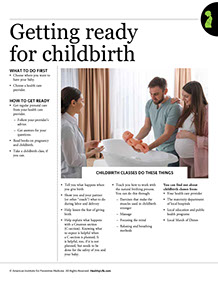
  • Getting Ready For Childbirth

    Pregnancy & Prenatal Care

    What to Do First

    *  Choose where you want to have your baby.

    *  Choose a health care provider.

    How to Get Ready

    *  Read books on pregnancy and childbirth.

    *  Take a childbirth class, if you can.

    *  Get regular prenatal care from your health care provider.

    Childbirth Classes Do These Things

    *  Tell you what happens when you give birth

    *  Show you and your partner (or other “coach”) what to do during labor and delivery

    *  Help lessen the fear of giving birth

    *  Help explain what happens with a Cesarean section (C-section). Knowing what to expect is helpful when a C-section is planned. It is helpful, too, if it is not planned, but needs to be done for the safety of you and your baby.

    *  Teach you how to work with the natural birthing process. You can do this through:

    – Exercises that make the muscles used in childbirth stronger

    – Massage

    – Focusing the mind

    – Relaxing and breathing methods

    You can find out about childbirth classes from:

    *  Your health care provider

    *  The maternity department of local hospitals

    *  Local education programs

    *  Local March of Dimes

    Prenatal Self-Care book by the American Institute for Preventive Medicine. www.HealthyLife.com. All rights reserved.

    © American Institute for Preventive Medicine

  • Staying Active With A Disability

    BE FIT

    Image of disabled man on treadmill.

    Most of us know that exercise is great for our health. But, if you or someone in your family has a disability, exercise can feel like a difficult task. Not only do you have to find time and energy to do it, but you need to worry about accessibility, too.

    Make sure your doctor gives you the okay before you begin any exercise program.

    It can be frustrating when your favorite activity doesn’t seem to work for you. But, some extra research may be worth the effort. These tips can help you get started:

    *  Check into races. There are many 5K, 10K and longer races that are accessible to people with many types of disabilities. And, many of them raise money for charitable causes. This may also help motivate your family to get out and train for a race and have fun together. Be sure to ask in advance about accessibility to be sure it will work for you.

    *  Get outside and do what you love. Have outside time a few times a week. This can be as simple as throwing a ball in the yard, going to an accessible playground, gardening or playing with the hose or sprinkler on a hot day.

    *  Ditch the car for short trips. If you live near a town, consider walking to the store for an errand. If this isn’t realistic, get some miles in at a mall or shopping center. Park at one end and visit the shops all the way at the other end.

    *  Modify your sports. Many sports can be fun and challenging with some minor changes. Walking instead of running for soccer, using a larger or softer ball for volleyball, or omitting the net in tennis may make the game work for you.

    *  Try low impact activities. Joining an aquatic exercise program or using rowing machines are two great activities for those who have joint limitations.

    Activities for people with disabilities

    Check with the following organizations to see who offers adaptive programs and activities:

    *  Your city or county recreation department

    *  Local YMCA or YWCA

    *  Boy Scouts or Girl Scouts councils

    *  Nearby high schools, colleges and universities

    *  Chamber of Commerce

    *  Center for Independent Living (CIL)

    *  National and State parks (many have paved hiking trails)

    Finally, talk with your doctor or health care provider about your desire to get active. They may have resources to help you get started. Join support groups with people who have disabilities like yours and use the power of community to find out about fun and active things you can do.

    Sources: The National Center on Health, Physical Activity and Disability (NCHPAD), U.S. Department of Health and Human Services

    © American Institute for Preventive Medicine

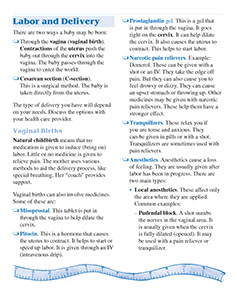
  • Labor And Delivery

    Pregnancy & Prenatal Care

    There are two ways a baby may be born:

    *  Through the vagina (vaginal birth). Contractions of the uterus push the baby out through the cervix into the vagina. The baby passes through the vagina to enter the world.

    *  Cesarean section (C-section). This is a surgical method. The baby is taken directly from the uterus.

    The type of delivery you have will depend on your needs. Discuss the options with your health care provider.

    Vaginal Births

    Natural childbirth means that no medication is given to induce (bring on) labor. Little or no medicine is given to relieve pain. The mother uses various methods to aid the delivery process, like special breathing. Her “coach” provides support.

    Vaginal births can also involve medicines. Some of these are:

    *  Misoprostal. This tablet is put in through the vagina to help dilate the cervix.

    *  Pitocin. This is a hormone that causes the uterus to contract. It helps to start or speed up labor. It is given through an IV (intravenous drip).

    *  Prostaglandin gel. This is a gel that is put in through the vagina. It goes right on the cervix. It can help dilate the cervix. It also causes the uterus to contract. This helps to start labor.

    *  Narcotic pain relievers. Example: Demerol. These can be given with a shot or an IV. They take the edge off pain. But they can also cause you to feel drowsy or dizzy. They can cause an upset stomach or throwing up. Other medicines may be given with narcotic pain relievers. These help them have a stronger effect.

    *  Tranquilizers. These relax you if you are tense and anxious. They can be given in pills or with a shot. Tranquilizers are sometimes used with pain relievers.

    *  Anesthetics. Anesthetics cause a loss of feeling. They are usually given after labor has been in progress. There are two main types:

    *  General anesthesia. This puts the mother to sleep. It is used most often for emergency C-sections. But it can be used in a vaginal birth when the baby is in a breech position. That’s when the baby’s bottom or one or both feet reach the cervix before the head does.

    *  Local anesthetics. These affect only the area where they are applied. Common examples:

    – Pudendal block. A shot numbs the nerves in the vaginal area. It is usually given when the cervix is fully dilated (opened). It may be used with a pain reliever or tranquilizer.

    – Epidural block. This is the most popular anesthetic used for labor. The mother lies on her left side or she sits up and leans forward. A shot is given in the back to numb the area. A thin plastic tube is put into the epidural space of the spine. Medicine is given through the tube. This causes some loss of feeling from the waist down. How much numbness occurs depends on the drug and dose used. An epidural block can have other effects. It can lower the mother’s blood pressure. It can make her unable to pass urine on her own. In that case, a tube called a Foley catheter is used to empty urine from the bladder. An epidural block can also increase the chance that forceps will be used at delivery. {Note: Just pain medicine can be given through the tube. It does not cause a loss of feeling from the waist down. If this is done, the mother may be able to get out of bed and walk. But an adult should be with her.}

    Whether or not pain medicine is used is not what matters most. The goal in labor and delivery is to have a healthy baby and a healthy mother.

    Cesarean Births

    A C-section requires anesthetics. Either an epidural block or spinal is used. General anesthesia is rarely used. C-sections are usually done with a low, left-to-right incision (cut) near the line of pubic hair. This is called a lower-segment incision or a “bikini” cut. An up-and-down incision is rare these days. But it may be used in an emergency. The type of incision in the skin may be different from the one made in the uterus.

    C-sections may or may not be planned. Here are some reasons for doing one:

    *  The baby (or babies) or mother is not doing well

    *  The baby is too big for the mother’s pelvis

    *  The mother has placenta previa or placenta abruptio.

    *  The mother had a past C-section with an up-and-down incision on the uterus.

    *  The baby is lying in a way that makes it hard to deliver.

    *  The mother has an active outbreak of genital herpes.

    *  Labor does not progress the way it should.

    *  The umbilical cord is wedged between the cervix and the baby. This cuts off blood flow to the baby.

    *  The mother is not strong enough for a vaginal delivery.

    *  The mother has health problems, like diabetes, high blood pressure, kidney disease, or preeclampsia.

    *  The baby is more than 2 weeks late and the placenta does not nourish the baby well.

    Vaginal Births after C-Section (VBAC)

    Some pregnant women have already had a C-section delivery. Of this group, some might be able to have a safe vaginal delivery. Some might not for the next baby.

    A vaginal delivery after a C-section may be possible if:

    *  The incision for the C-section was the left-to-right, lower-segment type.

    *  Your pelvis is normal size.

    *  Reasons for the past C-section are not present now. Examples:

    – Breech baby

    – Separation of the placenta (placenta abruptio)

    – More than one baby

    – Baby in distress

    Signs of Prelabor

    Prelabor is the period just before labor begins. Call your health care provider if any of these signs of prelabor happen more than one month before your due date:

    *  The baby begins to settle into your pelvis. It looks and feels as if the baby has “dropped.” This process is called lightening and engagement. It’s easier for you to breathe after it happens.

    *  You feel more pressure on the pelvis and rectum (rear end). The pressure can cause a dull ache in the pelvic area or lower back. It feels like menstrual cramps.

    *  Vaginal discharge may increase and thicken.

    *  Your energy level changes. Some women feel less energy. Others feel more. They want to clean the whole house. The “nesting instinct” is a way of getting ready for the new baby.

    *  You lose the mucus plug. That’s a blob of thick stuff that blocks the cervix. You can lose it several days before labor starts. Or you can lose it just as labor starts.

    *  You may see the bloody show. When the cervix opens, small blood vessels often break. The blood colors the mucus plug pink. Or it may streak the mucus plug with red. When the mucus plug falls out, you may see the blood. You may pass a big clump that looks like a wet cotton ball. Some women don’t notice the bloody show. Bloody show usually means that labor will start within 24 hours. But sometimes labor could still be a few days away.

    *  You have diarrhea. Some women get this just before labor starts.

    *  The “bag of waters” (or your “water”) breaks. That’s the sac inside the uterus. It holds the amniotic fluid. The baby grows there. About 15 percent of the time, the water breaks before labor starts. More often, this happens during labor. The fluid can come out in a gush or a slow trickle. Call your provider right away if this happens.

    1st Stage of Childbirth

    The First Stage of Childbirth: Labor

    Labor has three parts:

    *  The first part is called early or latent labor. This is usually the longest part. It’s usually the least painful, too.

    – Real contractions begin. Contractions are when the muscles of the uterus tighten and then relax. The feelings usually start in the lower back and travel to the belly. Some contractions are felt only in your back. Others are felt only in your belly. Contractions usually start about 15 to 20 minutes apart and last 30 to 45 seconds.

    – The cervix dilates to open 3 centimeters across. That’s about the size of a silver 50¢ piece. It gets thinner. This can happen over a period of days or weeks. You may not even be aware of it. Or it can happen with stronger contractions over a period of 2 to 6 hours. Rarely, it could take up to 24 hours with the stronger contractions.

    – Call your health care provider during the first part of labor. Your provider may tell you to go to the hospital or birthing center. Make sure you’re packed!

    *  The second part is called active labor. This part of labor is usually shorter than the first part. On average, it lasts 2 to 3  hours. But its length can vary greatly. If you’re not already at the hospital or birthing center, you should get there early in this part of labor. Signs of this part of labor:

    – Contractions are stronger. They come more often, usually every 3 to 4 minutes. They last longer, from 40 to 60 seconds each.

    – The cervix dilates to 7 centimeters. That’s about the size of the rim of a coffee mug.

    *  The third part is called advanced active labor or transition. It is the most tiring part. But it is also the shortest. The average length is 15 to 60 minutes. Here are signs that you are in transition:

    – Contractions are even stronger. They come every 2 to 3 minutes. Each lasts 60 to 90 seconds.

    – The cervix dilates fully. It opens 7 to 10 centimeters. That’s about the size of a small grapefruit.

    2nd Stage of Childbirth

    The Second Stage of Childbirth: Delivery

    During delivery, you push the baby down the birth canal and out into the world.

    *  Contractions continue. They are usually more regular than before. They come less than two minutes apart. Each lasts about 60 to 90 seconds. You only push when you have contractions. Your health care provider will tell you when to push.

    *  Most babies come out head first. Then the shoulders. After this, the rest of the baby’s body slips out with ease. Your baby may be placed on your tummy.

    *  The umbilical cord is clamped and cut.

    *  The time for this stage varies greatly. It can take from 10 minutes to 3 hours or more.

    3rd Stage of Childbirth

    The Third Stage of Childbirth: Delivery of the Placenta

    Delivery of the placenta usually lasts from about 5 to 30 minutes. Delivery takes place through mild contractions. You might not even feel them. One more push from you can help the placenta come out. Or a nurse or your health care provider may gently press down on your abdomen. This, too, can help the placenta come out.

    {Note: The total time for labor varies from woman to woman. It also varies from pregnancy to pregnancy for the same woman. First babies tend to take longer than later ones. This is not always the case, though.}

    During Labor

    Things Your Health Care Provider May Do During Labor

    Your health care provider and his or her staff may do any of the things below during labor. What they will do depends on your special needs. But find out ahead of time which ones the provider is sure to do.

    *  Do a physical exam.

    – Your provider feels your belly. This helps the provider know how big the baby is. It helps the provider to know how the baby is lying.

    – Your provider gives you a pelvic exam. This shows how open and thin your cervix is. Your “bag of waters” could break by itself during this exam.

    *  Put an IV (intravenous drip) in a hand or arm vein. Here are reasons why this may be done:

    – To give you fluids. This keeps you from getting dehydrated (dried out or without enough body fluids).

    – To give you glucose. Glucose is a type of sugar. It gives you energy. This will help if you have a long labor.

    – To provide a way to give you medicine quickly, if you need it.

    *  Use a fetal monitor to check the baby. This small machine can check your baby’s heartbeat before the baby is born. It can also record your contractions. There are 2 kinds of fetal monitors:

    – External monitor. This kind has two wide straps. The straps go over your belly. One strap picks up your baby’s heartbeat by ultrasound. The other connects to a pressure gauge. The gauge records your contractions on a printout.

    – Internal monitor. This kind has a small tube that goes inside the uterus. The “bag of waters” must be broken before this monitor can be used. It gets there through the vagina and cervix. A small electrode goes on the baby’s head. This monitor gives more detail than the external one. It is used when the baby doesn’t seem to be doing well. It may also be used when the external monitor is not giving an accurate reading. This can happen if the baby is very active. It can happen when the mother is obese.

    *  Break your “bag of waters.” Your provider pricks the “bag of waters” with a small tool. The tool enters through the opened cervix. The provider looks at the color of the fluid. Clear is a good sign. Yellow or green could signal a problem.

    *  Use forceps to help the delivery. Forceps are metal tongs. They are cradled around the baby’s head. They help ease the baby out of the birth canal if the mother can’t push.

    *  Use vacuum extraction to help the delivery. A suction cup is put on the baby’s head in the birth canal. This helps the baby come out if the mother can’t push. The suction cup is attached to a vacuum pump. Your doctor uses this to pull the baby gently with each contraction. Many doctors prefer this method to forceps. {Note: Forceps and vacuum extraction are not used until the baby’s head can be seen at the vaginal opening.}

    *  Do an episiotomy. This is a surgical cut. It is made in the skin between the vagina and the anus just before the baby is born. The purpose is to widen the vaginal opening. That helps the baby come out. It also helps keep the skin in the vaginal area from tearing. After the baby is born, the cut is stitched.

    How long you stay in the hospital or birthing center will depend on:

    *  The type of delivery you have and where you give birth. You may go home within 12 to 24 hours in a birthing center. You may be able to stay in a hospital for up to two days. Both of these are with normal vaginal deliveries without problems. C-section stays vary. They usually last 2 to 3 days.

    *  Your health insurance. Find out what your insurance pays for.

    *  Your medical needs. You or your baby may need to stay in the hospital longer than usual if you have special medical needs. Sometimes you and your baby get home health care. Your hospital or health insurance may provide this.

    Prenatal Self-Care book by the American Institute for Preventive Medicine. www.HealthyLife.com. All rights reserved.

    © American Institute for Preventive Medicine

  • Coping With The Loss Of A Spouse

    FAMILY LIFE

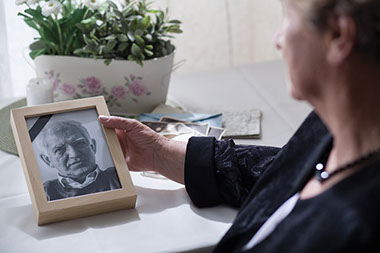
    Image of sad, older female sitting on couch.

    Losing a husband or wife is devastating. A whirlwind of intense emotions-overwhelming sadness as well as shock, fear, guilt, anger, and numbness-make the days and weeks after a spouse’s death agonizing and confusing.

    It may be small comfort to know that these feelings are normal and will be temporary.

    “Sadness may never go away entirely,” said clinical psychologist Dr. Hayley Hirschmann of Morris Psychological Group, “but the pain of acute grief becomes less intense over time as the good days start to outnumber the bad.”

    Dr. Hirschmann offers this advice:

    *Accentuate the positive:Studies have shown that those who are able to draw on humor and pleasurable memories are happier and healthier than those whose thoughts of the deceased are mostly sad and focused on their loss.

    *Let others help:Don’t shy away from expressing your feelings to those close to you; you will feel less alone if you can share your grief with a sympathetic listener. Accept help with chores and legal and financial responsibilities. Consider joining a bereavement support group.

    *Take care of yourself:Eat well, exercise regularly, get enough sleep. Be alert to falling into bad habits.

    *Don’t make big changes right away:Wait a while before moving or changing jobs.

    © American Institute for Preventive Medicine

  • Stepping Into The Stepparent Role

    FAMILY LIFE

    Image of husband and wife and two children.

    Stepfamilies face unique challenges and situations, especially when the family is newly blended. If you’re just getting to know your new stepfamily, it may take some time for everyone to feel comfortable with the new situation, says the National Stepfamily Resource Center. The organization offers this advice for new stepparents:

    *Understand that bonding takes time.Children of any age may need to get used to their new family. Try not to get discouraged if things don’t go smoothly right away.

    *Communication is key.All families need good communication. This means listening to each other and addressing problems and arguments calmly and directly.

    *Show interest in your stepchildren.Attend their activities, listen to their opinions, and ask them specific questions about their day. Try new family activities together such as walks in the park, bike rides, or something everyone will enjoy.

    *Use compromise to solve problems.Don’t use a “my way or the highway” approach, or the stepchild may become distant or show difficult behavior.

    *See a family counselor or therapistif you need extra help.

    © American Institute for Preventive Medicine

  • Love Is Healthy For Your Heart

    Heart & Circulation Problems

    Couple on beach making heart shape with their arms.

    Heart health isn’t just about not smoking and controlling cholesterol and blood pressure.

    *  Loving and feeling loved is vital to a healthy heart, as well as your overall well-being.

    *  Studies have consistently shown that:

    – Negative relationships raise the risk of heart problems.

    – Marriage lowers the risk of heart attack in both men and women of all ages.

    – People who hugged often showed lowered blood pressure and levels of stress hormones.

    Plan to spend time with loved ones. Go on a date with your partner once a week. Have a weekly family outing or game night.

    Say, “I love you,” “I care about you,” and “You mean a lot to me.” Give hugs. Cuddle a pet.

    Don’t spend too much time on your smart phone and other devices if it leads to neglecting loved ones.

    Health at Home Lifetime book by the American Institute for Preventive Medicine. www.HealthyLife.com. All rights reserved.

    © American Institute for Preventive Medicine

  • Eap Is At Your Service

    WORK LIFE

    Image of 2 business women shaking hands.

    In an edition of Psychology Today, Steve Albrecht, doctor of business administration, encourages employees to find out about the many services available from their Employee Assistance Program (EAP) and reach out for help if needed. Dr. Albrecht has written or co-written 15 books, including Ticking Bombs: Defusing Violence in the Workplace, and Fear and Violence on the Job. He is also a former police officer and domestic violence investigator with the San Diego Police Department.

    Dr. Albrecht gave four reasons why employees do not use their EAP services:

    1. They do not think what they say or do will be held in confidence.

    2. They see reaching out for help as a weakness. This is especially true  for men.

    3. They think they need to get permission from their boss or Human Resources to seek services from their EAP.

    4. They do not know their EAP exists.

    First, according to Dr. Albrecht, services and discussions between employees and EAP providers are kept confidential. There is an exception-an EAP counselor has a duty to warn or intervene if the employee wants to harm himself or herself or others. The company gets no reports or records of employee use of EAP services.

    Second, employees need to be reassured that EAP offers help for many very common issues that affect most people. Examples are money worries, marital issues, raising children or step-children, blended families, sick kids, and dealing with parents with Alzheimer’s disease.

    Employees can also get help for financial problems, burnout, stress-related illnesses, cancer and mental health issues. These include substance abuse, workplace conflicts, depression and suicidal thoughts.

    Third, employees simply need to call the EAP phone number and make an appointment. They do not have to tell coworkers, their boss or Human Resources.

    Lastly, Dr. Albrecht is puzzled why employees do not know about their EAP. Companies with EAP programs list their services and contact numbers on posters and brochures in lunch rooms and break rooms. New employees receive EAP information.

    To find out if your company offers EAP services, check your benefits manual or website or ask your human resources manager. Help is just a phone call away.

    © American Institute for Preventive Medicine