Men’s Health
The testicles (also called testes) are two oval shaped organs that make and store sperm. They also make male sex hormones. The testicles are inside the scrotum. This sac of skin hangs under the penis. The scrotum can swell or be painful without a testicle problem. An example of this is an inguinal hernia.
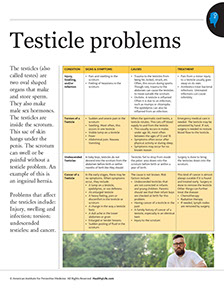
Problems that affect the testicles include: Injury, swelling and infection; torsion; undescended testicles; and cancer.
Signs & Symptoms
For Injury, Swelling, and/or Infection
* Pain and swelling in the scrotum.
* Feeling of heaviness in the scrotum.
For Torsion of a Testicle
* Sudden and severe pain in the scrotum.
* Swelling. Most often, this occurs in one testicle.
* Fever.
* Abdominal pain. Nausea. Vomiting.
For Undescended Testicles
* In baby boys, testicles do not descend into the scrotum from the abdomen before birth or within months of birth like they should.
For Cancer of a Testicle
In the early stages, there may be no symptoms. When symptoms occur, they include:
* A lump on a testicle, epididymis, or vas deferens.
* An enlarged testicle.
* A heavy feeling, pain or discomfort in the testicle or scrotum.
* A change in the way a testicle feels.
* A dull ache in the lower abdomen or groin.
* Enlarged or tender breasts.
* Sudden pooling of fluid in the scrotum.
Causes
For Injury, Swelling, and Infection
* Trauma to the testicles from being hit, kicked, struck, etc. Often, this occurs during sports. Though rare, trauma to the abdomen can cause the testicles to move outside the scrotum.
* Orchitis. With this, a testicle is inflamed. Often it is due to an infection, such as mumps or chlamydia. The epididymis can also be inflamed from an infection.
For Torsion of a Testicle
When the spermatic cord twists, a testicle rotates. This cuts off blood supply to and from the testicle.
* This usually occurs in males under age 30, most often between the ages of 12 and 18.
* Symptoms often occur after physical activity or during sleep.
* Symptoms may occur for no known reason.
For Undescended Testicles
Testicles fail to drop from inside the pelvic area down into the scrotum before birth or within a year of birth.
For Cancer of a Testicle
The cause is not known. Risk factors include:
* Undescended testicles that are not corrected in infants and young children. Parents should see that their infant boys are checked at birth for this problem.
* Having cancer of a testicle in the past.
* A family history of cancer of a testicle, especially in an identical twin.
* Injury to the scrotum.
Treatment
For Injury, Swelling, and/or Infection
* Pain from a minor injury to a testicle usually goes away on its own.
* Antibiotics treat bacterial infections. Untreated infections can cause infertility.
For Torsion of a Testicle
Emergency medical care is needed. The testicle may be untwisted by hand. If not, surgery is needed to restore blood flow to the testicle.
For Undescended Testicles
Surgery is done to bring the testicles down into the scrotum.
For Cancer of a Testicle
This kind of cancer is almost always curable if it is found and treated early. Surgery is done to remove the testicle. Other things can further treat the disease:
* Chemotherapy.
* Radiation therapy.
* If needed, lymph nodes are removed by surgery.
Questions to Ask
Self-Care / Prevention
To Avoid Injury to the Scrotum
* Wear protective gear and clothing during exercise and sports.
* Wear an athletic cup to protect the testicles.
To Help Prevent Infections
* See that your children get vaccines for measles, mumps, and rubella (MMR) as advised by their doctor.
* To help prevent STDs, follow “Safer Sex” guidelines.
To Treat Infections
* Take medication as prescribed.
* Take an over-the-counter medicine for pain and swelling, if needed. Follow directions.
* Rest.
* Apply cold compresses or an ice pack to painful, swollen area.
Testicular Self-Exam
Talk to your doctor about doing testicular self-exams (TSEs). If you choose to do TSEs, follow your doctor’s advice.
The best time to do a TSE is after a warm bath or shower. This relaxes the scrotum, allows the testicles to drop down, and makes it easier to find anything unusual. Doing a TSE is easy and takes only a few minutes.
1. Stand in front of a mirror. Look for any swelling on the skin of the scrotum.
2. Examine each testicle with both hands. Place your index and middle fingers underneath the testicle and your thumbs on top. Gently roll one testicle then the other between your thumbs and fingers. One testicle may be larger. This is normal. Examine each testicle for any lumps. These are usually painless and about the size of a pea.
3. Find the epididymis. This is the comma-shaped cord behind the testicle. It may be tender to the touch. Check it for lumps.
4. Examine the vas deferens. This is the tubelike structure at the back of each testicle. Check it for lumps.
Resources
© American Institute for Preventive Medicine