Tag: thyroid

  • Myths About Underactive Thyroid

    MEDICAL NEWS

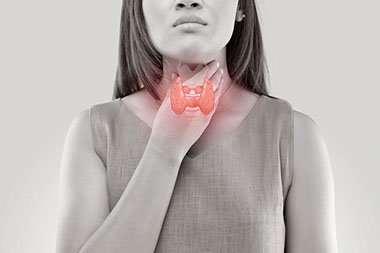
    Image of women holding her neck with an illustration of the thyroid gland on top.

    One of the most common thyroid problems is hypothyroidism, or underactive thyroid.

    Hypothyroidism means the thyroid gland isn’t making enough thyroid hormones. This can cause a number of symptoms, including:

    *  Fatigue

    *  Trouble with learning or remembering

    *  Dry hair, nails or skin

    *  Constipation

    *  Sore muscles

    *  Weight gain or bloating

    *  Heavy or irregular menstrual periods

    Although hypothyroidism is a common problem, there are many myths about it. Read on to learn about some common myths – and what you should know and hypothyroidism.

    Myth:You can’t lose weight if you have a thyroid problem.

    Fact:Many people can get to a healthy weight with hypothyroidism after getting on the proper dose of thyroid medication. They may need to work with a nutritionist or other health provider and get plenty of exercise. But losing weight is doable.

    Myth:You can’t get pregnant if you have hypothyroidism.

    Fact:Many women can get pregnant with an underactive thyroid. They should work with their doctor to make sure they are on thyroid medication that is safe and effective. It’s important to take thyroid medication consistently and carefully throughout pregnancy.

    Myth:Only older women have hypothyroidism.

    Fact:Thyroid problems can affect anyone, of any age. But women older than 60 years are at an increased risk for hypothyroidism.

    Myth:People with underactive thyroid need to take iodine.

    Fact:People with hypothyroidism should be on a medication that their doctor prescribes. Taking iodine supplements is usually not needed.

    Myth:High doses of thyroid medicine are better.

    Fact:Having too much thyroid hormone can lead to health problems like rapid heart rate, irregular heartbeat, bone loss and can even become life threatening. Work with your doctor to be sure your thyroid blood levels are within a healthy range.

    Myth:I can manage underactive thyroid with a healthy diet.

    Fact:A healthy diet is great for everyone, including people with underactive thyroid. However, even the best food choices cannot replace missing thyroid hormones. A person needs to take their thyroid medication as their doctor prescribes to replace these hormones.

    Source: American Association of Clinical Endocrinologists

    © American Institute for Preventive Medicine

  • Thyroid Awareness

    Ear, Nose & Throat Conditions

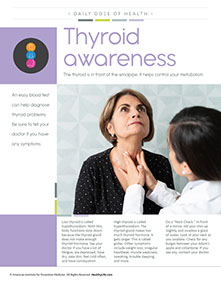
    Doctor examining women's neck.

    The thyroid is in front of the windpipe. It helps control your metabolism.

    An easy blood test can help diagnose thyroid problems. Be sure to tell your doctor if you have any symptoms.

    Low thyroid is called hypothyroidism. With this, body functions slow down because the thyroid gland does not make enough thyroid hormone. See your doctor if you have a lot of fatigue, are depressed, have dry, pale skin, feel cold often, and have constipation.

    High thyroid is called hyperthyroidism. The thyroid gland makes too much thyroid hormone. It gets larger. This is called goiter. Other symptoms include weight loss, irregular heartbeat, muscle weakness, sweating, trouble sleeping, and more.

    Do a “Neck Check:” In front of a mirror, tilt your chin up slightly and swallow a glass of water. Look at your neck as you swallow. Check for any bulges between your Adam’s apple and collarbone. If you see any, contact your doctor.

    Health at Home Lifetime book by the American Institute for Preventive Medicine. www.HealthyLife.com. All rights reserved.

    © American Institute for Preventive Medicine
  • Thyroid Problems

    General Health Conditions

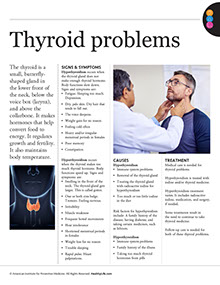
    The thyroid is a small, butterfly-shaped gland in the lower front of the neck, below the voice box (larynx), and above the collarbone. It makes hormones that help convert food to energy. It regulates growth and fertility. It also maintains body temperature.

    Signs & Symptoms

    Hypothyroidism occurs when the thyroid gland does not make enough thyroid hormone. Body functions slow down. Signs and symptoms are:

    *  Fatigue. Sleeping too much.

    *  Depression.

    *  Dry, pale skin. Dry hair that tends to fall out.

    *  The voice deepens.

    *  Weight gain for no reason.

    *  Feeling cold often.

    *  Heavy and/or irregular menstrual periods in females.

    *  Poor memory.

    *  Constipation.

    Hyperthyroidism occurs when the thyroid makes too much thyroid hormone. Body functions speed up. Two common forms are Graves’ disease and multinodular goiter. Signs and symptoms are:

    *  Swelling in the front of the neck. The thyroid gland gets larger. This is called goiter.

    *  One or both eyes bulge. Tremors. Feeling nervous.

    *  Mood swings.

    *  Weakness.

    *  Frequent bowel movements.

    *  Heat intolerance.

    *  Shortened menstrual periods in females.

    *  Weight loss for no reason.

    *  Fine hair or hair loss.

    *  Rapid pulse. Heart palpitations.

    {Note: In elderly persons, symptoms for this can be more like ones for hypothyroidism.}

    Causes

    For Hypothyroidism

    *  Immune system problems.

    *  Removal of the thyroid gland.

    *  Treating the thyroid gland with radioactive iodine for hyperthyroidism.

    *  Too much or too little iodine in the diet.

    Risk factors for hypothyroidism include: A family history of the disease; having diabetes; and taking certain medicines, such as lithium.

    For Hyperthyroidism

    *  Immune system problems.

    *  Family history of the illness.

    *  Taking too much thyroid hormones from pills.

    Treatment

    Medical care is needed for thyroid problems.

    Hypothyroidism is treated with iodine and/or thyroid medicine.

    Hyperthyroidism treatment varies. It includes radioactive iodine, medication, and surgery, if needed.

    Some treatments result in the need to continue to take thyroid medicine.

    Follow-up care is needed for both of these thyroid problems.

    Questions to Ask

    Self-Care / Prevention

    *  Take medication as directed.

    *  Tell your doctor if symptoms come back or still bother you.

    *  Follow your doctor’s advice for self-care measures.

    Neck Check

    To see if you have a lump on your thyroid gland or if it is enlarged, the American Association of Clinical Endocrinologists recommends this quick self-test:

    1.  Tilt your chin up slightly and swallow a glass of water in front of a mirror.

    2.  Look at your neck as you swallow.

    3.  Check for any bulges or protrusions between your Adam’s apple and collarbone. If you see any, contact your doctor.

    Resources

    American Thyroid Association

    www.thyroid.org

    Healthier at Home book by the American Institute for Preventive Medicine. www.HealthyLife.com. All rights reserved.

    © American Institute for Preventive Medicine