Introduction
Does Time Get the Best of You?
Defining Your Life Goals
Activity Worksheet
Activity Log
Time Management Techniques
Action Plan for Improving Time Usage
Procrastination Quiz
How Do I Procrastinate?
One Dozen Ways to Overcome Procrastination
Should You Delegate?
Delegation Caddy
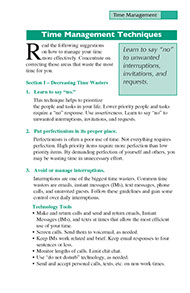
Read the following suggestions on how to manage your time more effectively. Concentrate on correcting those areas that waste the most time for you.
Decreasing Time Wasters
1. Learn to say “no.”
This technique helps to prioritize the people and tasks in your life. Lower priority people and tasks require a “no” response. Use assertiveness. Learn to say “no” to unwanted interruptions, invitations, and requests.
2. Put perfectionism in its proper place.
Perfectionism is often a poor use of time. Not everything requires perfection. High priority items require more perfection than low priority items. By demanding perfection of yourself and others, you may be wasting time in unnecessary effort.
3. Avoid or manage interruptions.
Interruptions are one of the biggest time wasters. Common time wasters are emails, instant messages (IMs), text messages, phone calls, and uninvited guests. Follow these guidelines and gain some control over daily interruptions.
Technology Tools
* Make and return calls and send and return emails, Instant Messages (IMs), and texts at times that allow the most efficient use of your time.
* Screen calls. Send them to voicemail, as needed.
* Keep IMs work-related and brief. Keep email responses to four sentences or less.
* Monitor lengths of calls. Limit chit chat.
* Use “do not disturb” technology, as needed.
* Send and accept personal calls, texts, etc. on non-work times.
Uninvited Visitors
* Close your door.
* Face desk away from office traffic.
* Establish quiet time – no guests.
* Plan regular visiting time.
* Remain standing when a visitor is present.
* Don’t add to chatter.
* Let the visitor know how you honestly feel about interruptions.
4. Delegate when possible.
Try assigning some low priority tasks to others. This can free up your time for more important things. Delegation is also a good option for tasks that do not require perfection.
5. Remember: Handle each piece of paper or mail only once.
Immediately make your decisions about what attention it requires. Don’t stack papers that you will look at again and again. Deal with emails efficiently, too. Delete ones you do not need. Unsubscribe to mailing lists not relevant to your work or that you do not read. Use your email server’s “Tools” menu to create “Action” and “Archive” folders, labels, and filters to organize emails. Set aside specific times to read and respond to emails.
6. Transform commuting and waiting time.
Listen to books, language programs, and education materials on audio cassettes while commuting, exercising, or waiting in line.
7. Have assigned places and systems for routine items and tasks.
Always store keys, purse, briefcase, tools, and utensils in the same place. Often used clothing and grooming items also need a special place. This reduces the time wasted searching for routine items.
Increase Productive Activities
1. Think of the 80/20 Principle.
Carefully choose where you will concentrate your efforts. The 80/20 principle states that 80% of the most valuable results come from 20% of the tasks you do. Concentrate your working time on just these important tasks. Avoid the trivial.
2. Distinguish between activity and productivity.
Are you wasting time on busy work (activity) that may not lead to a goal or are you spending time productively in a way that will produce results? Concentrate on productive time. Ask yourself often, “Am I just keeping busy or am I really being productive?”
3. Ask the question: “What is the best use of my time right now?”
Ask this question when you are uncertain about your use of time. Use this question to get you back on track in the following situations:
* after an interruption
* when distracted
* when procrastinating
* when you run out of steam
4. Make a “To Do” list.
Make this list every day! Write it down! Keep it at your fingertips! Having a list of activities that can be checked off is gratifying. It also gives you some idea of progress. Don’t list routine items, such as brushing teeth and commuting to work. However, do allow time for these activities.
5. Follow the ABC Priority System.
Categorize your activities under A, B, C priorities with “A” being the top priority. Focus your energies on completing the A’s. Perhaps B’s and C’s could be delegated to others. Some C’s may never even have to be done.
6. Avoid over-commitment.
This can be caused by inflexible scheduling or over-booking. Know your personal limits and time frames and have realistic expectations.
7. Schedule quiet time.
Establish a regular quiet time for yourself. Inform key interrupters and don’t take telephone calls. Allow yourself quiet time to restore your energy.
8. Balance quiet time and activity time.
Too much quiet time can reduce the productivity of those around you. They may depend upon your input – emotional and otherwise. Ask your co-workers/family if your quiet time is a problem for them.