Tag: Tobacco Cessation

  • Avoid Secondhand Smoke

    Tobacco Cessation

    Image of women smoking and child using an asthma inhaler.

    Somebody else’s habit can destroy your health.

    All that smoke that gets in your eyes is also getting in your airways and lungs, causing potentially fatal heart disease and cancer. It is also blamed for increased risk of sudden infant death syndrome, ear infections, colds, pneumonia, bronchitis, and more severe asthma. Researchers report that there is no safe level of exposure.

    What is secondhand smoke?

    Secondhand smoke is the combination of smoke given off a burning tobacco product and the smoke exhaled by a smoker. People can be exposed to secondhand smoke in homes, cars, the workplace, and public places, such as bars, restaurants, and leisure settings. It contains at least 250 harmful chemicals including hydrogen cyanide, carbon monoxide, and ammonia.

    Laws protect your air.

    Federal law bans smoking on most public transportation and in federally owned buildings. Many states and local governments have passed laws that ban smoking in public facilities, such as schools, hospitals, airports, bus terminals, parks, and beaches, as well as private workplaces, including restaurants and bars.

    Health risks of secondhand smoke:

    *  Breast cancer

    *  Cancers of the nose, throat, and sinus cavity

    *  Leukemia

    *  Lymphoma

    *  Brain tumors in children

    *  Sudden infant death syndrome (SIDS)

    *  Ear infections

    *  Colds

    *  Pneumonia

    *  Bronchitis

    *  Severe Asthma

    *  Coughing and wheezing

    Avoid thirdhand smoke, too!

    Thirdhand smoke is the residue left from tobacco smoke that lingers on a person’s clothing, skin, hair, and on carpet, drapes, walls, and furniture. And it does this long after the tobacco use has stopped. Thirdhand smoke has the same harmful chemicals as secondhand smoke.

    Even if you do not allow tobacco use in your home, avoid or limit being in homes and other places where smoking is allowed. And reserve nonsmoking hotel rooms and rental cars.

    Action Step

    Don’t let anyone, including your mate, smoke in your home. Never eat at restaurants that allow smoking or travel in a car with others who are smoking.

    Page from Ways to Well-Being book by the American Institute for Preventive Medicine. www.HealthyLife.com. All rights reserved.

    © American Institute for Preventive Medicine

  • How To Help Me Quit

    Healthylife® QuitWell™

    Part 3

    Friends sitting talking and drinking tea.

    1.Be patient.I am trying to free myself from tobacco/nicotine. Quitting may make me tense, anxious, and prone to sudden mood swings. This is because I am doing without something I was used to having. Soon I will be secure in my ability to manage and I will be better than ever. Please bear with me a little longer.

    2.Be curious.For years I have been using tobacco/nicotine to pass the time, to reward myself, to calm myself, to wake up, to help me think, and to get through stressful events. Now I am coping all on my own. Ask me how I am managing; ask me what my life is like without nicotine. It’s all very new to me and I may want to talk about it.

    3.Be sensitive.All day long I must deal with the urge to use tobacco/nicotine. Sometimes it seems as if just about everything makes me think about it: getting ready for work, talking on the phone, ending a meal… I could really use your help to distract myself from these thoughts. Unless I mention it first, please don’t bring up the subject of my quitting.

    4.Be supportive.I really need someone to root for me right now, someone to be on my side. I enjoy the special attention (like rewarding my first week without tobacco/nicotine with a special treat) that you give me while I am in the “crawling” stage of quitting.

    5.Be positive. Sometimes I feel it is hard to remember all the good things that come with quitting. I like it when you notice the positive changes that you see in me. It means a lot to know that you are proud of me.

    6.Be confident.I want to make it, but sometimes I am not sure that I have what it takes to quit. I need the people around me to believe that I can do it… and to say so.

    What else will be helpful to you? Share this with those who want to support you.

    © American Institute for Preventive Medicine

  • Nicotine Gum Can Help Smokers Quit

    Tobacco Cessation

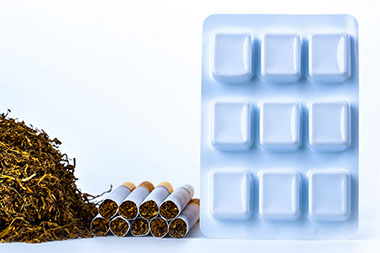
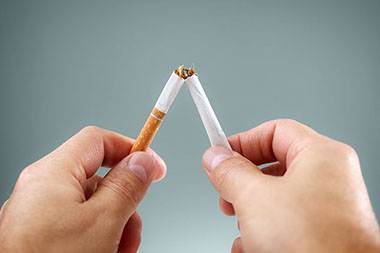
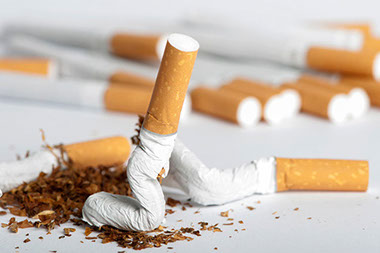
    Image of cigarette broken in half with nicotine gum next to it.

    Until lately, many people assumed cigarette smoking was just a bad habit (albeit an unhealthy one). In 1988, the Surgeon General’s Report on Smoking and Health changed that view. After reviewing over 2,000 scientific studies, the report confirmed what many scientists suspected: Smoking cigarettes is addictive, because they contain nicotine. So in order for you to quit smoking, you need to break the physical addiction as well as the psychological habit.

    A technique called nicotine replacement therapy can help break that stranglehold. With a nicotine replacement product, smokers absorb small amounts of nicotine. These little doses enable them to reduce their nicotine cravings and wean themselves off cigarettes with little anxiety, irritability, sleepiness, headaches, or other symptoms that make nicotine withdrawal such torture. (Some say nicotine withdrawal is worse than heroin withdrawal-or close to it.)

    If you think nicotine replacement therapy might help you to quit smoking:

    *  Talk to your doctor about prescribed medicines (nicotine inhaler or nicotine nasal spray) or over-the-counter nicotine replacement products, such as a patch, gum, or lozenges.

    *  Follow all instructions for the product you use.

    In order for nicotine replacement therapy to work, a smoker should also follow the kind of behavior modification techniques outlined in the previous tip. Or you can attend a reputable stop-smoking program. Studies have shown that combining a nicotine replacement product with a stop-smoking program can triple your chances for success.

    Page from A Year of Health Hints book by the American Institute for Preventive Medicine. www.HealthyLife.com. All rights reserved.

    © American Institute for Preventive Medicine

  • Separate Tobacco/Nicotine From Situations

    Healthylife® QuitWell™

    Part 2

    Image of couple walking.

    Many times you may feel that you want to smoke, dip, or vape when what you really want is something else. When uncomfortable feelings arise, such as anger, sadness, boredom, or frustration, you may reach for a cigarette (or can or vape pen) without even pausing. You have worn a deep groove in your mind, creating a habit that can happen without much thought.

    Chart showing how to separate nicotine from situations.

    Tobacco/nicotine does not clear up or change these feelings. If nothing else, it simply creates a “smoke screen.” When the smoke clears, your problems are still there. The next time you get an urge, ask yourself, “What do I really want?” or “What do I need to figure out?” Use the mindfulness tools to help you think logically.

    © American Institute for Preventive Medicine

  • Creative Imagination 2

    SleepWell® Program

    Week 4

    Image of women sitting outside in nature, thinking.

    This tool allows you to rehearse an event or thought in your mind so that you are better prepared to deal with it when it occurs.

    Identify an upcoming event or challenge. Picture other people there, what you do, what you say, and how you react to challenges you know are likely to arise. Mentally practice your feelings and actions to increase your confidence. Identify and address gaps in your plan.

    You can also use creative imagination to save thoughts for later. Take stressful thoughts out of your present mind to reduce anxiety and help you feel calmer. Try these techniques:

    *  Imagine your stressful thoughts in a fishbowl or behind thick glass. You can see the thought floating around but you cannot touch it or hear anything that is going on behind the glass.

    *  Imagine your thought is in a bubble floating away in the wind. The bubble dances in the breeze and eventually blows away.

    *  Imagine your thoughts are a baseball. Then imagine whacking that ball high into the sky, far away.

    *  Imagine your worries falling into the depths of the ocean.

    *  Imagine putting your ideas on a shelf to think about later.

    Make it Real

    Write your worries on an index card and put them in a shoebox. Put the box on a shelf, in the back of the closet, or in a drawer.

    Say this: “I can retrieve these thoughts later, but now it is time to sleep.”

    © American Institute for Preventive Medicine

  • Balance Of Choice 2

    Healthylife® QuitWell™

    Part 2

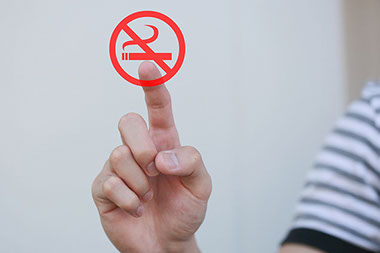
    Man's hand touching an abstract no smoking.

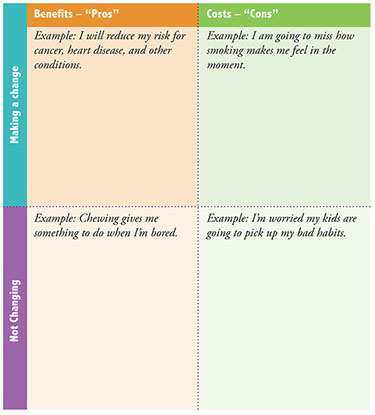
    Learn what is pulling you toward your goal and what is holding you back. All thoughts and feelings are valid. Is your goal more important to you than the challenges to achieve it? Are you pursuing this goal just because someone said you “should” do it? Complete the chart below as well as you can. If you think of something later, come back to this page to add another point to one of the boxes.

    Chart to fill out your choices.

    © American Institute for Preventive Medicine

  • I Am Quitting!

    Healthylife® QuitWell™

    Part 1

    Women putting on a patch on arm.

    Maybe you have started this program in the action phase-you are already quitting or have just quit. While you may have a quit date in mind, this phase is more than just one day. This phase usually lasts about six months for any behavior change. It starts when you start putting your plan into place and continues as you go through challenges and practice your new way of living.

    In a few words, describe your current quit plan.

    Who is supporting you?

    Remember, you may be moving back and forth between stages during your quitting process. Some days may be easier than others. It is important to stay very alert during the active phase, as slip-ups are very common. You will probably face many new challenges, from new stressors to different times of the year and holidays.

    Even if you have started this program in the action phase, work through the guide in order. Building a strong foundation will help you get through the first few months of quitting-and beyond.

    © American Institute for Preventive Medicine

  • Nicotine Replacement Therapy

    Healthylife® QuitWell™

    Part 3

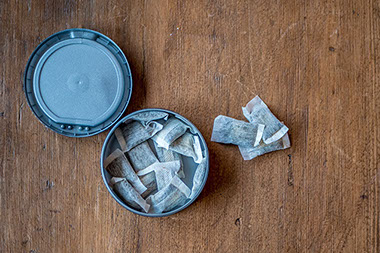
    Image of nicotine gum to help stop smoking.

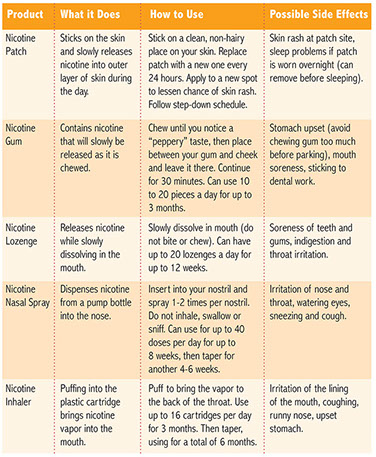
    All of these products contain nicotine. Patches, gum, and lozenges are available other-the-counter. The nicotine nasal spray and nicotine inhaler require a prescription.

    © American Institute for Preventive Medicine

  • Smokeless Inhalation

    Healthylife® QuitWell™

    Part 4

    Senior women deep breathing.

    This is one of the best Urge Tamers you will learn. Do this deep breathing when you have an urge.

    1. Breathe in deeply through your nose.

    2. Hold your breath for 3 seconds.

    3. Slowly breathe out through pursed lips to make a “whooshing” sound.

    4. Keep breathing this way until the urge goes away. Sometimes you may need to do the smokeless inhalation 2-3 times, or up to 12-13 times. An increase in oxygen helps you feel relaxed.

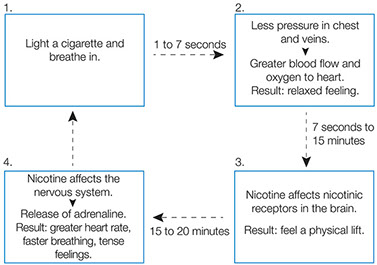
    The smoking cycle:

    Avoiding tobacco/nicotine and using smokeless inhalation can help you break the cycle.

    © American Institute for Preventive Medicine

  • Review & Prepare 4

    SleepWell® Program

    Week 1

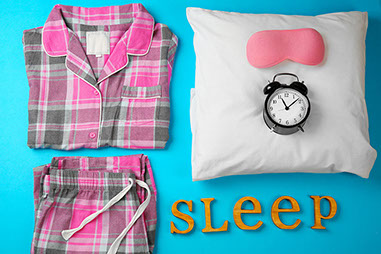
    Image of sleeping mask, pillow, clock, and pajamas.

    Complete the following.

    *  Why I am concerned about my sleep?

    *  What I think is the biggest challenge with my sleep: (e.g. not being able to fall asleep or stay asleep, waking up often, not feeling refreshed when I wake up)?

    *  Could any medical issues or medications be causing my sleep problems? (If you answered yes to this question, talk with your doctor about your sleep issues.)

    © American Institute for Preventive Medicine