Tag: Tobacco Cessation

  • Clean Your Environment

    Healthylife® QuitWell™

    Part 4

    Man cleaning the inside of his car.

    Go around your house, car, workplace, and other places you have stored tobacco products. Gather all your tobacco, lighters, matches, and other items related to your habit. Don’t forget to check your coats, purses, and drawers.

    If you have quit, throw these products away. Seeing these items will not be helpful to staying quit. If you are still working on quitting, having all these items out of sight will also reduce the unhelpful reminders of your habits. You will be more ready for the day you quit completely.

    © American Institute for Preventive Medicine

  • Know Your Triggers

    Healthylife® QuitWell™

    Part 5

    Group of teens.

    Relapse triggers can be placed into one of four groups:

    1. Emotional relapse triggers

    2. Interpersonal relapse triggers

    3. Internal relapse triggers

    4. Environmental relapse triggers

    Emotional Relapse Triggers

    These are events in which either uncomfortable feelings, such as boredom, sadness and worry or positive feelings, such as joy, happiness, or being relaxed increase the chances you might use tobacco/nicotine. Which of the following have been triggers for you in the past?

    *  When I am happy and celebrating

    *  When I am relaxed

    *  When I feel tired

    *  When I am bored or have nothing to do

    *  When I am alone and feeling sad

    *  When I am frustrated or angry about something

    *  When I feel unsure and rejected by someone

    *  When I am worried about a loved one

    *  When I am afraid

    *  When I am tense and restless

    *  When I am put under pressure at my job

    Interpersonal Relapse Triggers

    These are events in which you may feel either direct or indirect pressure from other people. Which of the following have been triggers for you in the past?

    *  When other people around me are using tobacco/nicotine

    *  When someone offers me tobacco/nicotine

    *  When I want to show how tough, sophisticated, or liberated I am

    *  When I want to fit in with others who are using tobacco/nicotine

    *  When I want to feel different from other people

    *  When I become angry with someone

    *  When my friend or spouse goes back to using tobacco/nicotine after quitting

    *  When I want to avoid talking to a friend or spouse

    *  When I feel “trapped” in a relationship

    *  When I am upset that I cannot solve a problem with another person

    Internal Relapse Triggers

    These are times when you may have an urge without having a clear-cut reason. Which of the following have been triggers for you in the past?

    *  When I get a strong craving

    *  When I have intense withdrawal signals

    *  When I have a feeling of emptiness

    *  When I want to test my willpower by smoking just one cigarette (or having just one dip, etc.)

    *  When I am curious about the taste of a cigarette, e-cigarette, or chew

    *  When I have a difficult time paying attention

    *  When I think smoking/vaping/chewing is going to make a situation more fun

    *  When I’ve had too much to drink

    *  When I am hungry

    *  When I have trouble falling asleep

    *  When I wake up at night and can’t get back to sleep

    *  When I’m having pain in my body (back pain, headache, cramps, etc.)

    Environmental Relapse Triggers

    Certain times, places, and activities may be linked with your tobacco/nicotine habit. Which of the following have been triggers for you in the past?

    *  When I come across a pack of cigarettes, can of chewing tobacco, or discarded e-cigarette

    *  When I’m in a store where I used to buy tobacco/nicotine

    *  When I take a break from work

    *  When I drink coffee

    *  When I finish a meal

    *  After sex

    *  When I first get up in the morning

    *  When having fun/doing activities that were triggers in the past (e.g. playing cards, during a concert intermission, fishing, hunting, golfing)

    *  When driving

    *  When partying

    *  When I’m on vacation

    *  When I put off an unpleasant task

    © American Institute for Preventive Medicine

  • Review & Prepare

    Healthylife® QuitWell™

    Part 2

    Image of no smoking sign.

    In this section, you were guided to understand the barriers you face with quitting. By carefully reading, thinking about each part, and answering questions along the way, you are getting yourself ready for success.

    *  How have you prepared yourself to quit? Write the steps you have taken, mentally and physically, to get to this point.

    *  Look back at your list of barriers. Do any of them feel more manageable now?

    *  Which of your strengths do you think will come in handy for quitting? Be confident in what you know you are good at and what makes you a strong person.

    © American Institute for Preventive Medicine

  • Take Small Steps To Get Started

    Healthylife® QuitWell™

    Part 3

    Close up of hands, breaking a cigarette in half.

    Taking small steps can help build confidence. Seeing the “wins” right away can show you how strong and capable of change you are. The activities in this section may not feel very exciting, but they are small on purpose. Once you get going, taking bigger steps will feel easier and you will be more successful with them.

    These activities can also help you learn more about what causes your urges and what you do without thinking. These activities can start weakening your old habits and strengthening new, healthy habits.

    © American Institute for Preventive Medicine

  • Cleaning Up Mind Pollution

    Healthylife® QuitWell™

    Part 4

    Image of women relaxing while thinking.

    Start with changing how you react to minor annoyances, like traffic or a chatty co-worker. Work to reduce the number of things that push your buttons. It is not the event itself that determines your feelings-it is what you tell yourself about it. You may have some truly big, serious stressors in your life. Avoid piling the little things on top.

    “Men are not disturbed by things, but by the views they take of them.”  – Epictetus

    Let’s pretend you got stuck in a traffic jam on the way to work today. You feel angry and upset. But it is not the traffic jam that makes you upset. It is what you tell yourself that upsets you: “I’m going to be late for work.” “I have so much to do.” “This is such a waste of time.”

    You cannot change the fact that you are stuck in traffic. Getting angry serves no purpose. If you can look at the delay as a minor problem that you can’t control, rather than a major event, you will feel much better. When your mind stays calm, you may even see ways around the issue, like taking another route or using hands-free calling to join a meeting you’re running late for.

    Your outlook on quitting is also very important. If you tell yourself that quitting will be awful, chances are the process will be as bad as you think. If you accept the fact that you will have urges, but nothing you can’t handle, you will have an easier time quitting. Focus on what is gained from quitting, not on what is being lost or the minor discomfort along the way.

    Thinking Differently

    You can change how you think, feel, and react to any event. The ABCDE model can help you do this.

    Activating Event:An event that triggers thoughts and feelings. Example – “I am trying to quit smoking and this event is making me anxious.”

    Belief:What you think or say to yourself about the activating event. Examples – “I just can’t quit.” “I don’t have any willpower.”

    Consequence:How you feel in response to your beliefs. Examples – “I feel discouraged.” “I feel embarrassed and defeated.”

    Dispute:Question your earlier beliefs. Examples – “Wait a minute here, I can do hard things!” “I don’t need to rely on willpower to quit. I can apply skills I’m learning in QuitWell™.”

    Effect:How you feel after you dispute your earlier beliefs. Examples – “I can succeed.” “I feel my actions are within my control.” “I can handle this.”

    © American Institute for Preventive Medicine

  • Look Ahead

    Healthylife® QuitWell™

    Part 1

    Image of women thinking.

    It can be easy to stay in the day-to-day of our lives. Looking ahead can help you see further down the road at where you are headed. Think about how you picture the next year of your life and answer the questions below:

    *  Who are the important people in your life?

    *  Where do you live?

    *  What are you working on?

    *  What is the most important thing in your life?

    *  At the end of one year, will you be using tobacco/nicotine?

    Now, jump ahead 10 years. Ask yourself the same questions. Imagine how you want your life to be. Be realistic and think about where the things you are working on now may take you.

    *  Who are the important people in your life?

    *  Where do you live?

    *  What are you working on?

    *  What is the most important thing in your life?

    *  In 10 years, how will you think of tobacco/nicotine?
    © American Institute for Preventive Medicine

  • Review & Prepare 2

    Healthylife® QuitWell™

    Part 3

    Image of older women.

    Summary of Small Steps You Can Take:

    *  Keep tracking your habit.

    *  Wait 5 minutes when you have an urge to use.

    *  Buy your cigarettes by the pack (not the carton), your chewing tobacco by the can, or a lower concentration of e-cigarette cartridge.

    *  Store tobacco/nicotine products in a different place then usual.

    *  Set up a buddy system. Write goals in S.M.A.R.T. ways.

    *  Add to your list of “pros” for quitting. Star what is important to you.

    Change Is Your Choice

    The decision to make changes is up to you. You can decide which changes you want to make, how long it takes you to make them, and who you will tell. Answer the following:

    *  What do I want to do? Am I willing to do this?

    *  What am I going to do right now (within the next hour)?

    *  How will today be different for me?

    © American Institute for Preventive Medicine
  • The Big Picture

    Healthylife® QuitWell™

    Part 1

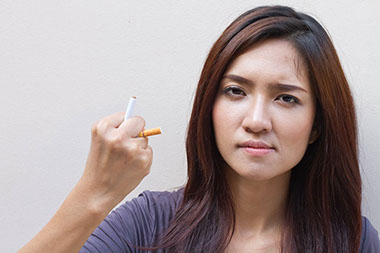
    Women crushing cigarette in hand.

    A tobacco/nicotine addiction has a degree of control over you, your time, the places you can go, and your experiences. Smoking steals your breath and your appearance over time. It also dims the world around you by dulling your senses of smell and taste.

    Imagine taking a vacation to somewhere you’ve always dreamed of seeing. Now imagine being too out of breath to enjoy a hike, standing outside on the deck to smoke while your traveling companions enjoy a shipboard show, stopping to smoke when you’d rather be in the water swimming or paddle boarding. Imagine not being able to fully enjoy your dream vacation.

    *  How does your current habit affect your life?

    *  What could you enjoy more if you left tobacco/nicotine behind?

    *  Relationships, career goals, financial goals, and other areas of life can also be affected. What other “big picture” goals do you have in your life right now?

    *  How would cutting back or quitting support these goals?

    Keep working hard on your other goals-you may find that seeing yourself succeed helps you feel more ready to tackle quitting.

    © American Institute for Preventive Medicine
  • Creative Imagination

    Healthylife® QuitWell™

    Part 5

    Image of smiling women.

    Creative imagination is the acting out of an event or activity in your mind before it really happens. It allows you to work through the event or activity ahead of time so that you will be better prepared to deal with it. Many athletes practice an upcoming game in their heads before stepping onto the playing field.

    A study was done to compare “creative imagination” to actual practice with a group of basketball players. Three groups of students were used.

    *Group 1– Practiced making free throws every day for 20 days.

    *Group 2– Threw the ball on the 1st and 20th days, but did not practice in between.

    *Group 3– Threw free throws on the first day and then spent 20 minutes a day for the next 20 days imagining that they were throwing the ball. If they missed, they had to imagine changing their aim.

    On the 20th day:

    *  Group 1 – Improved their scores by 24%

    *  Group 2 – No improvement

    *  Group 3 – Improved their scores by 23% by using creative imagination

    Mental practice can help you change your feelings about day-to-day events. Picture yourself succeeding with your goals and getting through trigger situations. The power of your mind to change what you imagine to be real is vast; all it takes is a little thinking and practice.

    What would you like to imagine doing differently? Picture yourself doing things the way you want. Repeat this practice every day for at least 2 weeks.

    © American Institute for Preventive Medicine

  • Make The Connection

    Healthylife® QuitWell™

    Part 2

    Parents giving kids piggy-back rides, laughing and having fun.

    Keeping your motivation and values in mind is a great way to encourage yourself when quitting gets tough. Look for ways to connect your motivation and values to your attitude and actions.

    How do your attitudes and actions show what is important to you? If you feel there is a mismatch, it might be time for a new point of view!

    Old view:Quitting is going to be horrible. I like to do what I want, when I want.

    New view:I value time with my family and want to be a good role model for my kids. It will be awesome to enjoy family time without the interruption of smoke breaks. I can model healthy behavior for my kids.

    © American Institute for Preventive Medicine