Tag: transplant

  • The Facts About Donating Organs

    MEDICAL NEWS

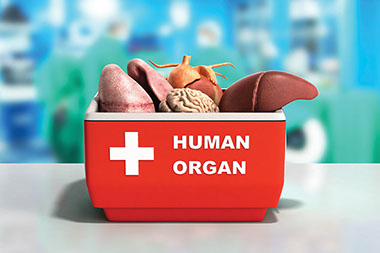
    Illustration of organs.

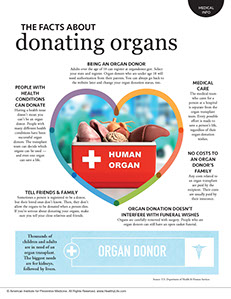
    Thousands of children and adults are in need of an organ transplant. The biggest needs are for kidneys, followed by livers.

    Being an organ donor

    Adults over the age of 18 can register at organdonor.gov. Select your state and register. Organ donors who are under age 18 will need authorization from their parents. You can always go back to the website later and change your organ donation status, too.

    People with health conditions can donate

    Having a health issue doesn’t mean you can’t be an organ donor. People with many different health conditions have been successful organ donors. The transplant team can decide which organs can be used – and even one organ can save a life.

    Tell friends & family

    Sometimes a person is registered to be a donor, but their loved ones don’t know. Then, they don’t allow the organs to be donated when a person dies. If you’re serious about donating your organs, make sure you tell your close relatives and friends.

    Medical care

    The medical team who cares for a person at a hospital is separate from the organ transplant team. Every possible effort is made to save a person’s life, regardless of their organ donation wishes.

    No costs to an organ donor’s family

    Any costs related to an organ transplant are paid by the recipient. Their costs are usually paid by their insurance.

    Organ donation doesn’t interfere with funeral wishes

    Organs are carefully removed with surgery. People who are organ donors can still have an open casket funeral.

    Source: U.S. Department of Health & Human Services
    © American Institute for Preventive Medicine

  • Alternatives To Baldness

    Men’s Health

    Image of mature man with thinning hair.

    A lot of men worry about going bald, especially if their fathers and grandfathers went bald. Worry builds when men hit their thirties and they notice their hair is thinning.

    Don’t be taken in by fraudulent claims for vitamin formulas, massage oils, lotions, or ointments that promise to cure baldness. No existing potion or ointment will produce a full head of hair. Medications can help some cases of baldness. Examples are the prescribed drug finasteride (brand name Propecia) and minoxidil (brand name Rogaine), which can be prescribed or obtained over-the-counter.

    Another option is hair replacement surgery. This involves using your existing hair. Techniques in hair replacement surgery include punch grafts; mini-grafts; micro-grafts; slit-grafts, and strip grafts. Other transplant techniques are flap surgery, tissue expansion; and scalp reduction. Talk to your doctor about these options.

    If you choose to wear a hairpiece, be sure it matches your natural hair and fits properly. And remember to keep your hairpiece as clean and well- groomed as your own hair.

    See your doctor if you suffer sudden hair loss-you may have a medical problem.

    A Year of Health Hints book by the American Institute for Preventive Medicine. www.HealthyLife.com. All rights reserved.

    © American Institute for Preventive Medicine

  • What Do You Know About Organ Donation?

    SELF-CARE CORNER

    Image of male doctor.

    Every year, thousands of Americans die waiting for a lifesaving organ transplant because there just aren’t enough organ donors. What do you know about donating organs? The Organ Transplantation experts at New York-Presbyterian Hospital give some facts:

    *  Very few medical conditions disqualify you from donating organs and tissues. It may turn out that while certain organs are not suitable for transplant, other organs and tissues are fine.

    *  It is possible to donate to someone who is not a relative and to someone from another racial or ethnic group. But transplant success rates increase when organs are matched between members of the same ethnic background.

    *  There are no costs directly related to donation.

    *  Although it is important to join a donor registry and indicate that you are an organ donor on your driver’s license, it is equally important to make your family, friends, and doctors aware of your wishes.

    *  The organ transplant waiting list is blind to wealth and celebrity status. People receive organs based on the severity of the illness, time spent on the waiting list, and blood type.

    *  For more information, go to the United Network of Organ Sharing (www.unos.org).

    © American Institute for Preventive Medicine