Tag: treatment

  • How To Stop A Nosebleed

    SELF-CARE CORNER

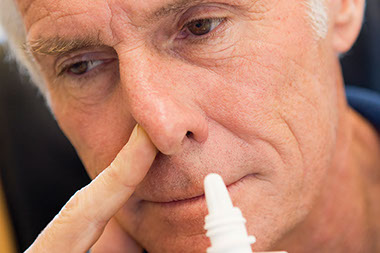
    Image of man using a nasal spray.

    When the furnace fires up and the humidity drops, the nose is most at risk. Nosebleeds can range from a simple, brief annoying amount of bleeding to life-threatening bleeding, according to Dr. Peter Shepard, an ear, nose, and throat expert.

    The nose has a collection of blood vessels called Kiesselbach’s plexus. This area is located at the front of the septum, the cartilage that divides the nose. Vessels from several different main trunks all meet in this spot and are very close to the surface. This is also the area of the nose that tends to dry out the most.

    If the surface cracks, the vessels will bleed. The size of the vessels determines how bad the bleeding is. People are more at risk if they have high blood pressure, take blood thinners, use oxygen, or have a deviated nasal septum.

    The best treatment for nosebleeds is avoiding them in the first place. Unless you can take an extended trip to Hawaii, you’ll want to work on improving the humidity inside your nose.

    Apply Vaseline at the front of your nostril twice a day. Saline spray can be kept with you and used throughout the day.

    If you do have a bleed, a few simple things will usually stop it.

    *  Apply pressure by squeezing the soft part of the nose between your thumb and index finger. Lean forward so you don’t swallow any blood (do not hold your head back, as some suggest).

    *  If that is not enough, oxymetazoline (Afrin) nasal spray can be a miracle drug for nosebleeds. It is a decongestant but works for nosebleeds since it causes blood vessels to tighten. Blow the blood out of the nose, spray twice, and then apply pressure for 15 minutes.

    *  If the bleeding won’t stop, go to the emergency room.

    © American Institute for Preventive Medicine

  • Pelvic Inflammatory Disease (Pid)

    Women’s Health

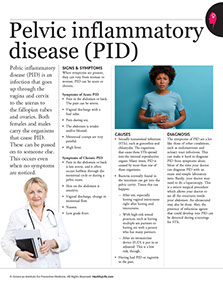
    Pelvic inflammatory disease (PID) is an infection that goes up through the uterus to the fallopian tubes. Both females and males carry the organisms that cause PID. These can be passed on to someone else. This occurs even when no symptoms are noticed.

    Signs & Symptoms

    When symptoms are present, they can vary from woman to woman. PID can be acute or chronic.

    Symptoms of Acute PID

    *  Pain in the abdomen or back. The pain can be severe.

    *  Vaginal discharge with a foul odor.

    *  Pain during sex.

    *  The abdomen is tender and/or bloated.

    *  Menstrual cramps are very painful.

    *  High fever.

    Symptoms of Chronic PID

    *  Pain in the abdomen or back is less severe. This often occurs halfway through the menstrual cycle or during a pelvic exam.

    *  Skin on the abdomen is sensitive.

    *  Vaginal discharge. Change in menstrual flow.

    *  Nausea.

    *  Low grade fever.

    Causes

    *  Sexually transmitted infections (STIs), such as gonorrhea and chlamydia. The organisms that cause these STIs spread into the internal reproductive organs. Many times, PID is caused by more than one of these organisms.

    *  Having had PID in the past.

    *  Recently having vaginitis.

    *  Bacteria normally found in the intestines can get into the pelvic cavity. Times this can happen:

    – After sex, especially having vaginal intercourse right after having anal intercourse.

    – With high risk sexual practices that increase the risk of infection. Examples are having multiple sex partners or having sex with a person who has many partners.

    – After an intrauterine device (IUD) is put in or adjusted. This is a low risk, though.

    Diagnosis

    The symptoms of PID are a lot like those of other conditions, such as endometriosis and urinary tract infections. This can make it hard to diagnose PID from symptoms alone. Most of the time your doctor can diagnose PID with an exam and simple laboratory tests. Rarely, your doctor may need to do a laparoscopy. This is a minor surgical procedure which allows your doctor to see all the structures inside your abdomen. An ultrasound may also be done.

    Treatment

    Antibiotics treat diagnosed PID. If the infection is severe, bed rest and antibiotics given through an IV may be needed. Treatment for an infected sex partner is also needed. This prevents getting the infection again.

    When PID is not treated, the infection can spread to other parts of the body. If it spreads to the blood, it may threaten life.

    Scarring from the infection can cause damage to a woman’s reproductive organs. It can cause infertility. Also, a woman who has had PID is at increased risk for:

    *  A tubal pregnancy.

    *  Premature labor and birth.

    Questions to Ask

    Self-Care / Prevention

    *  Wipe from front to back after a bowel movement to keep bacteria from getting into the vagina.

    *  When you menstruate, change tampons and/or pads often.

    *  Don’t have vaginal sex right after anal sex.

    *  Don’t have sex with anyone who has not been treated for a current case of PID or an STI or with anyone who has partners that haven’t been treated.

    *  Use barrier birth control methods with spermicides. These reduce the risk of getting PID from an infected partner. These include the male or female condom, cervical cap, or diaphragm. Use these even if you use other forms of birth control, such as the pill.

    *  Don’t use an IUD if you are at risk for STIs. If you use an IUD, have your doctor remove it if you become pregnant and then miscarry. If it is left in, your risk for PID goes up.

    *  Don’t smoke.

    *  Don’t use douches. These can spread bacteria further up the vagina.

    *  After childbirth, wait until you stop bleeding to have sex. After a D & C, abortion, or miscarriage, wait 1 week to have sex. Use a latex or polyurethane condom for 2 weeks after having an IUD put in.

    *  If you are at risk for PID, get tested for chlamydia and gonorrhea every 6 months.

    Resources

    National Women’s Health Information Center

    www.womenshealth.gov

    Women's Self-Care book by the American Institute for Preventive Medicine. www.HealthyLife.com. All rights reserved.

    © American Institute for Preventive Medicine

  • Know About Prostate Cancer

    MEDICAL NEWS

    Image of prostate cancer ribbon.

    Experts at Mount Sinai Medical Center offer this prostate cancer prevention advice:

    *Age is the strongest risk factor:Almost two-thirds of prostate cancers are found in men over the age of 65.

    *Family history can be important:Having a father or brother with prostate cancer more than doubles a man’s risk of developing this disease.

    *Race is a factor:Prostate cancer occurs more often in African-American men than in men of other races.

    *Follow a healthy diet:Eat more low-fat, high-fiber foods such as fruits and vegetables, and limit intake of red or processed meat.

    *Diagnose cancer early:Speak with your doctor about your risk for prostate cancer and the benefits of screening. For men at high risk, screening should be considered at age 40.

    Screening works

    Screenings consists of a PSA blood test, which measures the level of PSA, a protein that is produced by the prostate gland, and a digital rectal exam, which can uncover physical abnormalities of the prostate that may be a sign of cancer.

    NOTE:

    Prostate cancer screening guidelines vary with different health groups. Ask your doctor at what age you should discuss prostate cancer screening. Ask about the benefits and risks of PSA blood tests.

    © American Institute for Preventive Medicine

  • Prostate Cancer

    Cancer

    Man sitting looking up and sideways.

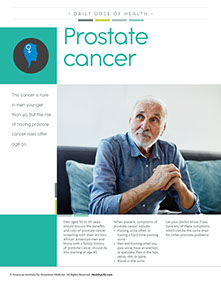
    This cancer is rare in men younger than 40, but the risk of having prostate cancer rises after age 50.

    Men aged 50 to 69 years should discuss the benefits and risks of prostate cancer screening with their doctors. African American men and those with a family history of prostate cancer should do this starting at age 40.

    When present, symptoms of prostate cancer include:

    *  Passing urine often or having a hard time passing urine

    *  Pain and burning when you pass urine, have an erection, or ejaculate. Pain in the hips, pelvis, ribs, or spine

    *  Blood in the urine

    Let your doctor know if you have any of these symptoms, which can be the same ones for other prostate problems.

    Health at Home Lifetime book by the American Institute for Preventive Medicine. www.HealthyLife.com. All rights reserved.

    © American Institute for Preventive Medicine

  • Nail The Infection

    SELF-CARE CORNER

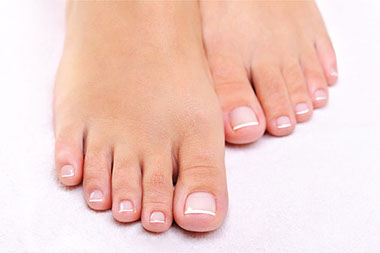
    Image of a women's feet.

    Despite the wealth of over-the-counter products available that claim to treat fungal nail infections (in the toenails and sometimes in the fingernails), the only way to cure an infection is to see a skin doctor (a dermatologist).

    Over-the-counter topical medications don’t penetrate the nail and therefore aren’t as effective as oral prescriptions. A dermatologist can prescribe the proper drugs to get rid of the fungi that are the problem in yellowing and misshapen nails.

    One of the best ways to deal with fungal nail infections is to prevent them from happening. The fungi love warm, damp environments around swimming pools and gym locker rooms-and inside your warm, sweaty socks.

    The best way to nail a nail infection is to keep your feet clean and dry and wear sandals in public shower areas.

    © American Institute for Preventive Medicine

  • Sexually Transmitted Infections (Sti)

    Sexual Health

    Smiling couple.

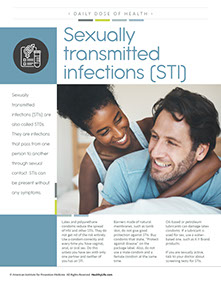
    Sexually transmitted infections (STIs) are also called STDs. They are infections that pass from one person to another through sexual contact. STIs can be present without any symptoms.

    Latex and polyurethane condoms reduce the spread of HIV and other STIs. They do not get rid of the risk entirely. Use a condom correctly and every time you have vaginal, anal, or oral sex. Do this unless you have sex with only one partner and neither of you has an STI.

    Barriers made of natural membranes, such as lamb skin, do not give good protection against STIs. Buy condoms that state, “Protect against disease” on the package label. Also, do not use a male condom and a female condom at the same time.

    Oil-based or petroleum lubricants can damage latex condoms. If a lubricant is used for sex, use a water-based one, such as K-Y Brand products.

    If you are sexually active, talk to your doctor about screening tests for STIs.

    Health at Home Lifetime book by the American Institute for Preventive Medicine. www.HealthyLife.com. All rights reserved.

    © American Institute for Preventive Medicine

  • Non-Drug Options For Chronic Pain

    SELF-CARE CORNER

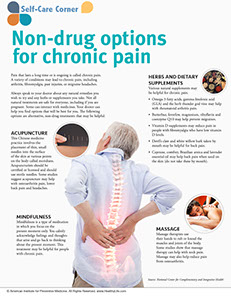
    Image of different herbs.

    Pain that lasts a long time or is ongoing is called chronic pain. A variety of conditions may lead to chronic pain, including  arthritis, fibromyalgia, past injuries, or migraine headaches.

    Always speak to your doctor about any natural remedies you wish to try and any herbs or supplements you take. Not all natural treatments are safe for everyone, including if you are pregnant. Some can interact with medicines. Your doctor can help you find options that will be best for you. The following options are alternative, non-drug treatments that may be helpful.

    Acupuncture

    This Chinese medicine practice involves the placement of thin, small needles into the surface of the skin at various points on the body called meridians. Acupuncturists should be certified or licensed and should use sterile needles. Some studies suggest acupuncture may help with osteoarthritis pain, lower back pain and headaches.

    Mindfulness

    Mindfulness is a type of meditation in which you focus on the present moment only. You calmly acknowledge feelings and thoughts that arise and go back to thinking about the present moment. This treatment may be helpful for people with chronic pain.

    Herbs and dietary supplements

    Various natural supplements may be helpful for chronic pain.

    *  Omega-3 fatty acids, gamma-linolenic acid (GLA) and the herb thunder god vine may help with rheumatoid arthritis pain.

    *  Butterbur, feverfew, magnesium, riboflavin and coenzyme Q10 may help prevent migraines.

    *  Vitamin D supplements may reduce pain in people with fibromyalgia who have low vitamin D levels.

    *  Devil’s claw and white willow bark taken by mouth may be helpful for back pain.

    *  Cayenne, comfrey, Brazilian arnica and lavender essential oil may help back pain when used on the skin (do not take these by mouth).

    Massage

    Massage therapists use their hands to rub or knead the muscles and joints of the body. Some studies show that massage therapy can help with neck pain. Massage may also help reduce pain from osteoarthritis.

    Source: National Center for Complementary and Integrative Health

    © American Institute for Preventive Medicine

  • Depression

    Student Health

    Depression is the most common reason college students go to their school’s counseling service. Depression makes a person less able to manage life. It affects a person’s mood, mind, body, and behaviors.

    Signs & Symptoms

    The number and severity of the symptoms vary from person to person. A person who is depressed has one or more of the signs and symptoms listed below.

    *  Feeling sad, hopeless, and helpless.

    *  Feeling guilty and/or worthless.

    *  Thinking negative thoughts.

    *  Having a loss of interest in things, such as social activities, hobbies, and sex.

    *  Sleeping too little or too much.

    *  Fatigue or loss of energy.

    *  Problems concentrating or making decisions.

    *  Ongoing physical symptoms, such as headaches, chronic pain, or digestive problems that don’t respond to treatment.

    *  Uncontrollable crying.

    *  Poor appetite with weight loss, or overeating and weight gain.

    *  Thoughts of suicide or death.

    Causes & Risk Factors

    *  Major changes and stress that accompany college, including choosing career goals, leaving home, and the strain from trying to study and socialize at the same time.

    *  Obsessing about expenses.

    *  Abuse of alcohol, drugs, and some medications.

    *  Relationship changes, such as break ups, a family divorce, or the death of someone close.

    *  Brain chemical imbalances. Also, some types of depression run in families.

    *  Hormonal changes. This could be from taking birth control pills or using anabolic steroids which can cause changes in mood.

    *  Lack of natural, unfiltered sunlight between late fall and spring. This is called Seasonal Affective Disorder (SAD). It may only affect some people that are prone to this disorder.

    *  Holiday “blues.”

    Most likely, depression is caused by a mix of: A family history of the illness; brain chemical imbalances; emotional issues; and other factors, such as a medical illness or alcohol abuse.

    In some people, events like extreme stress and grief may cause depression. In others, depression occurs even when life is going well.

    Treatment

    Treatment includes medicines, psychotherapy, and other therapies that are specific to the cause of the depression. Exposure to bright lights (similar to sunlight) for depression that results from SAD can be helpful. {Note: Some antidepressant medicines can increase the risk for suicidal thoughts and behaviors, especially in children and adolescents. This risk may be higher within the first days to a month after starting the medicine. Persons who take antidepressants should be closely monitored.}

    Questions to Ask

    Self-Care / Prevention

    *  Take medications as prescribed. Get your doctor’s advice before you take over-the-counter herbs, such as St. John’s Wort, especially if you take other medications.

    *  Don’t use illegal drugs. Limit alcohol. These can cause or worsen depression. Drugs and alcohol can also make medicines for depression less effective. Harmful side effects can occur when drugs and/or alcohol are mixed with medicine.

    *  Eat healthy foods. Eat at regular times.

    *  Get regular exercise.

    *  Talk to someone who will listen to the tensions and frustrations you are feeling.

    *  Try not to isolate yourself. Be with people you trust and feel safe with, even though you feel down.

    *  Do things you enjoy. Do something that lets you express yourself. Draw. Paint. Write your thoughts in a diary or journal.

    *  Relax. Listen to soft music, take a warm bath or shower. Do relaxation exercises.

    *  Avoid stressful situations or taking on added commitments when you feel depressed.

    *  Keep an emergency number handy (e.g., crisis hotline, trusted friend’s number, etc.) in case you feel desperate.

    Feeling better takes time. Don’t expect to just “snap out” of your depression.

    To Help A Friend Who Is Depressed

    *  Help your friend get an appropriate diagnosis. Make an initial appointment with a professional and offer to take your friend.

    *  Do not ignore remarks about suicide. Report them, immediately, to a student advisor, teacher, or health care provider.

    *  Be aware of the type of medication your friend needs to take and when it should be taken. If necessary, alert your friend’s health care provider about any side effects that you notice.

    *  Be supportive. Depression is no different from any other physical illness. It requires patience, understanding, love, and encouragement. Encourage your friend to continue with treatment and to see his or her health care provider if there is no improvement.

    *  Listen with care. Point out your friend’s successes and attributes when he or she feels worthless, helpless, or down about the future. Helping your friend see previous successes can help give the confidence needed to continue with treatment. Your friend doesn’t need you to tell him or her what to do. Listening is very helpful.

    *  Encourage your friend to go out and do things with you or with others, such as to see a movie or to do things your friend enjoyed in the past. Don’t push, though, or make too many demands.

    *  Seek support from organizations that deal with depression.

    Resources

    Your school’s Student Counseling Service or Student Mental Health Service. (Normally, these services are no cost to you.)

    International Foundation for Research and Education on Depression (IFRED)

    www.ifred.org

    Mental Health America (MHA)

    800.969.6642

    www.mentalhealthamerica.net

    National Mental Health Consumers’ Self-Help Clearinghouse

    800.553.4539

    www.mhselfhelp.org
    Student Self-Care book by the American Institute for Preventive Medicine. www.HealthyLife.com. All rights reserved.

    © American Institute for Preventive Medicine

  • Ouch! Arm And Shoulder Pain

    MEDICAL NEWS

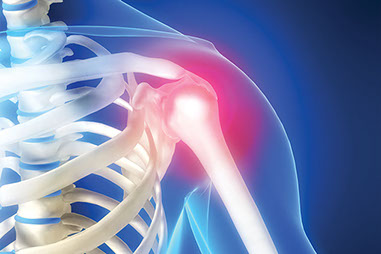
    Illustration of skeleton shoulder highlighted in red for pain.

    Any of these symptoms sound familiar?

    *  Sudden, sharp pain in the upper arm

    *  Popping or snapping you can hear in the shoulder or elbow

    *  Cramping of the biceps muscle with strenuous use of the arm

    *  Bruising from the middle of the upper arm down toward the elbow

    *  Pain or tenderness at the shoulder and the elbow

    *  Weakness in the shoulder and the elbow

    *  Difficulty turning the palm of the hand up or down

    Could be a torn or painful biceps muscle. And if you have that, you may also have a shoulder problem or a rotator cuff tear. Because a torn tendon can no longer keep the biceps muscles tight, a bulge in the upper arm above the elbow (“Popeye Muscle”) may appear, with a dent (signifying absence of muscle) closer to the shoulder.

    The first line of treatment for these types of injuries, according to orthopedic specialists, is a variety of nonsurgical options, such as rest, anti-inflammatory drugs, changing your activity, and physical therapy. Surgery can also be considered. But the best advice is to see your doctor, say experts at the American Academy of Orthopaedic Surgeons.

    © American Institute for Preventive Medicine

  • Vaginal Infections

    Women’s Health

    Vaginal infections are the most common reason American females see their doctors. Vaginal infections result in vaginitis (swelling of the vagina).

    Signs, Symptoms & Causes

    For Bacterial Vaginosis (BV)

    Nearly half of females with clinical signs of BV report no symptoms. When present, symptoms include:

    *  A thin, gray, or milky white vaginal discharge. This has a fishy odor, which is more noted after intercourse.

    *  Mild vaginal irritation or burning.

    Bacterial vaginosis results when certain bacteria outnumber normal and protective bacteria in the vagina. The exact cause is not known.

    Risk factors for BV include douching, using an IUD, and a change or an increase in sexual partners.

    For Vaginal Yeast Infections

    Vaginal yeast infections are also called Monilia, Candida, and fungal infections. Signs and symptoms range from mild to severe. They include:

    *  Thick, white vaginal discharge that looks like cottage cheese and may smell like yeast.

    *  Itching, irritation, and redness around the vagina.

    *  Burning and/or pain when urinating or with sex.

    Vaginal yeast infections result from the overgrowth of the fungus Candida. This is normally present in harmless amounts in the vagina, digestive tract, and mouth.

    Risk Factors for Vaginal Yeast Infections

    *  Hormonal changes that come with pregnancy or monthly periods. Taking hormones or birth control pills.

    *  Antibiotic use, especially “broad spectrum” ones. Corticosteroid medicine use.

    *  High blood sugar. This can occur when diabetes is not controlled.

    *  Sex that irritates the vagina a lot.

    *  Using douches. Using feminine hygiene sprays.

    *  Using hot tubs and jacuzzis a lot.

    Chronic vaginal yeast infections can be one of the first signs of diabetes, STIs, and HIV.

    Diagnosis

    Different vaginal infections have the same symptoms. This makes it hard to tell one from another. A doctor may need to diagnose the cause. A sample of vaginal fluid is taken and tested. Often, this takes less than 3 minutes.

    Treatment

    For Bacterial Vaginosis

    Prescribed antibiotic creams, gels, or pills are needed. Male sex partner(s) may also need treatment. Feminine hygiene sprays that mask vaginal odor should not be used. Nor should OTC medications, such as ones for vaginal yeast infections. These do not treat BV.

    For Vaginal Yeast Infections

    Prescribed and OTC vaginal creams or suppositories get rid of the Candida overgrowth. Oral medicines, such as Diflucan®, may be prescribed.

    Questions to Ask

    Self-Care / Prevention

    *  Take medications, as prescribed.

    *  For a repeat vaginal yeast infection, use an over-the-counter (OTC) antifungal vaginal medication, such as Monistat. Use it as directed. {Note: Stop using any OTC product for a vaginal yeast infection at least 24 hours before a vaginal exam.}

    *  Ask your pharmacist about an OTC cream for itching and burning to help with symptoms during treatment.

    *  Bathe or shower often. Clean the inside folds of the vulva. Dry the vaginal area well.

    *  Wipe from front to back after using the toilet.

    *  If your vagina is dry, use a water soluble lubricant, such as K-Y Liquid®, when you have sex.

    *  Wear all-cotton underwear. Don’t wear garments that are tight in the crotch. Change underwear and workout clothes as soon as possible after you sweat.

    *  Don’t use bath oils, bubble baths, feminine hygiene sprays, or perfumed or deodorant soaps.

    *  Don’t sit around in a wet bathing suit. Shower after you swim in a pool to remove the chlorine from your skin. Dry the vaginal area well.

    *  Eat well. Limit sugar and foods with sugar. Eat foods, such as yogurt, that contain live cultures of “lactobacillus acidophilus.” If you can’t tolerate yogurt, take an OTC product that has this.

    *  Let your doctor know if you are prone to getting yeast infections whenever you take an antibiotic. You may be told to also use a vaginal antifungal product.

    *  If you still menstruate, use unscented tampons or sanitary pads and change them often.

    Women's Self-Care book by the American Institute for Preventive Medicine. www.HealthyLife.com. All rights reserved.

    © American Institute for Preventive Medicine