Tag: triggers

  • Asthma

    Respiratory conditions

    Asthma is a chronic disease that causes the airways to narrow. Airflow is limited due to inflammation in the airways.

    General Information

    Symptoms

    *  A cough lasts more than a week. Coughing may be the only symptom. It often occurs at night or early in the morning.

    *  Shortness of breath. Breathing gets harder and may hurt. It is harder to breathe out than in.

    *  Wheezing (high pitched whistling sound)

    *  Tightness in the chest

    Causes & Risk Factors

    *  Genetic Factors. You are more likely to have asthma if other members of your family have or had it.

    *  Environmental Factors. Being exposed to certain things can set off an immune system response for asthma to develop. Examples are house-dust mites and viral respiratory infections.

    Diagnosis

    A doctor diagnoses asthma from:

    *  Your medical history

    *  Your family’s medical history

    *  Your symptoms

    *  A physical exam

    *  Lung function tests in persons age 5 years and older

    *  Other tests to check for conditions that have symptoms of asthma, but are not asthma

    Asthma Attack Triggers

    People with asthma have very sensitive airways. Exposure to triggers causes a response in the airways called an asthma attack or an asthma episode.

    With an asthma attack:

    *  Air becomes trapped in the lungs.

    *  The lining of the airways becomes inflamed.

    *  The muscles around the air tubes tighten.

    *  Thick mucus clogs the airways.
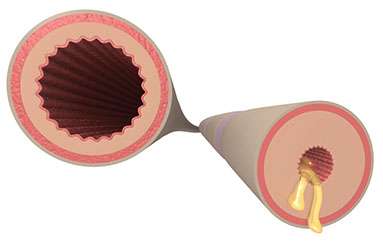
    Illustration of airway.

    (The last three things cause the airways to narrow.)

    Problems That Make It Harder to Manage Asthma

    *  Reflux of stomach acids which cause heartburn, belching, or spitting up

    *  Being overweight or obese

    *  Allergic rhinitis or sinusitis

    *  Sleep apnea that obstructs breathing

    *  Stress and depression

    Treating these problems may help improve asthma control.

    Common Asthma Attack Triggers

    *  Respiratory infections (colds, flu, bronchitis, etc.)

    *  Tobacco smoke

    *  Dust mites

    *  Animal dander (small pieces of skin, hair, or feathers from warm-blooded animals, such as dogs, cats, birds, etc.)

    *  Cockroach droppings

    *  Molds (indoor and outdoor)

    *  Strong odors and sprays from paints, new carpet, perfumes, etc.

    *  Air pollution

    *  Cold air and changes in temperature and humidity. Weather changes can also affect how much pollen and mold are in the air.

    *  Having strong feelings (laughing, crying, etc.)

    *  Sulfites. These are additives in wine and some foods, such as processed potatoes and dried fruits. Shellfish packed in ice that has sulfites can pick up the sulfites from the ice.

    *  Aspirin and other nonsteroidal anti-inflammatory drugs (NSAIDs), such as ibuprofen

    *  Beta blocker medicines. These are prescribed for heart disease, high blood pressure, and migraine headaches.

    When to Seek Medical Care

    Reasons to Call Doctor

    Call your doctor when you feel the first change in your asthma status. Deal with a problem early to help prevent a severe problem.

    *  You have asthma and have a cold or a fever.

    *  You cough up mucus that is bloody-colored, green, or yellow.

    *  An asthma attack does not respond to your medication.

    *  Medication is not helping like it used to.

    *  Your peak expiratory flow (PEF) numbers are in the yellow zone.

    *  You have a harder time breathing or you are short of breath more often than before.

    *  You breathe faster than usual.

    *  Your asthma attacks are coming more often or are getting worse.

    *  You use your rescue medication more than 2 times a week.

    Reasons to Get Medical Care Fast

    *  Your peak expiratory flow (PEF) numbers are in the red zone.

    *  You have a fever with heavy breathing.

    *  You have extreme shortness of breath. It may feel as if you can’t breathe at all. Or, you can’t say 4 or 5 words because you are so short of breath. Call 911!

    *  You cough so much that you can’t take a breath. Call 911!

    *  Your lips or fingernails are bluish in color. Call 911!

    Focus on breathing slow and easy until you get medical care. Sit upright. Try to remain as calm and relaxed as you can.

    Peak Flow Meters

    These devices measure peak expiratory flow (PEF). PEF is the amount of air blown out after taking a deep breath. Your PEF readings can tell you and your health care provider:

    *  About asthma triggers

    *  If an asthma attack is starting. PEF is decreased with an asthma attack.

    *  If your medicine plan is working

    *  When to add or stop medicine

    *  How severe your asthma is

    Use your peak flow meter, as directed by your doctor or health care provider.

    Find Your Personal Best Peak Flow Number

    Your personal best peak flow number is the highest peak flow number you can get over a 2-week period when your asthma is under good control. Good control is when you feel good and do not have any asthma symptoms.

    Take peak flow readings:

    *  Twice a day for 2 weeks – when you wake up and  about 10 to 12 hours later

    *  Before and after taking an inhaled beta2-agonist (if you take this medicine)

    *  As advised by your doctor or health care provider

    The Peak Flow Zone System

    Once you know your personal best peak flow number, your health care provider will give you the numbers that tell you what to do. The peak flow numbers are put into zones that are set up like a traffic light.

    Green Zone (80 to 100 percent of your personal best number). This signals all clear. No asthma symptoms are present, and you may take your medicines as usual.

    Yellow Zone (50 to 80 percent of your personal best number). This signals caution. You may need to take more of your asthma medicine(s) to treat your asthma. Or, your overall asthma may not be under control, and the doctor may need to change your asthma action plan.

    Red Zone (below 50 percent of your personal best number). This signals a medical alert. You must take an inhaled beta2-agonist right away and call your doctor without delay if your peak flow number does not return to the Yellow or Green Zone and stay in that zone.

    Treatment

    The goals of treatment are to:

    A. Prevent asthma attacks and control or treat asthma symptoms as they occur

    B. Allow normal daily activities, including exercise

    C. Promote restful sleep, free from waking up with asthma symptoms

    D. Do A, B, and C with few or no side effects from asthma medications

    E. Have no need for emergency medical care or to be hospitalized due to asthma

    Treatment for asthma varies on how severe it is and how well it is controlled. Since a person’s asthma can change over time and the response to medications may be age-related, asthma treatment guidelines are given for three different age groups:

    *  0-4 years

    *  5-11 years

    *  12 years and older

    A good way to help you manage your asthma is to follow a written action management plan that you develop with your doctor or health care provider. Your plan should include:

    *  What to do daily to avoid and deal with your asthma triggers and what to do when you have an asthma attack

    *  Names and doses of medicines to take daily and when you have specific symptoms

    *  Reasons to contact your doctor or to get medical care fast

    *  Your plan should be tailored for your needs.

    Keep a journal of your asthma symptoms. Include:

    *  When you had symptoms and what may have caused them. What you did to treat the symptoms. List the medicines you took, how you took them, and how much you took.

    *  Your peak flow meter readings. Record these before and after treatment steps.

    *  Results of the treatment steps you took

    Self-Care

    *  Know your warning signs and peak flow zones so you can begin treatment early. Monitor your peak expiratory flow rates. (See “Peak Flow Meters”.)

    *  Keep your asthma rescue medicine handy.

    *  Get a yearly flu vaccine, as advised.

    During an asthma attack:

    *  Sit up. Don’t lie down.

    *  RELAX. Keep calm. Focus on breathing slow and easy. Remove yourself from any stressors.

    *  Take the right amount of medicine, as prescribed in your asthma control plan. Call your doctor if you need to take more medicine than prescribed.

    Avoid your asthma triggers

    *  Do not smoke. Do not allow smoking in your home, car, or around you. Avoid air pollution.

    *  Use bedding, flooring, paint, vaccum cleaners, toys, and other products that are “Certified Asthma & Allergy Friendly™.” (Search for items fromwww.asthmaandallergyfriendly.com.) It is especially helpful to use these products in your bedroom and/or:

    – Sleep with no pillow or one your doctor suggests. Use a “dust-mite proof” cover to enclose your mattress and pillow (if you use one). Wash all bedding in hot water every week.

    – Try not to keep stuffed animals in the bedroom. If you must, have only one that can be washed. Wash it in hot water once a week.

    – Use curtains and rugs that can be washed often. Avoid carpeting, bed ruffles, and throw pillows.

    – Get someone else to vacuum and dust once or twice a week. Use a vacuum with a HEPA filter or double-thickness bags. If you dust or vaccum, wear a dust mask.

    – Reduce clutter in your bedroom. Store items in plastic containers with lids.

    – It is best not to keep a TV, DVD-player, etc. in your bedroom. These, too, can collect dust.

    *  Put an air filter on your furnace or use a portable air purifier, such as one with a HEPA filter.

    *  Stay out of the cold weather as much as you can.

    *  Change and/or wash furnace and air conditioner filters on a regular basis. Keep indoor humidity below 60 percent.

    *  When you are outside in cold weather, wear a scarf around your mouth and nose to warm the air as you breathe in.

    *  Stop exercising if you start to wheeze.

    *  If you are sensitive to sulfites, don’t take foods or medicines that have them. Sulfites are in wine, some processed potatoes and dried fruits. Shellfish packed in ice that has sulfites can pick up the sulfites from the ice.

    *  Drink plenty of liquids (2-3 quarts a day) to keep secretions loose.

    *  Don’t take over-the-counter medications unless cleared first with your doctor or health care provider.

    – Antihistamines dry nasal secretions and can cause airways to plug up by making secretions thicker. Antihistamines are also found in some cold remedies, so check labels.

    – Some ulcer drugs increase the effects of some bronchodilators.

    – Aspirin can trigger an attack in 3-5 percent of persons with asthma who have nasal polyps. Acetaminophen doesn’t have this effect.

    Medications

    Some medications are to be taken with an asthma attack. Other kinds are taken daily (or as prescribed) to help prevent asthma attacks.

    Long-Term Control Medicines

    These are taken daily (or as prescribed) to help prevent asthma attacks. Examples are:

    *  Corticosteroids. These help with the swelling in the airways that cause asthma symptoms. They can prevent, reduce, and/or reverse the swelling.

    – Inhaled corticosteroids (ICSs). These are the most effective long-term medicines that control asthma. These are not the same as anabolic steroids that athletes may abuse.

    – Oral corticosteroids. An example is prednisone. These are usually given for a short time, when a person’s asthma is not being controlled. Long-term use of these may be prescribed for persons with severe asthma that persists.

    *  Cromolyn sodium and nedocromil. These help prevent swelling in the airways when exposed to asthma triggers. They treat mild asthma that persists.

    *  LABAs (long acting beta2-agonists). These are bronchodilators. They relax the muscles of the airways. They are usually taken with ICSs to help control moderate and severe asthma and to help prevent symptoms during the night.

    *  Leukotriene modifiers. These prevent swelling in the airways and decrease mucus in the lungs. They treat mild asthma that persists or are combined with ICSs to treat moderate or severe asthma.

    *  Theophyllines. These are mild to moderate bronchodilators that may have mild anti-inflammatory effects.

    *  Medicines that modify the body’s immune response.

    Quick-Relief Medicines

    These are used to treat symptoms of an asthma attack. They help stop asthma symptoms before they get worse. They may be prescribed for use at other times, too, such as before exercising. Examples are:

    *  SABAs (short-acting beta-agonists). These are bronchodilators. They work quickly to relax the muscles of the airways and open up the air passages in the lungs and are the treatment of choice to relieve acute symptoms. They are usually taken in an inhaled form.

    *  Anticholinergics. These help prevent airway muscles from tightening and help keep mucus from forming. These are usually taken in an inhaled form.

    With proper treatment and monitoring of symptoms, asthma can be controlled. People with asthma can live active and healthy lives.

    Resources

    The Asthma and Allergy Foundation of America

    800.7.ASTHMA (727.8462)

    www.aafa.org

    National Heart, Lung, and Blood Institute

    301.592.8573
    www.nhlbi.nih.gov

    Asthma brochure by the American Institute for Preventive Medicine. www.HealthyLife.com. All rights reserved.

    © American Institute for Preventive Medicine

  • Is Your Relationship In Trouble?

    SUCCESS OVER STRESS

    Image of couple not getting along.

    Is your relationship stormy? Indifferent? One-sided? According to Pennsylvania psychologist, Dr. Michael S. Broder, these are the three types of troubled relationships. They account for the high divorce rate, as well as the much higher percentage of non-married relationships that end.

    Stormy Relationship:

    This type has plenty of passion, but it may not be the positive kind. Positive passion is a relationship at its best. Too much negative passion results in a great amount of anger and discomfort. At the extreme, these relationships can become abusive and even dangerous. A relationship with a lot of passion and little or no comfort can still be highly charged romantically and sexually. In some cases the most passionate sex actually occurs after the meanest and volatile arguments. The sad part is that the cause of the anger is never dealt with or resolved. Thus, the pattern can continue indefinitely.

    Indifferent Relationship:

    With this type, most-if not all-of the passion is missing. There can be a very comfortable living arrangement, but partners may have little feeling or sexual desire for each other. Sometimes partners simply grow apart without anger, or there can be as much anger as there is in the typical stormy relationship. The main difference is that there’s just not the tendency to argue or do battle with each other. This may be a result of the partners’ personality styles, or the absence of passion-including negative passion. Instead, the relationship merely begins to die a slow and quiet death. In other words, it may be brain alive but heart dead.

    One-Sided Relationships:

    In this type, one person usually puts out much more effort and energy to maintain and nurture the relationship than does the other. One partner can be quite content, having all the passion and comfort he or she needs. Yet the other partner feels somewhat to totally unfulfilled.

    In all types of troubled relationships it is important to ask: “What is the potential for change?” If the answer is none, the next question to ask yourself is, “Is this where I still want to be?”

    Adapted from Can Your Relationship Be Saved? How to Know Whether to Stay or Go by Dr. Michael S. Broder.

    © American Institute for Preventive Medicine
  • Headaches

    Brain & Nervous System

    Women sitting with blanket and holding forehead.

    Persons who suffer from headaches should see a doctor for proper diagnosis and treatment.

    Common causes of headaches are tension, sinus problems, tobacco smoke, low blood sugar, and things in your diet like red wine, aged cheese, and MSG.

    Keep a diary of when headaches occur, how long they last, and where and how severe the pain is. Keep track of other symptoms, such as nausea, too. Show this diary to your doctor to help them identify which type of headache you have and the most beneficial treatments.

    The most common treatments for headaches are rest and over-the-counter pain relievers. It is best to treat headaches when they begin or when they are still mild. Prescription medication may also be prescribed by your doctor.

    In addition to medicine, self-care practices can also help manage your symptoms and prevent headaches. Examples include putting a heat or ice pack on your head or neck, getting enough quality sleep, and drinking plenty of water.

    Health at Home Lifetime book by the American Institute for Preventive Medicine. www.HealthyLife.com. All rights reserved.

    © American Institute for Preventive Medicine

  • Headaches 2

    General Health Conditions

    Causes

    *  Anxiety, stress, caffeine withdrawal, or depression

    *  Lack of sleep. Poor sleep position.

    *  A sensitivity to certain foods and drinks.

    *  Reading a lot, especially in dim light

    *  Missing or delaying a meal

    *  Doing boring work

    *  Being in one position for a long time, like at a computer

    *  Hormone changes that come  with menstruation, while taking birth control pills, etc.

    *  Exposure to chemicals and/or pollution

    *  Side effects from some medications

    *  Dirty or polluted air

    *  Airplane travel

    *  Alcohol

    *  Poison

    *  Poor posture

    *  Cigarette smoke

    *  Too much physical activity

    *  Bright lights. This includes watching TV.

    *  Movement, such as riding in a car or elevator

    *  Loud noises

    *  Strong odors

    *  Eating or drinking something very cold, such as ice cream

    Types

    You can have cancer for years without having symptoms. There is usually no pain at the onset of cancer. As different types of cancers grow, warning signs may occur. See your doctor for a proper diagnosis.

    For Tension or Muscular Headaches

    About 90 percent of all headaches are tension or muscular headaches. These headaches respond well to self-care, without causing ongoing problems. Symptoms include:

    *  You have a dull ache in your forehead, above your ears, or at the back of your head.

    *  You feel pain in your neck or shoulders.

    Tense or tight muscles in the face, neck, or scalp result in these headaches. Common causes are:

    *  An illness

    *  Fever

    *  Tiredness

    *  Stress

    *  Worry

    *  Concentrating hard for long periods of time

    For Sinus Headaches

    Symptoms

    *  The pain is in your forehead, cheekbones, and nose.

    *  The pain is worse in the morning.

    *  It hurts more if you bend over or touch your face.

    *  Your nose is stuffy.

    Sinuses are behind your cheeks, around your eyes, and in your nose. You may get a sinus headache from:

    *  A cold or upper respiratory infection

    *  Allergies, like hay fever

    *  Other breathing problems

    *  Swimming in dirty or polluted water

    *  Airplane travel

    These things interfere with fluid drainage in the nose, causing a buildup of pressure. Pain results.

    For Cluster Headaches

    Cluster headaches usually start at night, can last from 15 minutes to 3 hours, and can interrupt sleep. They can also start during the hours a person is awake. These headaches come once or twice a year, usually in older men, and tend to run in families.

    Cluster headaches are much less common than migraines. Spring and autumn are the most common times of the year for them. Symptoms include:

    *  The pain is on one side of your head.

    *  The pain is in or on the sides of your eyes.

    *  Your eyes are watery.

    *  The pain is sharp, burning, and intense.

    *  Your pupils look smaller.

    *  One or both of your eyelids droop.

    *  You get headaches in groups (clusters), everyday for a week or longer.

    For Children’s Headaches

    Children’s headaches that come once in a while can be treated with ibuprofen or acetaminophen. Make sure you use the right type and dose for your child’s weight. Don’t give aspirin to anyone younger than 19 years of age due to its link to Reye’s Syndrome. Reye’s Syndrome is a rare disease that can cause death. It usually occurs 7 to 10 days after the onset of the flu or chicken pox. If the child complains of head pain on a regular basis, take the child to his or her doctor. Symptoms:

    *  The headaches tend to be shorter than ones in adults.

    *  Sometimes, an upset stomach and vomiting are also present.

    *  Headaches come in groups, then are gone for months.

    For Migraine Headaches

    Migraines happen when blood vessels in your head open too wide or close too tight. At least one in eight adults suffer from migraines. Women have migraines more often than men. Migraines tend to run in families, too. Symptoms include:

    *  One side of your head hurts more than the other.

    *  You feel sick to your stomach or throw up.

    *  You may see spots or zigzag flashes of light.

    *  Light hurts your eyes.

    *  Noise bothers you.

    *  Your ears ring.

    *  Your face is pale.

    *  After the headache, some people have a drained feeling with tired, aching muscles. Others feel great after the headache goes away.

    Types of Migraine Headaches

    *  Migraines with an aura. An aura is when a person sees spots or flashing lights for 10 to 15 minutes or his or her face becomes numb. (Ten percent of migraines are this type.)

    *  Migraines without an aura. They start more slowly and tend to last longer than migraines with an aura. They don’t begin with changes in a person’s vision or numbness. (Ninety percent of migraines are this type.)

    Prevention

    Keep a headache diary. Write down when, where, and why the headaches seem to start. Try to avoid things that trigger headaches.

    Be aware of early symptoms. Try to stop the headache as it begins.

    *  Exercise on a regular basis.

    *  Keep regular sleep hours, even on weekends.

    *  Don’t smoke. If you smoke, quit.

    *  Cut down on salt.

    *  Avoid excess alcohol. Alcohol can lead to a “hangover” headache.

    *  Don’t have foods and drinks known to trigger headaches in sensitive people.

    Foods and Drinks That May Cause Headaches

    *  Alcohol, especially red wine

    *  Bananas (if more than 1/2 banana daily)

    *  Beans: Broad, lima, fava, snow peas

    *  Brewer’s yeast

    *  Caffeine (from coffee, tea, cola soft drinks, some medications, chocolate) or caffeine withdrawal

    *  Chicken livers, paté

    *  Citrus fruits (if more than 1/2 cup daily)

    *  Cured meats (hot dogs, luncheon meats, etc.)

    *  Figs, raisins, papayas, avocados, red plums (no more than 1/2 cup daily)

    *  Foods with MSG (monosodium glutamate), such as soy sauce, meat tenderizers, seasoned salt

    *  Hard cheeses (aged cheddar, provolone, etc.)

    *  Herring, pickled or dried

    *  Nuts and peanut butter

    *  Onions

    *  Pickled, preserved, or marinated foods

    *  Sauerkraut

    *  Sour cream

    *  Sourdough bread

    *  Vinegar

    Treatment

    Usually, headaches are not linked to serious health problems. Self-care treats most headaches.

    Self-Care

    *  Rest in a quiet, dark room with your eyes closed.

    *  Rub the base of your skull with your thumbs. Work from the ears toward the center of the back of your head. Also, rub gently along the sides of your eyes, your shoulders, neck, and jaw.

    *  Take a warm bath or shower.

    *  Place a cold or warm washcloth, whichever feels better, over the area that aches.

    *  Take an over-the-counter (OTC) medicine (that your provider recommends) for pain. Take it right away.

    *  Relax. Imagine a calm scene. Meditate or breathe deeply.

    Medication

    *  Over-the-counter (OTC) pain medications. Examples are aspirin, ibuprofen, naproxen sodium and ketoprofen. Most tension and muscular headaches go away with OTC medications. Some OTC medicines (e.g., Excedrin Migraine® and Motrin Migraine Pain®) are FDA approved for migraine headaches.

    *  Prescribed medicines. Examples are:

    – Triptan drugs, such as sumatriptan

    – Ergotamines, with or without caffeine

    – Antihistamines

    – Beta-blockers

    – Calcium channel blockers

    – Tricyclic antidepressants

    Take medicines as prescribed.

    Biofeedback

    Biofeedback is a process of learning how to control internal functions to relieve pain. Biofeedback training has helped many people who have suffered from headaches.

    These things occur with biofeedback:

    *  A biofeedback therapist explains how the muscles react to stress and cause tension headaches.

    *  Most of the time, you sit in a comfortable chair in a dimly lit room.

    *  A headband, connected to a machine, is fastened across your forehead. The machine emits a steady sound that changes if muscles in the head or neck are tensed.

    *  A small thermometer is attached to one of your fingers. Another machine keeps track of your temperature.

    *  You learn how to use these biofeedback machines.

    *  You learn to control the automatic response of your muscles and blood vessels that cause headaches.

    *  Then you learn to do the same thing without the machines to control headaches on your own.

    Medical Care

    Reasons to Get Medical Care Fast

    *  A headache due to a serious head injury or a blow to the head causes severe pain, enlarged pupils, vomiting, confusion, or feeling sleepy.

    *  Severe pain occurs in and around one eye.

    *  A severe, persistent headache occurs with a stiff neck or a red or purple rash that doesn’t fade when pressure is applied to the skin.

    *  The headache came on suddenly and hurts much more than any headache you have ever had.

    Call 9-1-1 if signs of a stoke occur:

    *  A sudden and severe headache with no known cause

    *  Sudden numbness or weakness of the face, arm or leg, especially on one side of the body

    *  Sudden confusion, trouble speaking or understanding

    *  Sudden trouble seeing in one or both eyes

    *  Sudden trouble walking, dizziness, loss of balance or coordination

    Reasons to Call Doctor or Health Care Provider

    *  The headache has lasted more than 2 to 3 days and keeps getting worse.

    *  Migraine headaches (intense, throbbing, one-sided, often with nausea or vomiting) occur often. Flashing lights or spots may precede the pain.

    *  A headache persists or recurs and is present with nausea or vomiting.

    *  A headache started after taking a new medicine (prescribed or over-the-counter).

    Work with Your Health Care Provider

    For headaches that do not need medical care fast, contact your primary care provider first. Most likely, he or she will be able to figure out the type of headache you have. If not, he or she can refer you to a specialist. Tips on working with your doctor or health care provider:

    *  Make notes before your office visit.

    *  List every symptom, even if it seems minor.

    *  Be honest with your health care provider. The facts you give could be important in finding out why you have headaches.

    *  Follow your doctor’s advice. Let him or her know if the prescribed treatment helps. Tell your doctor if you have any side effects from treatment.

    *  Answer these questions before your office visit:

    – When did your headaches begin (days, weeks, months, years ago)?

    – How long does your headache last (minutes, hours, days)?

    – How often do you have these headaches (once a day, once a week, etc.)?

    – Where does it hurt (both sides, one side, etc.)?

    – How does the pain feel (dull, sharp, throbbing, nonstop)? How does the pain usually start (dull or sharp)?

    – Is there a pattern to your headaches? Are they gone for months at a time then come back several times a day? Are they worse lately?

    – Are your headaches different from each other? (You may have more than one kind.)

    – When does the pain usually start (at night, in the morning)?

    – Are there any symptoms just before the headache begins (stuffy nose, pain elsewhere, flashing lights)?

    – Do any other symptoms occur with the headache (upset stomach, pain elsewhere)?

    – What helps the headache go away (rest, medicine, hot or cold treatment, massage)?

    – Does anything make the pain worse (moving the head, standing or lying)?

    – Does an activity or situation bring on headaches (after exercise or eating a certain food)?

    – Are you taking any other medicines or drugs?

    – Is another health care provider treating you for anything else?

    Resources

    National Headache Foundation

    800.843.2256

    www.headaches.org

    Headaches brochure by the American Institute for Preventive Medicine. www.HealthyLife.com. All rights reserved.

    © American Institute for Preventive Medicine

  • Recognize And Treat Early Signs Of Burnout

    SUCCESS OVER STRESS

    Image of business man with a notebook over his head.

    Burnout isn’t something that happens overnight. It occurs over time from repeated and unresolved frustration or constant pressure to perform or achieve. With burnout, you feel exhausted, worn out, and detached from others. You feel as if you have nothing more to give and simply do not care about anything. Burnout puts your job, your relationships and your health in jeopardy.

    Signs on the road to burnout

    *  Too much work, not enough relaxation

    *  Feeling as if you have no control over your job

    *  Anger

    *  Fatigue

    *  Sleep problems

    *  Escaping through alcohol, drugs, TV, eating or gambling

    *  Avoiding making decisions

    *  Negative view of yourself and the world

    Also, some traits increase the risk for burnout. These include the need to be in control, wanting everything to be perfect and being a workaholic.

    Ten tips to prevent burnout

    1. Set career and personal goals that can be achieved.

    2. Follow healthy eating and sleeping habits.

    3. Exercise daily – At least 30 minutes most days of the week.

    4. Try not to spread yourself too thin. Delegate tasks at work and at home.

    5. Reduce long work or study hours, if you can. The more you do and the less you rest, the more likely burnout will occur.

    6. Take regular five to 10 minute relaxation breaks. Take mental breaks from stressful situations, too.

    7. Make time for leisure activities that you enjoy and look forward to.

    8. Get creative with a hobby or activity that has nothing to do with work.

    9. Manage stress through meditation, yoga, or therapy.

    10. Plan a vacation one or more times a year. Leave your work at home!

    Discuss feelings and problems you are having with your family, friends, and coworkers. Talking helps ease feelings of frustration that can feed burnout. It things do not get better seek professional help.

    © American Institute for Preventive Medicine

  • Headaches 3

    Women’s Health

    Headaches are a common health complaint in women.

    Signs, Symptoms & Causes

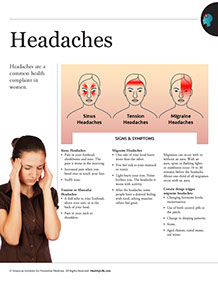
    For Tension or Muscular Headaches

    *  A dull ache in your forehead, above your ears, or at the back of your head.

    *  Pain in your neck or shoulders.

    Common causes are tense or tight muscles in the face, neck, or scalp, concentrating hard for long periods of time, stress, and lack of sleep.

    For Sinus Headaches

    *  Pain in your forehead, cheekbones, and nose. The pain is worse in the morning.

    *  Increased pain when you bend over or touch your face.

    *  Stuffy nose.

    A sinus headache occurs when fluids in the nose aren’t able to drain well and a buildup of pressure occurs in the sinuses. A cold, allergies, dirty or polluted water, and airplane travel can cause a sinus headache.

    For Migraine Headaches

    *  One side of your head hurts more than the other.

    *  You feel sick to your stomach or vomit.

    *  Light hurts your eyes. Noise bothers you. The headache is worse with activity.

    *   After the headache, some people have a drained feeling with tired, aching muscles; others feel great.

    Migraines can occur with or without an aura. With an aura, spots or flashing lights or numbness occur 10 to 30 minutes before the headache. Ten percent of all migraines are this type; 90% occur without an aura.

    Migraine headaches happen when blood vessels in your head open too wide or close too tight. They tend to run in families and affect nearly 30% of women at some time during their lives. They occur more often in women than in men.

    Migraines occur less often during pregnancy (especially the second half) and often disappear during menopause. Some women, though, may get migraines for the first time during menopause.

    Certain things trigger migraine headaches:

    *  Changing hormone levels. Menstruation.

    *  Use of birth control pills or the patch.

    *  Change in sleeping patterns.

    *  Stress.

    *  Aged cheeses. Cured meats. Red wines.

    Other Causes of Headaches

    *  Analgesic rebound from regular or repeated use of over-the-counter or prescribed pain relievers.

    *  Eating or drinking something very cold, such as ice cream. {Note: To prevent ice cream headaches, warm the ice cream for a few seconds in the front of your mouth.}

    *  Caffeine withdrawal.

    *  Low blood sugar, hunger, or sensitivity to certain foods and drinks.

    *  A symptom of a health problem. Examples are allergies, depression, high blood pressure, dental problems, and a pinched nerve in the neck.

    *  Cigarette smoke, pollution, etc.

    *  Uncorrected vision problems.

    Treatment

    Self-care can treat headaches caused by tension, fatigue, and/or stress. Certain over-the-counter medicines and prescribed medicines can treat sinus headaches and migraine headaches.

    Biofeedback has helped many people who have suffered from headaches.

    Headaches that are symptoms of health problems are relieved when the condition is treated with success.

    Questions to Ask

    Self-Care / Prevention

    *  Don’t smoke. If you smoke, quit!

    *  Try to stop the headache when it starts.

    *  Take an over-the-counter (OTC) medicine for pain as directed on the label.

    *  Rest in a quiet, dark room with your eyes closed.

    *  Massage the back of your neck with your thumbs. Work from the ears toward the center of the back of your head. Also, rub gently along the sides of your eyes. Gently rub your shoulders, neck, and jaw. Get a massage.

    *  Place a cold or warm washcloth or hot or cold pack, whichever feels better, over the area that aches.

    *  Take a warm bath or shower.

    *  Relax. Picture a calm scene in your head. Meditate or breathe deeply.

    *  Keep a diary of when, where, and why headaches occur.

    *  Get enough rest.

    *  Eat 5 to 6 small meals instead of 3 large meals. To ward off low blood sugar, don’t skip meals. Avoid sweets.

    *  Keep regular sleeping times as much as you can.

    *  When lying down, use a pillow that supports the neck. Sleep on your back.

    *  Avoid scents, foods, and beverages that trigger headaches.

    *  To help prevent headaches and nausea caused by a hangover, try an OTC product, such as Chaser-Freedom From Hangovers.

    *  For a hangover: After drinking alcohol, take an OTC pain reliever. Eat solid foods. Rest or sleep. Have 2 or more glasses of water before you go to sleep. Drink 2 or more glasses of water when you wake up.

    Foods and Drinks that May Cause Headaches

    *  Alcoholic beverage, especially red wine

    *  Aspartame (the artificial sweetener in NutraSweet®)

    *  Bananas (if more than 1/2 banana a day)

    *  Caffeine from coffee, tea, cola soft drinks, chocolate, or some medications

    *  Lack of caffeine if abruptly stopped, such as stopping coffee intake

    *  Citrus fruits (if more than 1/2 cup a day)

    *  Cured meats, such as frankfurters

    *  Food additives, such as monosodium glutamate (MSG)

    *  Hard cheeses, such as aged cheddar or provolone

    *  Nuts and peanut butter

    *  Onions

    *  Sour cream

    *  Soy sauce

    *  Vinegar

    Resources

    National Headache Foundation

    888.NHF.5552 (643.5552)

    www.headaches.org

    Women's Self-Care book by the American Institute for Preventive Medicine. www.HealthyLife.com. All rights reserved.

    © American Institute for Preventive Medicine

  • Nausea And Vomiting

    Pregnancy & Prenatal Care

    Nausea is when you feel like throwing up. Vomiting is when you do throw up. They are both signs of morning sickness. It is usually due to changes in hormones. Low blood sugar levels also cause it.

    Despite its name, morning sickness can happen any time of day. It can even happen in the evening. Morning sickness usually begins around the 6th week. For most women, it ends after the first trimester. For some, it lasts longer. For a few, it can last the whole pregnancy.

    Upset stomach and throwing up can also be caused by:

    *  A virus in the intestines. Diarrhea can go along with this.

    *  Spoiled food

    *  Eating or drinking too much

    Questions to Ask

    Self-Care / Prevention

    *  Keep crackers or dry cereal by your bed. Eat a few crackers or a handful of dry cereal in bed. Do this before you lift your head up in the morning.

    *  Get up and out of bed slowly. If you can, sit in bed for a half-hour before you get up.

    *  Use these tips to keep your blood sugar from getting too low:

    – Eat small regular meals and snacks through the day. Focus on foods high in carbohydrates. Examples: whole grain breads and cereals, potatoes, pasta. More examples: rice, beans and other legumes, vegetables, fruits.

    – Have a good source of protein at each meal. Examples: low-fat milk, yogurt, low-fat cheese, dry beans, dry peas.

    – Have a snack before you go to bed at night. Have one if you wake up at night.

    – Avoid foods with high sugar content.

    – Don’t drink alcohol.

    *  Don’t smoke.

    *  Don’t eat fried or greasy foods. These foods have a lot of fat. Fat stays in the stomach for a long time. This can lead to nausea.

    *  Don’t eat spicy foods.

    *  Don’t take any medicine without your health care provider’s okay.

    *  Take your prenatal vitamins (vitamin pills) with meals. This helps prevent stomach upset. Your doctor may prescribe PremesisRx®. This is a vitamin that helps nausea.

    *  Ask your health care provider about taking ginger and in what form.

    *  Write down the times when your stomach is upset and when you throw up. These may happen only after you eat certain foods. Or they may happen with certain smells. Once you know what they are, you can avoid them.

    *  Stay away from smoke and smoky rooms. Even stay away from cooking smells.

    *  Get plenty of rest.

    *  Discuss any home remedies with your health care provider. Do this to make sure they are safe.

    *  Ask your health care provider about a relief band. That’s a wrist band that helps with an upset stomach and throwing up.

    *  If the Self-Care Tips bring no relief, call your health care provider. He or she can prescribe medicines. Sometimes, IV fluids are needed.

    *  To get rid of cooking smells and odors:

    – Open the windows.

    – Run fans in the house. Use the exhaust fan on the stove.

    – Use a portable air cleaner or air purifier.

    Prenatal Self-Care book by the American Institute for Preventive Medicine. www.HealthyLife.com. All rights reserved.

    © American Institute for Preventive Medicine

  • Alter Your Eating Cues

    Healthylife® Weigh

    Part 4

    Rye sandwich with ricotta, herbs and basil.

    Eating cues are things that prompt you to eat. They come from links your brain has made between eating and other events. When done over and over again, the event itself triggers eating. Some examples of events that trigger eating are:

    *  Morning coffee breaks: Doughnuts, sweet rolls

    *  Watching football on TV: Potato chips, beer

    *  Shopping at the mall: Big cookies, soft pretzels, soda, specialty coffee

    *  Going to a movie: Buttered popcorn, soda, candy

    *  Going out to celebrate: Large meals, desserts, alcoholic beverages

    *  Attending sporting events: Beer, hot dogs, nachos with cheese, peanuts

    Focus on triggers that you face most often and that lead you to eat foods high in added sugar, saturated fat, and/or sodium.

    It is possible to break these links. The more you practice a new behavior, the stronger it becomes. You may want to replace eating with a non-eating behavior. Or, you may want to practice choosing a healthier food or drink at that time.

    Ways to Alter Eating Cues

    *  Eat a snack before going somewhere (including out to eat).

    *  If allowed, bring your own healthy snack.

    *  Bring or buy a “fun-sized” or small portion of the treat you are craving (if available).

    *  Eat meals and snacks in one specified place at home, such as the kitchen or dining room table.

    *  Never eat while standing-always be seated.

    *  Do no other activity, such as watching TV, while eating.

    *  Try to eat meals at the same time each day.

    *  Take along bottled water and high fiber snacks to places that trigger high-calorie drinking and eating.

    *  Take a walk break instead of a morning coffee break.

    *  Avoid walking by places that tempt you to eat while you shop.

    *  Go to places, be with people and/or do things not associated with eating.

    *  Take longer to eat a meal.

    *  Use utensils to eat.

    *  Put your fork or spoon down between bites.

    *  Chew & swallow each bite before taking another one.

    *  Take sips of water between bites.

    *  Split a meal or snack with someone else.

    © American Institute for Preventive Medicine