Tag: ulcer

  • Canker Sores

    Dental & Mouth Concerns

    Canker sores are small, round mouth sores in the lining of the mouth or on the tongue, gums, or lips. You can have one canker sore or a group of them.

    Signs & Symptoms

    *  A burning or tingling feeling before the sore appears

    *  Red-rimmed, shallow sores in the mouth

    *  Discomfort when you eat and talk

    Causes, Risk Factors & Care

    Canker sores may be caused by any tear in the mouth’s lining, from an uneven tooth, rough tooth brushing, a burn from a hot drink, etc. Vitamin/mineral deficiencies, emotional stress, and family traits may also trigger canker sores.

    Canker sores heal within 1 to 2 weeks. Self-care can help with symptoms and speed up healing. If needed, a mouthwash with tetracycline and/or an oral paste (amelxanox) can be prescribed.

    Self-Care / Prevention

    To Relieve Pain:

    *  Mix 1/2 cup salt in 1 cup of warm water. Rinse the mouth with an ounce of this mixture 4 times a day. Don’t swallow the water.

    *  Put ice on the canker sore or suck on a frozen popsicle.

    *  Avoid spicy foods and acidic drinks, like citrus juices.

    *  Use over-the-counter products, like Anbesol, Blistex, and aloe vera gel.

    *  Swish Mylanta or milk of magnesia around the mouth to coat the sore. Then spit the medicine out.

    *  Put the gel from a vitamin E capsule on the sore several times a day.

    *  Take an over-the-counter pain medicine.

    Prevention

    *  Avoid things that irritate the mouth, such as hot drinks and sharp objects.

    *  Use a toothbrush with soft bristles and a toothpaste without sodium lauryl sulfate. Don’t brush too hard.

    *  Take a daily vitamin/mineral supplement as advised by your doctor.

    Medical Care

    Contact Doctor When:

    *  You have any of these problems with the canker sore:

    – Fever and/or swollen glands

    – Severe pain

    – A sore on the roof of the mouth or white spots in the mouth that do not heal in 1 to 2 weeks

    *  A canker sore disturbs your sleep or does not allow you to eat.

    *  A canker sore appears only after you start a new medicine.

    *  A canker sore has not healed after 3 weeks.
    Healthier at Home book by the American Institute for Preventive Medicine. www.HealthyLife.com. All rights reserved.

    © American Institute for Preventive Medicine
  • Peptic Ulcers

    Abdominal & Urinary Conditions

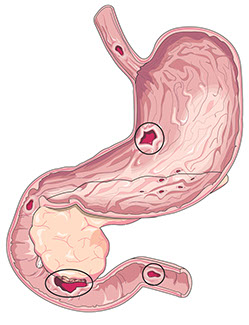
    Illustration of a peptic ulcer.

    A peptic ulcer is a sore in the stomach or first part of the small bowel.

    Peptic Ulcers

    Signs & Symptoms

    *  A gnawing or burning pain is felt in the abdomen between the breastbone and navel. The pain often occurs between meals and in the early hours of the morning. It may last from a few minutes to a few hours and may be relieved with eating or antacids.

    *  Appetite and weight loss.

    *  Nausea or vomiting dark, red blood or material that looks like coffee grounds.

    *  Bloody, black, or tarry stools.

    *  Paleness and weakness if anemia is present.

    Causes

    *  An infection with Helicobacter pylori (H. pylori) bacteria. This is the main cause.

    *  The repeated use of aspirin and other nonsteroidal anti-inflammatory drugs (NSAIDs), such as ibuprofen and naproxen sodium.

    A small percentage of peptic ulcers are caused by Zollinger-Ellison Syndrome. With this rare disorder, the body makes excess acid.

    Family history, smoking, caffeine, and making excess digestive acids play a role in peptic ulcers. So does stress, especially some types of physical stress (e.g., severe burns and major surgery).

    Treatment

    Treatment includes medicines to treat the problem and surgery, if needed.

    Questions to Ask

    Self-Care / Prevention

    *  Take medications as prescribed.

    *  Eat healthy foods. Include foods high in fiber.

    *  Don’t have coffee (regular and decaffeinated); tea and soft drinks with caffeine; and fruit juices high in acid like tomato juice. Don’t have alcohol or foods that bother you.

    *  Don’t use aspirin and other NSAIDs. Follow your doctor’s advice for prescribed NSAIDs.

    *  Try over-the-counter antacids or acid controllers (with your doctor’s okay). Use them on a short-term basis. Don’t try to self- medicate an ulcer.

    *  Don’t smoke. If you smoke, quit.

    Healthier at Home book by the American Institute for Preventive Medicine. www.HealthyLife.com. All rights reserved.

    © American Institute for Preventive Medicine