Tag: urine

  • Kidney Stones

    Abdominal & Urinary Conditions

    Kidney stones are hard masses of mineral deposits formed in the kidney(s). They can be as small as a tiny pebble or an inch or more across. They are more common in men.
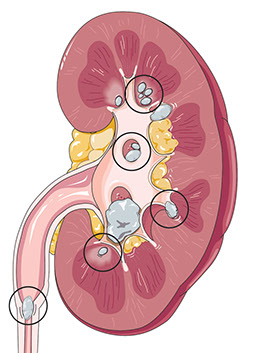
    Illustration of kidney stones.

    Kidney Stones

    Signs & Symptoms

    Some kidney stones cause no symptoms. Small ones can be passed, without pain, when you urinate. When symptoms occur, they include:

    *  Crampy pain that comes and goes. The pain starts in the lower back, travels down the side of the abdomen, and into the groin area. The pain can be severe.

    *  Bloody, cloudy, or dark-colored urine.

    *  You may need to pass urine often. You may pass only small amounts of urine. You may only be able to pass urine in certain positions.

    *  Nausea and vomiting. Fever and chills (if an infection is also present).

    Causes

    *  Too much calcium in the urine or in the blood.

    *  High levels of uric acid in the blood.

    *  A diet high in oxalic acid. This is in spinach, leafy vegetables, rhubarb, and coffee.

    *  Repeated urinary tract infections.

    *  Mild dehydration that persists.

    *  Family history of kidney stones.

    *  Living in certain parts of the U.S. Areas of the southeast have the highest rates.

    In some cases, the cause is not known.

    Treatment

    If the stone is small and can be passed in the urine, treatment may be just drinking plenty of fluids. For stones too large to be passed, lithotripsy using ultrasound is a common treatment. With this, shock waves are directed to the stone location and break the stone into fragments. Drinking fluids helps flush the fragments from the person’s system.

    Questions to Ask

    Self-Care / Prevention

    *  Drink lots of fluids. Drink at least 8 to 10 glasses of water a day.

    *  Eat a well-balanced diet. Vary food choices.

    *  Save any stone you pass in your urine. Take it to your doctor. Its contents can be analyzed. Follow your doctor’s advice to prevent and treat kidney stones.
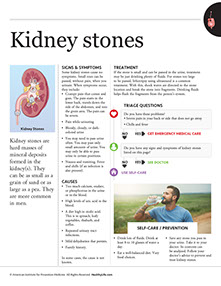
    Healthier at Home book by the American Institute for Preventive Medicine. www.HealthyLife.com. All rights reserved.

    © American Institute for Preventive Medicine

  • Kidney Stones Hurt

    MEDICAL NEWS

    Image of male doctor.

    Although they can be painful, kidney stones rarely cause permanent damage, and you may be able to prevent them, according to the National Institutes of Health. Back or side pain that won’t go away is the primary symptom of a kidney stone. You may also have pinkish or foul-smelling urine, a fever, or painful urination. Caucasians are more prone to kidney stones than African Americans, and men are more prone than women. Age is also a factor. The chance of getting a kidney stone rises as men enter their 40s and continues to rise into their 70s. For women, the risk peaks in their 50s.

    Each day, about 50 gallons of blood flows through your kidneys. The kidneys remove waste products including various minerals and other substances from the blood and transfer them into urine so your body can get rid of these waste products. In people who get stones, certain minerals in the urine combine with other waste products and start to form a stone.

    Kidney stones aren’t all the same. The most common type is made of the mineral calcium, combined with either oxalate or phosphate. Less common types of stones are made of uric acid or other chemicals, all of which are naturally found in the body. No one knows why these substances form kidney stones in some people but not in others, since we all have them in our urine.

    Most kidney stones eventually pass out of the body during urination. But some can grow large enough to begin blocking the flow of urine. That causes intense pain and may also put you at risk for infection. Most kidney stones that don’t pass on their own are treated in an outpatient setting. The most common procedure is called lithotripsy. Greek for “stone crushing,” this technique uses shock waves to reduce kidney stones into small fragments, which then easily flow away in urine.

    If you’ve had more than one kidney stone, you’re at higher risk for forming another. But there are ways to help prevent most types of kidney stones. First, your doctor needs to know what type of stone it is. If you pass a stone, try to catch it in a strainer. A laboratory analysis can help your doctor plan a strategy to prevent more stones. Other tests, which may include urine and blood tests, can help your doctor figure out why you had a kidney stone.

    Drinking more water may help prevent kidney stones. Depending on the type of stone you’re at risk for, your doctor may also advise you to avoid certain foods or drinks. For example, people prone to forming calcium oxalate stones should avoid spinach, peanuts, and chocolate. People prone to forming uric acid stones should cut back on meat. Doctors can also prescribe certain medications to help prevent these types of stones.

    Stone watch

    Call a doctor if you have any of the following signs of a kidney stone:

    *  Extreme pain in your back or side that won’t go away

    *  Blood in your urine (it will look pink)

    *  Fever and chills

    *  Vomiting

    *  Urine that smells bad or looks cloudy

    *  A burning feeling when you urinate

    © American Institute for Preventive Medicine