Tag: vegetables

  • Keep Produce At Its Peak

    Nutrition

    Image of reusable bag filled with produce.

    Produce-fresh fruits and vegetables-is a gold mine of nutrients, usually with a price to match. To get the most nutrition for the “lettuce” you fork over for fresh produce, follow these suggestions.

    *  Select fruits and vegetables that look crisp or feel firm.

    *  When buying citrus fruits and pineapple, choose fruits that feel heavy for their size.

    *  Don’t buy produce that’s soft or bruised.

    *  Don’t buy more than you can use within a few days. If not used within a few days, store it under refrigeration. Most kinds of produce kept at room temperature ripens-or spoils-more rapidly. That’s fine if you’re eager to eat an avocado or banana, but not so great if you want to be able to use every last orange or lemon in the bag.

    *  Don’t soak produce in water-nutrients will leach out.

    *  Pat produce dry after washing, to prolong freshness.

    *  Don’t cut vitamin C rich fruits or vegetables, like strawberries and peppers, until just prior to eating. Exposure to the air destroys vitamin C.

    Page from A Year of Health Hints book by the American Institute for Preventive Medicine. www.HealthyLife.com. All rights reserved.

    © American Institute for Preventive Medicine

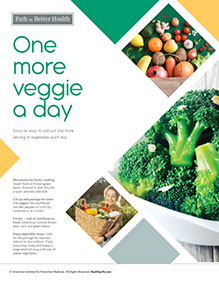
  • One More Veggie A Day

    Nutrition

    Women carrying a basket filled with vegetables.

    Focus on ways to add just one more serving of vegetables each day.

    *Microwave for faster cooking:Steam fresh or frozen green beans, broccoli or bok choy for a quick and easy side dish.

    *Cut up and package for later:Use veggies like cauliflower and bell peppers in a stir-fry, casserole or as a snack.

    *Frozen – just as nutritious as fresh:Good buys include frozen peas, corn and green beans.

    *Enjoy vegetable soups:Look on the package for reduced-sodium or low-sodium. If you have time, make and freeze a large batch of soup with lots of added vegetables.

    Page from HealthyLife Weigh book by the American Institute for Preventive Medicine. www.HealthyLife.com. All rights reserved.

    © American Institute for Preventive Medicine

  • Reach For A Rainbow Of Fruits & Veggies

    Nutrition

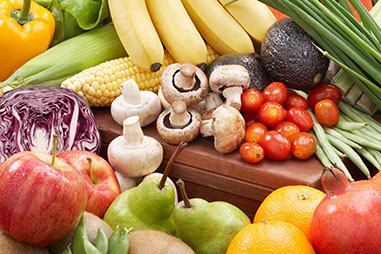
    Image of various fruits and veggies.

    Pick, buy, and eat nature’s healthy foods.

    Fruits and veggies contain essential vitamins, minerals, antioxidants, and fiber that may help protect you from chronic health problems, including stroke, certain cancers, and heart diseases. Health experts agree that half your daily intake of food should be fruits and veggies. Sadly, studies show that most people don’t eat enough colorful foods from nature.

    Put some color into your meals and snacks.

    Fruits and veggies are nature’s art, but their real beauty comes from what’s inside. The more colorful the foods on your plate, the more beneficial nutrients you will receive. For example:

    *  Lentils, artichokes, and chick peas are high in fiber.

    *  Spinach and asparagus have folate, a B vitamin.

    *  Sweet potatoes, pumpkin, and carrots are rich with Vitamin A.

    *  Strawberries, oranges and tomatoes are high in Vitamin C.

    *  Potatoes, bananas, prunes, dried peaches, and apricots are high in potassium.

    Grab and go tips:

    *  Keep a bowl of fresh fruits on the counter.

    *  Keep cut and ready-to-eat veggies front and center in the fridge. Examples are avocados, bell peppers, broccoli, carrots, cauliflower, celery, cucumbers, and grape or cherry tomatoes.

    *  Buy fresh fruits in season.

    *  Stock fruits that are dried, frozen, and canned (in water or 100% fruit juice).

    *  Choose packaged fruits without added sugars.

    *  Include a tangerine, banana or grapes with lunch.

    *  Add cut-up fruit to tossed salads.

    *  Keep packages of dried fruit in your desk drawer – pineapple, bananas, cherries, figs, dates, cranberries, blueberries, raisins, etc.

    *  Stock the freezer with frozen juice bars (100% juice).

    *   Experiment with different textures, such as crunchy apples, creamy bananas, and juicy oranges.

    Action Step

    Under clean, running water, gently rub fruits to remove dirt, bacteria and chemicals. Produce with nooks and crannies – broccoli, cauliflower, and lettuce – should be soaked for 1 to 2 minutes in clean water.

    Page from Ways to Well-Being book by the American Institute for Preventive Medicine. www.HealthyLife.com. All rights reserved.

    © American Institute for Preventive Medicine

  • Fill Your Grill, But Keep It Healthy

    HEALTHY EATING

    Vegetables on the grill.

    Many people like to use their grill or barbecue during the summer months. While grilling can create delicious meals, it’s important to know how to avoid grilling meats the wrong way, which can increase cancer-causing substances in the food.

    Substances known as polycyclic aromatic hydrocarbons (PAHs) and heterocyclic amines (HCAs) can be found in meat that is cooked at high temperatures. These substances have been shown to cause cancer in laboratory animals. But the levels used in the animal studies were very high. Experts cannot say for sure how much of these substances would cause cancer in people.

    PAHs and HCAs can be found in meat that has been grilled, especially if it’s charred or blackened. Meat that is smoked may also contain these chemicals.

    To lower these substances in grilled food, you can:

    *  Avoid burning or charring the food when grilling.

    *  Turn meat frequently when grilling to avoid burnt or very hot areas.

    *  Don’t let the flames touch the meat directly.

    *  Marinade the meat first.

    *  Wrap meat in foil before placing it on the grill.

    *  Trim excess fat off of meat to avoid charring.

    *  Cut it up. Smaller pieces of meat will cook faster throughout. Try skewers or small pieces mixed in foil packets with vegetables.

    Beyond meat

    Vegetables and fruits can be delicious on the grill and they don’t have the risk of PAHs or HCAs. This doesn’t mean that meat-lovers have to avoid their favorite foods. Instead, have a portion of meat about the size of a deck of cards. Then fill the rest of your plate with vegetables. Red peppers, tomatoes, pineapple, peaches and asparagus are just a few of the vegetarian options that are both delicious and nutritious on the grill.

    Sources: American Institute for Cancer Research, National Cancer Institute

    © American Institute for Preventive Medicine

  • Plant-Forward Eating

    HEALTHY EATING

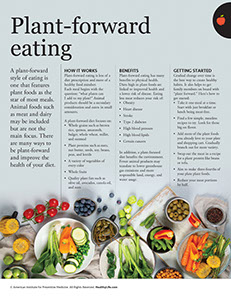
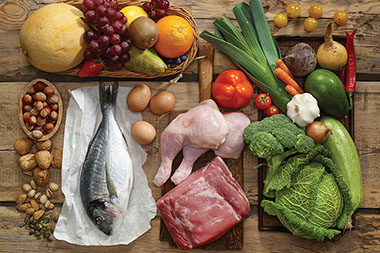
    Variety of plant based foods.

    A plant-forward style of eating is one that features plant foods as the star of most meals. Animal foods such as meat and dairy may be included but are not the main focus. There are many ways to be plant-forward and improve the health of your diet.

    How it works

    Plant-forward eating is less of a diet prescription and more of a healthy food mindset.

    Each meal begins with the question: “what plants can I add to my plate?” Animal products should be a secondary consideration and eaten in small amounts.

    A plant-forward diet focuses on:

    *  Whole grains such as brown rice, quinoa, amaranth, bulger, whole wheat, millet, and oatmeal

    *  Plant proteins such as nuts, nut butter, seeds, soy, beans, peas, and lentils

    *  A variety of vegetables of every color

    *  Whole fruits

    *  Quality plant fats such as olive oil, avocados, canola oil, and nuts

    Benefits

    Plant-forward eating has many benefits to physical health. Diets high in plant foods are linked to improved health and a lower risk of disease. Eating less meat reduces your risk of:

    *  Obesity

    *  Heart disease

    *  Stroke

    *  Type 2 diabetes

    *  High blood pressure

    *  High blood lipids

    *  Certain cancers

    In addition, a plant-focused diet benefits the environment. Fewer animal products may translate to lower greenhouse gas emissions and more responsible land, energy, and water usage.

    Getting started

    Gradual change over time is the best way to create healthy habits. It also helps to get family members on board with “plant forward.” Here’s how to get started:

    *  Take it one meal at a time. Start with just breakfast or lunch being meat-free.

    *  Find a few simple, meatless recipes to try. Look for those big on flavor.

    *  Add more of the plant foods you already love to your plate and shopping cart. Gradually branch out for more variety.

    *  Swap out the meat in a recipe for a plant protein like beans or tofu.

    *  Aim to make three-fourths of your plate plant foods.

    *  Reduce your meat portions by half.

    © American Institute for Preventive Medicine

  • The Mighty Cruciferous

    HEALTHY EATING

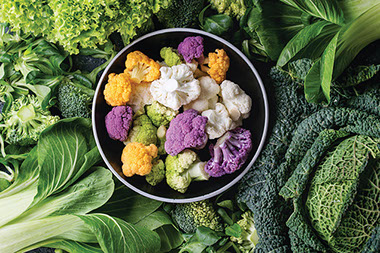
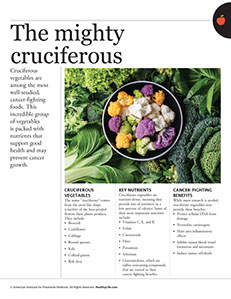
    Different colored cauliflower in bowl, surrounded by bok choy, cabbage, kale.

    Cruciferous vegetables are among the most well-studied, cancer-fighting foods. This incredible group of vegetables is packed with nutrients that support good health and may prevent cancer growth.

    Cruciferous vegetables

    The name “cruciferous” comes from the cross-like shape (crucifer) of the four-petaled flowers these plants produce. They include:

    *  Broccoli

    *  Cauliflower

    *  Cabbage

    *  Brussel sprouts

    *  Kale

    *  Collard greens

    *  Bok choy

    Key nutrients

    Cruciferous vegetables are nutrient-dense, meaning they provide lots of nutrition in a low amount of calories. Some of their most important nutrients include:

    *  Vitamins C, E, and K

    *  Folate

    *  Carotenoids

    *  Fiber

    *  Potassium

    *  Selenium

    *  Glucosinolates, which are sulfur-containing compounds that are central to their cancer-fighting benefits.

    Cancer-fighting benefits

    While more research is needed, cruciferous vegetables may provide these benefits:

    *  Protect cellular DNA from damage

    *  Neutralize carcinogens

    *  Have anti-inflammatory effects

    *  Inhibit tumor blood vessel formation and metastasis

    *  Induce tumor cell death

    © American Institute for Preventive Medicine

  • Healthy Eating 4

    Nutrition

    Family sitting around table eating.

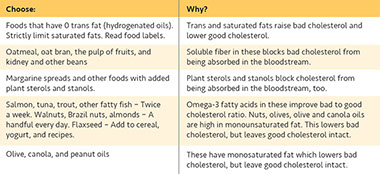
    Choose foods that help lower LDL (bad) cholesterol and raise HDL (good) cholesterol. Medicines have a big impact on improving blood cholesterol (lipid) levels.  Follow your doctor’s advice for taking medications.

    Action Step:Take a walk at least 30 minutes a day, five days a week. Lose weight. Weight loss and moderate physical activity raise HDL (good) cholesterol.

    Page from HealthyLife Weigh book by the American Institute for Preventive Medicine. www.HealthyLife.com. All rights reserved.

    © American Institute for Preventive Medicine

  • A Diet For Lifetime Health

    Mature Health: Over Age 50

    Image rich in B vitamins.

    Studies show that some older adults are deficient in vitamins B6, B12, and folate (a B vitamin). To guard against vitamin deficiencies, plan a diet that includes food sources of these nutrients.

    *  Lean meats, chicken, organ meats and fish, are high in B6.

    *  Milk, eggs, and lean meats are excellent sources of B12.

    *  Asparagus, brussels sprouts, and almost all green, leafy vegetables are high in folate. Other sources are cantaloupe, orange juice, and fortified grain products.

    *  Citrus fruits, tomatoes, cantaloupe, strawberries, green pepper, and broccoli are rich in vitamin C.

    It is also important to get adequate protein and calcium daily. Low-fat dairy products are rich sources of calcium. Two servings a day of 2 to 3 ounces of meat, chicken, or fish provide the protein you need. Other sources of protein include cooked dried beans, peanut butter, milk, and eggs.

    A Year of Health Hints book by the American Institute for Preventive Medicine. www.HealthyLife.com. All rights reserved.

    © American Institute for Preventive Medicine

  • Healthy Eating Tips

    Children’s Health

    Image of young boy eating oranges.

    *  Make half your grains whole. Choose whole-grain food, like whole-wheat bread, oatmeal, and brown rice more often.

    *  Vary your veggies. Go dark green and orange with your vegetables. Eat spinach, broccoli, carrots and sweet potatoes.

    *  Focus on fruits. Eat them at meals. Eat them at snack times, too. Choose fresh, frozen, canned or dried fruits. Go easy on fruit juices.

    *  Go lean with protein. Eat lean or low-fat meat, chicken, turkey, and fish. Also, choose dry beans and peas more often. Add chick peas, nuts, or seeds to a salad. Add pinto beans to a burrito. Add kidney and/or other beans to soup.

    *  Get calcium-rich foods. Have low-fat and fat-free milks, yogurts, and cheeses. If you have soy milks and yogurts, choose ones with calcium. Have broccoli, kale and collard greens. Calcium helps to build strong bones.

    *  Change your oil. Get yours from fish, nuts, and liquid oils, like canola, corn, olive, and soybean. Avoid foods with trans fat. Read food labels.

    *  Don’t sugarcoat it. Choose foods and beverages that do not list sugar, corn syrup and other sugars as one of the first ingredients. Added sugars give calories, but have few, if any, nutrients.

    Page from Children's Self-Care book by the American Institute for Preventive Medicine. www.HealthyLife.com. All rights reserved.

    © American Institute for Preventive Medicine

  • Preventing Cancer

    Cancer

    Nearly 1 in 4 deaths in the U.S. is due to cancer. In the U.S., the lifetime risk for developing cancer is:

    *  Slightly less than 1 in 2 for men

    *  A little more than 1 in 3 for women

    What is Cancer?

    *  Cancer is a broad group of diseases.

    *  All types of cancer begin when cells in a part of the body start to grow out of control and become abnormal.

    *  These extra cells may form a mass of tissue called a growth or tumor.

    *  The tumor destroys healthy tissue.

    *  If the tumor gets bigger, it can invade and grow into other tissues and organs.

    *  Cancer cells also can break away and spread through the lymphatic system or blood stream to other parts of the body. This is called metastasis.

    *  Tumors that are not cancer are called benign. They do not grow into other tissues. They cannot spread to other parts of the body. Benign tumors can cause problems, especially if they grow very large and press on healthy tissues and body organs, but they almost never threaten life.

    *  Untreated cancers can cause serious illness and even death.

    Warning Signs & Symptoms

    You can have cancer for years without having symptoms. There is usually no pain at the onset of cancer. As different types of cancers grow, warning signs may occur. See your doctor for a proper diagnosis.

    For Bladder Cancer

    *  Blood in urine

    *  Pale yellow-red colored urine to bright red urine

    *  Frequent urination or feeling the need to without being able to urinate

    *  Pain during urination

    For Breast Cancer

    *  Lump or firmness in your breast or under your arm

    *  A change in the size or shape of your breast

    *  A nonmilky discharge from the nipple. Sometimes this has blood.

    *  Inverted or tender nipple

    *  The skin on a breast, areola, or nipple may be scaly, red, or swollen.

    *  An area of the breast may retract or pucker.

    Discuss with your doctor the pros and cons of doing monthly breast self-exams and how to perform them. Ask, too, about your risk for breast cancer. You can also call 800.4.CANCER (422.6237) or accesswww.cancer.gov/bcrisktoolfor the Breast Cancer Risk Assessment Tool.

    Note: Men can get breast cancer, too, and should report a breast lump or other change to their doctors.

    For Colon and Rectal Cancers

    *  Rectal bleeding or red or dark blood in or on the stool. Very narrow stools.

    *  Change in bowel habits for 2 or more weeks or constipation or diarrhea for 1 week or longer

    *  Frequent gas pains, cramps, bloating, or feeling of fullness in the abdomen

    *  Feeling that your bowel does not empty completely

    *  Weight loss with no explanation

    For Kidney Cancer

    *  Blood in urine

    *  Lump or mass on the side or lower back

    *  Low back pain on one side (not due to an injury)

    *  Weight loss without trying

    *  Fever that doesn’t go away after a few weeks and that is not from an infection

    *  Feeling very tired

    *  Swelling of the ankles and legs

    For Lung Cancer

    *  Cough that gets worse or does not go away. Hoarse voice. Coughing up blood or rust-colored phlegm

    *  Shortness of breath. New onset of wheezing.

    *  Chest pain. Often, this worsens with taking deep breaths, coughing, or laughing.

    *  Bronchitis, pneumonia, and other lung infections occur often and keep coming back.

    *  Tiredness

    *  Unexplained weight loss

    For Ovarian Cancer

    These 4 symptoms last almost daily for longer than a few weeks:

    *  Bloating or swelling of the abdomen

    *  Pain in the upper abdomen or pelvic pressure

    *  Trouble eating or feeling full quickly

    *  Urgent need to urinate or urinating often

    For Prostate Cancer

    Early prostate cancer often does not cause symptoms. When symptoms occur, they may include:

    *  Problems urinating

    *  Blood in the urine or semen

    *  Pain in the lower back, hips, ribs, or upper thighs

    *  Trouble having or keeping an erection

    *  Weakness or numbness in the feet or legs

    For Testicular Cancer

    *  A lump on either testicle or surrounding area

    *  An enlarged testicle

    *  A feeling of heaviness in the scrotum

    *  A dull ache in the lower abdomen or groin

    *  Sudden build-up of fluid in the scrotum

    *  Pain or discomfort in a testicle or the scrotum

    *  Enlarged or tender breasts

    These symptoms could also be caused by other problems, such as infection or trauma of the scrotum or testicle from being hit or kicked. See your doctor if any of these symptoms lasts 2 weeks or longer. Males who are 15 and older should do a testicular self-exam if and as often as their doctors advise. Results are best after a warm bath or shower, which relaxes the scrotum, allowing the testicles to drop down for easier examination.

    For Throat Cancer

    *  A sore in the mouth that does not heal

    *  Numbness of the tongue or other mouth area

    *  Pain in the mouth or bad breath that persists. A sore throat or a feeling that something is caught in the throat. This doesn’t go away.

    *  A white or red patch on the gums, tongue, tonsil, or lining of the mouth

    *  Hoarseness or other changes in the voice

    *  Lump or mass in the neck or cheek or a feeling of a lump in the throat

    *  Pain in the front of the neck, sometimes going up to the ears

    *  Trouble chewing or swallowing or moving the jaw or tongue.

    *  A cough that doesn’t go away

    *  Pressure, fullness, or burning sensations as food goes down the throat

    *  Upset stomach, heartburn, vomiting, and choking on food

    *  Unexplained weight loss

    Basal and Squamous Cell Cancers

    *  Basal cell. More than 90% of all skin cancers in the U.S. are this type. It grows slowly. It seldom spreads to other parts of the body.

    *  Squamous cell. This type of skin cancer spreads more often than the basal cell type. It is still rare for it to spread, though.

    Basal and squamous cell cancers are found mainly on areas of the skin that are exposed to the sun, like the head, face, neck, hands, and arms. These skin cancers can occur anywhere, though.

    Early Warning Signs of Basal and Squamous Cell Cancers

    Small, smooth, shiny, pale, or waxy lump.

    Firm red lump.

    A lump that bleeds or develops a crust.

    A flat, red spot that is rough, dry, or scaly.

    Warning Signs of Melanoma

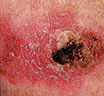
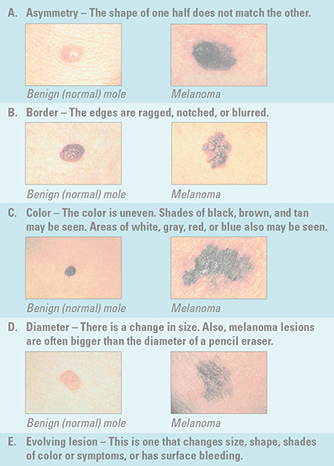
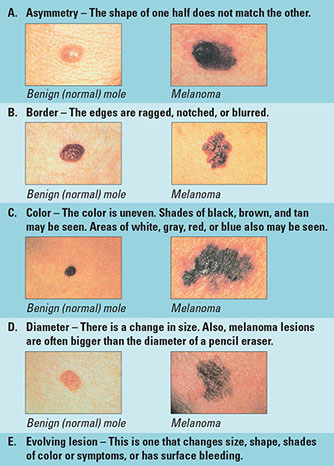
    This type of skin cancer can spread to other parts of the body and be fatal if not treated early. Often, the first sign is a change in the size, shape, or color of an existing mole. It also may appear as a new, abnormal, or “ugly looking” mole. Learn the ABCD and E’s that can help you detect it early.

    Skin Self-Exam

    *  Do an exam monthly, after a shower or bath. To check your skin, use:

    – A well-lit room

    – A full-length mirror

    – A hand-held mirror

    *  Locate your birthmarks, moles, and blemishes. Check for a change in the size, texture, or color of a mole. Check for a sore that does not heal.

    Check all areas.

    1.  Look at the front and back of your body in the mirror. Raise your arms and look at your left and right sides.

    2.  Bend your elbows and look carefully at the palms of your hands. Look at both sides of your forearms and upper arms.

    3.  Look at the back and front of your legs. Look between the buttocks and around the genital area.

    4.  Sit and closely examine your feet. Look at the soles and between the toes.

    5.  Look at your face, neck, and scalp. Use a comb to move your hair so you can see your scalp.

    See your doctor if you find anything unusual.

    Causes & Risk Factors

    With all cancers, genes that control cell growth and division malfunction. Damage to genes can occur from many factors.

    Factors that damage genes include:

    *  Tobacco use and exposure

    *  Exposure to ultraviolet (UV) rays from the sun and indoor tanning

    *  Exposure to cancer causing chemicals

    *  A person’s genetic makeup and immune status

    *  Use of certain medicines, such as DES (a synthetic estrogen)

    *  Certain viruses and bacteria:

    – Human papillomavirus (HPV). This causes most cervical cancers and some vaginal and vulvar cancers.

    – Hepatitis B virus (HBV). This raises the risk for liver cancer.

    – Human immunodeficiency virus (HIV). This raises the risk for some cancers, such as Kaposi sarcoma and non-Hodgkin lymphoma.

    – Helocobactor pylori (H. pylori) bacteria, the main cause of stomach ulcers, raises the risk for stomach cancer.

    Lower Your Risk

    There are many things you can do to prevent and lower your risk of getting cancer. Do them for yourself. Do them for your loved ones.

    *  Protect yourself from ultraviolet (UV) radiation. Limit time in the sun. Wear sunscreen, sunglasses, a hat, and clothing that protects your skin. And, don’t fake bake. Sun lamps and tanning booths also emit cancer-causing rays.

    *  Have X-rays only when necessary.

    *  Avoid asbestos, pesticides, herbicides, and other cancer-causing agents. Protect yourself from cancer-causing chemicals at work and elsewhere.

    *  Have your home tested and treated for radon, if found.

    *  Do regular physical activity. Control your weight.

    *  Eat healthy foods. Have 5-9 colorful fruits and vegetables per day. Opt for whole-grain breads and cereals. Limit red meat and foods high in fat.

    *  Limit alcohol -no more than two drinks per day for men; no more than one drink per day for women.

    *  Find ways to manage stress. Too much stress can weaken your immune system.

    *  Talk with your doctor about taking vitamins, herbal products, or other supplements.

    *  Follow your doctor’s advice to prevent, lower the risk, and treat virus and bacteria that can cause cancer.

    *  The obvious – avoid tobacco:

    – Don’t smoke it.

    – Don’t shove it between your lips and gums.

    – Don’t inhale it secondhand.

    – Avoid thirdhand smoke – tobacco toxins that linger in carpets, clothes, furniture, and other materials hours or even days after a cigarette is put out.

    Screening Tests & Treatments

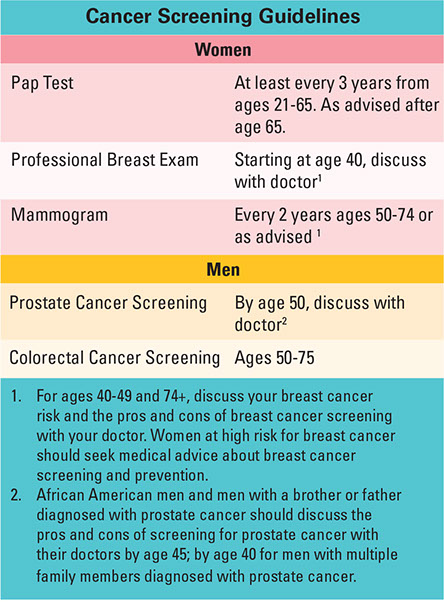
    Screening tests help detect some types of cancer in early stages, when they are most treatable.

    Finding and removing precancerous tissue can prevent cancers of the cervix, colon, and rectum.

    Get screening tests, as listed below, or as advised by your doctor. If you are at a greater risk for one or more cancers, you may need screenings earlier or more often. You may need additional screenings. If a certain type of cancer is common in your family, consider asking your doctor about genetic testing. Also, check with your insurance plan to find out if and when screening tests are covered.

    Treatment

    Treatment depends on the type of cancer, the stage it is in, and individual factors. Cancer treatment includes:

    *  Surgery to remove the cancerous tumor(s) and clear any obstruction to vital passageways

    *  Radiation therapy

    *  Chemotherapy

    *  Biological therapy

    *  Targeted therapy, such as drugs, that affect only the cancer cells

    *  Stem cell or bone marrow transplant

    *  Clinical trials

    Resources

    American Cancer Society

    800.ACS.2345 (227.2345)

    www.cancer.org

    National Cancer Institute

    800.4.CANCER (422.6237)

    www.cancer.gov

    Clinical Trials

    www.clinicaltrials.gov

    Preventing Cancer brochure by the American Institute for Preventive Medicine. www.HealthyLife.com. All rights reserved.

    © American Institute for Preventive Medicine