Tag: visibility

  • Bike Safety

    BE FIT

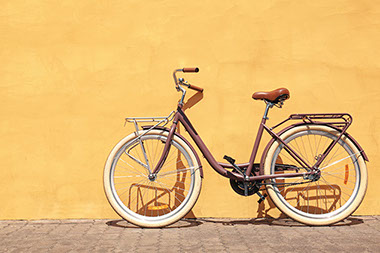
    Bike up against a yellow wall.

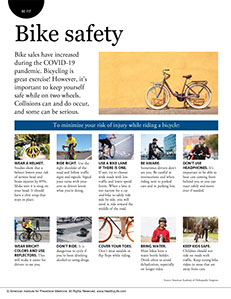
    Bike sales have increased during the COVID-19 pandemic. Bicycling is great exercise! However, it’s important to keep yourself safe while on two wheels. Collisions can and do occur, and some can be serious.

    To minimize your risk of injury while riding a bicycle:

    *Wear a helmet.Studies show that a helmet lowers your risk of serious head and brain injuries by 85%. Make sure it is snug on your head. It should have a chin strap that stays in place.

    *Ride right.Use the right shoulder of the road and follow traffic signs and signals. Signal your turns with your arm so drivers know what you’re doing.

    *Use a bike lane if there is one.If not, try to choose wide roads with less traffic and lower speed limits. When a lane is too narrow for a car and bike to safely ride side by side, you will need to ride toward the middle of the road.

    *Be aware.Sometimes drivers don’t see you. Be careful at intersections and when riding next to parked cars and in parking lots.

    *Don’t use headphones.It’s important to be able to hear cars coming from behind you so you can react safely and move over if needed.

    *Wear bright colors and use reflectors.This will make it easier for drivers to see you.

    *Don’t ride.It is dangerous to cycle if you’ve been drinking alcohol or using drugs.

    *Cover your toes.Don’t wear sandals or flip flops while riding.

    *Bring water.Most bikes have a water bottle holder. Drink often to avoid dehydration, especially on longer rides.

    *Keep kids safe.Children should not ride on roads with traffic. Keep young bike riders in areas that are away from cars.

    Source: American Academy of Orthopaedic Surgeons
    © American Institute for Preventive Medicine

  • After-Dark Joggers, Heed This Advice

    Personal Safety

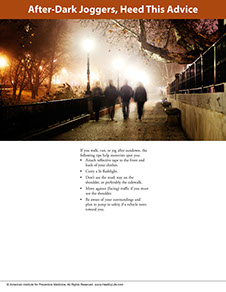
    Image of people walking/jogging in the dark.

    If you walk, run, or jog after sundown, the following tips help motorists spot you.

    *  Attach reflective tape to the front and back of your clothes.

    *  Carry a lit flashlight.

    *  Don’t use the road; stay on the shoulder, or preferably the sidewalk. Move against (facing) traffic if you must use the shoulder.

    *  Be aware of your surroundings and plan to jump to safety if a vehicle veers toward you.

    A Year of Health Hints book by the American Institute for Preventive Medicine. www.HealthyLife.com. All rights reserved.

    © American Institute for Preventive Medicine
  • Take The Hazard Out Of Halloween

    Child Safety

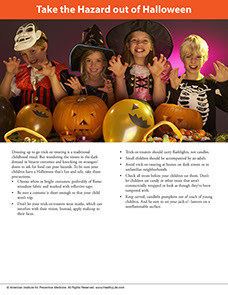
    Image of children in halloween customs.

    Dressing up to go trick-or-treating is a traditional childhood ritual. But wandering the streets in the dark dressed in bizarre costumes and knocking on strangers’ doors to ask for food can pose hazards. To be sure your children have a Halloween that’s fun and safe, take these precautions.

    *  Choose white or bright costumes, preferably of flame-retardant fabric and marked with reflective tape.

    *  Be sure a costume is short enough so that your child won’t trip.

    *  Don’t let your trick-or-treaters wear masks, which can interfere with their vision. Instead, apply makeup to their faces.

    *  Trick-or-treaters should carry flashlights, not candles. Small children should be accompanied by an adult.

    *  Avoid trick-or-treating at homes on dark streets or in unfamiliar neighborhoods.

    *  Check all treats before your children eat them. Don’t let children eat candy or other treats that aren’t commercially wrapped or look as though they’ve been tampered with.

    *  Keep carved, candlelit pumpkins out of reach of young children. And be sure to set your jack-o’- lantern on a nonflammable surface.

    A Year of Health Hints book by the American Institute for Preventive Medicine. www.HealthyLife.com. All rights reserved.

    © American Institute for Preventive Medicine

  • Help Your Refrigerator Help You

    Healthylife® Weigh

    Part 4

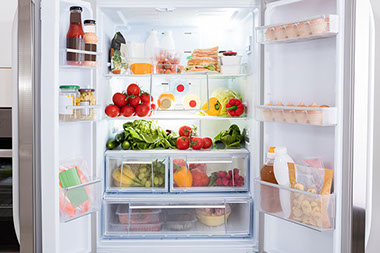
    Refrigerator filled with fresh fruits and vegetables.

    Once foods are right in front of you, it is harder to make a choice based on what your body needs. Instead, you are likely to choose foods based on these factors:

    *  If you can see it

    *  Color

    *  How fresh you think it is

    *  What you think it tastes like

    *  If you’ve thought about the food earlier or the reward you will get from having the food

    Tips for a Weight-Friendly Fridge

    *  Store chopped veggies and fruits on the middle shelf at eye-level. Use clear glass or plastic containers.

    *  Put less-healthy leftovers in the crisper or behind healthier options. Store healthy leftovers in clear containers or with clear plastic wrap.

    *  Avoid washing fruit (especially berries) until you are ready to eat (moisture invites mold).

    *  Wrap cake, pizza, and other less healthy leftovers in aluminum foil or use solid-colored containers.

    *  Use the produce drawer to hide sweets and less-healthy foods.

    *  Put washed grapes or cherry tomatoes in a colander.  Put this on a plate to allow liquid to drain.

    *  Keep hard-boiled eggs, string cheese, grilled turkey burger patties, and non-fat or Greek yogurts in front for easy,  high-protein snacks.

    *  Keep all un-opened sodas and sugar-sweetened drinks out of the fridge. Out of sight, out of mind!

    Plan Your Refrigerator Layout

    Plan where you are going to place healthy foods. Plan, too, where you are going to place less healthy foods. Use specific examples of foods you already have or that you plan to buy.

    © American Institute for Preventive Medicine
  • 8 Ways To Be Promotable

    WORK LIFE

    Image of a group of co-workers smiling.

    No matter what the job, there are certain qualities that all top-performing employees share, according to job-placement expert Phil Blair, author of Job Won! Below are Blair’s 8 ways to be promotion-worthy:

    1.Look and act promotable.You’ve got a job, but unless you plan to make it the last job you ever have, think long term. Act like you’re a man or woman on a mission, always prepared to take the next step, to take your career to the next level. Dress accordingly. In fact, dress for the job you want, not the job you have. Showcase your work when you can. Go above and beyond.

    2.Create value in everything you do.Don’t just cross things off a to-do list. If you have a job to do, do it well. Commit your best effort to all tasks, large and small. That might be challenging at times, but people notice.

    3.Be resourceful.Think outside the box. If you’re doing a job and you see a better way to do it, speak up (in a polite, respectful way). Anticipate problems and find answers before they’re needed. Don’t be afraid to do a little legwork, a little sweating before it’s necessary. It will always pay off.

    4.Get noticed.There’s nothing wrong with stepping up and stepping out: Volunteer for extra duties. Look for chances to be part of a team. Likewise look for chances to work with other departments, both to learn about that department but also to meet new people.

    5.Stay informed.Become an expert in your field. That includes staying on top of industry news and trends, company policies, and department memos. Read the company newsletter. Talk to others in the know. The more information you have at hand, the better prepared you will be when opportunity comes knocking.

    6.Keep positive.No matter what’s going on, remain level-headed, upbeat, with your eye on the prize. There are always ups and downs but focus on the long term. If you have a temper, it is your responsibility to never show it at work.

    7.Be a team player.This is about more than just getting along with others or telling a good joke. In meetings or group efforts, you want to be seen as a valued contributor who offers feedback, meets deadlines, and gets things done-all for the common good. Know your teammates, their strengths, and strive to make them look good too.

    8.Conduct effective meetings.The best way to not get anything done is to call a meeting. That’s a little harsh but meetings are probably the most abused aspect of the workday. The best meetings are short, sweet, and to the point. If you’re calling the meeting or running it, make sure you have an agenda and stick to it. Make sure only the people who need to be at the meeting are there. Stay on point. Allow everyone to speak who wants to speak, but keep them focused on the subject. Try to complete all of the tasks of the meeting before the meeting ends. If that’s not possible, assign action items with due dates.

    © American Institute for Preventive Medicine
  • Safe On 2 Wheels

    BE FIT

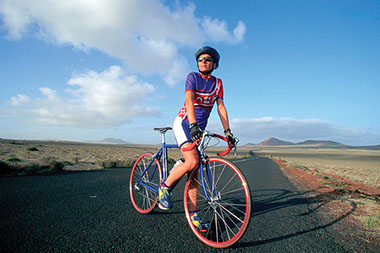
    Image of women on bike.

    Cycling is a good form of exercise. But with more than 1.4 million injuries reported in 2012 according to the Consumer Product Safety Commission, riders need to be safety conscious before hitting the pavement (literally).

    The American Academy of Orthopaedic Surgeons offers cycling safety rules:

    *  Use a bicycle that is the proper size.

    *  Make sure you are fit enough to ride before you  start pedaling.

    *  Change riding positions to reduce stress on pressure points on your body and avoid overstressing muscles.

    *  Always wear a helmet approved by the American National Standards Institute (ANSI). It should fit  snugly but comfortably and not obstruct vision.

    *  Check your bicycle’s mechanical components regularly (brakes, tires, gears).

    *  Follow traffic signs and lights. Signal your turns   so drivers can anticipate your actions.

    *  Ride in the direction of traffic. Be aware of all surroundings.

    *  Use caution on uneven or slippery surfaces.

    *  Do not listen to music with head phones, talk on  your phone, text or do anything else that can   obstruct your hearing and vision.

    *  Avoid loose clothing. Wear padded gloves and appropriate footwear. Never wear flip flops. Use padded cycling shorts for longer rides.

    *  At night, wear bright fluorescent colors; make sure to have rear reflectors. Both a working tail light and headlight should be visible from 500 feet away.

    © American Institute for Preventive Medicine