Tag: voice

  • Be Kind To Your Voice

    WORK LIFE

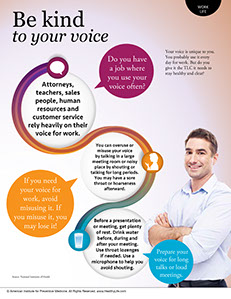
    Man smiling.

    Your voice is unique to you. You probably use it every day for work. But do you give it the TLC it needs to stay healthy and clear?

    Do you have a job where you use your voice often?

    Attorneys, teachers, sales people, human resources and customer service rely heavily on their voice for work.

    If you need your voice for work, avoid misusing it. If you misuse it, you may lose it!

    You can overuse or misuse your voice by talking in a large meeting room or noisy place by shouting or talking for long periods. You may have a sore throat or hoarseness afterward.

    Prepare your voice for long talks or loud meetings.

    Before a presentation or meeting, get plenty of rest. Drink water before, during and after your meeting. Use throat lozenges if needed. Use a microphone to help you avoid shouting.

    © American Institute for Preventive Medicine

  • Be Assertive 2

    Healthylife® QuitWell™

    Part 5

    Image of cigarettes and money.

    Learn the differences between passive, aggressive, and assertive communication.

    Passive

    *  You lack expression for yourself.

    *  You do not stand up for your rights and needs.

    Result: You usually do not achieve your goal. You may feel like someone is walking all over you.

    Aggressive

    *  You stand up for your rights and needs, but at the expense of someone else.

    Result: You usually put down or hurt someone else. You gain no respect and may even start a conflict.

    Assertive

    *  You stand up for your rights and needs without putting down or hurting someone else.

    Result: You build self-respect and feel good about yourself. You are likely to achieve your goal.

    Example

    Your co-worker offers you a cigarette, saying that you can have just one, even though you recently quit. This person wants to smoke with you for old time’s sake. You know this could send you back to using tobacco.

    Passive Response:“All right, I’ll have a cigarette with you, but just this one.”

    Aggressive Response:“You really have some nerve offering me a cigarette. I hate cigarettes and I think it’s disgusting that you smoke. You should smell your breath. Don’t ever come near me with a cigarette again.”

    Assertive Response:“No, thank you. I have quit smoking and I plan to stay that way. Even one can trigger my old addiction. You can help me remain an ex-smoker by not offering me any.”

    © American Institute for Preventive Medicine

  • Be Assertive 3

    SleepWell® Program

    Week 5

    Image of man practicing speech in mirror.

    Passive

    *  You lack expression for yourself.

    *  You do not stand up for your rights and needs.

    Result: You usually do not achieve your goal.

    Aggressive

    *  You stand up for your rights and needs, but at the expense of someone else.

    Result: You usually put down or hurt someone else. You gain no respect.

    Assertive

    *  You stand up for your rights and needs without putting down or hurting someone else.

    *  You increase the chance of achieving your goals.

    *  You express your feelings without becoming victim to them.

    Result: You build self-respect and feel good about yourself.

    What Assertive Looks Like

    Body Posture: Be relaxed and natural. Avoid slouching, putting your hands in your pockets, and facing away from the person you are speaking with.

    Eye Contact: Good eye contact is vital to convey self-confidence and interest. Don’t stare at the other person; this comes across as a challenge.

    Voice, Tone, and Quality: Use a strong, varied tone. Speak clearly and firmly. Don’t shout or speak too softly. Don’t whine.

    Distance from the Person: Don’t position yourself too far or too close.

    Facial Expression: Let your face convey the same message as what you are saying.

    Content: Use short sentences. Be specific, clear, and firm.

    Benefits of Being Assertive

    *  You can feel comfortable saying “no.”

    *  You have more confidence to ask others for help.

    *  You gain more respect from others.

    *  You feel less angry with yourself and with others.

    *  You feel justified to say what you want to say.

    *  You feel comfortable to request clarification.

    *  You accept compliments graciously.

    *  You can change your mind without feeling guilty.

    Practice First

    Plan or write down what you want to say. Have responses ready ahead of time to deal with questions and comments. Reinforce your remarks by saying what positive outcomes will occur for you and the other person. Practice in front of a mirror or with a friend.

    Use the L.A.D.D.E.R. Technique

    This is a step-by-step way to be more assertive.

    *Look at your needs, wants, rights, and feelings about the situation.

    *Arrange a meeting that is convenient for you and the other person to talk.

    *Define the problem or issue clearly to the other person.

    *Describe your feelings using “I messages.” I messages let you take charge of your feelings.

    *Express your needs and desires in an assertive manner using a few clear sentences. Be aware of your eye contact, hand gestures, posture, voice and facial expression.

    *Reinforce your remarks by saying what positive outcomes will occur for you and the other person.

    Example:

    L – I wish my partner would help with household chores so I don’t stay up so late at night finishing what needs to get done.

    A – I’ll plan to talk with him or her after dinner tomorrow.

    D – Tell your partner, “When I stay up late doing household chores, I do not get enough sleep at night. I don’t have enough energy to be alert and productive at work the next day.”

    D – “I feel I could get more sleep with your help.”

    E – “I would like to divvy up household to-dos between us. I know we are each better at different tasks.

    R – “This change would help me get more sleep at night and I will have more energy when we spend time together.”

    © American Institute for Preventive Medicine

  • Laryngitis

    Ear, Nose & Throat Conditions

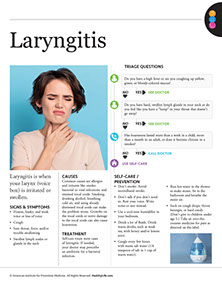
    Laryngitis is when your larynx (voice box) is irritated or swollen.

    Signs & Symptoms

    *  Hoarse, husky, and weak voice or loss of voice.

    *  Cough.

    *  Sore throat, fever, and/or trouble swallowing.

    Causes

    Common causes are allergies and irritants like smoke; bacterial or viral infections; and strained vocal cords. Smoking, drinking alcohol, breathing cold air, and using already distressed vocal cords can make the problem worse. Growths on the vocal cords or nerve damage to the vocal cords can also cause hoarseness.

    Treatment

    Self-care treats most cases of laryngitis. If needed, your doctor may prescribe an antibiotic for a bacterial infection.

    Questions to Ask

    Self-Care / Prevention

    *  Don’t smoke. Avoid secondhand smoke.

    *  Don’t talk if you don’t need to. Write notes, instead.

    *  Use a cool-mist humidifier in your bedroom.

    *  Drink a lot of fluids. Drink warm drinks, such as weak tea, with honey and/or lemon juice.

    *  Gargle every few hours with warm salt water (1/4 teaspoon of salt in 1 cup of warm water).

    *  Run hot water in the shower to make steam. Sit in the bathroom and breathe the moist air.

    *  Suck on cough drops, throat lozenges, or hard candy. (Don’t give to children under age 5.) Take an over-the-counter medicine for pain as directed on the label.

    Resources

    American Academy of Otolaryngology –

    Head and Neck Surgery

    www.entnet.org

    Healthier at Home book by the American Institute for Preventive Medicine. www.HealthyLife.com. All rights reserved.

    © American Institute for Preventive Medicine

  • Be Assertive

    Healthylife® Weigh

    Part 4

    Women with arms crossed looking convinced and confident.

    Learn the differences between passive, aggressive, and assertive communication.

    Passive

    *  You lack expression for yourself.

    *  You do not stand up for your rights and needs.

    Result: You usually do not achieve your goal.

    Aggressive

    *  You stand up for your rights and needs, but at the expense of someone else.

    Result: You usually put down or hurt someone else. You gain no respect.

    Assertive

    *  You stand up for your rights and needs without putting down or hurting someone else.

    *  You express your feelings without becoming victim to them.

    Result: You build self-respect and feel good about yourself.

    Example: Your aunt offers you a large piece of cherry pie that she said she made especially for you. You know that you have eaten enough for the meal and eating the piece of pie does not fit your eating goals.

    *  Passive Response: “Thank you. It’s delicious!” Thinking… “I really don’t want to eat this right now, but I don’t want to hurt her feelings.”

    *  Aggressive Response: “I can’t believe you’re offering me cherry pie when you know I’m trying to lose weight. You’re going to ruin my diet!”

    *  Assertive Response: “I appreciate that you went to the trouble of making this pie for me! It looks great and I’m sure it tastes great. I am very serious about losing weight so I’d like to split that piece with someone.”

    What Assertive Looks Like

    *  Body Posture: Be relaxed and natural. Avoid slouching, putting your hands in your pockets, and facing away from the person you are speaking with.

    *  Eye Contact: Good eye contact is vital to convey self-confidence and interest. Don’t stare at the other person; this comes across as a challenge.

    *  Voice, Tone, and Quality: Use a strong, varied tone. Speak clearly and firmly. Don’t shout or speak too softly. Don’t whine.

    *  Distance from the Person: Don’t position yourself too far or too close.

    *  Facial Expression: Let your face convey the same message as what you are saying.

    *  Content: Use short sentences. Be specific, clear, and firm.

    Practice First

    Plan or write down what you want to say. Have responses ready ahead of time to deal with questions and comments. Reinforce your remarks by saying what positive outcomes will occur for you and the other person. Practice in front of a mirror or with a friend.

    Benefits of Being Assertive

    *  You can feel comfortable saying “no.”

    *  You have more confidence to ask others for help.

    *  You gain more respect from others.

    *  You feel less angry with yourself and with others.

    *  You feel justified to say what you want to say.

    *  You feel comfortable requesting clarification.

    *  You accept compliments graciously.

    *  You can change your mind without feeling guilty.

    © American Institute for Preventive Medicine

  • Forget Shouting

    WELL-BEING

    Image of 2 men talking.

    While many people try to steer clear of arguments with family members, two Vanderbilt University philosophy professors offer a better solution.

    Scott F. Aikin and Robert B. Talisse co-wrote Why We Argue (and How We Should): A Guide to Political Disagreement. The trend to avoid arguments with loved ones has more to do with how bad we are at arguing than how strong our beliefs are, according to Aikin. “The better solution would be to improve our skill at making arguments in ways that allow for better, more reasoned exchange.”

    Aikin and Talisse suggest the following:

    *  Remember that reasonable and intelligent people disagree about important matters. Keep this in mind even when your relative says something appalling.

    *  When arguing, be sure to acknowledge your family member’s good points.

    *  Be prepared to say what it would take for you to change your mind. Consider what evidence would make your view wrong.

    *  Know the weak points about your view. Be able to articulate what the best arguments against your view are.

    “Acknowledging the opposition’s good points and seeing troubles for your own side are too often taken to be a sign of weakness,” Aikin said. “But it’s that attitude that actually makes us bad at argument and makes argumentative exchange so unpleasant and dogmatic. Instead, these habits make exchanges more reasonable and productive.”

    © American Institute for Preventive Medicine