Tag: water

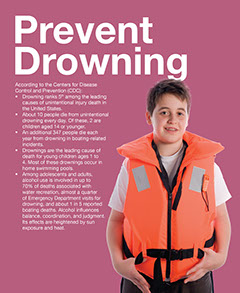
  • Prevent Drowning

    Home Safety

    Do This, Not That

    According to the Centers for Disease Control and Prevention (CDC):

    *  Drowning ranks 5th among the leading causes of unintentional injury death in the United States.

    *  About 10 people die from unintentional drowning every day. Of these, 2 are children aged 14 or younger.

    *  An additional 347 people die each year from drowning in boating-related incidents.

    *  Drownings are the leading cause of death for young children ages 1 to 4. Most of these drownings occur in home swimming pools.

    *  Among adolescents and adults, alcohol use is involved in up to 70% of deaths associated with water recreation, almost a quarter of Emergency Department visits for drowning, and about 1 in 5 reported boating deaths. Alcohol influences balance, coordination, and judgment. Its effects are heightened by sun exposure and heat.

    General Guidelines
    Safe at Home - Do This, Not That Book. Published by the American Institute for Preventive Medicine. www.HealthyLife.com. All rights reserved.

    © American Institute for Preventive Medicine
  • Choose Water Instead Of Sugar-Sweetened Beverages

    Nutrition

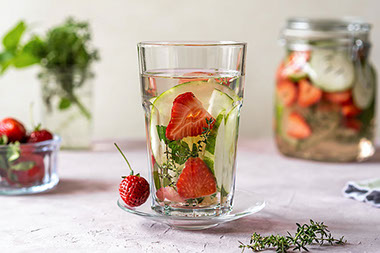
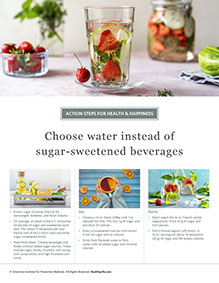
    Glass of water flavored with strawberries and cucumbers.

    *  Excess sugar increases the risk for overweight, diabetes, and heart disease.

    *  On average, an adult in the U.S. consumes 60 pounds of sugar and sweeteners each year. This about 17 teaspoons per day! Nearly half of this is from soda and other sugar-sweetened drinks.

    *  Read food labels. Choose beverages and foods without added sugar sources. These include sugar, honey, fructose, corn syrup, corn syrup solids, and high-fructose-corn syrup.

    Dos

    *  Choose a 16 oz. black coffee with 1 oz. reduced fat milk. This has 2 g of sugar and less than 25 calories.

    *  Enjoy unsweetened iced tea with lemon. It has no sugar and no calories.

    *  Drink fruit-flavored water or fizzy water with no added sugar and minimal calories.

    Don’ts

    *  Don’t select the 16 oz. French vanilla cappuccino. It has 42 g of sugar and 320 calories.

    *  Don’t choose regular soft drinks. A 12-oz. serving has about 10 teaspoons (38 g) of sugar and 150 empty calories.

    Page from HealthyLife Weigh book by the American Institute for Preventive Medicine. www.HealthyLife.com. All rights reserved.

    © American Institute for Preventive Medicine
  • Drink Water, The Nutrient For Every Cell

    Nutrition

    Image of person filling up glass with tap water.

    Two-thirds of your body is composed of water, making it your body’s most vital nutrient. Water:

    *  Provides a valuable source of minerals, like calcium and magnesium.

    *  Helps digest food and absorb nutrients into the body.

    *  Carries nutrients to organs via the bloodstream.

    *  Moistens mucous membranes and lubricates the joints.

    *  Carries away bodily waste products.

    *  Cools the body through perspiration.

    Many people underestimate their need for water. The average adult should drink six to eight 8-ounce glasses of water (or its equivalent) a day. You can meet part of that quota by consuming high water content foods.

    Some examples include:

    *  Iceberg lettuce (95 percent water).

    *  Cantaloupe (91 percent water).

    *  Raw carrots (88 percent water).

    Page from A Year of Health Hints book by the American Institute for Preventive Medicine. www.HealthyLife.com. All rights reserved.

    © American Institute for Preventive Medicine
  • Eat, Drink, And Be Wary

    Healthy Travel

    Image of couple eating at a resturant.

    It’s been said that travel expands the mind and loosens the bowels. One-third of visitors to developing countries suffer from travel sickness, or turista. This includes diarrhea, cramps, fatigue, and sometimes fever and nausea. Food and water contaminated with bacteria are usually to blame. Here’s what to do.

    *  If you plan to travel outside the United States, check with the local tourist board to find out if the water is safe for foreign visitors to drink.  Often, natives who are used to the local water can drink it with no ill effects, but outsiders experience nausea or diarrhea (or both).

    *  If you know or suspect the water is unsafe, drink and brush your teeth with bottled water that has a sealed cap. The same goes for making ice cubes, washing fruits and vegetables, or cooking.

    *  Carry an immersion coil so you can boil your water. Boil the water for at least 10 minutes, and allow it to cool before you use it.

    *  If you can’t boil your water, use purifying tablets, such as Halazone or Potable Aqua tablets, which you can buy at most drugstores and many sporting goods stores.

    *  Drink beverages served in original bottles, cans, etc. Don’t use ice made from tap water.

    *  Don’t eat raw fruits or vegetables (including salad). The exception: fresh fruit you peel yourself.

    *  Don’t order undercooked meat. Beef, pork, chicken, and fish should be cooked thoroughly.

    *  Don’t eat raw or undercooked shellfish.

    *  Avoid smorgasbords and buffet meals, where food is often left out for long periods of time, giving disease-causing microbes plenty of time to grow.

    *  Avoid unpasteurized milk and cheeses in countries outside the United States and western Europe.

    *  If your choice of safe foods is severely limited, take a daily multiple vitamin and mineral capsule to supply the nutrients you may be missing out on.

    Ask your doctor about taking diarrhea medicine with you. Ask what  product you should take and in what doses. (Note: Don’t take Pepto-Bismol if you’re allergic to aspirin. Don’t give Pepto-Bismol to anyone under age 19. Like aspirin, it contains salicylate.)

    Page image from A Year of Health Hints book by the American Institute for Preventive Medicine. www.HealthyLife.com. All rights reserved.

    © American Institute for Preventive Medicine
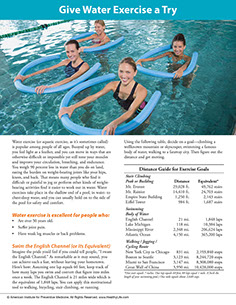
  • Give Water Exercise A Try

    Fitness

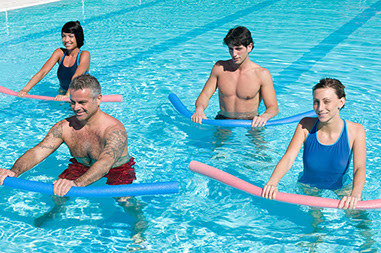
    Water exercise class in session.

    Water exercise (or aquatic exercise, as it’s sometimes called) is popular among people of all ages. Buoyed up by water, you feel light as a feather, and you can move in ways that are otherwise difficult or impossible yet still tone your muscles and improve your circulation, breathing, and endurance. You weigh 90 percent less in water than you do on land, easing the burden on weight-bearing joints like your hips, knees, and back. That means many people who find it difficult or painful to jog or perform other kinds of weight-bearing activities find it easier to work out in water. Water exercises take place in the shallow end of a pool, in waist- to chest-deep water, and you can usually hold on to the side of the pool for safety and comfort.

    Swim the English Channel (or Its Equivalent)

    Imagine the pride you’d feel if you could tell people, “I swam the English Channel.” As remarkable as it may sound, you can achieve such a feat, without leaving your hometown. Here’s how: Assuming one lap equals 60 feet, keep track of how many laps you swim and convert that figure into miles once a week. The English Channel is 21 miles wide which is the equivalent of 1,848 laps. You can apply this motivational tool to walking, bicycling, stair climbing, or running. Using the following table, decide on a goal-climbing a well-known mountain or skyscraper, swimming a famous body of water, walking to a faraway city. Then figure out the distance and get moving.

    Water exercise is excellent for people who:

    *  Are over 50 years old.

    *  Suffer joint pain.

    *  Have weak leg muscles or back problems.

    Page image from A Year of Health Hints book by the American Institute for Preventive Medicine. www.HealthyLife.com. All rights reserved.

    © American Institute for Preventive Medicine

  • Hydrate To Feel Great

    Fitness

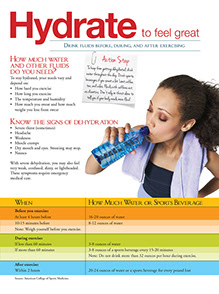
    Drink fluids before, during, and after exercising.

    How much water and other fluids do you need?

    To stay hydrated, your needs vary and depend on:

    *  How hard you exercise

    *  How long you exercise

    *  The temperature and humidity

    *  How much you sweat and how much weight you lose from sweat

    Know the signs of dehydration:

    *  Severe thirst (sometimes)

    *  Headache

    *  Weakness

    *  Muscle cramps

    *  Dry mouth and eyes. Sweating may stop.

    *  Nausea

    With severe dehydration, you may also feel very weak, confused, dizzy, or lightheaded. These symptoms require emergency medical care.

    Action Step

    To keep from getting dehydrated, drink water throughout the day. Drink sports beverages if you sweat a lot. Limit coffee, tea, and colas. Don’t rely on thirst alone to tell you if your body needs more fluid.

    Page image from the Ways to Well-Being book by the American Institute for Preventive Medicine. www.HealthyLife.com. All rights reserved.

    © American Institute for Preventive Medicine
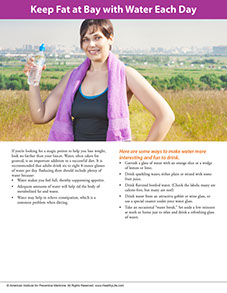
  • Keep Fat At Bay With Water Each Day

    Weight Control

    Image of water bottle.

    If you’re looking for a magic potion to help you lose weight, look no farther than your faucet. Water, often taken for granted, is an important addition to a successful diet. It is recommended that adults drink six to eight 8-ounce glasses of water per day. Reducing diets should include plenty of water because:

    *  Water makes you feel full, thereby suppressing appetite.

    *  Adequate amounts of water will help rid the body of metabolized fat and waste.

    *  Water may help to relieve constipation, which is a common problem when dieting.

    Here are some ways to make water more interesting and fun to drink.

    *  Garnish a glass of water with an orange slice or a wedge of lemon or lime.

    *  Drink sparkling water, either plain or mixed with some fruit juice.

    *  Drink flavored bottled water. (Check the labels; many are calorie-free, but many are not!)

    *  Drink water from an attractive goblet or wine glass, or use a special coaster under your water glass.

    *  Take an occasional “water break.” Set aside a few minutes at work or home just to relax and drink a refreshing glass of water.

    Page from A Year of Health Hints book by the American Institute for Preventive Medicine. www.HealthyLife.com. All rights reserved.

    © American Institute for Preventive Medicine
  • Only You Can Prevent Christmas Tree Fires

    Home Safety

    Image of Christmas tress in front of fire place.

    Every Christmas season, many families tragically lose their homes because of Christmas tree fires. Here’s how to prevent them.

    To choose a tree:

    *  Pick the freshest tree you can find. Hold the tree by the trunk and tap it against the ground. If needles drop profusely, look for another tree.

    *  Keep the tree outdoors with the trunk in water as long as possible. Once you bring the tree into a heated building, it will dry out more quickly.

    *  Indoors, keep the trunk in water. Check the water level daily, and refill when needed.

    *  Don’t stand the tree near a fireplace, wood stove, heat register, or electrical wires.

    To decorate the tree:

    *  Purchase only tree lights bearing a UL label from Underwriters Laboratory, which shows they meet safety standards.

    *  Check for broken bulbs, worn-out insulation, and damaged sockets. Replace or repair as necessary.

    *  Never attach electrical lights to an artificial, metal tree. Don’t overload extension cords.

    *  Discourage children from touching a decorated tree-it may tip over.

    *  To discourage pets from attacking the tree, avoid shiny decorations, and don’t place tinsel or ornaments on the lower branches.

    A Year of Health Hints book by the American Institute for Preventive Medicine. www.HealthyLife.com. All rights reserved.

    © American Institute for Preventive Medicine
  • Drink Water

    Healthylife® Weigh

    Part 3

    Elderly man drinking water.

    Water does many important jobs for your body:

    *  Transports nutrients

    *  Helps you digest food

    *  Carries waste from the body

    *  Regulates body temperature

    *  Gives a feeling of fullness

    *  Helps break down fat for energy

    *  Lubricates joints

    *  Helps prevent muscle cramps

    Action Steps:

    *  Drink a glass of water before meals and snacks. This may help you manage your appetite.

    *  Replace a sugar-sweetened drink with water.

    *  Eat foods that are high in water, like cucumbers, leafy greens, and watermelon.

    *  Drink water regularly throughout the day.

    *  Keep a water bottle handy that you can refill when needed.

    *  If you are increasing your fiber intake, also increase your water intake to reduce the risk of constipation.

    How much should I drink?

    Your water needs depend on your activity level and weight. A general rule of thumb is to drink 8 cups of water per day. You may need more if you are very active or sweat a lot.

    How do I know if I’ve had enough?

    Check your urine. When you are properly hydrated, your urine should be light yellow or clear. If it is a darker yellow, you need to drink more water.

    © American Institute for Preventive Medicine
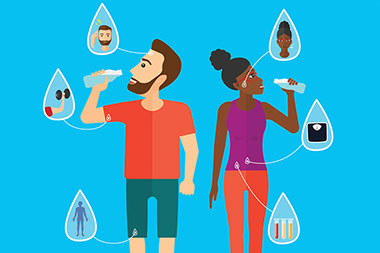
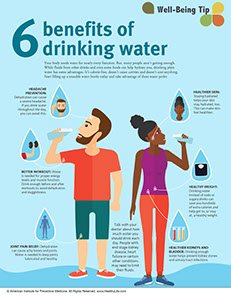
  • 6 Benefits Of Drinking Water

    WELL-BEING

    Illustration of drinking water and it's benefits.

    Your body needs water for nearly every function. But, many people aren’t getting enough. While fluids from other drinks and even some foods can help hydrate you, drinking plain water has some advantages. It’s calorie-free, doesn’t cause cavities and doesn’t cost anything. Start filling up a reusable water bottle today and take advantage of these water perks:

    Headache prevention:Dehydration can cause a severe headache. If you drink water throughout the day, you can avoid this.

    Better workout:Water is needed for proper energy levels and muscle function. Drink enough before and after workouts to avoid dehydration and sluggishness.

    Joint pain relief:Dehydration can cause achy bones and joints. Water is needed to keep joints lubricated and healthy.

    Healthier skin:Staying hydrated helps your skin stay hydrated, too. This can make skin feel healthier.

    Healthy weight:Drinking water instead of soda or sugary drinks can save you hundreds of extra calories and help get to, or stay at, a healthy weight.

    Healthier kidneys and bladder:Drinking enough water helps prevent kidney stones and urinary tract infections.

    Talk with your doctor about how much water you should drink each day. People with end stage kidney disease, heart failure or certain other conditions may need to limit their fluids.

    © American Institute for Preventive Medicine