Tag: Weight Control

  • Plan Problem-Solving

    Healthylife® Weigh

    Part 6

    Problem, think, idea, solution diagram.

    Your worries and concerns take up time in your day. Many issues cannot simply be ignored or brushed aside. To avoid letting these thoughts trigger unhealthy eating habits, plan time to address them.

    Steps to Address Your Worries

    1. Write a worry at the top of a piece of paper.

    2. Divide the paper into three columns:

    a. What I can’t do. Recognize what is out of your control.

    b. What I can do. List possible actions that are within your control. Write things you know how to do and that are realistic actions for you to take.

    c. What I will do. Decide which action you are ready to take first. This action may not solve every part of the problem, but is a small step toward a solution. Write when you will do this.

    Mind Dump

    Use this tool when you feel you have too many thoughts to juggle and aren’t sure where to start. Use small pieces of paper or index cards to “mind dump” thoughts that come to mind. Write down concerns, ideas, and things you need to remember. Pull one card and use the steps above to address this worry. Don’t pull another card until you are satisfied with your plan to deal with the first worry.

    © American Institute for Preventive Medicine

  • Scramble Your Daily Behaviors

    Healthylife® Weigh

    Part 4

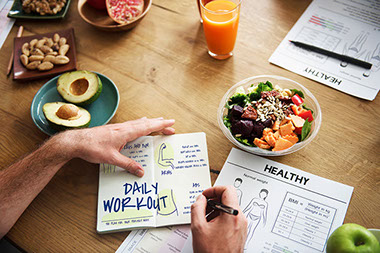
    Person writing in fitness notebook with healthy snacks on table.

    Changing how you go about your day can help get rid of eating cues and prepare you to establish new, healthy habits. Examples:

    *  Change the order of morning events: get up, shower, brush hair, eat breakfast, brush teeth, read paper, walk dog.

    *  Change the order of work events: take off coat, talk with co-workers, organize desk, review appointments or assignments, open email,  make calls.

    *  Alter driving routine: wear gloves, turn on/off radio, raise/lower volume, try listening to a new station, open/close windows, take a new route to work.

    *  Develop new telephone behavior. Stand instead of sit, hold phone with your opposite hand to your opposite ear, talk in a different room, walk as you talk.

    Be realistic.Allow time to establish a new habit. Some new habits are picked up quickly. Others may take several weeks or months of practice.

    Be consistent.Practice your new behaviors every day. This is how your new behavior will become a reliable habit.

    © American Institute for Preventive Medicine

  • Tips For Healthy Celebration

    Healthylife® Weigh

    Part 6

    Thanksgiving dinner and family eating at table.

    Happy times may also be triggers for overeating or making less healthy food choices. Holidays and other special occasions may also make it harder to fit in physical activity.

    Items that trip you up during a celebration:

    *  Drinks: soda, alcoholic beverages

    *  Foods: desserts, large helpings of “comfort foods”

    *  Gifts of candy, cookies, etc.

    *  Too many things to do and less time to prepare healthy meals

    *  Workplace parties and cookie exchanges

    *  More travel or a change of routine

    *  Events centered around large meals, or appetizers

    *  All-you-can-eat buffets on cruise ships or at resorts

    Approaches to Celebration

    There are many ways you can approach a celebration.

    1. Make choices that fit with your healthy eating goals. Choose this option most of the time.

    2. Make mostly healthy choices, but choose small treat foods. Choose small portions of these treats and eat them mindfully.

    3. Eat without restriction. Eat and drink what you would like without feeling guilty for choosing less healthy foods. Choose this option rarely and plan to make healthy choices the next day.

    If you have been making healthy choices for a while, you may notice your body’s negative response to certain unhealthy foods. Foods high in saturated fat seem to sit in your stomach longer and make you feel uncomfortable. Meals low in fiber may leave you constipated. Artificial sugars may give you a headache. Pay attention to this difference. It can help you choose less of these foods in the future.

    © American Institute for Preventive Medicine

  • Good Cheer For Holiday Dieting

    HEALTHY EATING

    Image of gift sitting on a plate.

    Big holiday coming up? Don’t panic. With a good game plan and strategic planning you and your diet can not only survive holidays but you can actually thrive on them. Holidays do not have to be a time of feast or famine-you can strike a happy balance between gorging and self-sacrifice.

    *  Review your eating habits from the previous year’s celebration. Does food take center stage during the holidays? Do you genuinely enjoy foods like fruitcake, for example, or do you just eat them out of custom and tradition?

    *  Before digging in at a big holiday feast, imagine how you will feel after eating it. Visualize the bloated, uncomfortable, and guilty feelings you’ve experienced on past occasions.

    *  Forget about being “perfect” on holidays. Stringent dieting may be unrealistic and you could sabotage your efforts by setting standards that are too high. Don’t set yourself up for failure by only thinking of what you can’t have. Concentrate instead on healthy options such as fruit baskets.

    *  Learn to be festive without depending on alcohol. A drink here, a toast there-the calories of alcohol can add up. Substitute club soda or mineral water for alcohol.

    *  If you’re invited to someone’s home for dinner, ask if you can bring a dish, then make it  low-calorie. (And be sure to make plenty. Low-calorie foods are usually very popular.)

    *  Remember that the major purpose of the holidays is to enjoy family and friends. Food and alcohol are secondary factors.

    © American Institute for Preventive Medicine

  • Avoid Drowsy Driving

    Healthylife® Weigh

    Part 3

    Alert driver.

    Driving while sleepy can severely impair your driving and cause an accident. Studies have linked sleepiness and fatigue to decreases in reaction time, decision-making, and mind and body coordination. All of these factors are very important for safe driving.

    According to estimates from the National Safety Council in 2017, one out of every five deadly traffic crashes is due to drowsy driving.

    Drive when you feel alert. On long drives, plan 15-minute breaks to get out and stretch your legs every 2 hours. Avoid using food to stay alert. Closing your eyes for even a second (called microsleep) can be enough to travel blindly down the road (or off the road). If you drive while you are fatigued, you and anyone around you is at serious risk.

    Signs of Fatigue

    *  You can’t stop yawning.

    *  You have trouble keeping your head up.

    *  Your eyes close for a moment or go out of focus.

    *  You have wandering, disconnected thoughts.

    *  You have no memory of driving the last few miles.

    *  You miss seeing a sign or your exit.

    *  You slow down when you don’t mean to or brake suddenly or too late.

    *  You drift across the road or veer off onto rumble strips.

    What to do:

    *  Pull to the side of the road or go to a rest stop.

    *  Take a 15-20-minute nap. If you can, have 250-300 mg of caffeine (about 2 cups of coffee) before the nap.

    *  Get a non-drowsy person to drive or find some way of getting to your destination without driving yourself.

    *  Drive to a motel or place where you can sleep.

    © American Institute for Preventive Medicine

  • Create Self-Enhancing Feelings

    Healthylife® Weigh

    Part 4

    Man thinking.

    Take responsibility for your thoughts, feelings, and actions. You will feel better about yourself and your life. Blaming others is a natural, child-like reaction. It is more adult-like to figure out the amount of control you have in a given situation and respond to it in a mature way. You may not have control in every situation, but you can choose how to respond to others.

    One reason to become more accountable for your responses is that a “victim” response forms negative, draining feelings. Self-responsibility creates positive energy. With it you can manage every event in a more positive, self-nurturing manner. One way to do this is to look at your language and see if you use “victim” or “accountability” phrases.

    Example “victim” phrase:I can’t lose weight until my family also tries to lose weight.

    Example “accountability” phrase:I can talk with my family about how they can be supportive of my efforts. I can help with family meal planning so I have more control over the foods kept in the house and served during meals.

    Complete the chart on the next page to practice taking responsibility for your thoughts, feelings, and actions.

    © American Institute for Preventive Medicine

  • Feeling Full

    Healthylife® Weigh

    Part 6

    Man feeling full.

    Learn to better evaluate your fullness. It can take twenty minutes to start feeling physically full.

    1. Be satisfied in other ways. Enjoy the taste of food, the people you are with, or the place you are eating.

    2. Express gratitude for your food. This includes who prepared the food (it may be you!) and where it comes from.

    3. Drink a glass of water throughout the meal. This will help with digestion and feeling full.

    4. Make half your plate vegetables. It will take longer to eat these nutrient-dense foods.

    5. Keep consistent “food rules” like sitting at the table and drinking a glass of water with each meal or snack. This can be a built in “speed bump” for overeating. If you don’t want to sit at the table or drink water, you may not be physically hungry and emotional hunger is your trigger.

    6. When tracking your intake, also track your hunger-fullness using the scale to the right. Try to eat in the gray area (range 4-7). Avoid being too hungry or too full.

    The Hunger-Fullness Scale

    0: Empty

    1: Ravenous

    2: Over-hungry

    3: Hunger pangs

    4: Hunger awakens

    5: Neutral

    6: Just satisfied

    7: Completely satisfied

    8: Full

    9: Stuffed

    10: Sick

    7. Slow down. If you can, try to increase the time it takes you to finish your meal by 50%. If you currently finish dinner in 10 minutes, set a timer to stretch the meal out by 5 minutes-or longer!

    © American Institute for Preventive Medicine

  • Identify Emotions That Prompt You To Eat

    Healthylife® Weigh

    Part 6

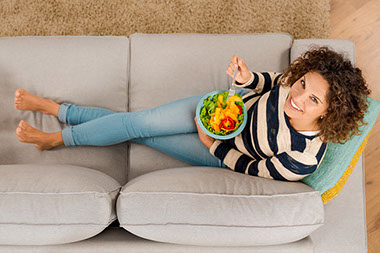
    Top view of woman on the sofa eating a healthy salad.

    Indicate how often the following scenarios apply to you.

    *  When I’m angry or upset, I think, “I don’t care what I eat or how much I eat.”

    *  When I see something tasty, I eat it but regret it later. I find myself saying, “Why did I just do that? I didn’t really want it.”

    *  When I have a craving for something, it is very difficult for me not to satisfy it right away. I may feel frustrated until I have it.

    *  When I’m stressed, I tell myself, “I can take a break from eating healthy so I can focus on the stressful things. I will get back on track later.”

    *  When I am eating with my friends or family, I can’t seem to stick to my healthy plans.

    *  Once I start eating something I really like, I have a hard time stopping, even when I want to.

    *  I find myself saying, “Oh, what the heck, I blew it anyway. I might as well eat whatever I want.”

    © American Institute for Preventive Medicine

  • Make Unhealthy Habits Less Convenient

    Healthylife® Weigh

    Part 4

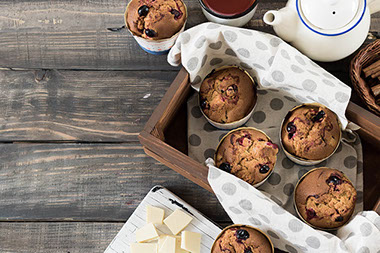
    Muffins with cranberries and white chocolate.

    To help make your healthy habits easier, make doing your unhealthy habits harder or unpleasant. Make healthy choices pleasant and convenient.

    Ways to Make Unhealthy Habits Unpleasant and Inconvenient

    *  Sit in an uncomfortable chair when having an unhealthy food or drink. Don’t sit on the couch to eat.

    *  Keep unhealthy foods and drinks in the basement, the laundry room, or a closet. Don’t keep these foods in the kitchen or in easy sight.

    *  Eat foods with the wrong utensil (e.g., try eating a pizza with a spoon).

    *  Set the volume on the TV very low as a cue to do something active. If you turn up the volume and watch, turn the volume back down before turning the TV off. The reminder will be there for you next time.

    *  Hide the TV remote in a drawer or on top of a book case.

    How can you make an unhealthy habit unpleasant and inconvenient?

    Ways to Make Healthy Habits Pleasant & Convenient

    *  Wear new workout clothes-even new socks can make an experience more fun!

    *  Listen to your favorite music while exercising or eating a healthy snack.

    *  Add fresh flowers to the table when you serve a healthy meal.

    How can you make a healthy habit pleasant and convenient?

    Take Small Steps Toward a New Habit

    1. List one unhealthy eating habit you want to change. Make sure the change is something you want to do, not something you are doing just to please someone else. Be specific.

    2. Make a list of the reasons you want to do this. Read this list often. For extra support: use a sticky note or index card and post this list where the unhealthy eating habit takes place.

    3. Write a positive statement about yourself or an encouraging message on a sticky note or an index card. Post this where you will see it, such as on a refrigerator or bathroom mirror.

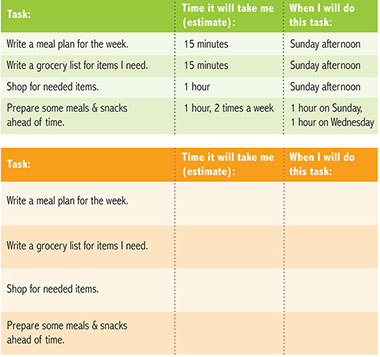
    4. Working backwards from your goal, write a series of steps you can take to get there. Make the first step something you feel ready to do today. As soon as you take each step, set a time goal for taking the next step. It can be tempting to break a goal into so many steps that it takes a very long time to make any changes. It is normal to not want to fail. However, if you stretch a change out too long, you risk losing motivation. If you are taking steps that seem easy, try taking a little bigger step. You may find you are able to do more at once than you thought! If that bigger step is too hard, try again or go back to the smaller step. Keep going.

    5. Reflect on your success or any challenges you experienced.

    – How easy/hard was it to make this change?

    – What changes did you have to make to your steps as you went along?

    6. Reward yourself for small steps.

    – Pay attention to any rewarding thoughts or feelings that occur, such as feeling more confident or more organized.

    – Notice any physical feelings, such as having more energy or sleeping better at night.

    – Take time to reflect on one of your values statements. How has taking these steps allowed you to show yourself and others what you value?

    – Treat yourself with non-food rewards, such as a new book, fresh flowers, or new music. Reflect on the intrinsic rewards of your changes.
    © American Institute for Preventive Medicine

  • Pack Travel Snacks

    Healthylife® Weigh

    Part 3

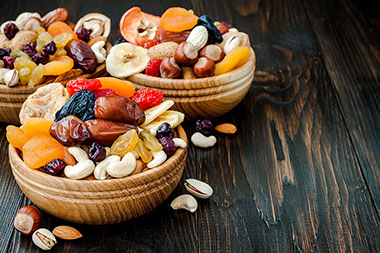
    Mix of dried fruits and nuts.

    Pack these items ahead of time. Take them with you when you drive, fly, or take a bus or train. Be sure to pack snacks for kids traveling with you as well. This can help kids get in the habit of packing their own travel snacks. It can also take away your excuse to stop for fast food and buy candy or salty snacks. Use these ideas for a healthy work snack as well. Keep a healthy snack in your desk drawer, locker or fridge, if they need to be kept cold, like hummus or fresh edamame.

    *  Homemade granola bars. Look for recipes with nuts, seeds, peanut butter, and dried fruit to help keep you full and give you lasting energy.

    *  Homemade trail mix.

    *  Peanut butter + apple slices, celery sticks, or whole grain crackers

    *  Hummus + sliced veggies (celery, carrots, cucumber slices)

    *  Apple slices with cinnamon

    *  Almonds, peanuts, walnuts, cashews

    *  Dried fruit

    *  String cheese

    *  Whole fruit, like apples and bananas

    *  Edamame

    *  Protein bar

    *  Small, single-serving boxes of whole grain cereal

    *  Small square of dark chocolate

    Respect Food Allergies

    If traveling in a public place (e.g., train, bus, airplane), avoid snacks that contain peanuts. If someone has a severe peanut allergy, you may be putting their life in danger.

    © American Institute for Preventive Medicine