Tag: wellness

  • Does Tea Make You Healthier?

    HEALTHY EATING

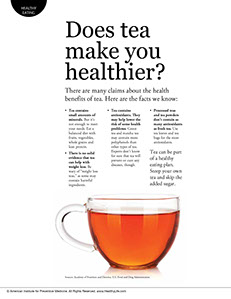
    A cup of tea.

    There are many claims about the health benefits of tea. Here are the facts we know:

    *  Tea contains small amounts of minerals. But it’s not enough to meet your needs. Eat a balanced diet with fruits, vegetables, whole grains and lean protein.

    *  There is no solid evidence that tea can help with weight loss. Be wary of “weight loss teas,” as some may contain harmful ingredients.

    *  Tea contains antioxidants. They may help lower the risk of some health problems. Green tea and matcha tea may contain more polyphenols than other types of tea. Experts don’t know for sure that tea will prevent or cure any diseases, though.

    *  Processed teas and tea powders don’t contain as many antioxidants as fresh tea. Use tea leaves and tea bags for the most antioxidants.

    Tea can be part of a healthy eating plan. Steep your own tea and skip the added sugar.

    Sources: Academy of Nutrition and Dietetics, U.S. Food and Drug Administration

    © American Institute for Preventive Medicine

  • Eat Your Vitamins For Good Health

    HEALTHY EATING

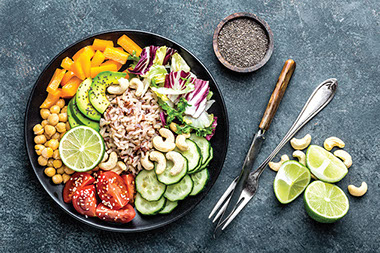
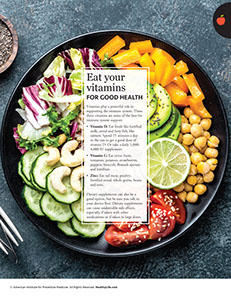
    Bowl of vegetables with rice and chickpeas.

    Vitamins play a powerful role in supporting the immune system. These three vitamins are some of the best for immune system support:

    *  Vitamin D: Eat foods like fortified milk, cereal and fatty fish, like salmon. Spend 15 minutes a day in the sun to get a good dose of vitamin D. Or take a daily 1,000-4,000 IU supplement.

    *  Vitamin C: Eat citrus fruits, tomatoes, potatoes, strawberries, peppers, broccoli, Brussels sprouts and kiwifruit.

    *  Zinc: Eat red meat, poultry, fortified cereal, whole grains, beans and nuts.

    Dietary supplements can also be a good option, but be sure you talk to your doctor first. Dietary supplements can cause undesirable side effects, especially if taken with other medications or if taken in large doses.

    © American Institute for Preventive Medicine

  • Destination: Fun

    Healthy Travel

    Couple smiling, sitting in front of eiffel tower.

    Taking a break from it all is good for your health and happiness. Planning ahead, packing smart, and knowing your destination will help you relax and enjoy. Use these tips for a safe and healthy vacation.

    *  Find out what to expect at your destination – weather, construction areas, and health concerns.

    *  If you are going outside the U.S., find out if you need any vaccines. Ask your doctor or visitcdc.gov/travel.

    *  Don’t carry large amounts of cash.

    *  Make sure you have enough of your medicines. Pack them in your carry-on bag.

    *  Pack a first-aid kit with over-the-counter (OTC) medicines, sunscreen, and bandages.

    *  During airplane travel, stretch your arms and legs at least every hour.

    *  Leave valuables at home. Don’t become a target for theft.

    *  Stay hydrated. If the drinking water is unsafe, choose bottled water. Limit alcohol and caffeine.

    *  Wash your hands often. Take alcohol-based hand sanitizers that contain least 60% alcohol.

    *  Talk to your family about safety concerns. Don’t let kids wander.

    *  Supervise your children at all times.

    Action Step:Use a sunscreen with a sun protection factor (SPF) of 15 or higher to protect your skin from the sun’s ultraviolet rays.

    Page from HealthyLife Weigh book by the American Institute for Preventive Medicine. www.HealthyLife.com. All rights reserved.

    © American Institute for Preventive Medicine

  • Working In Exercise While At Work

    Fitness

    Move more, even when you sit.

    Chances are you don’t have one of those newfangled treadmill desks in your office. That shouldn’t stop you from adding exercise into your work schedule. If you get breaks, use them to march up and down the stairs or walk around the building a few times. Or, go into an empty conference room and pound out some pushups. While you probably won’t get enough of a workout for one day’s needs, short stints of exercise add up.

    Don’t just stand there.

    Waiting for the coffee to brew? Burst into a 60-second aerobic routine that includes side stepping or marching in place. Or, squat and stand as the copy machine spits out your papers. And, perhaps just to freak out co-workers, strike a warrior pose in the break room. See if you can hold it for a minute without talking (or laughing).

    Do sitting-down-on-the-job exercises.

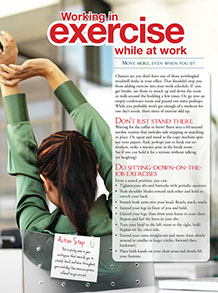
    Women sitting at desk, stretching arms above her head.

    From a seated position, you can:

    *  Tighten your abs and buttocks with periodic squeezes.

    *  Push shoulder blades toward each other and hold to stretch your back.

    *  Stretch both arms over your head. Reach, reach, reach.

    *  Extend your legs in front of you and hold.

    *  Extend your legs, than draw your knees to your chest. Repeat and feel the burn in your abs.

    *  Turn your head to the left, torso to the right, hold. Repeat on the other side.

    *  Extend your arms straight out and move them slowly around in smaller to larger circles, forward then backward.

    *  Place both hands on your chair arms and slowly lift your bottom.

    Action Step

    Put a sticky note in your workspace that reminds you to stretch, bend, and move throughout your workday. Use exercise options offered to you at work.

    Page image from Ways to Well-Being book by the American Institute for Preventive Medicine. www.HealthyLife.com. All rights reserved.

    © American Institute for Preventive Medicine

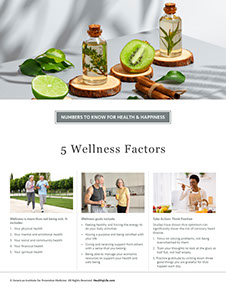
  • 5 Wellness Factors

    Personal Safety

    Slices of lime and kiwi, with bottles of oil and herbs.

    Wellness is more than not being sick. It includes:

    1.  Your physical health

    2.  Your mental and emotional health

    3.  Your social and community health

    4.  Your financial health

    5.  Your spiritual health

    Wellness goals include:

    *  Feeling healthy and having the energy to do your daily activities

    *  Having a purpose and being satisfied with your life

    *  Giving and receiving support from others with a sense that you belong

    *  Being able to manage your economic resources to support your health and well-being

    Take Action: Think Positive

    Studies have shown that optimism can significantly lower the risk of coronary heart disease.

    1.  Focus on solving problems, not being overwhelmed by them.

    2.  Train your thoughts to look at the glass as half full, not half empty.

    3.  Practice gratitude by writing down three good things you are grateful for that happen each day.

    A Year of Health Hints book by the American Institute for Preventive Medicine. www.HealthyLife.com. All rights reserved.

    © American Institute for Preventive Medicine

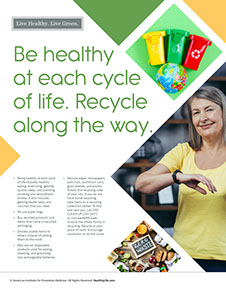
  • Be Healthy At Each Cycle Of Life. Recycle Along The Way.

    Home Safety

    Women with smart watch and fist up in the air.

    *  Being healthy at each cycle of life includes healthy eating, exercising, getting quality sleep, and avoiding smoking and secondhand smoke. It also includes getting health tests and vaccines that you need.

    *  Re-use paper bags.

    *  Buy recycled products and items that come in recycled packaging.

    *  Donate usable items to others instead of adding them to the trash.

    *  Rely less on disposable products used for eating, cleaning, and grooming. Use rechargeable batteries.

    *  Recycle paper, newspapers, junk mail, aluminum cans, glass bottles, and plastic. Follow the recycling rules of your city. If you do not have home recycling, take items to a recycling collection center. To find one near you, call 800.CLEAN.UP (253.2687) or visitearth911.com. Involve the whole family in recycling. Recycle at your place of work. Encourage coworkers to do the same.

    A Year of Health Hints book by the American Institute for Preventive Medicine. www.HealthyLife.com. All rights reserved.

    © American Institute for Preventive Medicine

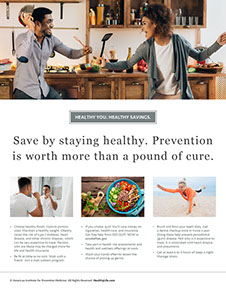
  • Save By Staying Healthy. Prevention Is Worth More Than A Pound Of Cure.

    Medical Care

    Couple play dueling in the kitchen, laughing.

    *  Choose healthy foods. Control portion sizes. Maintain a healthy weight. Obesity raises the risk of type 2 diabetes, heart disease, and other chronic diseases, which can be very expensive to treat. Persons who are obese may be charged more for life and health insurance.

    *  Be fit at little or no cost. Walk with a friend.  Join a mall walkers program.

    *  If you smoke, quit! You’ll save money on cigarettes, health care, and insurance. Get free help from 800.QUIT. NOW orsmokefree.gov.

    *  Take part in health risk assessments and health and wellness offerings at work.

    *  Wash your hands often to lessen the chance of picking up germs.

    *  Brush and floss your teeth daily. Get a dental checkup once or twice a year. Doing these help prevent periodontal (gum) disease. Not only is it expensive to treat, it is associated with heart disease and pneumonia.

    *  Get at least 6 to 8 hours of sleep a night. Manage stress.

    A Year of Health Hints book by the American Institute for Preventive Medicine. www.HealthyLife.com. All rights reserved.

    © American Institute for Preventive Medicine

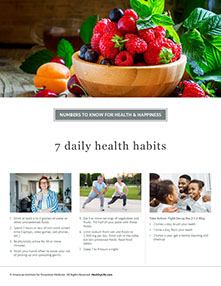
  • 7 Daily Health Habits

    General Health Conditions

    A wooden bowl filled with berries.

    1.  Drink at least 6 to 8 glasses of water or other unsweetened fluids.

    2.  Spend 2 hours or less of non-work screen time (laptops, video games, cell phones, etc.).

    3.  Be physically active for 30 or more minutes.

    4.  Wash your hands often to lower your risk of picking up and spreading germs.

    5.  Eat 5 or more servings of vegetables and fruits. Fill half of your plate with these foods.

    6.  Limit sodium from salt and foods to 2,300 mg per day. Omit salt at the table. Eat less processed foods. Read food labels.

    7.  Sleep 7 to 9 hours a night.

    Take Action: Fight Decay the 2-1-2 Way

    *  2 times a day, brush your teeth

    *  1 time a day, floss your teeth

    *  2 times a year, get a dental cleaning and checkup

    Health at Home Lifetime book by the American Institute for Preventive Medicine. www.HealthyLife.com. All rights reserved.

    © American Institute for Preventive Medicine

  • 10 Ways To Get The Most Out Of Midlife

    SELF-CARE CORNER

    Image of couple dancing.

    Are your best years ahead? A national survey of women between the ages of 35 and 49, sponsored in partnership with the National Association of Nurse Practitioners in Women’s Health and Teva Women’s Health shows that more than three-quarters of women in midlife say the best years are ahead, not behind. Yet midlife is notoriously known as a time of crisis. Women’s health expert, Dr. Judith Reichman, tells how women are seizing the midlife moment and making new choices related to their health.

    If you have not already joined the ranks of women enjoying midlife, here are 10 ways to get the most out of these years:

    1. Don’t obsess about those 8 glasses of water each day. Drink when you are thirsty and when you are exercising briskly. Too much water reduces the impact of electrolytes and strains the bladder.

    2. Focus on family bonding. Often midlife crises for women are not an age phenomenon but rather due to the very significant changes that occur in the lives of our growing-up children and our maturing (we hope) partners.

    3. Spend more time with your partner. Don’t wait until the nest is already empty. This is the time to rediscover why you fell in love in the first place.

    4. Rev up the love life. You are free to go on dates with your partner-real dates!

    5. Periodically reevaluate your choice of birth control. The second-highest rates of unplanned pregnancies occur in midlife.

    6. Worry more about you. PMS gets worse with age, and work and family responsibilities continue to rise, so it is important to establish de-stressing routines, including setting aside time to exercise and visit with friends.

    7. Cut down on salt, reduce your caloric intact by 100-200 calories per day and boost your calcium and vitamin D intake. By midlife, most women are at high risk for high blood pressure and heart disease. Cutting salt can save your life and set up your family for healthy habits as they get older.

    8. Embrace your desire to sleep. Now is the time to develop good sleep habits to prepare you for the next stage of life as hormonal changes during menopause increase sleep troubles.

    9. Do something you thought you would never have time for. Take up a new hobby or go back to an activity you love-knitting, dancing, learning, or volunteering. Do something that makes you feel good about yourself.

    10. See your doctor. You have always made sure everyone else in the family gets a yearly check-up, but what about you? Schedule those yearly health screenings and don’t neglect your own health.

    Judith Reichman, MD, is an attending physician in gynecology at Cedars-Sinai Medical Center and author of Slow Your Clock Down: The Complete Guide to a Healthy, Younger You.
    © American Institute for Preventive Medicine

  • 3 “S”S For Being Active At Work

    FAMILY LIFE

    Two coworkers holding a set of dumb bells in hands.

    Many people have jobs that require sitting at a desk or being inactive for long periods of time. This can make it hard to reap the benefits of exercise, like having more energy and weight loss. But you can fit in fitness at work with just a few tricks.

    1.  Shoes. If you wear a dress or work shoes, bring your sneakers to work. Keep them under your desk and slip them on during your lunch break so you can take a brisk walk in comfort.

    2.  Stairs & standing. Whenever possible, take the stairs instead of the elevator. A few extra calories burned is better than none. Try to stand or walk when you don’t need to be sitting. This could be during a phone conversation, or going down the hall to speak to someone instead of calling or emailing them.

    3.  Schedule. Put time in your schedule to exercise. It’s one of the most important things you can do for YOU! If you don’t have enough time at lunch, find a way to exercise either before or after work. Write it down in your work calendar as a reminder that it’s an important commitment.

    © American Institute for Preventive Medicine