Tag: Women’s Health Issues

  • The Latest On Mammograms

    MEDICAL NEWS

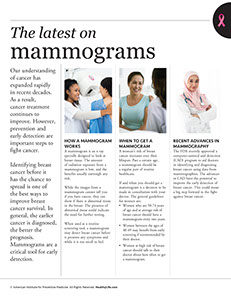
    Female doctor smiling.

    Our understanding of cancer has expanded rapidly in recent decades. As a result, cancer treatment continues to improve. However, prevention and early detection are important steps to fight cancer.

    Identifying breast cancer before it has the chance to spread is one of the best ways to improve breast cancer survival. In general, the earlier cancer is diagnosed, the better the prognosis. Mammograms are a critical tool for early detection.

    How a mammogram works

    A mammogram is an x-ray specially designed to look at breast tissue. The amount of radiation exposure from a mammogram is low, and the benefits usually outweigh any risk.

    While the images from a mammogram cannot tell you if you have cancer, they can show if there is abnormal tissue in the breast. The presence of abnormal tissue could indicate the need for further testing.

    When used as a routine screening tool, a mammogram may detect breast cancer before it presents any symptoms and while it is too small to feel.

    When to get a mammogram

    A woman’s risk of breast cancer increases over their lifespan. Past a certain age, a mammogram should be a regular part of routine healthcare.

    If and when you should get a mammogram is a decision to be made in consultation with your doctor. The general guidelines for women are:

    *  Women who are 50-74 years of age and at average risk of breast cancer should have a mammogram every two years.

    *  Women between the ages of 40-49 may benefit from early screening if recommended by their doctor.

    *  Women at high risk of breast cancer should talk to their doctor about how often to get a mammogram.

    Recent Advances in Mammography

    The FDA recently approved a computer-assisted and detection (CAD) program to aid doctors in identifying and diagnosing breast cancer using data from mammographies. The advances in CAD have the potential to improve the early detection of breast cancer. This could mean a big step forward in the fight against breast cancer.

    © American Institute for Preventive Medicine

  • Getting Help For Violence And Abuse

    Women’s Health

    Violence uses force, power, or threats to cause physical or emotional harm on purpose.

    Abuse is one form of violence. It can be emotional, physical, financial, and/or sexual.

    It may not be easy to admit that you are the victim of abuse. You may be confused about what to do or how to find a way out.

    Time to Get Help When

    It is time to get help if the person you love, live with, or work with does any of these things:

    *  Puts you down in public.

    *  Criticizes you for little things.

    *  Keeps you from seeing or talking to family, friends, or co-workers.

    *  Monitors what you are doing all of the time.

    *  Keeps accusing you of being unfaithful.

    *  Destroys things you own or care about.

    *  Gets angry when he or she drinks alcohol or uses drugs.

    *  Blames you for his or her angry outbursts.

    *  Threatens to hurt you, children, or animals. Beats, chokes, hits, kicks, pushes, shoves, or slaps you or them, or hurts you in any way.

    *  Says it is your fault if he or she hurts you, then promises that it will not happen again.

    *  Threatens to or uses weapons against you.

    *  Forces you to have sex against your will. {The Department of Veterans Affairs uses the term military sexual trauma (MST) for sexual assault or repeated, threatening sexual harassment that occurred while a Veteran was in the service.}

    Causes

    Violence and abuse are ways to gain and keep control over others. Persons who commit violence or abuse come from all ethnic groups and backgrounds. Often, they have these problems:

    *  Poor skills to communicate.

    *  Past family violence. They may have been abused in the past. They may have seen one parent beat the other.

    *  Alcohol or drug problems.

    Regardless of the cause, no one deserves to be abused! Most often, persons who abuse others or commit violence, find it hard to change their behavior without expert help. If you are a victim of violence or abuse, get help and support.

    Getting Help

    *  If you are assaulted or threatened or need emergency help, call 911!

    *  If you are not in immediate danger, have a plan for times you feel unsafe or in danger or when you decide to leave the abusive setting.

    – Decide who you will call (e.g., police, neighbors, relatives, and a shelter). Make a list of these telephone numbers. Memorize the numbers, too.

    – Decide where you will go. If you have children, plan how you will take them with you. Have a plan for where they should go if you can’t get away. Practice these safety plans with your children. Plan how you will take your pets, too, if you can.

    *  To help recover from sexual assault or trauma, contact your doctor or health care provider for proper counseling and treatment. {Note: Veterans can receive free treatment for military sexual trauma (MST) at all VA health care facilities.}

    Be prepared to leave an abusive setting. Keep important items in a safe place (unknown to the person who is abusing you) until you are ready to leave or if you have to leave quickly. Get these items together ahead of time.

    *  Extra keys to your car, house, and safety deposit box.

    *  Cash. Credit cards and ATM card. Checkbook, bankbooks, and investment records or their account numbers.

    *  Jewelry or other small objects that you can sell in case you need money.

    *  Cell phone, a phone calling card, and phone numbers that you need.

    *  Personal papers for you and your children. These can be the original forms, copies of them, or information, such as numbers and dates written on paper. Items include:

    – Birth certificates and social security numbers.

    – Driver’s license, state ID, and passports.

    – Car registration, title, and insurance information.

    – Medical ID cards and medical records for you and your children.

    – Marriage license, divorce papers, legal papers for custody, restraining orders, etc.

    – House deed or lease agreement.

    Resources

    National Domestic Violence Hotline

    800.799.SAFE (799.7233)

    Rape, Abuse, and Incest National Network (RAINN)

    www.rainn.org

    National Sexual Assault Hotline

    800.656.HOPE (656.4673)

    National Sexual Assault Online Hotline

    https://ohl.rainn.org/online

    Women's Self-Care book by the American Institute for Preventive Medicine. www.HealthyLife.com. All rights reserved.

    © American Institute for Preventive Medicine

  • When To See A Gynecologist

    Women’s Health

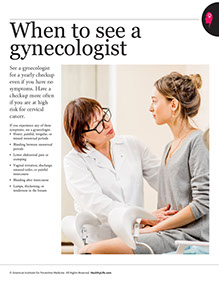
    Image of female doctor with female patient.

    If you experience any of these symptoms, see a gynecologist.

    *  Heavy, painful, irregular, or missed menstrual periods. Bleeding between menstrual periods.

    *  Lower abdominal pain or cramping.

    *  Vaginal irritation, discharge, or painful intercourse. Bleeding after intercourse.

    *  Lumps, thickening, or tenderness in the breasts.

    Also see a gynecologist for a yearly checkup even if you have no symptoms. Have a checkup more often if you are at high risk for cervical cancer.

    A Year of Health Hints book by the American Institute for Preventive Medicine. www.HealthyLife.com. All rights reserved.

    © American Institute for Preventive Medicine

  • Pap Smear Needed Even With Hpv Vaccine

    MEDICAL NEWS

    Image of women talking with her doctor.

    HPV (human papillomavirus) vaccines that are often recommended to help prevent infections related to cervical and other cancers should not discourage women from also getting a Pap smear, UT Southwestern Medical Center cancer experts said.

    “Women should continue to be screened even if they have undergone HPV vaccination. The vaccine does not target all types of HPV that cause cancer. It is intended to reduce the risk of cancer, but has not been proven to eliminate the need for screening,” explains Dr. Jayanthi Lea.

    Unless you have a history of precancerous lesions, cancer, immune deficiency, or other risks, testing every three years between ages 21 and 65 is sufficient, Dr. Lea said. “There is also the option of combining a Pap test with HPV testing for women over age 30. Screening this way is typically performed every five years.”

    © American Institute for Preventive Medicine