Tag: Women’s Health

  • Fainting

    Women’s Health

    Fainting is a brief loss of consciousness. It can last from seconds to 30 minutes.

    Signs & Symptoms

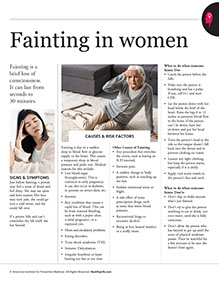
    Just before fainting, a person may feel a sense of dread and feel dizzy. She may see spots and have nausea. Her face may turn pale, she could go into a cold sweat, and she could fall over.

    If a person falls and can’t remember the fall itself, she has fainted.

    Causes

    Fainting is due to a sudden drop in blood flow or glucose supply to the brain. This causes a temporary drop in blood pressure and pulse rate. Medical reasons for this include:

    *  Low blood sugar (hypoglycemia). This is common in early pregnancy. It can also occur in diabetes, in persons on severe diets, etc.

    *  Anemia.

    *  Any condition that causes a rapid loss of blood. This can be from internal bleeding, such as with a peptic ulcer, a tubal pregnancy, or a ruptured cyst.

    *  Heart and circulatory problems, such as abnormal heart rhythm, heart attack, or stroke.

    *  Eating disorders.

    *  Toxic shock syndrome (TSS).

    *  Seizures.

    Other Causes of Fainting

    *  Any procedure that stretches the cervix, such as having an IUD inserted.

    *  Extreme pain.

    *  A sudden change in body position, such as standing up too fast.

    *  Sudden emotional stress or fright.

    *  A side effect of some prescription drugs, such as some that lower blood pressure.

    *  Recreational drugs or excessive alcohol.

    *  Being in hot, humid weather or being in a stuffy room.

    Know what to do when someone faints.

    Dos

    *  Catch the person before she falls.

    *  Lie the person down with her head below the level of the heart. Raise the legs 8 to 12 inches to promote blood flow to the brain. If the person can’t lie down, have her sit down, bend forward, and put her head between her knees.

    *  Turn the person’s head to the side so the tongue doesn’t fall back into the throat and to prevent choking on vomit.

    *  Loosen any tight clothing, but keep the person warm, especially if the surroundings are chilly.

    *  Apply moist towels to the person’s face and neck.

    Don’ts

    *  Don’t slap or shake anyone who’s just fainted.

    *  Don’t try to give the person anything to eat or drink, not even water, until she is fully conscious.

    *  Don’t allow the person who’s fainted to get up until the sense of physical weakness passes. Then be watchful for a few minutes to be sure she doesn’t faint again.

    Questions to Ask

    Self-Care / Prevention

    *  When you feel faint, lie down and elevate both legs. Or, sit down, bend forward and put your head between your knees.

    *  Get up slowly from bed or from a sitting position.

    *  Follow your doctor’s advice to treat any condition which may lead to fainting. Take prescribed medicines, but tell your doctor about any side effects, so he or she can monitor your condition.

    *  Don’t wear tight clothing around your neck.

    *  Avoid turning your head suddenly.

    *  Stay out of stuffy rooms and hot, humid places. If you can’t, use a fan.

    *  If you have fainting spells often, avoid activities that can put lives in danger, such as driving a car.

    *  Drink a lot of fluids, but drink alcoholic ones in moderation, if at all. Eat small, frequent meals.

    When Pregnant

    *  Get out of bed slowly.

    *  Keep crackers at your bedside and eat a few before getting out of bed.

    *  Eat small, frequent meals instead of a few large ones. With each meal, have a good source of protein, such as lean meat, low-fat cheese, milk, etc. Avoid sweets. Don’t skip meals or go for a long time without eating. Drink plenty of fluids.

    *  Don’t sit for long periods of time. Elevate your legs when you sit.

    *  When you stand, as in a line, move your legs to pump blood up to your heart.

    *  Take vitamin and mineral supplements, as your doctor prescribes.

    *  Don’t lay on your back during the 2nd and 3rd trimesters of your pregnancy. Lie on your left side. When you can’t, lie on your right side.
    Women's Self-Care book by the American Institute for Preventive Medicine. www.HealthyLife.com. All rights reserved.

    © American Institute for Preventive Medicine
  • Menopause

    Women’s Health

    Menopause occurs when menstrual periods have stopped for one whole year. It is also called “the change of life.” In general, this occurs between the ages of 45 and 55. It can, though, occur as early as age 35 or as late as age 65. It can also result when both ovaries are removed by surgery.

    Signs & Symptoms

    Signs and symptoms usually span 1 to 2 or more years. This is called peri-menopause. Symptoms vary from woman to woman. They result from hormone changes, the aging process itself, fatigue, and stress.

    Physical Signs and Symptoms

    *  Hot flashes. These are sudden waves of heat that can start in the waist or chest and work their way to the neck and face and sometimes the rest of the body. They can occur as often as every 90 minutes. Each one can last from 15 seconds to 30 minutes; 5 minutes is average. Seventy-five to 80% of women going through menopause have hot flashes. Some women are more bothered by them than others. Sometimes heart palpitations come with hot flashes.

    *  Vaginal dryness. The vaginal wall also becomes thinner. These problems can make sex painful or uncomfortable. Irritation can increase the risk for infection.

    *  Loss of bladder tone. This can result in stress incontinence (leaking urine when you cough, sneeze, laugh, or exercise).

    *  Headaches.

    *  Dizziness.

    *  The skin is more likely to wrinkle.

    *  Hair grows on the face, but thins at the temples.

    *  Muscles lose some strength and tone.

    *  Bones become more brittle. This increases the risk for osteoporosis.

    *  Irregular periods:

    – Bleeding can occur between periods. This is the most common bleeding pattern in peri-menopause.

    – Periods get shorter and lighter for 2 or more years.

    – Periods can stop for a few months and then start up again and are more widely spaced.

    – Periods occur with heavy bleeding and/or the passage of many small or large blood clots.

    Emotional Signs and Symptoms

    *  Irritability.

    *  Mood changes.

    *  Lack of concentration. Memory problems.

    *  Tension, anxiety, depression.

    *  Insomnia. Hot flashes can interrupt sleep.

    Causes

    Hormone changes that come with aging cause menopause. The body makes less estrogen and progesterone.

    Treatment

    Self-care may be all that is needed. Just estrogen can be prescribed. This is estrogen therapy (ET). Estrogen plus progestogen can be prescribed. This is called EPT. The term hormone therapy (HT) is used for both ET and EPT. Hormone therapy helps protect against osteoporosis, but has health risks. Each women should discuss the benefits and risks of HT and non-estrogen treatments with her doctor.

    Questions to Ask

    Self-Care / Prevention

    For Hot Flashes

    *  Wear lightweight clothes made of natural fibers, such as cotton.

    *  Limit or avoid alcohol. Limit caffeine.

    *  Have cool drinks, especially water, when you feel a hot flash coming on and before and after you exercise. Avoid hot drinks.

    *  Keep cool. Open a window. Lower the thermostat when the heat is on. Use air conditioning and/or fans. Carry a small fan with you.

    *  Try to relax when you get a hot flash. Getting stressed out over one only makes it worse.

    *  Use relaxation techniques, such as meditation, biofeedback or yoga.

    *  Follow your doctor’s advice for taking herbal products, such as black cohosh; vitamin supplements; over-the-counter menopause aids; and soy products.

    *  If you suffer from night sweats (hot flashes that occur as you sleep):

    – Wear loose fitting cotton nightwear. Have changes of nightwear ready.

    – Sleep with only a top sheet, not blankets.

    – Keep the room cool.

    For Vaginal Dryness and Painful Sex

    *  Don’t use deodorant soaps or scented products in the vaginal area.

    *  Use a water soluble lubricant, such as K-Y Liquid®, Replens®, etc. These make penetration easier during sex. Avoid oils or petroleum-based products. These promote infection.

    *  Ask your doctor about the benefits and risks of using estrogen (pills, patches, vaginal cream, or rings).

    *  Stay sexually active. Having sex often may lessen the chance of having the vagina constrict. It also helps to maintain natural lubrication and pelvic muscle tone. Reaching orgasm with a partner or alone gives these benefits.

    *  If you can, avoid using antihistamines. They dry mucus membranes in the body.

    For Emotional Symptoms

    *  Exercise regularly. This helps maintain hormonal balance.

    *  Talk to other women who have gone through or are going through menopause.

    *  Avoid stress as much as you can.

    *  To deal with stress, use relaxation techniques. Examples are meditation, yoga, listening to soft music, and massages.

    *  Eat healthy. Take vitamins and minerals, as advised.

    Resources

    National Women’s Health Information Center

    www.womenshealth.gov

    North American Menopause Society (NAMS)

    www.menopause.org

    Women's Self-Care book by the American Institute for Preventive Medicine. www.HealthyLife.com. All rights reserved.

    © American Institute for Preventive Medicine
  • Varicose Veins

    Women’s Health

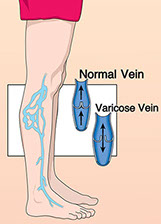
    Varicose veins may occur in almost any part of the body. They are most often seen in the back of the calf or on the inside of the leg between the groin and the ankle.

    Signs & Symptoms

    Illustration of varicose veins.

    *  Swollen and twisted veins look blue and are close to the surface of the skin.

    *  Veins bulge and feel heavy.

    *  The legs and feet can swell.

    *  The skin can itch.

    Causes & Risk Factors

    *  Obesity.

    *  Pregnancy.

    *  Hormonal changes at menopause.

    *  Activities or hobbies that require standing or lifting heavy objects for long periods of time.

    *  A family history of varicose veins.

    *  Often wearing clothing that is tight around the upper thighs.

    *  Body positions that restrict lower leg blood flow for long periods of time. One example is sitting in an airplane, especially in the economy class section, on a long flight.

    *  Past vein diseases, such as thrombophlebitis. This is inflammation of a vein before a blood clot forms.

    Treatment

    Medical treatment is not required for most varicose veins unless problems result. These include a deep vein blood clot or severe bleeding, which can be caused by an injury to the vein. Problems can occur without an injury, as well. An X-ray of the vein (venogram) or a special ultrasound can tell if there are any problems.

    Medical Treatment

    *  Surgery can remove all or part of the vein.

    *  Sclerotherapy. This uses a chemical injection into the vein, causing it to close up.

    *  Laser therapy. This causes the vein to fade away.

    Questions to Ask

    Self-Care / Prevention

    *  Don’t cross your legs when sitting.

    *  Exercise regularly. Walking is a good choice. It improves leg strength and vein strength.

    *  Maintain a healthy weight. Lose weight if you are overweight.

    *  Don’t stand for long periods of time.

    *  If your job or hobby requires you to stand, shift your weight from one leg to the other every few minutes. Just wiggling your toes can help, too.

    *  Wear elastic support stockings or support hose, as advised by your doctor.

    *  Don’t wear clothing or undergarments that are tight or constrict your waist, groin, or legs.

    *  Eat high-fiber foods, like bran cereals, whole-grain breads, and fresh fruits and vegetables, to promote regularity. Constipation may be a factor in varicose veins.

    *  Elevate your legs when resting.

    *  Exercise your legs. From a sitting position, rotate your feet at the ankles, turning them first clockwise, then counterclockwise, using a circular motion. Next, extend your legs forward and point your toes to the ceiling then to the floor. Next, lift your feet off the floor and gently bend your legs back and forth at the knees.

    *  Get up and move about every 35 to 45 minutes when traveling by air or even when sitting in an all-day conference. Opt for an aisle seat in such situations.

    *  Stop and take short walks at least every 45 minutes when taking long car rides.

    Resources

    American Academy of Dermatology

    866.503.SKIN (503.7546)

    www.aad.org

    American College of Phlebology

    www.phlebology.org

    Women's Self-Care book by the American Institute for Preventive Medicine. www.HealthyLife.com. All rights reserved.

    © American Institute for Preventive Medicine
  • Anemia

    Women’s Health

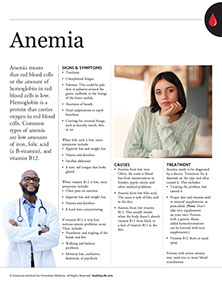
    Paper cutouts of blood drops with stethoscopes.

    Anemia means that red blood cells or the amount of hemoglobin in red blood cells is low. Hemoglobin is a protein that carries oxygen in red blood cells.

    Signs, Symptoms & Causes

    There are many types of anemia. Common ones are low amounts of iron, folic acid (a B vitamin), and vitamin B12. In general, symptoms include:

    *  Tiredness.

    *  Weakness.

    *  Paleness. This could be pale skin or paleness around the gums, nailbeds, or the linings of the lower eyelids.

    *  Shortness of breath.

    *  Heart palpitations or rapid heartbeat.

    With anemia from low iron, extra symptoms can occur. These include:

    *  Tiny cracks at the corner of the mouth.

    *  A smooth, sore tongue.

    *  Brittle nails.

    *  A hard time concentrating.

    *  Unusual cravings for ice, starch, or dirt.

    In the United States, up to 20% of all women of childbearing age have this form of anemia. Only 2% of adult men do. The main cause is blood lost during menstruation. Eating too few iron-rich foods or not absorbing enough iron can make the problem worse.

    Pregnancy, breastfeeding, and blood loss from peptic ulcers or other medical problems, can also deplete iron levels. Older women who have poor diets, especially when they live alone, often have low iron anemia.

    When folic acid is very low, extra symptoms can occur. These include:

    *  A smooth and tender tongue.

    *  Appetite loss and weight loss.

    *  Nausea and diarrhea.

    *  Headache.

    Folic acid is needed to make red blood cells. Folic acid levels are low from a lack of folic acid in the diet or faulty absorption. The need for this vitamin more than doubles during pregnancy. This is often not met by diets of pregnant women. A supplement of 400 micrograms (0.4 milligrams) of folic acid per day is advised.

    Females who are planning a pregnancy, should take folic acid, too. Folic acid is important when a female conceives and during the first months of pregnancy. Low folic acid levels at these times have been linked to low birth weight and major birth defects, such as neural tube defects (spina bifida) in babies. Folic-acid deficiency can also lead to infertility and an increased risk of infection. Low levels of this vitamin are often seen among elderly women, especially those who have poor diets.

    When vitamin B12 is low, extra symptoms can occur. These include:

    *  Chest pain on exertion.

    *  Swollen red tongue or bleeding gums.

    *  A hard time concentrating.

    *  Appetite loss and weight loss.

    *  Nausea and diarrhea.

    When vitamin B12 is very low, nervous system problems can occur, such as:

    *  Numbness and tingling in the hands and feet.

    *  Walking and balance problems.

    *  Memory loss, confusion, dementia or psychosis.

    One form of vitamin B12 deficiency anemia is pernicious anemia. This is usually caused when the body doesn’t absorb vitamin B12 from food. It can result from a lack of digestive acids and a substance called the intrinsic factor. Both are needed to absorb vitamin B12. Other causes are surgery that removes part or all of the stomach and autoimmune problems that cause cells in the stomach’s lining to shrink. Vitamin B12 is found only in animal foods. It is not in plant foods unless the vitamin is added, such as in some cereals.

    Other Types of Anemia

    *  Sickle cell anemia. This is an inherited disorder that affects the red blood cells’ ability to carry oxygen to the body’s tissues. Sickle cell anemia occurs mostly in African Americans but can occur in other ethnic groups too.

    *  Aplastic anemia. This is a serious disease of decreased bone marrow production.

    Also, alcohol, certain drugs, large amounts of aspirin, and some chronic diseases can cause anemia.

    Treatment

    Anemia shares symptoms with many health problems. It needs to be diagnosed by a doctor. Persons with severe anemia may need one or more blood transfusions.Treatment for it depends on the type and what caused it. This includes:

    *  Treating the problem that caused it.

    *  Eating a proper diet and taking vitamin and/or mineral supplements, as prescribed. {Note: Don’t take iron supplements on your own. Persons with a genetic illness called hemochromatosis (iron overload disease) can be harmed with iron supplements.}

    *  Getting vitamin B12 shots, if needed.

    Questions to Ask

    Self-Care

    To Get and Absorb Iron

    *  Eat foods that are good sources of iron: green leafy vegetables, lean red meat, beef liver, poultry, fish, wheat germ, oysters, dried fruit, and iron-fortified cereals.

    *  Eat foods high in vitamin C, such as citrus fruits, kiwi, tomatoes, strawberries, broccoli, and green or red bell peppers.

    *  If you drink tea, drink it between meals. Tannins in tea block iron absorption. Or add milk to tea. The calcium in milk binds with the tannins. (Herbal tea does not have tannins.)

    *  Take the supplements your doctor advises. {Note: High levels of iron in the blood may increase the risk for heart attacks. This is especially a concern if you have gone through menopause.}

    *  Avoid antacids, phosphates (which are found in soft drinks, beer, ice cream, candy bars, etc.), and the food additive EDTA. These block iron absorption.

    To Get and Absorb Folic Acid

    *  Eat good food sources of folate every day. These include asparagus, Brussels sprouts, spinach, romaine lettuce, collard greens, and broccoli. Other good sources are black-eyed peas, cantaloupe, orange juice, oatmeal, and whole-grain or fortified cereals.

    *  Eat fresh, raw fruits and vegetables often. Don’t overcook food. Heat destroys folic acid.

    *  Take the supplement your doctor advises.

    *  Don’t smoke or drink alcohol.

    Tips for Getting Vitamin B12

    *  Eat animal sources of food. Good choices are lean meats, fish, poultry, nonfat or low-fat dairy products.

    *  Strict vegetarians (vegans) who eat no animal sources of food should get vitamin B12 from a supplement or foods fortified with it, such as cereals or plant-based milks or nutritional yeast.

    Resources

    National Heart, Lung, and Blood Institute

    www.nhlbi.nih.gov

    Women's Self-Care book by the American Institute for Preventive Medicine. www.HealthyLife.com. All rights reserved.

    © American Institute for Preventive Medicine
  • Fibroids

    Women’s Health

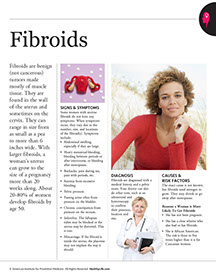
    Fibroids are benign (not cancerous) tumors made mostly of muscle tissue. They are found in the wall of the uterus and sometimes on the cervix. They can range in size from as small as a pea to more than 6 inches wide. With larger fibroids, a woman’s uterus can grow to the size of a pregnancy more than 20 weeks along. About 20% to 25% of women over the age of 35 get fibroids.

    Signs & Symptoms

    Some women with uterine fibroids do not have any symptoms. When symptoms occur, they vary due to the number, size, and locations of the fibroid(s). Symptoms include:

    *  Abdominal swelling, especially if they are large.

    *  Heavy menstrual bleeding, bleeding between periods or after intercourse, or bleeding after menopause.

    *  Backache, pain during sex, pain with periods, etc.

    *  Anemia from excessive bleeding.

    *  Pelvic pressure.

    *  Passing urine often from pressure on the bladder.

    *  Chronic constipation from pressure on the rectum.

    *  Infertility. The fallopian tubes may be blocked or the uterus may be distorted.

    *  Miscarriage. If the fibroid is inside the uterus, the placenta may not implant the way it should.

    Diagnosis

    Fibroids are diagnosed with a medical history and a pelvic exam. Your doctor can also do other tests, such as an ultrasound and hysteroscopy to confirm their presence, location, and size.

    Causes & Risk Factors

    Reasons a Woman is More Likely To Get Fibroids

    *  She has not been pregnant.

    *  She has a close relative who also had or has fibroids.

    *  She is African American. The risk is three to five times higher than it is for Caucasian women.

    The exact cause is not known, but fibroids need estrogen to grow. They may shrink or go away after menopause.

    Treatment

    “Watchful waiting”

    Your doctor will “watch” for any changes and may suggest “waiting” for menopause, since fibroids often shrink or disappear after that time. If you have problems during this “waiting” period, you may decide that you do not want to “wait” for menopause, but choose to have something done to treat your fibroids. Problems include: Too much pain; too much bleeding; an abdomen that gets too big; the need to take daily iron to prevent anemia; and other abdominal problems.

    Medication

    One type is called GnRH agonists. These block the production of estrogen by the ovaries. This shrinks fibroids in some cases, but is not a cure. The fibroids return when the medicine is stopped. Shrinking the fibroids might allow a minor surgery (with less blood loss) to be done instead of a major one. GnRH agonists are taken for a few months, but not more than six, because their side effects mimic menopause and may lead to osteoporosis. In some cases, GnRH agonists can be used longer with “Add Back Therapy.” This uses low dose estrogen to make side effects milder.

    Surgery Methods Include:

    *  Myomectomy. The fibroids are removed. The uterus is not. This can be done using a laparoscope and a laser (laparoscopy). The fibroids could also be cut out using a resectoscope (hysteroscopy). Fibroids can be removed under direct vision during abdominal surgery (laparotomy). Myomectomy methods may allow fibroids to grow back. The more fibroids there are to begin with, the greater the chance they will grow back.

    *  Procedures to destroy the uterine lining. These do not remove fibroids or the uterus, but stop or lighten menstrual flow from then on. The uterine lining can be destroyed using a laser, heat, or ultra cold.

    *  Uterine artery embolization. A catheter is inserted in a large blood vessel in the groin and sent to the level of the uterine arteries. A substance is given that blocks blood flow to the uterine arteries that nourish the fibroids. This treatment shrinks the fibroids.

    *  Hysterectomy. This surgery removes the uterus and the fibroids with it. This method is advised when the fibroid is very large or when other treatments don’t stop severe bleeding. It is the only way to get rid of fibroids for sure. A women can no longer get pregnant after the surgery. This treatment is also advised if the fibroid is cancerous. This rarely occurs.

    Questions to Ask

    Self-Care / Prevention

    *  Take medications as advised.

    *  Maintain a healthy body weight. Follow a diet low in fat. The more body fat you have, the more estrogen your body is likely to have. This promotes fibroid growth.

    *  Do regular exercise. This may reduce your body’s fat and estrogen levels.

    Resources

    National Women’s Health Information Center

    www.womenshealth.gov

    Women's Self-Care book by the American Institute for Preventive Medicine. www.HealthyLife.com. All rights reserved.

    © American Institute for Preventive Medicine
  • More Than One Baby

    Pregnancy & Prenatal Care

    Causes

    Having more than one baby may happen more often if:

    *  There is a family history of it.

    *  The mother is taking medicine or having treatment to get pregnant.

    *  She is an older mother.

    More than one baby can happen in two ways. The most common way is when two or more eggs are fertilized by two or more sperm. These babies can be either boys or girls. They may or may not look alike. They are called fraternal twins or triplets, etc.

    Less common is when an egg is fertilized by a sperm as usual. Then, for some reason, the egg splits apart. Two or more babies grow. They are the same sex. Their hair, eyes, and skin will be the same color. They are called identical twins or triplets, etc.

    In rare cases, the egg doesn’t split apart all the way. The twins stay joined together at the head or back. Or they may be joined at some other part of the body. They are called conjoined twins. Sometimes surgery can separate them after they are born. This can be very risky.

    Signs

    At first, a woman may not know she is carrying more than one baby. Her health care provider can usually tell within 8 weeks, though. Signs include:

    *  Severe nausea and vomiting

    *  The uterus is growing faster than usual.

    *  There are two or more heartbeats.

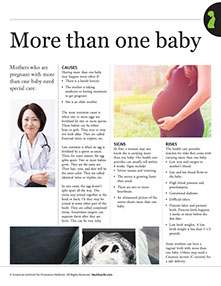
    *  An ultrasound picture of the uterus shows more than one baby.

    Risks

    The health care provider watches for risks that come with carrying more than one baby.

    *  Low iron and oxygen in mother’s blood.

    *  Less and less blood flows to the baby.

    *  High blood pressure and preeclampsia.

    *  Gestational diabetes.

    *  Difficult labor

    *  Preterm labor and preterm birth. Preterm birth happens 3 weeks or more before the due date.

    *  Low birth weights. A low birth weight is less than 5-1/2 pounds.

    Some mothers can have a vaginal birth with more than one baby. Others may need a Cesarean section (C-section) for a safe delivery.

    Questions to Ask

    Self-Care / Prevention

    *  You will need more prenatal health care visits than with just one baby. You will need extra blood tests and blood pressure checks. Your provider will need to make sure each baby is doing well. Call your provider whenever you have questions during your pregnancy.

    *  Eat healthy foods.

    *  Eat smaller meals more often. This helps ease things as your growing uterus presses on your stomach.

    *  Take your prenatal vitamins (vitamin pills) every day. They should include iron and folic acid. They will supply other needed vitamins and minerals, too.

    *  Don’t smoke, drink alcohol, or take drugs.

    *  Exercise only with your health care provider’s consent. Women carrying more than one baby tire more easily. In later pregnancy, avoid any activity that takes a lot of energy. Avoid any activity that could injure you or your babies.

    *  Lie on your left side. This helps blood flow to the babies. It may help keep blood pressure down, too. It also makes you more comfortable. Don’t lie on your back.

    *  Reduce stress in your life. Stress can lead to early labor.

    *  Get enough sleep. Learn and use methods to relax.

    *  Follow your health care provider’s advice on rest during the day.

    *  Get help with daily tasks, like caring for other children. If you can, take time off from your job after the 24th week.

    *  Watch for signs of preterm labor. Your provider may have you wear an electronic monitor. It senses contractions of the uterus.

    *  Choose a well-equipped hospital. Do this with your health care provider’s help. The hospital should be well suited for births of more than one baby. Choose one with a neonatal intensive care unit (NICU). This has special staff and equipment for babies born too early.

    Prenatal Self-Care book by the American Institute for Preventive Medicine. www.HealthyLife.com. All rights reserved.

    © American Institute for Preventive Medicine
  • Want To Have A Baby? Try This

    Pregnancy & Prenatal Care

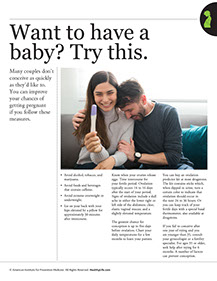
    Image of happy couple looking at positive pregnancy test, while male is making a phone call.

    Many couples don’t conceive as quickly as they’d like to. You can improve your chances of getting pregnant if you follow these measures.

    *  Avoid alcohol, tobacco, and marijuana.

    *  Avoid foods and beverages that contain caffeine.

    *  Avoid extreme overweight or underweight.

    *  Lie on your back with your hips elevated by a pillow for approximately 30 minutes after intercourse.

    *  Know when your ovaries release eggs. Time intercourse for your fertile period. Ovulation normally occurs 14 to 16 days after the start of your period. Signs of ovulation include a dull ache in either the lower right or left side of the abdomen; clear, elastic vaginal mucus; and a slightly elevated temperature.

    You can buy an ovulation predictor kit at most drugstores. The kit contains sticks which, when dipped in urine, turn blue if you’re ovulating.

    Or you can keep track of your fertile days with a special basal thermometer, also available at drugstores. Having intercourse when your temperature drops approximately 0.4ºF increases your chances of conception.

    If you fail to conceive after one year of trying, consult your gynecologist or a fertility specialist. A number of factors can prevent conception.

    A Year of Health Hints book by the American Institute for Preventive Medicine. www.HealthyLife.com. All rights reserved.

    © American Institute for Preventive Medicine
  • Anemia 2

    General Health Conditions

    Anemia means that red blood cells or the amount of hemoglobin in red blood cells is low. Hemoglobin is a protein that carries oxygen in red blood cells. Common types of anemia are low amounts of iron, folic acid (a B-vitamin), and vitamin B12.

    Signs & Symptoms

    *  Tiredness.

    *  Weakness.

    *  Paleness. This could be pale skin or paleness around the gums, nailbeds, or the linings of the lower eyelids.

    *  Shortness of breath.

    *  Heart palpitations or rapid heartbeat.

    *  Cravings for unusual things, such as laundry starch, dirt, or ice.

    When folic acid is low, extra symptoms can occur. These include: Appetite loss and weight loss; nausea and diarrhea, swollen abdomen, and a sore, red tongue that looks glazed. When vitamin B12 is low, extra symptoms include: Chest pain on exertion; appetite loss and weight loss; nausea and diarrhea, a hard time concentrating, and a sore, red tongue that looks glazed. If vitamin B12 is very low, nervous system problems occur. These include: Numbness and tingling of the hands and feet; walking and balance problems; memory loss, confusion, dementia, or psychosis. This is known as pernicious anemia.

    Causes

    *  Anemia from low iron. Often, the cause is blood loss from menstruation in females, peptic ulcers, and other medical problems.

    *  Anemia from low folic-acid. The cause is lack of folic acid in the diet.

    *  Anemia from low vitamin B12. This usually results when the body doesn’t absorb vitamin B12 from food, not a lack of vitamin B12 in the diet.

    Treatment

    Anemia shares symptoms with many health problems. It needs to be diagnosed by a doctor. Treatment for it depends on the type and what caused it. This includes:

    *  Treating the problem that caused it.

    *  Proper diet and vitamin and/or mineral supplements, as prescribed. {Note: Don’t take iron supplements on your own. Persons with a genetic illness called hemochromatosis (iron overload disease) can be harmed with iron supplements.}

    *  Vitamin B12 shots, if needed.

    Persons with severe anemia may need one or more blood transfusions.

    Questions to Ask

    Self-Care / Prevention

    Follow your doctor’s treatment plan.

    To Get and Absorb Iron

    *  Eat foods that are good sources of iron: Lean, red meats; green, leafy vegetables; beef liver; poultry; fish; wheat germ; oysters; dried fruit; and iron-fortified cereals.

    *  Eat foods high in vitamin C, such as citrus fruits, tomatoes, and strawberries. Vitamin C helps your body absorb iron from plant foods.

    *  Take the supplements your doctor advises.

    *  If you drink tea, drink it between meals. Tannins in tea block iron absorption. Or, add milk to tea. The calcium in milk binds with the tannins. (Herbal tea does not have tannins.)

    *  Avoid antacids, the food additive EDTA, and phosphates (found in soft drinks, beer, ice cream, etc.). These block iron absorption.

    To Get and Absorb Folic Acid

    *  Eat good food sources of folate every day. Examples are asparagus, brussels sprouts, spinach, collard greens, broccoli, peas, oranges, cantaloupe, oatmeal, and whole-grain cereals.

    *  Eat fresh, raw fruits and vegetables often. Don’t overcook food. Heat destroys folic acid.

    *  Take the supplement your doctor advises.

    *  Don’t smoke. Don’t drink alcohol.

    For Getting B12

    *  Eat animal sources of food. Good choices are lean meats, fish, poultry, nonfat or low-fat dairy products, and cereals with added vitamin B12.

    *  Strict vegetarians (vegans) who eat no animal sources of food may need a vitamin B12 supplement or foods fortified with it.

    Healthier at Home book by the American Institute for Preventive Medicine. www.HealthyLife.com. All rights reserved.

    © American Institute for Preventive Medicine

  • Gestational Diabetes

    Pregnancy & Prenatal Care

    A pregnant woman can have diabetes. If she didn’t have it before the pregnancy, it’s called gestational diabetes. (Gestational refers to pregnancy.) It can begin any time during pregnancy. It usually begins in the last half, though. It goes away after the baby is born. But the woman has a greater risk of getting diabetes later.

    Symptoms

    *  Feeling very tired

    *  Rapid weight gain

    *  Feeling very thirsty

    *  Having to pass urine often

    Also, a sign for gestational diabetes is when the baby gets too big during the pregnancy.

    All pregnant women should be screened for diabetes. Screening happens through urine and blood tests. Those are part of routine prenatal health care visits.

    Causes

    Any pregnant woman can develop gestational diabetes. But risk factors may be:

    *  Obesity before pregnancy

    *  High blood pressure before pregnancy

    *  Having a baby that weighed more than 9 pounds at birth in the past

    *  Having a stillbirth in the past

    *  Having a child with a birth defect in the past

    *  Being older than 25

    *  Being pregnant with more than one baby

    Treatment

    Special problems can be avoided with treatment. Without treatment, the baby can get too big. The mother may not be able to have a vaginal birth. Other problems are preeclampsia and preterm birth. Preterm birth is when the baby is born 3 or more weeks before the due date. There can also be delivery problems. But a woman with gestational diabetes can have a healthy baby. She needs proper medical care, though.

    Blood sugar must be controlled. This is done through:

    *  Special diet from the health care provider

    *  Exercises from the health care provider

    *  Insulin shots, in some cases, when diet and exercise are not enough. Insulin is a hormone. Among other things, it keeps blood sugar from getting too high. The provider teaches how to do the shots. The provider teaches the mother how to check her own blood sugar. It is important to do what the provider requests.

    *  Having prenatal visits more often. The provider checks the mother’s daily blood sugar record. Tests are done to see how the baby is doing.

    *  Extra care at delivery

    {Note: The baby should be checked for low blood sugar a day or so after birth.}

    Questions to Ask

    Self-Care / Prevention

    If you get diabetes during pregnancy:

    *  Follow the diet and exercise plan your health care provider or dietitian gives you.

    *  Drink at least 8 to 10 cups of fluids a day. Drink enough for your thirst. Limit ones with a lot of sugar. Examples: all kinds of sodas, fruit drinks and juices.

    *  Get plenty of rest when you feel tired.

    *  If you are told to do so, test your blood sugar levels at home. Your health care provider will tell you how. Keep a daily record of the results.

    *  After you have your baby, get your blood sugar checked when your doctor tells you to.

    {Note: Some pregnant women need to give themselves insulin shots at home. If your provider says you need to, you will be shown how. Be sure to give the insulin correctly. It’s an important way of taking care of yourself and your baby.}

    Prenatal Self-Care book by the American Institute for Preventive Medicine. www.HealthyLife.com. All rights reserved.

    © American Institute for Preventive Medicine
  • Nausea And Vomiting

    Pregnancy & Prenatal Care

    Nausea is when you feel like throwing up. Vomiting is when you do throw up. They are both signs of morning sickness. It is usually due to changes in hormones. Low blood sugar levels also cause it.

    Despite its name, morning sickness can happen any time of day. It can even happen in the evening. Morning sickness usually begins around the 6th week. For most women, it ends after the first trimester. For some, it lasts longer. For a few, it can last the whole pregnancy.

    Upset stomach and throwing up can also be caused by:

    *  A virus in the intestines. Diarrhea can go along with this.

    *  Spoiled food

    *  Eating or drinking too much

    Questions to Ask

    Self-Care / Prevention

    *  Keep crackers or dry cereal by your bed. Eat a few crackers or a handful of dry cereal in bed. Do this before you lift your head up in the morning.

    *  Get up and out of bed slowly. If you can, sit in bed for a half-hour before you get up.

    *  Use these tips to keep your blood sugar from getting too low:

    – Eat small regular meals and snacks through the day. Focus on foods high in carbohydrates. Examples: whole grain breads and cereals, potatoes, pasta. More examples: rice, beans and other legumes, vegetables, fruits.

    – Have a good source of protein at each meal. Examples: low-fat milk, yogurt, low-fat cheese, dry beans, dry peas.

    – Have a snack before you go to bed at night. Have one if you wake up at night.

    – Avoid foods with high sugar content.

    – Don’t drink alcohol.

    *  Don’t smoke.

    *  Don’t eat fried or greasy foods. These foods have a lot of fat. Fat stays in the stomach for a long time. This can lead to nausea.

    *  Don’t eat spicy foods.

    *  Don’t take any medicine without your health care provider’s okay.

    *  Take your prenatal vitamins (vitamin pills) with meals. This helps prevent stomach upset. Your doctor may prescribe PremesisRx®. This is a vitamin that helps nausea.

    *  Ask your health care provider about taking ginger and in what form.

    *  Write down the times when your stomach is upset and when you throw up. These may happen only after you eat certain foods. Or they may happen with certain smells. Once you know what they are, you can avoid them.

    *  Stay away from smoke and smoky rooms. Even stay away from cooking smells.

    *  Get plenty of rest.

    *  Discuss any home remedies with your health care provider. Do this to make sure they are safe.

    *  Ask your health care provider about a relief band. That’s a wrist band that helps with an upset stomach and throwing up.

    *  If the Self-Care Tips bring no relief, call your health care provider. He or she can prescribe medicines. Sometimes, IV fluids are needed.

    *  To get rid of cooking smells and odors:

    – Open the windows.

    – Run fans in the house. Use the exhaust fan on the stove.

    – Use a portable air cleaner or air purifier.

    Prenatal Self-Care book by the American Institute for Preventive Medicine. www.HealthyLife.com. All rights reserved.

    © American Institute for Preventive Medicine