Tag: Women’s Health

  • Headaches 3

    Women’s Health

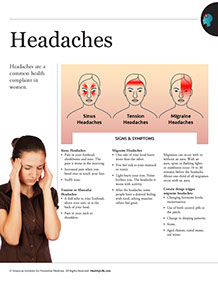
    Headaches are a common health complaint in women.

    Signs, Symptoms & Causes

    For Tension or Muscular Headaches

    *  A dull ache in your forehead, above your ears, or at the back of your head.

    *  Pain in your neck or shoulders.

    Common causes are tense or tight muscles in the face, neck, or scalp, concentrating hard for long periods of time, stress, and lack of sleep.

    For Sinus Headaches

    *  Pain in your forehead, cheekbones, and nose. The pain is worse in the morning.

    *  Increased pain when you bend over or touch your face.

    *  Stuffy nose.

    A sinus headache occurs when fluids in the nose aren’t able to drain well and a buildup of pressure occurs in the sinuses. A cold, allergies, dirty or polluted water, and airplane travel can cause a sinus headache.

    For Migraine Headaches

    *  One side of your head hurts more than the other.

    *  You feel sick to your stomach or vomit.

    *  Light hurts your eyes. Noise bothers you. The headache is worse with activity.

    *   After the headache, some people have a drained feeling with tired, aching muscles; others feel great.

    Migraines can occur with or without an aura. With an aura, spots or flashing lights or numbness occur 10 to 30 minutes before the headache. Ten percent of all migraines are this type; 90% occur without an aura.

    Migraine headaches happen when blood vessels in your head open too wide or close too tight. They tend to run in families and affect nearly 30% of women at some time during their lives. They occur more often in women than in men.

    Migraines occur less often during pregnancy (especially the second half) and often disappear during menopause. Some women, though, may get migraines for the first time during menopause.

    Certain things trigger migraine headaches:

    *  Changing hormone levels. Menstruation.

    *  Use of birth control pills or the patch.

    *  Change in sleeping patterns.

    *  Stress.

    *  Aged cheeses. Cured meats. Red wines.

    Other Causes of Headaches

    *  Analgesic rebound from regular or repeated use of over-the-counter or prescribed pain relievers.

    *  Eating or drinking something very cold, such as ice cream. {Note: To prevent ice cream headaches, warm the ice cream for a few seconds in the front of your mouth.}

    *  Caffeine withdrawal.

    *  Low blood sugar, hunger, or sensitivity to certain foods and drinks.

    *  A symptom of a health problem. Examples are allergies, depression, high blood pressure, dental problems, and a pinched nerve in the neck.

    *  Cigarette smoke, pollution, etc.

    *  Uncorrected vision problems.

    Treatment

    Self-care can treat headaches caused by tension, fatigue, and/or stress. Certain over-the-counter medicines and prescribed medicines can treat sinus headaches and migraine headaches.

    Biofeedback has helped many people who have suffered from headaches.

    Headaches that are symptoms of health problems are relieved when the condition is treated with success.

    Questions to Ask

    Self-Care / Prevention

    *  Don’t smoke. If you smoke, quit!

    *  Try to stop the headache when it starts.

    *  Take an over-the-counter (OTC) medicine for pain as directed on the label.

    *  Rest in a quiet, dark room with your eyes closed.

    *  Massage the back of your neck with your thumbs. Work from the ears toward the center of the back of your head. Also, rub gently along the sides of your eyes. Gently rub your shoulders, neck, and jaw. Get a massage.

    *  Place a cold or warm washcloth or hot or cold pack, whichever feels better, over the area that aches.

    *  Take a warm bath or shower.

    *  Relax. Picture a calm scene in your head. Meditate or breathe deeply.

    *  Keep a diary of when, where, and why headaches occur.

    *  Get enough rest.

    *  Eat 5 to 6 small meals instead of 3 large meals. To ward off low blood sugar, don’t skip meals. Avoid sweets.

    *  Keep regular sleeping times as much as you can.

    *  When lying down, use a pillow that supports the neck. Sleep on your back.

    *  Avoid scents, foods, and beverages that trigger headaches.

    *  To help prevent headaches and nausea caused by a hangover, try an OTC product, such as Chaser-Freedom From Hangovers.

    *  For a hangover: After drinking alcohol, take an OTC pain reliever. Eat solid foods. Rest or sleep. Have 2 or more glasses of water before you go to sleep. Drink 2 or more glasses of water when you wake up.

    Foods and Drinks that May Cause Headaches

    *  Alcoholic beverage, especially red wine

    *  Aspartame (the artificial sweetener in NutraSweet®)

    *  Bananas (if more than 1/2 banana a day)

    *  Caffeine from coffee, tea, cola soft drinks, chocolate, or some medications

    *  Lack of caffeine if abruptly stopped, such as stopping coffee intake

    *  Citrus fruits (if more than 1/2 cup a day)

    *  Cured meats, such as frankfurters

    *  Food additives, such as monosodium glutamate (MSG)

    *  Hard cheeses, such as aged cheddar or provolone

    *  Nuts and peanut butter

    *  Onions

    *  Sour cream

    *  Soy sauce

    *  Vinegar

    Resources
    National Headache Foundation

    888.NHF.5552 (643.5552)

    www.headaches.org

    Women's Self-Care book by the American Institute for Preventive Medicine. www.HealthyLife.com. All rights reserved.

    © American Institute for Preventive Medicine
  • Pregnancy Tests

    Pregnancy & Prenatal Care

    How can you find out for sure if you are pregnant? Do a home pregnancy urine test. You can do one yourself. Facts about these tests:

    *  They test for a hormone called HCG. HCG is present in the urine only during pregnancy.

    *  You can buy them over-the-counter. Look for them at the drug store or supermarket.

    *  They are 95 to 100% error-free. But you have to do what the label says.

    *  They come in many brands. Some brands include a second test in the package.

    *  They are not all used the same way. Read the label to find out what to do. Some can be used the day after you miss a period. That’s about 14 days after conception. Some have you wait 3 to 5 days after you miss a period. Some have you use your first morning urine sample.

    {Note: If your test is positive, call your health care provider. Make a date to be seen. Ask what prenatal vitamins (vitamin pills) you should take. Do this if you are not already taking them. It is a good idea to start taking prenatal vitamins before you get pregnant and right at the start of pregnancy. Doing this, especially getting enough folic acid, may prevent some birth defects. Prenatal vitamins will supply the minerals you need, too.}

    *  Get a lab or in-office urine test. Ask your health care provider to order one. Facts about these tests:

    – They test for HCG in the urine.

    – They are nearly 100% error-free.

    – They can confirm pregnancy 7 to 10 days after conception.

    *  Get a blood test. Ask your health care provider to order it. Facts about these tests:

    – They test for HCG in the blood.

    – They are 100% error-free.

    – They can confirm pregnancy 7 days after conception. That’s even before you miss a period.

    Always follow up your pregnancy test with a medical exam. Your health care provider can see signs of pregnancy by or even before the 6th week!

    Prenatal Self-Care book by the American Institute for Preventive Medicine. www.HealthyLife.com. All rights reserved.

    © American Institute for Preventive Medicine
  • Choosing Your Health Care Provider

    Pregnancy & Prenatal Care

    Read the options below. Discuss them with your health insurance carrier. Do this before you get pregnant. Who you choose will partly depend on:

    *  Your health insurance coverage.

    *  You may need to choose from a certain list. Find out who is on it. Ask if there is a waiting period for maternity coverage.

    *  The health care providers in your area

    Your personal wishes are important, too. For example, do you prefer a female or a male provider? Do you want a provider who works alone? Or do you want one in a group practice?

    Where You Can Give Birth

    Where do you want to have your baby? These are places to think about:

    *  Hospitals. There may also be choices within hospitals. These could be:

    – Regular delivery room. Your family may be able to be with you here.

    – Birthing center or birthing room. Your family can be with you here.

    – Special high-risk pregnancy section. Sometimes mothers and newborns need high-risk care. Some hospitals offer high-risk care. Find out what services local hospitals can offer.

    *  Birthing centers not inside hospitals. These are sometimes called alternative birthing centers. They are for low-risk pregnancies. Find out what hospital is used when special needs arise.

    {Note: Your special needs during pregnancy may determine where you can have your baby. Do not plan a home birth. It is not safe for you and your baby.}

    Types of Providers

    *  OB/GYN (obstetrician/gynecologist). This doctor gives prenatal and delivery care. That care ends 6 weeks after delivery. The OB/GYN treats women when they’re not pregnant, too. You may already have an OB/GYN. If you do, you could choose this provider for your pregnancy. Most women choose an OB/GYN. If you belong to an HMO, you may need a referral for an OB/GYN. A referral is when your primary care provider says you need a special doctor. You don’t need a referral if the OB/GYN is your primary care provider. You also don’t need a referral if your HMO lets you pick an OB/GYN plus a primary care provider.

    *  Family practice doctor. A family practice doctor can act as an OB/GYN, an internist, and a pediatrician. That means the provider can give you prenatal care and deliver your baby. You and your child can both go on seeing this same provider afterward. But if you need a cesarean section (c-section), you will need an OB/GYN.

    *  Maternal and fetal medicine specialist. This provider may be needed to help with high-risk pregnancies. Your primary care doctor or your OB/GYN would give you a referral if he or she can’t provide the care needed for your high-risk problems.

    *  Infertility specialist. This provider helps persons who want to get pregnant, but haven’t been able to after trying for a year. You may want to see this doctor if your regular OB/GYN cannot help you with your needs.

    *  Certified nurse-midwife. This provider cares for women with low-risk pregnancies. The nurse-midwife is trained to handle low-risk births. Be sure he or she works with a medical doctor. A lay midwife cannot provide total care. Find out if your insurance will pay for a nurse-midwife. Be sure the midwife is certified. Call the American Midwifery Certification Board (AMCB) at 866.366.9632 or go to its Web site:www.amcbmidwife.org.

    How to Find a Provider

    There are a lot of ways to find providers who might suit you:

    *  Look in the directory of providers from your health insurance carrier.

    *  Ask your regular doctor or specialist.

    *  Do you have any friends who had a baby recently? Are their ideas about having babies like yours? Ask them.

    *  Call information at the hospital you want. Ask for the name and phone number of the nurse in charge of the maternity section. Ask for the name and phone number of a resident in obstetrics who works at that hospital. A resident is a doctor who is in training. Ask for the “Physician Referral Service.” Call any or all of them and ask what doctor(s) they recommend.

    *  Call the medical school closest to you. Ask which obstetricians it recommends.

    *  Ask your county medical society.

    *  Look in the Directory of the American Medical Association. Ask for this at your doctor’s office or library.

    *  Look in the Directory of Medical Specialties for OB/GYNs. Your doctor’s office or library should have this, too.

    *  Look for a doctor who can take care of special needs you may have.

    *  Do you want a doctor with a high interest in prepared childbirth? Prepared childbirth is a special approach. The pregnant mother goes to classes. Her partner or other childbirth “coach” goes with her. They both learn ways of helping the birth happen, like special breathing. The doctor works with the mother in this approach to childbirth.

    How to Follow Up with a Provider

    Have you found some likely prospects? Now you can:

    *  Call the American Board of Medical Specialties at 866.275.2267 or go to its Web site:www.abms.org. Find out if the provider is properly trained and licensed.

    *  Ask yourself some questions.

    – Do you think you could work well with the provider?

    – Does the provider’s office seem to be managed well?

    *  Ask the provider some questions. You may be able to do this on the phone. (You may be charged an office visit for the phone call.) Or you may need to make a date to meet in person. Here are some questions to ask. You will think of others.

    – Does the provider accept your health insurance? What do services cost? How must payment be made? How much do you have to pay?

    – What hospital(s) does the provider use?

    – Is the hospital accredited? The Joint Commission on Accreditation of Healthcare Organizations (JCAHO) does this.

    – Does the hospital have a birthing center or birthing room?

    – Does it have a Level III neonatal intensive care unit (NICU)?

    – Can fathers and other persons be with you in the delivery room? In the operating room?

    – Will the provider be the one who delivers your baby?

    – Does the provider have partners who share the practice? If so, what would their roles be?

    – Would a resident deliver your baby? A resident is a doctor in training.

    – How would you reach your OB/GYN or health care provider? Would this differ at certain times of day or night? For emergencies?

    – Who would take care of you when your health care provider is away?

    – What is the provider’s Cesarean section (C-section) rate? If the rate is more than 35%, ask why.

    – For what reasons does the provider do a C-section?

    – Does the provider prefer a certain form of pain relief? If so, what and why?

    – At the place you will deliver, can you get anesthetics for an epidural any time of the day or night? An epidural is an anesthesia that can block most of the pain during labor and delivery.

    – What else can be given for pain?

    You can talk to two or more providers. Compare the answers you get. Then you can decide who will give you care and deliver your baby.

    Prenatal Self-Care book by the American Institute for Preventive Medicine. www.HealthyLife.com. All rights reserved.

    © American Institute for Preventive Medicine
  • Healthy Pregnancy Checklist

    Pregnancy & Prenatal Care

    You can do a lot of things to improve the chance of having a healthy pregnancy. And you should not do some other things! Knowing what to do and what to avoid will help you and your baby stay well.

    *  Ask your health care provider before you take any medicines, even ones you can buy without a prescription.

    *  Go to all your prenatal health care visits.

    *  Don’t drink alcohol, take drugs, or smoke. When you drink alcohol, smoke, or take drugs, your baby does, too!

    *  Have a routine for exercise. Follow your health care provider’s advice.

    *  Eat healthy foods.

    *  Take your prenatal vitamins (vitamin pills) every day. These also supply the minerals you need.

    *  Get plenty of rest.

    *  Wash your hands throughout the day.

    *  Accept all your emotions. Express your feelings to others.

    *  Learn to deal with stress. Experts think stress may limit blood supply to the placenta. The placenta is the baby’s only source of oxygen and nutrients.

    *  Don’t have X-rays unless your prenatal health care provider says it’s okay.

    *  Avoid harmful chemicals such as paint fumes, insect poisons, and weed killers. Ask your health care provider what else you should avoid.

    *  When you use cleaning agents, wear rubber gloves. Make sure there is plenty of fresh air.

    *  Don’t wear high-heeled shoes.

    *  Don’t pick up, carry, or move heavy objects.

    *  Stay out of hot tubs and saunas. When you bathe, use warm water only. Never use hot water. Put a rubber mat in the tub or shower to prevent slipping.

    *  Don’t handle cat feces or cat litter. If you have a cat, have someone else empty the litter box. Cat droppings can carry a disease called toxoplasmosis. (Eating meat that is not cooked enough can cause this, too.) If a pregnant woman gets this disease, the baby can be harmed. It’s okay to pet your cat.

    *  Don’t have any contact with hamsters, guinea pigs or any rodents. These animals can carry a virus that can cause severe harm to your baby.

    *  Discuss your work life with your health care provider. Find out if it is healthy for you and your baby.

    *  Find out if you should limit or stop having sex. Bleeding or pain during sex could be reasons. Ask your health care provider.

    *  Always wear lap and shoulder seat belts when you ride in a vehicle. Fasten the lap belt as low as you can, below your belly.

    *  Are you going far from home late in your pregnancy? Have your health care provider refer you to a provider in the area where you are going. Take a copy of your prenatal records with you.

    *  When you travel:

    – By plane or train, get up and walk around every now and then. Get an aisle seat.

    – By car, stop at least every 2 hours and do the same.

    Prenatal Self-Care book by the American Institute for Preventive Medicine. www.HealthyLife.com. All rights reserved.

    © American Institute for Preventive Medicine
  • Signs Of Pregnancy

    Pregnancy & Prenatal Care

    What to Look For

    Do you think you might be pregnant? Here are some signs to look for:

    *  You have missed a menstrual period. You are at least 2 weeks late. {Note: Stress or illness can cause your period to be late, too. And, some women do not have regular periods. It may be hard for them to know if their period is  2 weeks late. Other women can have a light menstrual period or spotting and still be pregnant. So watch for other signs also listed here.}

    *  You feel tired. This is the most common sign.

    *  You feel sick to your stomach. You may even throw up. This is called “morning sickness.” But it can occur any time of day or night.

    *  You need to pass urine more often.

    *  You have food cravings.

    *  Your taste for certain foods changes.

    *  You have a metallic taste in your mouth.

    *  There are changes in your breasts.

    – They feel tender.

    – They feel tingly.

    – They are swollen.

    – The dark areas around your nipples are darker than before.

    – The tiny glands around your nipples stick up.

    Prenatal Self-Care book by the American Institute for Preventive Medicine. www.HealthyLife.com. All rights reserved.

    © American Institute for Preventive Medicine