Tag: Work Life

  • Is Multitasking Really Helpful?

    WORK LIFE

    Concept image of man running with laptop.

    It seems that today’s world is built for multitasking. With smartphones and tablets, you can check your email, surf the web, and chat from nearly anywhere. And at work, you may be typing while on a conference call or checking messages during a meeting.

    But the American Psychological Association (APA) says this culture of multitasking could actually be harmful, not helpful. The brain is only capable of doing one thing at a time, and therefore, multitasking in itself is not truly possible. Your brain actually switches back and forth between tasks when you think you’re multitasking, says the APA. This process of switching costs you time, and can make you less efficient.

    In addition, Harvard Medical School says multitasking leads to errors and mistakes at work. Maybe you’re shifting back and forth between activities or thinking about something else (like the dinging of your smartphone) while you’re supposed to be doing a task. As a result, you may be more likely to miss details or forget to do things.

    So how do you break the multitasking habit? Find your main sources of distraction and put them aside. If your smartphone is the problem, try putting it in the next room or out of sight while you work on a task. At the very least, silence alerts you don’t need right away such as emails and text messages.

    If the beeping of your email at work is keeping you from focusing on your task at hand, consider closing your email program and only checking it at designated times.

    Cutting out the main sources of distraction can help you stay focused and productive at work or at home.

    © American Institute for Preventive Medicine

  • 3 “S”S For Being Active At Work

    FAMILY LIFE

    Two coworkers holding a set of dumb bells in hands.

    Many people have jobs that require sitting at a desk or being inactive for long periods of time. This can make it hard to reap the benefits of exercise, like having more energy and weight loss. But you can fit in fitness at work with just a few tricks.

    1.  Shoes. If you wear a dress or work shoes, bring your sneakers to work. Keep them under your desk and slip them on during your lunch break so you can take a brisk walk in comfort.

    2.  Stairs & standing. Whenever possible, take the stairs instead of the elevator. A few extra calories burned is better than none. Try to stand or walk when you don’t need to be sitting. This could be during a phone conversation, or going down the hall to speak to someone instead of calling or emailing them.

    3.  Schedule. Put time in your schedule to exercise. It’s one of the most important things you can do for YOU! If you don’t have enough time at lunch, find a way to exercise either before or after work. Write it down in your work calendar as a reminder that it’s an important commitment.

    © American Institute for Preventive Medicine

  • 8 Ways To Be Promotable

    WORK LIFE

    Image of a group of co-workers smiling.

    No matter what the job, there are certain qualities that all top-performing employees share, according to job-placement expert Phil Blair, author of Job Won! Below are Blair’s 8 ways to be promotion-worthy:

    1.Look and act promotable.You’ve got a job, but unless you plan to make it the last job you ever have, think long term. Act like you’re a man or woman on a mission, always prepared to take the next step, to take your career to the next level. Dress accordingly. In fact, dress for the job you want, not the job you have. Showcase your work when you can. Go above and beyond.

    2.Create value in everything you do.Don’t just cross things off a to-do list. If you have a job to do, do it well. Commit your best effort to all tasks, large and small. That might be challenging at times, but people notice.

    3.Be resourceful.Think outside the box. If you’re doing a job and you see a better way to do it, speak up (in a polite, respectful way). Anticipate problems and find answers before they’re needed. Don’t be afraid to do a little legwork, a little sweating before it’s necessary. It will always pay off.

    4.Get noticed.There’s nothing wrong with stepping up and stepping out: Volunteer for extra duties. Look for chances to be part of a team. Likewise look for chances to work with other departments, both to learn about that department but also to meet new people.

    5.Stay informed.Become an expert in your field. That includes staying on top of industry news and trends, company policies, and department memos. Read the company newsletter. Talk to others in the know. The more information you have at hand, the better prepared you will be when opportunity comes knocking.

    6.Keep positive.No matter what’s going on, remain level-headed, upbeat, with your eye on the prize. There are always ups and downs but focus on the long term. If you have a temper, it is your responsibility to never show it at work.

    7.Be a team player.This is about more than just getting along with others or telling a good joke. In meetings or group efforts, you want to be seen as a valued contributor who offers feedback, meets deadlines, and gets things done-all for the common good. Know your teammates, their strengths, and strive to make them look good too.

    8.Conduct effective meetings.The best way to not get anything done is to call a meeting. That’s a little harsh but meetings are probably the most abused aspect of the workday. The best meetings are short, sweet, and to the point. If you’re calling the meeting or running it, make sure you have an agenda and stick to it. Make sure only the people who need to be at the meeting are there. Stay on point. Allow everyone to speak who wants to speak, but keep them focused on the subject. Try to complete all of the tasks of the meeting before the meeting ends. If that’s not possible, assign action items with due dates.

    © American Institute for Preventive Medicine

  • Is Your Job A Pain In The Neck?

    WORK LIFE

    Image of business man holding his neck.

    No, really, if you sit all day in front of a computer at work, your computer workstation may be the cause of your nagging neck and shoulder pain. And not surprising, said Dr. Vincent Fortanasce, a rehab specialist and author of End Back & Neck Pain, “The setup of your computer workstation can play a large factor in your ability to stay symptom free.” He and his coauthors point out 3 common workstation mistakes people make that lead to pain.

    *  Overreaching injuries occur because items on your desktop such as your keyboard or mouse, phone, documents, and other desk items are not on the same level surface. So you reach to grab that stapler or strain to pick up files.The solution: rearrange the desktop, adjust your chair, put the keyboard and mouse on the same surface, put things you use the most closest to you.

    *  Use of incorrect heights refers to the up and down motions and placement of items. Incorrect height occurs as a result of the positioning of the chair, including the armrests, seat back, seat pan, desktop where work is placed, monitor, and the surface holding the keyboard and mouse. Incorrect height may also refer to furniture and features of the work area that are not adjustable.The solution: a proper chair is of critical importance. Can you adjust it? Do you have to reach above your head to get items in shelves above your desk? Is the top line of the text displayed on your monitor at eye level?

    * Unbalanced work area refers to twisting motion you do to reach items. If you’re right handed, and you use your right hand for all desktop activities such as answering the phone, you may have pain on your right side. Do you twist to see your monitor?The solution: Place your monitor right in front of you. Are items you use directly ahead of you?

    Back, neck, and arm pain are often the result of repeated actions, over and over, over time. Assess what’s causing your pain and adjust your workstation.

    © American Institute for Preventive Medicine

  • 3 Ways To Avoid Distractions At Work

    WORK LIFE

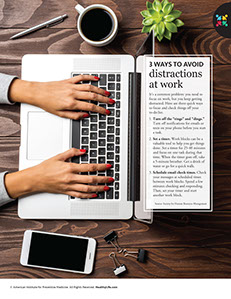
    Close up of hands typing on laptop keyboard.

    It’s a common problem: you need to focus on work, but you keep getting distracted. Here are three quick ways to focus and check things off your to-do list.

    1. Turn off the “rings” and “dings.” Turn off notifications for emails or texts on your phone before you start a task.

    2. Set a timer. Work blocks can be a valuable tool to help you get things done. Set a timer for 25-40 minutes and focus on one task during that time. When the timer goes off, take a 5-minute breather. Get a drink of water or go for a quick walk.

    3. Schedule email check times. Check your messages at scheduled times between work blocks. Spend a few minutes checking and responding. Then, set your timer and start another work block.

    Source: Society for Human Resource Management

    © American Institute for Preventive Medicine

  • Are You Driving Yourself To Burnout?

    SUCCESS OVER STRESS

    Image of elevated train and cars on road.

    Commuting length, distance, and means are stress factors that can lead to burnout, said Annie Barreck of the University of Montreal’s School of Industrial Relations.

    By car:

    No surprises: the bigger the city, the more stressful the commute, at least for people traveling by car. Passengers are more likely to be stressed out than drivers because carpooling reduces the passenger commuters’ sense of control, which causes them more stress before they’ve even arrived at work.

    By public transit:

    People with long commutes from rural areas via bus or train connections are stressed about uncontrollable delays. The stress carries over into the workplace. But transit users in major urban areas are less likely to have symptoms of burnout.

    By bike or on foot:

    Biking is also a mixed bag that is determined by the area the commuter is working in. Commuting by bike in the suburbs is more stressful than biking in the city where cyclists and walkers have access to safety features such as cycle paths and pedestrian crossings, which increase their sense of control over their commute.

    Study findings show that the risk of burnout increases significantly when a commute lasts more than 20 minutes. Above 35 minutes, all employees are at increased risk of cynicism toward their job. Barreck believes this should lead employers to adopt flexible commuting arrangements.

    © American Institute for Preventive Medicine

  • Listening: A Skill Well Worth Mastering

    WELL-BEING

    Image of 2 men talking and smiling.

    You’ve heard the saying, “You’re born with two ears, but only one mouth.” According to the Society for Human Resource Management, being a good listener has many advantages at work and at home. You can come up with better ideas, work with others more easily, and connect with people more deeply.

    So how is it done? Try these tips:

    *  Don’t interrupt.

    *  Don’t offer a solution or advice unless the person asks for it.

    *  Don’t think about your response while the other person is still talking. Hear them all the way through.

    *  When the other person is finished, repeat what they said in your own words. “So what I hear you saying is…”

    *  Don’t make it about you. Remember the other person wants to tell you their story first. Stop yourself from turning it into a discussion about yourself or your problem.

    Having this valuable skill can enhance all the professional and personal relationships in your life.

    © American Institute for Preventive Medicine
  • 4 Tips For Lunchtime Walking

    WORK LIFE

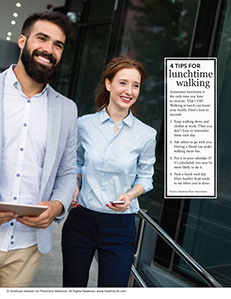
    Coworkers walking outside.

    Sometimes lunchtime is the only time you have to exercise. That’s OK! Walking at lunch can boost your health. Here’s how to succeed:

    1.  Keep walking shoes and clothes at work. Then you don’t have to remember them each day.

    2.  Ask others to go with you. Having a friend can make walking more fun.

    3.  Put it in your calendar. If it’s scheduled, you may be more likely to do it.

    4.  Pack a lunch each day. Have healthy food ready to eat when you’re done.

    Source: American Heart Association

    © American Institute for Preventive Medicine

  • Avoid The Aches And Pains Of Technology

    SELF-CARE CORNER

    Image of business man with laptop and smart phone.

    You can prevent BlackBerry thumb and text neck-new ailments that came with devices such as smartphones and BlackBerries and their small keyboards, advises the American Chiropractic Association.

    *  Avoid typing for more than 3 minutes without a break.

    *  Keep messages short and simple; abbreviate.

    *  Practice using other fingers for typing, especially when thumbs hurt.

    *  Don’t slouch when texting.

    *  Keep wrists upright, straight and close to the body when holding a device.

    *  Don’t bend your neck excessively when texting; tuck your chin in instead and look down.

    *  Turn your devices off on the weekends (or at least on Sunday).

    *  Get outside, exercise and enjoy nature too. Balance is key to staying healthy.

    For more tips on proper use of technology and good health, visitwww.TechnoHealthy.com.

    © American Institute for Preventive Medicine

  • Make The Most Of Your Commute

    WORK LIFE

    Image of man on phone while waiting at the subway.

    A commute is just a part of life for many working people. But whether you spend that time on a bus, train, or in a car, your commute doesn’t have to be a low point in your day. Instead, use that time to make your day better! Try these tips:

    *Practice relaxation.If you’re not driving, try doing some meditation or guided imagery. You can purchase scripts and songs for your phone or other device to listen to.

    *Stay cool while driving.If you’re driving, listen to peaceful music and focus on slow, deep breaths. Breathe in through the nose and out through the mouth. This can help relieve “road rage” while you focus on driving.

    *Wait for work time.Don’t check email or do other work tasks before you’ve arrived at work. Instead, stay “unplugged” for a more relaxing start to your day. This is especially important if you’re driving!

    *Exercise your brain.An audiobook or podcast can help you feel productive during this down time. Some mobile phone apps and podcasts can even help you learn a new language.

    Commuter-friendly snacks

    If you’re starving by the time you walk through the door each night, you can end up overeating or reaching for the first bag of chips you see. Hold off your hunger by packing a snack for your ride home:

    *  An ounce of nuts, such as almonds, cashews, or walnuts

    *  A cup of fresh berries and a piece of string cheese

    *  Baby carrots or celery with hummus

    *  Plenty of water to stay hydrated, fight fatigue, and curb hunger

    © American Institute for Preventive Medicine