Blog

  • You’re Built For Rest

    Sleep Well

    Man resting in circle chair.

    Stress and anxiety can make life hectic and harder to keep a consistent sleep schedule. Try keeping a daily journal. Note how stress in life may impact your sleep at night.

    You can’t hope to succeed in other areas of health, if you neglect your nightly rest. Most adults need 7-9 hours of quality sleep each night. That means your body should move through the various sleep stages, including REM sleep. Here are four tips to get started:

    1. Maintain a consistent sleep and wake schedule – even on weekends.

    2. Make sure your mattress supports you well. Replace your pillow every year.

    3. Remove all electronic devices from your room. That includes your phone. Use an old-school alarm clock to wake up.

    4. Talk to your doctor about any sleep issues you have. They may point to other health problems.

    © American Institute for Preventive Medicine

  • You’re Built For Dreaming

    Sleep Well

    Small glass jar with rolled up paper and label with the word "dreams."

    Success starts with knowing what makes you tick, then mastering that passion. Ask yourself: What captivates me? What am I meant for?

    What do you dream of accomplishing in the next 5, 10 or 20 years? A new home? A new career? Financial freedom? We all aspire to greater things. How do you plan to get where you want to go? Start with these three steps.

    1. Write it down, and tell someone about it. You may be more likely to accomplish your goal.

    2. Do your homework and consult an expert. Learn about what it will take to get where you want to go.

    3. Identify any obstacles that stand in the way of your dreams. Then, take steps to remove them.

    © American Institute for Preventive Medicine

  • When You Don’T Get Enough Sleep

    SleepWell® Program

    Week 1

    Image of doctor listening to patient's heart.

    According to the National Sleep Foundation, about 60 percent of Americans between the ages of 13 and 64 report having problems with sleep every night or almost every night. Studies find that the average person gets less than seven hours of sleep per night. In general, adults need at least seven to nine hours of sleep each night. A lack of sleep or getting poor quality sleep can lead to a wide range of short-term and long-term health problems.

    Health Problems from a Lack of Sleep:

    * Anxiety, depression, and alcohol abuse

    * Obesity

    * Heart disease

    * High blood pressure

    * Diabetes

    * Stroke

    * Gum disease

    Sleep is also important to maintain proper mental function and stabilize mood. Poor sleep can also hurt immunity (see below), stress management, cell repair, and metabolism. Any time the body does not get enough sleep, it is not going to function optimally. It only takes one night of poor sleep to affect decision-making, learning, and reaction time.

    Immunity

    Immunity is about more than avoiding sniffles and the flu (though both of these can be serious for your health and disrupt your life!). The risk for cancer, heart disease, and type 2 diabetes increases with sleep deprivation.

    During sleep, molecules in the blood that kill cancer cells rise sharply. Also, inflammation increases in the body after only a two-hour sleep deficit. Inflammation is linked to many chronic diseases. These include cardiovascular problems, stroke, Alzheimer’s disease, and skin problems.

    © American Institute for Preventive Medicine

  • Maintain Healthy Sleep Habits

    SleepWell® Program

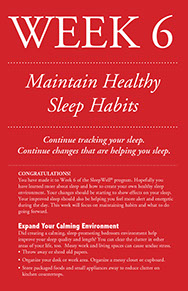
    Week 6

    Image of women lying on living room sofa.

    Congratulations!

    You have made it to Week 6 of the SleepWell® program. Hopefully you have learned more about sleep and how to create your own healthy sleep environment. Your changes should be starting to show effects on your sleep. Your improved sleep should also be helping you feel more alert and energetic during the day. This week will focus on maintaining habits and what to do going forward.

    Expand Your Calming Environment

    Did creating a calming, sleep-promoting bedroom environment help improve your sleep quality and length? You can clear the clutter in other areas of your life, too. Messy work and living spaces can cause undue stress.

    *  Throw away or shred old papers.

    *  Organize your desk or work area. Organize a messy closet or cupboard.

    *  Store packaged foods and small appliances away to reduce clutter on kitchen countertops.

    SleepWell® Program

    QUICK LINKS: WEEK 6

    Reinforce Healthy Habits

    Prepare for New Challenges

    Respond to a Bad Night of Sleep

    How to Talk about Your Sleep Improvements

    Summary

    © American Institute for Preventive Medicine

  • Build Social Support

    SleepWell® Program

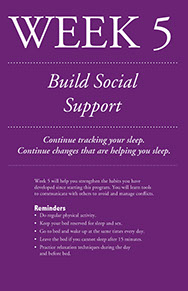
    Week 5

    Image of a group of friends having a picnic.

    Week 5 will help you strengthen the habits you have developed since starting this program. You will learn tools to communicate with others to avoid and manage conflicts.

    Reminders

    *  Do regular physical activity.

    *  Keep your bed reserved for sleep and sex.

    *  Go to bed and wake up at the same times every day.

    *  Leave the bed if you cannot sleep after 15 minutes.

    *  Practice relaxation techniques during the day and before bed.

    SleepWell® Program

    QUICK LINKS: WEEK 5

    Strengthen Your Home Team

    Show You Care

    Discuss Your Sleep Needs with Your Sleep Partner

    Manage Conflicts

    Be Assertive

    Create Self-Enhancing Feelings

    Review & Prepare

    © American Institute for Preventive Medicine

  • Review & Prepare 8

    SleepWell® Program

    Week 5

    Image of women sleeping peacefully.

    Look at your pattern of sleep over the past week. Compare it to your sleep patterns during the previous weeks. Beyond Week 6, continue to reflect on a weekly basis. Notice when your sleep quality is slipping. Make changes as soon as you notice this.

    Answer these questions:

    *  I fall asleep more quickly now.

    *  I have more daytime energy.

    *  I wake up fewer times during the night.

    *  If or when I do wake up, I am able to fall asleep again more quickly.

    *  Ways I have discussed my sleep goals with the people I live with.

    *  How I will approach a conflict (or have already dealt with one).

    *  Are you ready for another week of attention to your sleep?

    Shift Your Bedtime Again

    Do you feel you are now sleeping most or all of the time you are in bed? Continue to shift your bedtime back by 15 minutes each week until you are satisfied with your energy during the day. Remember, only make a shift when your sleep quality is high.

    © American Institute for Preventive Medicine
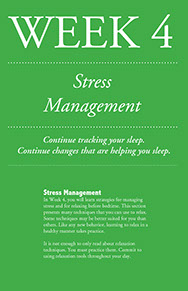
  • Stress Management 2

    SleepWell® Program

    Week 4

    Image of women sitting in a comfortable chair relaxing while reading a book and drinking tea.

    In Week 4, you will learn strategies for managing stress and for relaxing before bedtime. This section presents many techniques that you can use to relax. Some techniques may be better suited for you than others. Like any new behavior, learning to relax in a healthy manner takes practice.

    It is not enough to only read about relaxation techniques. You must practice them. Commit to using relaxation tools throughout your day.

    SleepWell® Program

    QUICK LINKS: WEEK 4

    Stress & Sleep

    Learn to Relax

    Seek Downtime Daily

    Mindfulness

    Plan Problem Solving

    Take a Step Back

    Creative Imagination

    Dispute Irrational Thoughts

    Clean Up Psychological Pollution

    Practice Relaxation Techniques

    Biofeedback

    Review & Prepare

    © American Institute for Preventive Medicine

  • Review & Prepare 7

    SleepWell® Program

    Week 4

    Image of man thinking at desk.

    Look at your pattern of sleep over the past week. Compare it to your sleep patterns over the past few weeks of tracking. Answer these:

    *  I fall asleep more quickly now.

    *  I have more daytime energy.

    *  I wake up fewer times during the night.

    *  If or when I do wake up, I am able to fall asleep again more quickly.

    *  Relaxation techniques I practiced this past week.

    *  How I responded to racing thoughts when I tried to sleep.

    *  Are you ready for another week of attention to your sleep?

    Shift Your Bedtime Again

    Has your sleep continued to improve? If yes, you are ready to adjust your bedtime. Remember, only make a shift when your sleep quality is high.

    © American Institute for Preventive Medicine
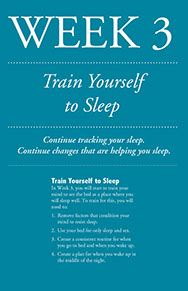
  • Train Yourself To Sleep

    SleepWell® Program

    Week 3

    Image of a happy women waking up in the morning.

    In Week 3, you will start to train your mind to see the bed as a place where you will sleep well. To train for this, you will need to:

    1. Remove factors that condition your mind to resist sleep.

    2. Use your bed for only sleep and sex.

    3. Create a consistent routine for when you go to bed and when you wake up.

    4. Create a plan for when you wake up in the middle of the night.

    SleepWell® Program

    QUICK LINKS: WEEK 3

    Stimulus Control

    Create a Bedtime Routine

    Create a Waking Routine

    Restrict Time in Bed

    Stop Hitting the Snooze!

    Trouble Staying Asleep

    Can I Have a Nap?

    Manage Risks of Shift Work

    Review and Prepare

    © American Institute for Preventive Medicine

  • Review & Prepare 6

    SleepWell® Program

    Week 3

    Image of man sleeping.

    Look at your pattern of sleep over the past week. Compare it to your sleep patterns over the past few weeks of tracking.

    Answer the following:

    *  I fall asleep more quickly now.

    *  I have more daytime energy.

    *  I wake up fewer times during the night.

    *  If or when I do wake up, I am able to fall asleep again more quickly.

    *  Changes I made to my bedtime and waking routines.

    *  Changes I made to what I do in bed or in the bedroom.

    *  Are you ready for another week of attention to your sleep?

    Shift Your Bedtime

    If you think your sleep has improved during the past week, you can begin to shift your bedtime earlier. Do this gradually. Only make a shift when your sleep quality is high. This means:

    *  You are able to fall asleep within 15 minutes of getting into bed.

    *  You are rarely waking up during sleep.

    *  If you do wake up, you are able to go back to sleep within 15 minutes.

    *  You stay asleep until your planned wake time.

    *  You wake feeling refreshed.

    If your sleep quality has not improved, maintain the original schedule for another week. When you are ready, shift your bedtime 15 minutes earlier. Keep the same wake time. This will give you more time to sleep as your body becomes trained to sleep in bed.

    © American Institute for Preventive Medicine