Author: AIPM

  • Conquer Job Stress

    SUCCESS OVER STRESS

    Happy man with arms up while setting at work desk.

    Burnout: When stress goes too far

    When stress goes on for too long, a person may feel “burned out.” This usually means they become exhausted and unable to do their job well anymore. They may also become negative or feel angry toward others at work.

    Burnout can seriously affect your health. It can lead to depression and possibly other problems, like heart disease and stroke.

    Stop the cycle

    It’s not too late to manage your work stress. Even if you feel your stress is high, there are ways to make things better. Here’s how:

    *Take breaks – even short ones.Just 10 minutes of downtime during the day can make a big difference in your stress levels. Don’t work through lunch and break times.

    *Practice the art of waiting and walking away.If you feel angry or stressed about something, don’t respond right away. Say something like, “let me think about that and get back to you.” Avoid sending angry emails when you feel stressed.

    *Go easy on yourself.Are you expecting perfection from yourself? No one is perfect. Learn from mistakes and move on.

    *Discuss your concerns.If you’re having trouble with something at work, talk to your supervisor about solutions. Don’t keep it bottled inside and assume it will work itself out.

    Source: American Psychological Association

    © American Institute for Preventive Medicine

  • Corn On The Cob: A Summertime Staple

    HEALTHY EATING

    Two corn on the cobs.

    Corn on the cob is a favorite food at summer barbecues and outings. Its popular flavor makes it a treat – but it has plenty of health benefits too.

    Basics of corn

    Corn isn’t a vegetable. It’s actually a type of grain. Whole grain corn contains vitamins and heathy plant compounds.

    Some of corn’s nutrients include:

    *  Soluble and insoluble fiber, which helps with digestion and preventing constipation

    *  B vitamins, including vitamin B5, folate, B6, and niacin, which help with energy and many body processes

    *  Potassium, which is important for heart health

    *  Antioxidants, including zeaxanthin and lutein, which may be linked to eye health

    Making corn the healthy way

    Corn is versatile and can be cooked in several different ways. Many people simply remove the husk and boil it until tender. But you can also grill it, bake it and microwave it.

    If you can’t find fresh corn on the cob, frozen corn (on the cob or removed) is a healthy option. Look for brands that do not add salt, sugar or other ingredients. Frozen corn is usually microwaved or steamed.

    If you use butter or margarine, measure it so you know how much you’re using. Start with 1/2 teaspoon and see if you can cover the entire ear of corn with that small amount. Try a salt-free seasoning blend or black pepper for a flavor kick without sodium.

    What about corn chips?

    If corn is healthy, then are foods with corn in them a healthy choice? Not necessarily.

    Corn is used in many processed foods like chips and crackers. These products won’t have the same health benefits as real corn on the cob.

    Many processed foods contain added salt, sugar and unhealthy fats. They may also remove many of corn’s natural nutrients. Some research shows that eating a lot of highly processed foods can lead to obesity and health problems.

    Sources: American Heart Association, United States Department of Agriculture

    © American Institute for Preventive Medicine

  • Covid-19, Cold, Flu, Or Allergy?

    SELF-CARE CORNER

    Women wearing a face mask.

    Know the difference

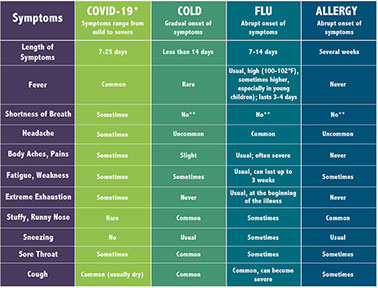
    You’re feeling pretty lousy. You’ve got sniffles, sneezing, and a sore throat. Is it COVID-19, a cold, flu, or allergies? It can be hard to tell them apart because they share so many symptoms. But understanding the differences will help you choose the best treatment.

    Comparison chart of symptoms between COVID-19, Cold, Flu and Allergies.

    © American Institute for Preventive Medicine
  • Creamy Squash Soup With Shredded Apples

    HEALTHY EATING

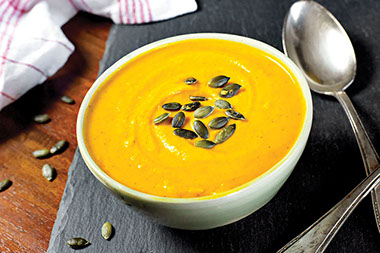
    Creamy squash soup.

    Who says creamy soup has to be unhealthy? This recipe uses the bounty of fall without lots of calories from too much fat or added sugar. It can be prepped in 10 minutes, with just 20 minutes of cooking time.

    Ingredients

    *  2 boxes (16 oz each) frozen pureed winter (butternut) squash

    *  2 medium apples (try Golden Delicious or Gala)

    *  1 tablespoon olive oil

    *  ½ teaspoon pumpkin pie spice

    *  2 cans (12 oz each) fat-free evaporated milk

    *  ¼ teaspoon salt

    *  ⅛ teaspoon ground black pepper

    Directions

    1.  Place the frozen squash in a microwave-safe dish. Cover loosely. Defrost in the microwave on medium power for 5-10 minutes, until mostly thawed.

    2.  Meanwhile, peel then shred the apples using a grater or food processor, or peel and finely chop apples into thin strips. Set aside ¼ cup.

    3.  Warm oil in a 4-quart saucepan over medium heat. Add all but ¼ cup of the apples. Cook and stir until apples soften, about 5 minutes.

    4.  Stir in thawed squash and pumpkin pie spice.

    5.  Add the evaporated milk about ½ cup at a time, stirring after each addition.

    6.  Season with salt and pepper.

    7.  Cook and stir over medium heat just until soup is about to boil.

    8.  Ladle into individual soup bowls. Top each with a tablespoon of the unused apples. Sprinkle with additional pumpkin pie spice or a few pumpkin seeds, if desired.

    Tip: For chunkier soup, try two bags (14 oz each) frozen diced butternut squash. Or, cut a fresh butternut into small chunks, and place in a microwave-safe dish covered with 1 inch of water.  Microwave on high for 5-10 minutes, or until squash is tender and can be easily pierced with a fork. Remove skin. Place squash in blender until desired consistency.

    Nutrition Facts: 4 servings. Calories 334; Total fat 4 g; Saturated fat 1 g; Sodium 370 mg; Total fiber 5 g; Protein 18 g; Carbohydrates 62 g

    Source: National Heart, Lung, and Blood Institute

    © American Institute for Preventive Medicine
  • Create A Family Mission Statement

    FAMILY LIFE

    Family sitting together talking.

    A family mission statement defines your core values & priorities. It’s a useful tool to bind your family together for a common purpose.

    Gather as a family to talk about what you value most. Brainstorm words that best describe your family dynamics and priorities.

    Ask good questions

    *  What is our family’s purpose?

    *  What do we love to do together?

    *  What makes our family unique?

    *  What legacy do we hope to leave?

    Create a draft

    Identify themes from your conversations together and write a mission statement. The statement can be a paragraph, bullet points, or phrases that capture your family.

    Reflect & refine

    Take time to reflect on your first draft and see if it fits your family. Talk about what you’ve put together and get feedback. Adjust and refine as needed.

    Finalize & display

    Your mission statement doesn’t have to be perfect, but it should accurately reflect your family’s core values and goals. Display it somewhere visible.

    Update

    As your family grows and changes, your mission statement should change, too. Your values and goals will naturally evolve over time.

    © American Institute for Preventive Medicine

  • Crossfit Faq

    BE FIT

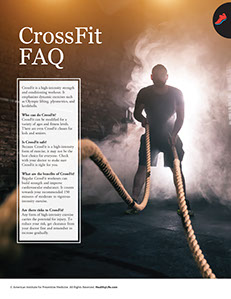
    Man in gym working out.

    CrossFit is a high-intensity strength and conditioning workout. It emphasizes dynamic exercises such as Olympic lifting, plyometrics, and kettlebells.

    Who can do CrossFit?

    CrossFit can be modified for a variety of ages and fitness levels. There are even CrossFit classes for kids and seniors.

    Is CrossFit safe?

    Because CrossFit is a high-intensity form of exercise, it may not be the best choice for everyone. Check with your doctor to make sure CrossFit is right for you.

    What are the benefits of CrossFit?

    Regular CrossFit workouts can build strength and improve cardiovascular endurance. It counts towards your recommended 150 minutes of moderate to vigorous-intensity exercise.

    Are there risks to CrossFit?

    Any form of high-intensity exercise carries the potential for injury. To reduce your risk, get clearance from your doctor first and remember to increase gradually.

    © American Institute for Preventive Medicine

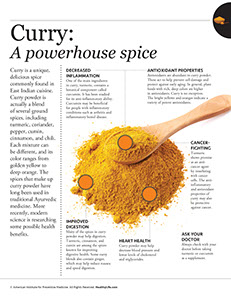
  • Curry: A Powerhouse Spice

    HEALTHY EATING

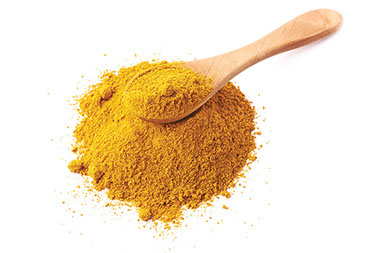
    Curry powder and wooden spoon.

    Curry is a unique, delicious spice commonly found in East Indian cuisine. Curry powder is actually a blend of several ground spices, including turmeric, coriander, pepper, cumin, cinnamon, and chili. Each mixture can be different, and its color ranges from golden yellow to deep orange. The spices that make up curry powder have long been used in traditional Ayurvedic medicine. More recently, modern science is researching some possible health benefits.

    Decreased Inflammation

    One of the main ingredients in curry, turmeric, contains a botanical component called curcumin. It has been studied for its anti-inflammatory ability. Curcumin may be beneficial for people with inflammatory conditions such as arthritis and inflammatory bowel disease.

    Improved Digestion

    Many of the spices in curry powder may help digestion. Turmeric, cinnamon, and cumin are among the spices known for improving digestive health. Some curry blends also contain ginger, which may help reduce nausea and speed digestion.

    Antioxidant Properties

    Antioxidants are abundant in curry powder. These act to help prevent cell damage and protect against early aging. In general, plant foods with rich, deep colors are higher in antioxidants. Curry is no exception. The bright yellows and oranges indicate a variety of potent antioxidants.

    Heart Health

    Curry powder may help decrease blood pressure and lower levels of cholesterol and triglycerides.

    Cancer-Fighting

    Turmeric shows promise as an anti-cancer agent by interfering with cancer cells. The anti-inflammatory and antioxidant properties of curry may also be protective against cancer.

    Ask Your Doctor

    Always check with your doctor before taking turmeric or curcumin as a supplement.

    © American Institute for Preventive Medicine

  • Dealing With Difficult Personalities

    WORK LIFE

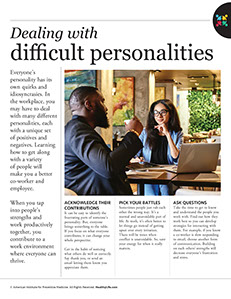
    Two coworkers sitting with laptop, talking and drinking coffee.

    Everyone’s personality has its own quirks and idiosyncrasies. In the workplace, you may have to deal with many different personalities, each with a unique set of positives and negatives. Learning how to get along with a variety of people will make you a better co-worker and employee.

    When you tap into people’s strengths and work productively together, you contribute to a work environment where everyone can thrive.

    Acknowledge their contributions

    It can be easy to identify the frustrating parts of someone’s personality. But, everyone brings something to the table. If you focus on what everyone contributes, it can change your whole perspective.

    Get in the habit of noticing what others do well or correctly. Say thank you, or send an email letting them know you appreciate them.

    Pick your battles

    Sometimes people just rub each other the wrong way. It’s a normal and unavoidable part of life. At work, it’s often better to let things go instead of getting upset over every irritation. There will be times when conflict is unavoidable. So, save your energy for when it really matters.

    Ask questions

    Take the time to get to know and understand the people you work with. Find out how they work best so you can develop strategies for interacting with them. For example, if you know a co-worker is slow responding to email, choose another form of communication. Building on each others’ strengths will decrease everyone’s frustration and stress.

    © American Institute for Preventive Medicine
  • Dealing With Family Arguments

    FAMILY LIFE

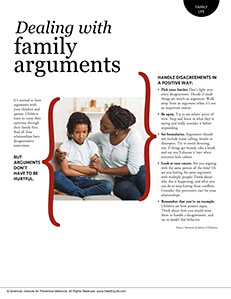
    Mother comforting her young son who's upset.

    It’s normal to have arguments with your children and spouse. Children learn to voice their opinions through their family first. And all close relationships have disagreements sometimes.

    But arguments don’t have to be hurtful.

    Handle disagreements in a positive way:

    *Pick your battles:Don’t fight over every disagreement. Decide if small things are worth an argument. Walk away from an argument when it’s not an important matter.

    *Be open.Try to see others’ point of view. Stop and listen to what they’re saying and really consider it before responding.

    *Set boundaries.Arguments should not include name calling, insults or disrespect. Try to avoid shouting, too. If things get heated, take a break and say you’ll discuss it later when everyone feels calmer.

    *Look at root causes.Are you arguing with the same person all the time? Or are you having the same argument with multiple people? Think about why this is happening, and what you can do to stop having these conflicts. Consider this preventive care for your relationships.

    *Remember that you’re an example.Children see how parents argue. Think about how you would want them to handle a disagreement, and try to model that behavior.

    Source: American Academy of Pediatrics

    © American Institute for Preventive Medicine