Author: AIPM

  • Hives

    Skin Conditions

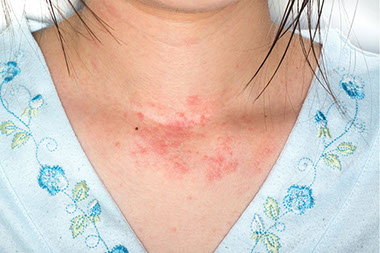
    Image of a hive rash below neck.

    Hives can be (but aren’t always) an allergic response to something you touched, inhaled, or swallowed.

    Signs & Symptoms

    *  Red or pink, raised areas on the skin (welts). Each welt can range in size from less than 1/8″ to 8″ or larger in diameter.

    *  Itching

    *  Hives often appear, sometimes in clusters, on the face, and trunk of the body. Less often, hives appear on the scalp or backs of the hands and feet.

    *  Swelling on the eyelids, lips, tongue, or genitals may occur.

    *  Hives can change shape, fade, then rapidly reappear.

    *  A single hive lasts less than 24 hours. After an attack, though, new ones may crop up for up to 6 weeks.

    Causes & Care

    Common causes of hives are reactions to medicines, such as aspirin, sulfa, and penicillin and exposure to chemicals and things you are allergic to.

    Sometimes it is not known what causes hives. To identify the triggers, keep a diary of when you get hives. List things you expect may have caused the hives.

    In most cases, hives are harmless and go away on their own if you avoid what caused them. Self-care helps with symptoms. Prescribed medicines may be needed for severe hives or for attacks of hives that recur.

    Your doctor may advise allergy testing if you have hives that last a long time or recur. Emergency medical care is needed for hives that are part of a severe allergic reaction.

    Self-Care

    *  Take a lukewarm bath or shower. Heat worsens most rashes and makes them itch more. Add an oatmeal bath product, such as Aveeno, or one cup of baking soda to the bath water.

    *  Apply a cold compress.

    *  Wear loose-fitting clothes.

    *  Relax as much as you can. Relaxation therapy may help ease the itching and discomfort of hives.

    *  Ask your doctor whether or not you should take an antihistamine and to recommend one. Antihistamines can help relieve itching and suppress hives. Take as directed by your doctor or by directions on the label.

    *  Use calamine lotion on itchy areas.

    *  Don’t take aspirin, ibuprofen, ketoprofen, or naproxen sodium. These may make hives worse.

    When to Seek Medical Care

    Contact Doctor When:

    *  You have constant and severe itching, and/or a fever with hives.

    *  Hives last for more than 6 weeks.

    *  Hives started after taking medicine.

    Get Immediate Care When:

    Hives are present with signs of a severe allergic reaction (anaphylactic shock).

    Signs of a Severe Allergic Reaction

    *  A hard time breathing or swallowing

    *  Severe swelling all over, or of the face, lips, tongue, and/or throat n Obstructed airway

    *  Wheezing

    *  Dizziness, weakness

    *  “Signs & Symptoms” of shock
    Health at Home Lifetime book by the American Institute for Preventive Medicine. www.HealthyLife.com. All rights reserved.

    © American Institute for Preventive Medicine
  • Hospice Care

    Mature Health: Over Age 50

    Hospice care is for people with a terminal illness. To enter a hospice program (and to receive Medicare benefits), a doctor’s diagnosis is required stating that life expectancy is no more than about 6 months. No efforts are made to prolong life or to hasten death. The patient is kept comfortable and pain free. Hospice eases the process of dying. Most referrals for hospice come from doctors. Hospice care may be provided in:

    *  The home. Eighty percent of persons enrolled in hospice are cared for at home.

    *  A hospital

    *  A nursing home

    *  A hospice facility

    The bulk of care, especially with home hospice, is usually given by family members and friends. It is supported by a hospice care team which includes doctors, social workers, therapists, volunteers, clergy, nurses, and family members. The team plans care that ensures quality of life. {Note: VA offers Hospice & Palliative Care.}

    Most health insurance plans include the option of hospice care. Medicare and Medicaid cover the costs if the facility or hospice organization is certified by them. Under Medicare, the length of stay is two 90 day benefit periods. This may be followed by a 30 day period. Extensions are available. Persons must be certified to be terminally ill at the start of each period.

    Sometimes patients are charged if they do not qualify for reimbursement. Hospice care is based on need. No one is rejected for lack of finances.

    Some advantages to hospice care include:

    *  Availability of 24 hour a day, 7 day a week assistance. This is true for hospice care in hospitals, nursing homes, and hospice facilities. Find out if the home hospice program offers this service.

    *  Respite for family caretakers when care is given in the home

    *  Emotional comfort and support by trained hospice staff and volunteers

    *  Bereavement counseling

    Resources

    The National Hospice and Palliative Care Organization

    1-703-837-1500

    www.nhpco.org

    Health at Home Lifetime book by the American Institute for Preventive Medicine. www.HealthyLife.com. All rights reserved.

    © American Institute for Preventive Medicine

  • Housing Options

    Mature Health: Over Age 50

    Some people find the upkeep for a house too demanding. Health concerns may not allow some people to meet these demands. Consider other housing options:

    *  Condominium. This is a townhouse or apartment that is privately owned. A fee is charged to cover maintenance of items like the lawn, swimming pool, etc.

    *  Co-Operative. This is a housing facility where everyone owns a share. People live in unit apartments and vote on key issues.

    *  Rental. A landlord takes care of maintenance. Residents pay a monthly rental fee plus a security deposit.

    *  Retirement Community/Assisted Living Facility. Residents live independently, but have services available to them. These include recreation activities, meals served in a common area, transportation. Often a social worker or counselor is on site. There may be age restrictions.

    *  Federal Housing. This is independent living for those over 62 years old with low to moderate incomes.

    *  Group Housing/Adult Custodial Care Homes. These provide room and board for those in need of nonmedical care. Help with daily living makes this option well suited for Alzheimer’s patients.

    *  Life Care at Home (LCAH). Services are given in one’s own home. Start up and monthly fees apply. A manager personalizes a program of care to meet the client’s needs.

    *  Intermediate Care. This is a residence for those who should not live alone, but can manage simple personal care, like dressing. Meals are provided. Cleaning services and nursing care are offered on site.

    *  Nursing Homes. These are designed for people who require care 24 hours a day. These are medically supervised. Find and compare nursing homes in your area atwww.medicare.gov/NHCompare/home.asp.

    Health at Home Lifetime book by the American Institute for Preventive Medicine. www.HealthyLife.com. All rights reserved.

    © American Institute for Preventive Medicine

  • How Aging Affects Digestion

    Abdominal & Urinary Conditions

    Image of elderly man.

    As you age, your digestive muscles move slower. Your body makes less acid. Other things can hamper the digestive system, too. These include:

    *  Increased use of medicines

    *  Getting less exercise

    *  Changes in eating habits

    *  Dental problems

    *  Loss of muscle tone and elasticity. This could be a factor in hiatal hernias and diverticulosis, which are common in persons as they get older.

    Health at Home Lifetime book by the American Institute for Preventive Medicine. www.HealthyLife.com. All rights reserved.

    © American Institute for Preventive Medicine

  • How To Use The Emergency Department

    First Aid

    Do Prepare for an E.R. Visit

    If you do need to use a hospital emergency department, follow these steps.

    Call the E.R. Ahead of Time

    If there is time, call the E.R. and report:

    *  Who the victim is

    *  What the problem is

    *  What caused the problem

    *  When you think you will get there

    *  If the victim will need help from the car

    *  Who the victim’s doctor is (name and phone number)

    Have These Things Ready

    Keep the things listed below in a handy place.

    *  Personal identification.

    *  Emergency phone numbers. Put them by the telephones in your home and in the glove compartment or first aid kit in your car. Memorize them.

    *  Medical record or information form for you and each family member

    *  Health insurance information

    *  Consent form or letter written by you to allow your child to get medical, surgical, and/or emergency treatment. Ask your child’s doctor where you can get a consent form or what to put in a letter. Make sure you sign this form or letter. You can get copies of “Medical Consent to Treat Form,” “Emergency Information Form for Children with Special Health Care Needs,” and “Personal Medical History” from the American Academy of Emergency Physicians’ Web site:www.acep.orgor by calling 800.798.1822.

    *  Phone numbers where you can be reached when someone cares for your children

    {Note: Let others who take care of your children know where these things are.}

    People with specific medical conditions and severe allergies should wear a medical alert tag (e.g., bracelet, neck chain.) This helps a rescuer know what special precautions may need to be taken. You can buy these tags at many drug stores or order one from Medic Alert Foundation International at 888.633.4298 orwww.medicalert.org.

    Do Take a Companion to the E.R.

    When you need emergency medical care, it’s a good idea to have a relative or friend go with you. He or she can do the following:

    *  Get you registered

    *  Answer questions for you if you can’t answer them yourself

    *  Speak on your behalf and in your best interest. {Note: If you have an advance directive – Durable Power of Attorney for Health Care, take a copy with you to the hospital. Let your relative or friend know if you have this and how it can be obtained (e.g., your lawyer’s or doctor’s phone number). If you do not have this advance directive, let your relative or friend know.}

    *  Serve as a “clear head” to monitor the procedures being done

    *  Check out what kind of service you’re getting

    *  Be available in the waiting area

    *  Take you home

    Do Know What to Expect at the E.R.

    Triage

    *  A triage nurse evaluates your condition. He or she ranks all the patients in 3 general categories:

    – Life-threatening

    – Urgent, but not  life-threatening

    – Less urgent

    *  You need to describe the problem and the steps that led to it. (You may have to tell this to other people as well.)

    *  The seriousness of your condition and of other people at the E.R. will determine how soon you are seen.

    Registration

    *  You are asked for personal and insurance information. A family member or friend may provide this information while you are in triage.

    *  A medical record is set up for your visit. If the problem is life-threatening, this step would be completed later.

    Waiting Room

    *  You’ll probably have to wait to be seen. How long you wait will depend on the number of people to be seen and where you rank on the triage list. Other people may come in with a more serious condition than yours while you are waiting. This can cause you to wait even longer.

    *  Let the triage nurse know if you feel worse while you are waiting.

    *  Don’t eat or drink anything or take any medication until you are seen by the doctor (unless the triage nurse tells you it is okay).

    Examination Room

    *  Here you are first seen by a nurse who gets more information to help diagnose your problem. This includes asking questions, taking your temperature, etc.

    *  While you are in the examination room, the nurse consults with the physician in the E.R.

    *  You are then seen by a physician who gets a more detailed medical history and examines you.

    Diagnosis and Treatment

    *  The doctor makes an initial diagnosis.

    *  The doctor may order blood tests, X-rays, etc.

    *  When a final diagnosis is made, treatment is prescribed or provided.

    Outcome

    Depending upon the diagnosis and treatment, you are either discharged, admitted to the hospital, or moved to a facility that is better equipped to treat the problem.

    What to Do When You Are Discharged

    *  Make sure you get a written list of things you are to do after you leave. Read the list before you leave. Make sure you understand what you are supposed to do.

    *  Before you leave, find out where you can get a prescription filled or any other supplies you need (i.e., 24 hour pharmacy).

    *  Ask the following questions:

    –  What follow-up care is needed?

    –  What is the name of the E.R. doctor who treated you?

    –  Are there special considerations for the next 24 to 48 hours?

    –  Should you contact your own doctor and how soon?

    *  Have someone else drive you home.

    *  Call your doctor and/or the E.R. when you are told to do so. It could be to report:

    –  What has happened

    –  How you are doing

    –  If you are getting worse

    –  If you have more problems

    First Aid WiseGuide book by the American Institute for Preventive Medicine. www.HealthyLife.com. All rights reserved.

    © American Institute for Preventive Medicine
  • Human Papillomavirus (Hpv)

    Sexual Health

    Sexually transmitted infections (STIs) are ones that pass from one person to another through sexual contact. This can be from vaginal, anal, or oral sex, and from genital-to-genital contact. STIs are also called sexually transmitted diseases (STDs).

    Signs & Symptoms

    In Females and Males

    Often, there are no visible signs or symptoms. Genital warts can appear several weeks after being infected or may not show up for months or even years. This makes it hard to know when the virus was acquired and which partner was the carrier. Genital warts:

    *  Can be soft or hard; pink, red, or yellow-gray in color.

    *  Are inside the vagina, on the lips of the vagina, or around the anus in females.

    *  Are on the penis, inside the head of the penis, on the scrotum, or around the anus in males.

    Causes

    HPV is spread by direct skin-to-skin contact during vaginal, anal, or (rarely) oral sex with an infected partner. Genital warts are not caused by touching warts on the feet, hands, etc.

    Treatment

    *  HPV vaccine can prevent cervical cancer* and genital warts due to HPV. It is advised for boys and girls 11 to 12 years of age, but can be given from age 9 to age 26.

    *  Genital warts can be treated with topical creams or a gel prescribed by a doctor. You apply these yourself. Medical treatments can remove genital warts.

    Questions to Ask

    Self-Care / Prevention

    Safer Sex To Help Prevent STIs

    *  The only sure way to avoid STIs is not having sex. This includes intercourse, oral sex, anal sex, and genital-to-genital contact. Caressing, hugging, dry kissing, and masturbation are no risk or extremely low-risk practices. So is limiting your sexual contact to one person your entire life. This is if your partner does not have an STI and has sex only with you.

    *  Latex and polyurethane condoms can help reduce the risk of spreading HIV and other STIs (i.e., chlamydia, gonorrhea, and trichomoniasis). To do this, they must be used the right way for every sex act. They do not get rid of the risk entirely. Barriers made of natural membranes, such as from lamb, do not give good protection against STIs.

    *  Females and males should use latex or polyurethane condoms every time they have genital-to-genital contact and/or oral sex. Use polyurethane condoms if either partner is allergic to latex. You don’t need condoms to prevent STIs if you have sex only with one partner and neither of you has an STI.

    *  For oral-vaginal sex and oral-anal sex, use latex dams (“doilies”). These are latex squares.

    *  Latex condoms with spermicides, such as nonoxynol-9 (N-9) are no better than other lubricated condoms for preventing HIV/STIs. Spermicides with N-9 do not prevent chlamydia, cervical gonorrhea, or HIV. on’t use spermicides alone to prevent HIV/STIs. Using spermicides with N-9 often has been linked with genital lesions which may increase the risk of spreading HIV. Also, N-9 may increase the risk of spreading HIV during anal intercourse.

    *  Use water-based lubricants, such as K-Y Brand Jelly. Don’t use oil-based or “petroleum” ones, such as Vaseline. They can damage latex barriers.

    *  To lower your risk for HPV, use latex or polyurethane condoms. These work best at covering areas of the body that HPV is most likely to affect. A diaphragm does not prevent the spread of HPV.

    *  Don’t have sex while under the influence of drugs or alcohol. You are less likely to use “safer sex” measures.

    *  Limit sexual partners. Sexual contact with many persons increases the risk for STIs, especially if no protection is used.

    *  Discuss a new partner’s sexual history with him or her before you start having sex. Know that persons are not always honest about their sexual past.

    *  Avoid sexual contact with persons whose health status and health practices are not known.

    *  Follow your doctor’s advice to check for STIs.

    Resources

    American Social Health Association (ASHA)

    www.ashastd.org

    CDC National STD Hotline

    800.CDC.INFO (232.4636)

    www.cdc.gov/STD

    Healthier at Home book by the American Institute for Preventive Medicine. www.HealthyLife.com. All rights reserved.

    © American Institute for Preventive Medicine
  • Hormone Therapy

    Women’s Health

    Hormone therapy (HT) was formerly known as hormone replacement therapy (HRT). It gives prescribed hormones – estrogen and progesterone or its synthetic form (e.g., progestin). Estrogen given alone is estrogen therapy (ET). This was commonly called estrogen replacement therapy (ERT).

    Hormones can be given in many forms: Oral pills; estrogen patches and vaginal creams; and the vaginal ring, Estring.

    According to the Food and Drug Administration (FDA), the overall risks of HT to women outweigh its benefits. The FDA recommends, though, that each woman consult her doctor about hormone therapy. Each woman should discuss non-estrogen treatments with her doctor, too.

    Risks

    Risks of Hormone Therapy

    Combined estrogen and progestin therapy has been found to increase the risks for:

    *  Breast cancer

    *  Blood clots

    *  Gallbladder disease

    *  Heart attacks

    *  Stroke

    There is no increased risk for uterine cancer if progesterone is given with estrogen. Estrogen without progesterone may increase the risk for uterine cancer.

    Benefits

    Benefits of Hormone Therapy

    *  Increases bone mineral density and reduces the risk of fractures

    *  Relieves hot flashes and night sweats

    *  Reduces thinning of the vaginal lining and sagging of the pelvic muscles

    *  Improves bladder function. This can help with incontinence.

    *  May lower the risk of colon cancer and macular degeneration

    Side Effects

    Side Effects of Hormone Therapy

    *  Weight gain or bloating

    *  Headaches

    *  Vaginal bleeding

    *  Breast tenderness

    *  Depression

    Should You Take Hormone Therapy?

    Discuss the possible benefits, risks, and side effects with your doctor. The decision should be based on:

    *  Your age and stage of menopause you are in

    *  Your personal health history and risk factors for heart disease, osteoporosis, breast cancer, etc.

    *  Your symptoms and how severe they are

    *  An understanding of the risks and benefits of HT

    A major study concluded that the harmful effects of a specific combination of estrogen and progestin therapy are likely to exceed the chronic disease prevention benefits for most women. If you decide to use HT, use the lowest dose that helps and for the shortest time needed.

    When you take HT, consult your doctor about its continued use. You should also have regular medical checkups, as advised. Checkups should include a blood pressure reading, pelvic and breast exams, and a mammogram.

    If You Choose Not to Take Hormone Therapy or are Advised Against It

    *  Follow “Self-Care” measures in “Menopause”.

    *  Follow “Prevention” measures and “Self-Care” measures for “Osteoporosis”.

    *  Have regular checkups with your doctor.

    *  Ask about medicine alternatives and other ways to reduce the risk of bone fractures and heart disease.

    Health at Home Lifetime book by the American Institute for Preventive Medicine. www.HealthyLife.com. All rights reserved.

    © American Institute for Preventive Medicine

  • Master The “Hug Of Life”

    First Aid

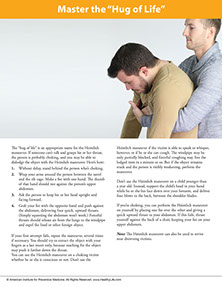
    Image of a man performing the Heimlich maneuver.

    The “hug of life” is an appropriate name for the Heimlich maneuver. If someone can’t talk and grasps his or her throat, the person is probably choking, and you may be able to dislodge the object with the Heimlich maneuver. Here’s how:

    1.  Without delay, stand behind the person who’s choking.

    2.  Wrap your arms around the person between the navel and the rib cage. Make a fist with one hand. The thumb of that hand should rest against the person’s upper abdomen.

    3.   Ask the person to keep his or her head upright and facing forward.

    4.  Grab your fist with the opposite hand and push against the abdomen, delivering four quick, upward thrusts. (Simply squeezing the abdomen won’t work.) Forceful thrusts should release air from the lungs to the windpipe and expel the food or other foreign object.

    If your first attempt fails, repeat the maneuver, several times if necessary.

    You should try to extract the object with your fingers as a last resort only, because reaching for the object may push it farther down the throat.

    You can use the Heimlich maneuver on a choking victim whether he or she is conscious or not. Don’t use the Heimlich maneuver if the victim is able to speak or whisper, however, or if he or she can cough. The windpipe may be only partially blocked, and forceful coughing may free the lodged item in a minute or so. But if the object remains stuck and the person is visibly weakening, perform the maneuver.

    Don’t use the Heimlich maneuver on a child younger than a year old. Instead, support the child’s head in your hand while he or she lies face down over your forearm, and deliver four blows to the back, between the shoulder blades.

    If you’re choking, you can perform the Heimlich maneuver on yourself by placing one fist over the other and giving a quick upward thrust to your abdomen. If this fails, thrust yourself against the back of a chair, keeping your fist on your upper abdomen.

    Note: The Heimlich maneuver can also be used to revive near drowning victims.

    A Year of Health Hints book by the American Institute for Preventive Medicine. www.HealthyLife.com. All rights reserved.

    © American Institute for Preventive Medicine

  • Hyperventilation

    First Aid

    Hyperventilation is breathing too deeply and faster than normal. This causes too much carbon dioxide to be exhaled. As a result, levels of carbon dioxide in the blood and brain tissue drop.

    Signs & Symptoms

    *  Your heart pounds.

    *  It feels like you can’t get enough air.

    *  You feel tingling and numbness in the arms, legs, and around the mouth.

    *  You feel a sense of doom.

    *  You may pass out.

    Symptoms usually last 20 to 30 minutes, but seem to last hours. Though scary, hyperventilation is not usually dangerous.

    Causes

    *  Anxiety is the most common cause.

    *  Panic attacks.

    *  Central nervous system problems.

    Treatment

    Self-care may be enough to treat hyperventilation. If it persists or occurs with other symptoms, seek medical care.

    Questions to Ask

    Self-Care / Prevention

    *  Open up a small paper bag. Loosely cover your nose and mouth with it. Breathe slowly into the bag. Rebreathe the air in the bag. Do this about 10 times. Set the bag aside. Breathe normally for a couple of minutes.

    *  Repeat the steps above for up to 15 minutes.

    *  Try to breathe slowly. Focus on taking one breath every 5 seconds.

    {Note: If you still hyperventilate after using Self-Care / First Aid, call your doctor.}

    Healthier at Home book by the American Institute for Preventive Medicine. www.HealthyLife.com. All rights reserved.

    © American Institute for Preventive Medicine
  • Right And Wrong Reasons For A Hysterectomy

    Women’s Health

    Image of female doctor with female patient.

    If you are told that you need a hysterectomy (surgical removal of the uterus), get a second opinion. Your medical insurance plan may even require it. Your condition may have other treatment options.

    Hysterectomies are still warranted for:

    *  Large fibroids.

    *  Severe hemorrhaging not controlled with medication. Irreversible damage from an untreated infection. Cancer of the cervix or uterus.

    Alternative treatments exist for heavy, painful periods, fibroid tumors, endometriosis, and a prolapsed uterus. If these conditions don’t respond to more conservative treatment, then a hysterectomy may be warranted. So if you’re told you need a hysterectomy:

    *  Ask about alternatives to surgery.

    *  Ask for specific details about the condition you’re being treated for and the expected outcome of surgery.

    *  Ask if your ovaries can be spared, to prevent shutting off the release of estrogen and, subsequently, premature menopause.

    *  Don’t hesitate to get a second opinion if you question the need for a hysterectomy.

    A Year of Health Hints book by the American Institute for Preventive Medicine. www.HealthyLife.com. All rights reserved.

    © American Institute for Preventive Medicine