Author: AIPM

  • Splinters

    Skin Conditions

    Signs & Symptoms

    *  An opening near the skin where the splinter entered.

    *  Pain may not be felt and the splinter may or may not be visible.

    *  Bleeding, swelling, and/or pain at the wound area, especially for splinters stuck deep under the skin.

    Causes

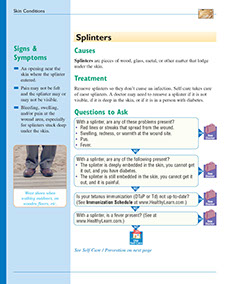
    Splinters are pieces of wood, glass, metal, or other matter that lodge under the skin.

    Treatment

    Remove splinters so they don’t cause an infection. Self-care takes care of most splinters. A doctor may need to remove a splinter if it is not visible, if it is deep in the skin, or if it is in a person with diabetes.

    Questions to Ask

    Self-Care / Prevention

    To Prevent Getting Splinters

    *  Wear shoes out-of-doors at all times and whenever you walk on unfinished floors.

    *  Sand, varnish, and/or paint handrails to keep from getting splinters in the hands.

    *  Clean up all broken glass and metal shavings around the house. Be careful when you handle broken glass.

    *  Wear hard-soled shoes when glass has been broken.

    *  Wear work gloves when you handle plants with thorns, sharp tips, or spines.

    To Remove a Splinter

    *  Wash your hands, but don’t let the area around a wooden splinter get wet. A wooden splinter that gets wet will swell. This will make it harder to remove.

    *  Sterilize tweezers. Place the tips in a flame. Wipe off the blackness on the tips with sterile gauze if you use a lit match for the flame.

    *  Use the tweezers to gently pull the part of the splinter that sticks out through the skin. It should slide right out. If necessary, use a magnifying glass to help you see close up.

    *  If the splinter is buried under the skin, sterilize a needle and gently slit the skin over one end of the splinter. Then, use the needle to lift that end and pull the splinter out with the tweezers.

    – Check to see that all of the splinter has been removed. If not, repeat the above step.

    – If you still can’t get the splinter out, soak the skin around the splinter in a solution made with 1 tablespoon of baking soda mixed in 1 cup of warm water. Do this 2 times a day. After a few days, the splinter may work its way out.

    – Once the splinter is removed, clean the wound by washing it with soap and water. Blot it dry with a clean cloth or sterile gauze pad. Apply a sterile bandage.

    – To remove a large number of close-to-the- surface splinters, such as cactus spines, apply a layer of hair removing wax or white glue, such as Elmer’s, to the skin. Let it dry for 5 minutes. Gently peel it off by lifting the edges of the dried wax, gel, or glue with tweezers. The splinter(s) should come up with it.

    – Contact your doctor if you still have the splinter(s) after using self-care measures. Also, see that your tetanus immunizations are up-to-date.
    Healthier at Home book by the American Institute for Preventive Medicine. www.HealthyLife.com. All rights reserved.

    © American Institute for Preventive Medicine
  • Sprains, Strains & Sports Injuries

    First Aid

    Signs & Symptoms

    For Sprains

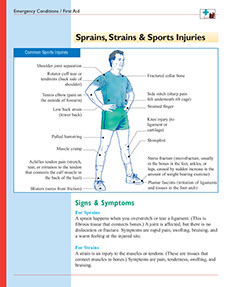
    A sprain happens when you overstretch or tear a ligament. (This is fibrous tissue that connects bones.) A joint is affected, but there is no dislocation or fracture. Symptoms are rapid pain, swelling, bruising, and a warm feeling at the injured site.

    For Strains

    A strain is an injury to the muscles or tendons. (These are tissues that connect muscles to bones.) Symptoms are pain, tenderness, swelling, and bruising.

    For Sports Injuries

    Sports injury symptoms depend on the injury. They include pain, tenderness, swelling, and bruising. Bones may be broken or dislocated.

    Causes

    Sprains occur from an accident, injury, fall, etc. A strain occurs when you overstretch or overexert a muscle or tendon (not a ligament). This is usually due to overuse and injuries, such as sports injuries.

    Treatment

    Treatment for sprains, strains, and sports injuries depends on the injury and on the extent of damage. Self-care may be all that is needed for mild injuries. Sports injuries and sprains may need medical treatment. Some sprains need a cast. Others may need surgery if the tissue affected is torn.

    Broken bones (other than broken toes) need medical care right away.

    Questions to Ask

    Self-Care / First Aid

    *  If the injury is not serious, stop what you are doing and use R.I.C.E.

    *  If you sprained a finger or hand, remove rings. (If you don’t and your fingers swell up, the rings may have to be cut off.)

    *  Take an over-the-counter medicine for pain, if needed. {Note: Many sports medicine providers do not recommend aspirin-like medicine at first, because it can make bleeding and bruising worse.}

    *  Try liniments and balms. These give a cooling or warming sensation by masking the pain. They do not promote healing.

    *  Once the injury begins to heal, use M.S.A.:

    – Movement. Work toward a full range of motion as soon as possible. This will help maintain flexibility during healing and prevent any scar tissue from limiting future performance.

    – Strength. Gradually strengthen the injured area once the swelling is controlled and a range of motion is back.

    – Alternative Activities. Do regular exercises that do not strain the injured part. Start this a few days after the injury, even though the injured part is still healing.

    To Prevent Serious Injuries (especially during contact sports)

    *  Wear the right protective gear and clothing for the sport (e.g., a helmet; shoulder, knee, and wrist pads; a mouth guard, etc.).

    *  Train in the sport so you learn how to avoid injury. “Weekend athletes” are prone to injury. Follow the rules that apply to the sport.

    General Prevention

    *  Ease into any exercise program. Build up gradually.

    *  Avoid running on hard surfaces like asphalt and concrete. Run on flat surfaces. Running uphill puts added stress on the achilles tendon.

    *  Don’t lock your knees. When you jump, land with your knees bent.

    *  Wear shoes and socks that fit well. The widest area of your foot should match the widest area of the shoe. You should be able to wiggle your toes with the shoe on when you sit and when you stand. Wear shoes that provide shock absorption and stability.

    *  Stop if you feel pain. Don’t do the activity until you can do it without pain.

    *  Cool down after exercise. Do the activity at a slower pace for 5 minutes.

    Healthier at Home book by the American Institute for Preventive Medicine. www.HealthyLife.com. All rights reserved.

    © American Institute for Preventive Medicine

  • Sexually Transmitted Infections (Sti)

    Sexual Health

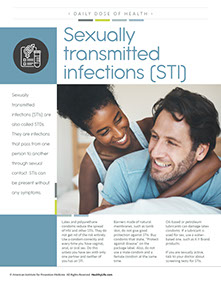
    Smiling couple.

    Sexually transmitted infections (STIs) are also called STDs. They are infections that pass from one person to another through sexual contact. STIs can be present without any symptoms.

    Latex and polyurethane condoms reduce the spread of HIV and other STIs. They do not get rid of the risk entirely. Use a condom correctly and every time you have vaginal, anal, or oral sex. Do this unless you have sex with only one partner and neither of you has an STI.

    Barriers made of natural membranes, such as lamb skin, do not give good protection against STIs. Buy condoms that state, “Protect against disease” on the package label. Also, do not use a male condom and a female condom at the same time.

    Oil-based or petroleum lubricants can damage latex condoms. If a lubricant is used for sex, use a water-based one, such as K-Y Brand products.

    If you are sexually active, talk to your doctor about screening tests for STIs.

    Health at Home Lifetime book by the American Institute for Preventive Medicine. www.HealthyLife.com. All rights reserved.

    © American Institute for Preventive Medicine
  • Sticky Snacks Spell Trouble

    Dental & Mouth Concerns

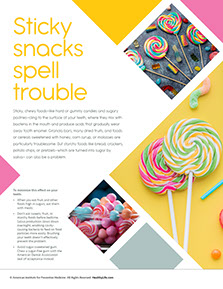
    Image of chewy candy.

    Sticky, chewy foods-like cough drops, hard candies, and sugary pastries-cling to the surface of your teeth, where they mix with bacteria in the mouth and produce acids that gradually wear away tooth enamel. Granola bars, many dried fruits, and foods or cereals sweetened with honey, corn syrup, or molasses are particularly troublesome. But starchy foods like bread, crackers, potato chips, or pretzels-which are turned into sugar by saliva-can also be a problem. To minimize this difficulty:

    *  If you eat fruit and other foods high in sugars, eat them with meals.  Finish a meal with foods that help buffer acid formation.

    *  Don’t eat sweets, fruit, or starchy foods before bedtime. Saliva production slows down overnight, enabling cavity-causing bacteria to feed on food particles more easily. Brushing your teeth doesn’t effectively prevent the problem.

    *  Avoid sugar-sweetened gum and beverages. Chew a sugar-free gum instead, especially one with the artificial sweetener xylitol.

    A Year of Health Hints book by the American Institute for Preventive Medicine. www.HealthyLife.com. All rights reserved.

    © American Institute for Preventive Medicine
  • Stress & Emotional Eating

    Student Health

    College life may leave you feeling stressed. Do you need extra vitamins and nutrients? Though a busy schedule may sometimes cause people to neglect eating well, we do not use any more (or fewer) nutrients while under mental stress. When you are feeling stressed and strung-out, try these tips:

    *  Take time to take care of yourself. This includes taking time to eat well. Don’t just snack all day. Sit down and enjoy your meal.

    *  Try quick foods, such as fresh, canned, or frozen veggies added to canned soups or pastas. Order in if you like, but try not to skip meals.

    *  Start your day with breakfast! It will help you get going for the rest of the day.

    Food cravings may be a sign of hunger created from skipping meals, from a lack of nutrients in your diet, or an attempt to satisfy emotional needs. Food won’t solve your emotional dilemmas. The next time you find yourself heading for the fridge for a quick emotional fix, use the following tips.

    *  You are studying for that big exam and find yourself nervous and anxious. Instead of splurging on ice cream, seek out different relaxation techniques. Sit quietly with your eyes closed and breathe deeply for a few minutes. Or, go for a quick walk. Get enough sleep. Sleep deprivation makes most people anxious and irritable.

    *  You’ve had a big fight with your roommate and are furious. Anger can cause overeating quicker than most other emotions. Instead of eating as a response to this, try, instead, to confront the target of your anger. Have that difficult conversation after you have had a chance to calm down or write out your feelings in a letter.

    *  You find yourself with nothing to do, but sit around and eat. Many people eat out of boredom. Solution? Diversion! Find something else to capture your attention. Find which diversions work best for you and use them.

    *  Most importantly, don’t spend time feeling guilty when you eat to get an emotional fix. Doing this occasionally is not a problem.

    Snacks and Your Backpack

    Snacking is a big part of hectic college life. When you are out shopping for snacks, stock up on pretzels, fruit, graham crackers, mini-size cereal boxes, popcorn, meal replacement bars, etc.

    If snacking and studying go together, try setting a schedule. Study for one hour and then grab a snack. This helps keep calories in control. Measure out a portion size of the snack rather than eating out of a large box or bag.

    When it comes to eating on the run, have a 6 inch submarine sandwich on a whole grain roll or a vegetarian pita. Don’t go long periods of time without eating. This leaves you famished and fatigued.

    Resources

    Page from Student Self-Care book by the American Institute for Preventive Medicine. www.HealthyLife.com. All rights reserved.

    © American Institute for Preventive Medicine
  • Stress Relief For Caregivers

    Mature Health: Over Age 50

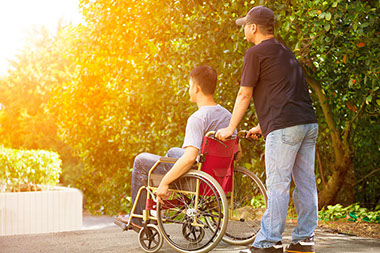
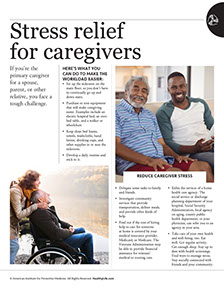
    Image of a caregiver helping a man in a wheelchair.

    If you’re the primary caregiver for a spouse, parent, or other relative, you face a tough challenge. Here’s what you can do to make the workload easier.

    *  Set up the sickroom on the main floor, so you don’t have to continually go up and down stairs.

    *  Purchase or rent equipment that will make caregiving easier. Examples include an electric hospital bed, an over-bed table, and a walker or wheelchair.

    *  Keep clean bed linens, towels, washcloths, hand lotion, drinking cups, and other supplies in or near the sickroom.

    *  Develop a daily schedule and stick to it.

    To reduce the stress of your ongoing responsibility:

    *  Delegate some tasks to family and friends.

    *  Investigate community services that provide transportation, deliver meals, and provide other kinds of help.

    *  Enlist the services of a home health care agency. The social service or discharge planning department of your hospital, Social Security Administration, local agency on aging, county public health department, or your physician, can refer you to an agency in your area.

    *  Plan to get out of the house to shop or socialize at least one day a week.

    *  Find out if the cost of hiring help to care for someone at home is covered by your medical insurance provider, Medicaid, or Medicare. The Veterans Administration may be able to provide financial assistance for veterans’ medical or nursing care.

    A Year of Health Hints book by the American Institute for Preventive Medicine. www.HealthyLife.com. All rights reserved.

    © American Institute for Preventive Medicine
  • Stroke (Brain Attack)

    First Aid

    A stroke is also called a “brain attack.” With a stroke, brain cells die due to a blood clot or rupture of a blood vessel in the brain. The end result is brain damage (and possible death).

    In the U.S., strokes are the 3rd leading cause of death. They are the leading cause of adult disability.

    Signs & Symptoms

    *  Sudden numbness or weakness of the face, arm, or leg, especially on one side of the body.

    *  Sudden confusion, trouble speaking or understanding.

    *  Sudden trouble seeing in one or both eyes.

    *  Sudden trouble walking, dizziness, loss of balance or coordination.

    *  Sudden severe headache with no known cause.

    Causes

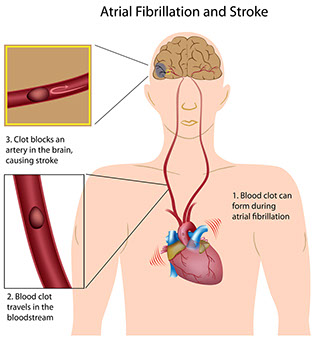
    Most strokes are caused by a blood clot in an artery in the neck or brain. Some are caused by bleeding into or around the brain.

    Risk Factors for a Stroke

    *  Previous stroke or transient ischemic attack (TIA)-a temporary lack of blood supply to the brain.

    *  Atrial fibrillation. This is an irregular beating of the heart.

    *  High blood pressure. Cigarette smoking. Diabetes. Coronary artery disease.

    *  Being a male over age 70.

    Illustration of how a stroke is caused.

    Prevention

    *  Take medicine(s), as prescribed, to control blood pressure, blood cholesterol, diabetes, and atrial fibrillation. Aspirin may help reduce the risk of stroke in women ages 55-79 years. Discuss this with your doctor.

    *  Get to and stay at a healthy weight. Get regular exercise.

    *  Don’t smoke. If you smoke, quit. Use alcohol in moderation. Manage stress.

    Questions to Ask

    Self-Care / Prevention

    First Aid before Emergency Care

    *  Note the time when the first sign(s) of stroke occurred. Report this time to emergency personnel. For the most common type of strokes, a clot-busting drug should to be given within 3 hours of the start of symptoms.

    *  Do not give the person anything to eat or drink. Do not give aspirin.

    Healthier at Home book by the American Institute for Preventive Medicine. www.HealthyLife.com. All rights reserved.

    © American Institute for Preventive Medicine
  • Depression

    Student Health

    Depression is the most common reason college students go to their school’s counseling service. Depression makes a person less able to manage life. It affects a person’s mood, mind, body, and behaviors.

    Signs & Symptoms

    The number and severity of the symptoms vary from person to person. A person who is depressed has one or more of the signs and symptoms listed below.

    *  Feeling sad, hopeless, and helpless.

    *  Feeling guilty and/or worthless.

    *  Thinking negative thoughts.

    *  Having a loss of interest in things, such as social activities, hobbies, and sex.

    *  Sleeping too little or too much.

    *  Fatigue or loss of energy.

    *  Problems concentrating or making decisions.

    *  Ongoing physical symptoms, such as headaches, chronic pain, or digestive problems that don’t respond to treatment.

    *  Uncontrollable crying.

    *  Poor appetite with weight loss, or overeating and weight gain.

    *  Thoughts of suicide or death.

    Causes & Risk Factors

    *  Major changes and stress that accompany college, including choosing career goals, leaving home, and the strain from trying to study and socialize at the same time.

    *  Obsessing about expenses.

    *  Abuse of alcohol, drugs, and some medications.

    *  Relationship changes, such as break ups, a family divorce, or the death of someone close.

    *  Brain chemical imbalances. Also, some types of depression run in families.

    *  Hormonal changes. This could be from taking birth control pills or using anabolic steroids which can cause changes in mood.

    *  Lack of natural, unfiltered sunlight between late fall and spring. This is called Seasonal Affective Disorder (SAD). It may only affect some people that are prone to this disorder.

    *  Holiday “blues.”

    Most likely, depression is caused by a mix of: A family history of the illness; brain chemical imbalances; emotional issues; and other factors, such as a medical illness or alcohol abuse.

    In some people, events like extreme stress and grief may cause depression. In others, depression occurs even when life is going well.

    Treatment

    Treatment includes medicines, psychotherapy, and other therapies that are specific to the cause of the depression. Exposure to bright lights (similar to sunlight) for depression that results from SAD can be helpful. {Note: Some antidepressant medicines can increase the risk for suicidal thoughts and behaviors, especially in children and adolescents. This risk may be higher within the first days to a month after starting the medicine. Persons who take antidepressants should be closely monitored.}

    Questions to Ask

    Self-Care / Prevention

    *  Take medications as prescribed. Get your doctor’s advice before you take over-the-counter herbs, such as St. John’s Wort, especially if you take other medications.

    *  Don’t use illegal drugs. Limit alcohol. These can cause or worsen depression. Drugs and alcohol can also make medicines for depression less effective. Harmful side effects can occur when drugs and/or alcohol are mixed with medicine.

    *  Eat healthy foods. Eat at regular times.

    *  Get regular exercise.

    *  Talk to someone who will listen to the tensions and frustrations you are feeling.

    *  Try not to isolate yourself. Be with people you trust and feel safe with, even though you feel down.

    *  Do things you enjoy. Do something that lets you express yourself. Draw. Paint. Write your thoughts in a diary or journal.

    *  Relax. Listen to soft music, take a warm bath or shower. Do relaxation exercises.

    *  Avoid stressful situations or taking on added commitments when you feel depressed.

    *  Keep an emergency number handy (e.g., crisis hotline, trusted friend’s number, etc.) in case you feel desperate.

    Feeling better takes time. Don’t expect to just “snap out” of your depression.

    To Help A Friend Who Is Depressed

    *  Help your friend get an appropriate diagnosis. Make an initial appointment with a professional and offer to take your friend.

    *  Do not ignore remarks about suicide. Report them, immediately, to a student advisor, teacher, or health care provider.

    *  Be aware of the type of medication your friend needs to take and when it should be taken. If necessary, alert your friend’s health care provider about any side effects that you notice.

    *  Be supportive. Depression is no different from any other physical illness. It requires patience, understanding, love, and encouragement. Encourage your friend to continue with treatment and to see his or her health care provider if there is no improvement.

    *  Listen with care. Point out your friend’s successes and attributes when he or she feels worthless, helpless, or down about the future. Helping your friend see previous successes can help give the confidence needed to continue with treatment. Your friend doesn’t need you to tell him or her what to do. Listening is very helpful.

    *  Encourage your friend to go out and do things with you or with others, such as to see a movie or to do things your friend enjoyed in the past. Don’t push, though, or make too many demands.

    *  Seek support from organizations that deal with depression.

    Resources

    Your school’s Student Counseling Service or Student Mental Health Service. (Normally, these services are no cost to you.)

    International Foundation for Research and Education on Depression (IFRED)

    www.ifred.org

    Mental Health America (MHA)

    800.969.6642

    www.mentalhealthamerica.net

    National Mental Health Consumers’ Self-Help Clearinghouse

    800.553.4539

    www.mhselfhelp.org

    Student Self-Care book by the American Institute for Preventive Medicine. www.HealthyLife.com. All rights reserved.

    © American Institute for Preventive Medicine
  • Student Health

    Student Health

    General Safety Guidelines

    Alcohol Safety

    Set Up Good Sleep Habits

    Choose Healthy Foods & Control Your Weight

    Stress & Emotional Eating

    Use ChooseMyPlate.Gov

    Depression

    Eating Disorders

    Mononucleosis (“Mono”)

    Suicidal Thoughts

    4 Warning Signs of Teen Depression

    Nutrition, Health & Safety Issues

    © American Institute for Preventive Medicine
  • Stye

    Eye Conditions

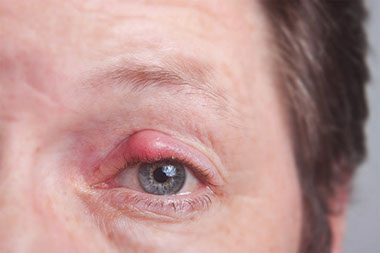
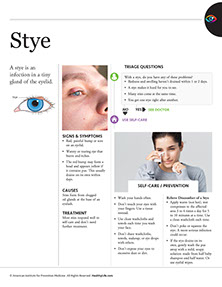
    Close up image of eye with a stye.

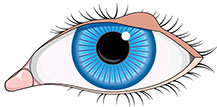
    A stye is an infection in a tiny gland of the eyelid.

    Illustration of a stye.

    Signs & Symptoms

    *  Red, painful bump or sore on an eyelid.

    *  Watery or tearing eye that burns and itches.

    *  The red bump may form a head and appears yellow if it contains pus. This usually drains on its own within days.

    Causes

    Sties form from clogged oil glands at the base of an eyelash.

    Treatment

    Most sties respond well to self-care and don’t need further treatment.

    Questions to Ask

    Self-Care / Prevention

    *  Wash your hands often.

    *  Don’t touch your eyes with your fingers. Use a tissue instead.

    *  Use clean washcloths and towels each time you wash your face.

    *  Don’t share washcloths, towels, makeup, or eye drops with others.

    *  Don’t expose your eyes to excessive dust or dirt.

    To Relieve the Discomfort of a Stye

    *  Apply warm (not hot), wet compresses to the affected area 3 to 4 times a day for 5 to 10 minutes at a time. Use a clean washcloth each time.

    *  Don’t poke or squeeze the stye. A more serious infection could occur.

    *  If the stye drains on its own, gently wash the pus away with a clean, wet cloth.

    Healthier at Home book by the American Institute for Preventive Medicine. www.HealthyLife.com. All rights reserved.

    © American Institute for Preventive Medicine