Author: AIPM

  • Vaginal Infections

    Women’s Health

    Vaginal infections are the most common reason American females see their doctors. Vaginal infections result in vaginitis (swelling of the vagina).

    Signs, Symptoms & Causes

    For Bacterial Vaginosis (BV)

    Nearly half of females with clinical signs of BV report no symptoms. When present, symptoms include:

    *  A thin, gray, or milky white vaginal discharge. This has a fishy odor, which is more noted after intercourse.

    *  Mild vaginal irritation or burning.

    Bacterial vaginosis results when certain bacteria outnumber normal and protective bacteria in the vagina. The exact cause is not known.

    Risk factors for BV include douching, using an IUD, and a change or an increase in sexual partners.

    For Vaginal Yeast Infections

    Vaginal yeast infections are also called Monilia, Candida, and fungal infections. Signs and symptoms range from mild to severe. They include:

    *  Thick, white vaginal discharge that looks like cottage cheese and may smell like yeast.

    *  Itching, irritation, and redness around the vagina.

    *  Burning and/or pain when urinating or with sex.

    Vaginal yeast infections result from the overgrowth of the fungus Candida. This is normally present in harmless amounts in the vagina, digestive tract, and mouth.

    Risk Factors for Vaginal Yeast Infections

    *  Hormonal changes that come with pregnancy or monthly periods. Taking hormones or birth control pills.

    *  Antibiotic use, especially “broad spectrum” ones. Corticosteroid medicine use.

    *  High blood sugar. This can occur when diabetes is not controlled.

    *  Sex that irritates the vagina a lot.

    *  Using douches. Using feminine hygiene sprays.

    *  Using hot tubs and jacuzzis a lot.

    Chronic vaginal yeast infections can be one of the first signs of diabetes, STIs, and HIV.

    Diagnosis

    Different vaginal infections have the same symptoms. This makes it hard to tell one from another. A doctor may need to diagnose the cause. A sample of vaginal fluid is taken and tested. Often, this takes less than 3 minutes.

    Treatment

    For Bacterial Vaginosis

    Prescribed antibiotic creams, gels, or pills are needed. Male sex partner(s) may also need treatment. Feminine hygiene sprays that mask vaginal odor should not be used. Nor should OTC medications, such as ones for vaginal yeast infections. These do not treat BV.

    For Vaginal Yeast Infections

    Prescribed and OTC vaginal creams or suppositories get rid of the Candida overgrowth. Oral medicines, such as Diflucan®, may be prescribed.

    Questions to Ask

    Self-Care / Prevention

    *  Take medications, as prescribed.

    *  For a repeat vaginal yeast infection, use an over-the-counter (OTC) antifungal vaginal medication, such as Monistat. Use it as directed. {Note: Stop using any OTC product for a vaginal yeast infection at least 24 hours before a vaginal exam.}

    *  Ask your pharmacist about an OTC cream for itching and burning to help with symptoms during treatment.

    *  Bathe or shower often. Clean the inside folds of the vulva. Dry the vaginal area well.

    *  Wipe from front to back after using the toilet.

    *  If your vagina is dry, use a water soluble lubricant, such as K-Y Liquid®, when you have sex.

    *  Wear all-cotton underwear. Don’t wear garments that are tight in the crotch. Change underwear and workout clothes as soon as possible after you sweat.

    *  Don’t use bath oils, bubble baths, feminine hygiene sprays, or perfumed or deodorant soaps.

    *  Don’t sit around in a wet bathing suit. Shower after you swim in a pool to remove the chlorine from your skin. Dry the vaginal area well.

    *  Eat well. Limit sugar and foods with sugar. Eat foods, such as yogurt, that contain live cultures of “lactobacillus acidophilus.” If you can’t tolerate yogurt, take an OTC product that has this.

    *  Let your doctor know if you are prone to getting yeast infections whenever you take an antibiotic. You may be told to also use a vaginal antifungal product.

    *  If you still menstruate, use unscented tampons or sanitary pads and change them often.
    Women's Self-Care book by the American Institute for Preventive Medicine. www.HealthyLife.com. All rights reserved.

    © American Institute for Preventive Medicine
  • Vaginal Problems

    Women’s Health

    A number of vaginal problems occur in women over age 50. Often, the problems are due to changes in the vagina that come with menopause. These include:

    *  Vaginal dryness

    *  Thinning of the walls of the vagina

    *  Loss of elasticity in the muscles in the vagina

    *  Shrinkage of the labia (external genitals that cover and protect the opening of the vagina)

    These changes can lead to common vaginal problems, such as:

    *  Pain during and after intercourse

    *  Vaginitis – vaginal swelling, irritation, and/or infections.

    Less common vaginal problems in women over 50 are:

    *  Sexually transmitted infections (STIs).

    *  Cancer of the vagina, which is rare.

    *  Abnormal vaginal bleeding (unless still menstruating or on hormone therapy (HT)

    It is common for menstrual periods to be irregular for several years before menopause. This is normal vaginal bleeding. For premenopausal women, the most common causes of abnormal vaginal bleeding, in this order, are: Not ovulating; malignancy; pregnancy; endometriosis; and benign tumors. The most common cause after menopause is malignancy.

    The chart below lists signs and symptoms of vaginal problems and what to do about them. {Note: All vaginal bleeding that occurs after menstruation has stopped should be evaluated by your doctor.}

    Hemorrhage

    Signs & Symptoms

    Vaginal bleeding with:

    *  A known bleeding disorder and you also have blood in your urine or stool

    *  Heavy vaginal bleeding after taking a clot dissolving drug for a heart attack or stroke

    What to Do

    Get immediate care.

    Internal Injury

    Signs & Symptoms

    Vaginal bleeding after trauma to the abdomen, pelvis, or vagina or vaginal bleeding with any of these problems:

    *  Dizziness and very heavy bleeding (you saturate more than 1 full sized pad in an hour’s time)

    *  Pale and moist skin and a decreased level of consciousness

    *  Extreme shortness of breath or a very hard time breathing

    *  Severe abdominal pain

    What to Do

    Get immediate care.

    Pelvic Inflammatory Disease (PID)

    This is an infection of the uterus, fallopian tubes, and/or ovaries.

    Signs & Symptoms

    Vaginal bleeding with 2 or more of these problems:

    *  Abdominal tenderness and/or bloating

    *  Pain in the pelvis or back

    *  Pain during intercourse

    *  Skin on your abdomen feels sensitive

    *  Vaginal discharge with abnormal color or odor

    *  Change in menstrual flow, if still menstruating

    *  Fever, chills

    What to Do

    Contact doctor.

    Infection of the cervix, uterus, or vagina

    Cervical, uterine, or vaginal cancer.

    Signs & Symptoms

    Vaginal bleeding after menopause, unless on estrogen therapy (ET).

    What to Do

    Contact doctor.

    Gonorrhea or similar sexually transmitted infection (STI)

    Signs & Symptoms

    Abnormal vaginal bleeding with:

    *  Mild itching and burning around the vagina

    *  Burning or pain when urinating or urinating more often

    *  A vaginal discharge with abnormal color

    *  Abdominal discomfort

    What to Do

    Contact doctor.

    Genital Herpes

    Signs & Symptoms

    Sores and/or painful blisters in the genital area and sometimes on the thighs or buttocks

    What to Do

    Contact doctor.

    Trichomoniasis

    Signs & Symptoms

    *  Vaginal itching, burning, and redness

    *  Greenish-yellow vaginal discharge

    *  Burning or pain when urinating

    What to Do

    Contact doctor.

    Bacterial Vaginosis

    This is an infection from one or more types of bacteria that may or may not be sexually transmitted.

    Signs & Symptoms

    *  Mild vaginal irritation or burning

    *  A thin, gray, or milky white vaginal discharge. This has a fishy odor, which is noticed more after sex. (About half of females have no symptoms.)

    What to Do

    Contact doctor.

    Atrophic Vaginitis

    This is caused by a decrease in estrogen.

    Signs & Symptoms

    Vaginal dryness, irritation, itching, and burning

    What to Do

    Contact doctor.

    Vaginal Yeast Infection

    Signs & Symptoms

    *  Itching, irritation, and redness around the vagina

    *  Thick, white vaginal discharge that looks like cottage cheese and may smell like yeast

    *  Burning and/or pain when urinating or with sex

    What to Do

    Use self-care.

    Vaginitis from Contact Dermatitis

    Signs & Symptoms

    Itching and redness in the outer genital area without other symptoms

    What to Do

    Use self-care.

    Care

    Medical treatment depends on the cause.

    For Atrophic Vaginitis:

    Use a prescribed estrogen cream or prescribed estrogen pills.

    For Bacterial Vaginosis:

    Use a prescribed antibiotic cream or gel or prescribed antibiotic pills.

    For a Vaginal Yeast Infection:

    It is important, though, to make sure that you have the right problem diagnosed. A burning sensation could be a symptom of a urinary tract infection caused by bacteria, which requires an antibiotic. Antibiotics will not help yeast infections. They make them worse. Trichomoniasis mimics yeast infections, too.

    Chronic vaginal infections can be one of the first signs of diabetes, sexually transmitted diseases, or HIV in women.

    Self-care measures treat most vaginal yeast infections. Your doctor can prescribe a vaginal cream or suppositories or an oral antifungal medicine, such as Diflucan.

    For a Severe Case of Contact Dermatitis in the Vaginal Area:

    Use an ointment prescribed by your doctor.

    Other medical treatments are treating the specific cause, such as STIs, cervical cancer, and uterine cancer.

    Self-Care / Prevention

    For a Vaginal Yeast Infection or Bacterial Vaginosis:

    *  Bathe or shower often. Clean the inside folds of the vulva. Dry the vaginal area well.

    *  Wipe from front to back after using the toilet.

    *  Wear all-cotton underwear.

    *  Don’t wear garments that are tight in the crotch.

    *  Change underwear and workout clothes right away after sweating.

    *  If you still menstruate, use unscented tampons or sanitary pads and change them often.

    *  Don’t use bath oils, bubble baths, feminine hygiene sprays, or perfumed or deodorant soaps.

    *  Don’t sit around in a wet bathing suit.

    *  Shower after you swim in a pool to remove the chlorine from your skin. Dry the vaginal area well.

    *  Eat well. Include foods that contain live cultures of “lactobacillus acidophilus,” such as yogurt. If you can’t tolerate yogurt, take an over- the-counter product that contains lactobacillus acidophilus.

    *  Let your doctor know if you tend to get yeast infections whenever you take an antibiotic. He or she may have you also take a vaginal antifungal agent.

    When You Have a Vaginal Yeast Infection:

    *  Use an over-the-counter product for vaginal yeast infections, such as Monistat, Gyne-Lotrimin, etc.

    *  Douche with a mild solution of 1 to 3 tablespoons of vinegar mixed in 1 quart of warm water. Repeat only once a day (up to 7 days) until the symptoms subside. Don’t do this if you are pregnant or if you have a sexually transmitted disease.

    *  Limit sugar and foods with sugar.

    For Vaginal Dryness and Painful Intercourse:

    *  Don’t use deodorant soaps or scented products in the vaginal area.

    *  Use a water soluble lubricant, such as K-Y Jelly, Replens, etc. Avoid oils or petroleum-based products.

    *  Use an estrogen cream for the vagina. Your doctor needs to prescribe this.

    *  Keep sexually active.

    *  Don’t use antihistamines unless truly needed.

    For Contact Dermatitis in the Vaginal Area:

    *  Avoid products that cause the problem (scented items, douches, etc.).

    *  Apply an over-the-counter hydrocortisone cream to the affected area. Use this infrequently, though. Hydrocortisone can, itself, lead to thinning of the vaginal tissue. Follow package directions.

    *  Put a cool compress on the affected area.

    *  Wash your underwear in a gentle detergent. Rinse it twice. Use only plain water for the second rinse. Don’t use a fabric softener.

    Health at Home Lifetime book by the American Institute for Preventive Medicine. www.HealthyLife.com. All rights reserved.

    © American Institute for Preventive Medicine
  • Varicose Veins

    Women’s Health

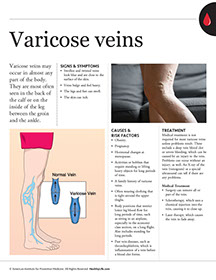
    Varicose veins may occur in almost any part of the body. They are most often seen in the back of the calf or on the inside of the leg between the groin and the ankle.

    Signs & Symptoms

    Illustration of varicose veins.

    *  Swollen and twisted veins look blue and are close to the surface of the skin.

    *  Veins bulge and feel heavy.

    *  The legs and feet can swell.

    *  The skin can itch.

    Causes & Risk Factors

    *  Obesity.

    *  Pregnancy.

    *  Hormonal changes at menopause.

    *  Activities or hobbies that require standing or lifting heavy objects for long periods of time.

    *  A family history of varicose veins.

    *  Often wearing clothing that is tight around the upper thighs.

    *  Body positions that restrict lower leg blood flow for long periods of time. One example is sitting in an airplane, especially in the economy class section, on a long flight.

    *  Past vein diseases, such as thrombophlebitis. This is inflammation of a vein before a blood clot forms.

    Treatment

    Medical treatment is not required for most varicose veins unless problems result. These include a deep vein blood clot or severe bleeding, which can be caused by an injury to the vein. Problems can occur without an injury, as well. An X-ray of the vein (venogram) or a special ultrasound can tell if there are any problems.

    Medical Treatment

    *  Surgery can remove all or part of the vein.

    *  Sclerotherapy. This uses a chemical injection into the vein, causing it to close up.

    *  Laser therapy. This causes the vein to fade away.

    Questions to Ask

    Self-Care / Prevention

    *  Don’t cross your legs when sitting.

    *  Exercise regularly. Walking is a good choice. It improves leg strength and vein strength.

    *  Maintain a healthy weight. Lose weight if you are overweight.

    *  Don’t stand for long periods of time.

    *  If your job or hobby requires you to stand, shift your weight from one leg to the other every few minutes. Just wiggling your toes can help, too.

    *  Wear elastic support stockings or support hose, as advised by your doctor.

    *  Don’t wear clothing or undergarments that are tight or constrict your waist, groin, or legs.

    *  Eat high-fiber foods, like bran cereals, whole-grain breads, and fresh fruits and vegetables, to promote regularity. Constipation may be a factor in varicose veins.

    *  Elevate your legs when resting.

    *  Exercise your legs. From a sitting position, rotate your feet at the ankles, turning them first clockwise, then counterclockwise, using a circular motion. Next, extend your legs forward and point your toes to the ceiling then to the floor. Next, lift your feet off the floor and gently bend your legs back and forth at the knees.

    *  Get up and move about every 35 to 45 minutes when traveling by air or even when sitting in an all-day conference. Opt for an aisle seat in such situations.

    *  Stop and take short walks at least every 45 minutes when taking long car rides.

    Resources

    American Academy of Dermatology

    866.503.SKIN (503.7546)

    www.aad.org

    American College of Phlebology

    www.phlebology.org

    Women's Self-Care book by the American Institute for Preventive Medicine. www.HealthyLife.com. All rights reserved.

    © American Institute for Preventive Medicine
  • Vomiting & Nausea

    Abdominal & Urinary Conditions

    Signs & Symptoms

    *  Vomiting is throwing up the stomach’s contents. Dry heaves may precede or follow vomiting.

    *  Nausea is when you feel like you’re going to throw up.

    Causes

    *  Viruses in the intestines. Eating spoiled food or eating or drinking too much.

    *  A side effect of some medications, such as certain antibiotics.

    *  Motion sickness. Morning sickness in pregnant females.

    *  Labyrinthitis. This is inflammation of an area in the ear. Often, a respiratory infection causes this.

    *  Migraine headaches.

    *  Acute glaucoma.

    *  Stomach ulcers.

    *  A blockage in the small or large intestine (bowel).

    *  A concussion from a head injury.

    *  Hepatitis.

    *  Meningitis. This is inflammation of membranes that cover the brain and spinal cord.

    Questions to Ask

    Self-Care / Prevention

    For Vomiting

    *  Don’t smoke, drink alcohol, or take aspirin.

    *  Don’t eat solid foods. Don’t drink milk.

    *  Drink clear liquids at room temperature (not too hot or cold). Good examples are water; sport drinks, such as Gatorade; diluted fruit juices; ginger ale, etc. Take small sips. Drink only 1 to 2 ounces at a time. Stir carbonated beverages to get all the bubbles out before you sip them. Suck on ice chips if nothing else will stay down. {Note: For children, contact your child’s doctor about using over- the-counter (OTC) mixtures, such as Pedialyte.}

    *  Gradually return to a regular diet, but wait about 8 hours from the last time you vomited. Start with foods like dry toast, crackers, rice, and other foods that are easy to digest. Or, eat foods as tolerated. Avoid greasy or fatty foods.

    For Nausea Without Vomiting

    *  Drink clear liquids. Eat small amounts of dry foods, such as soda crackers, if they help.

    *  Avoid things that irritate the stomach, such as alcohol and aspirin.

    *  For motion sickness, use an over-the-counter medicine, such as Dramamine. You could also try Sea-Bands, a wrist band product that uses acupressure on a certain point on the wrist to control motion sickness. Sporting goods stores and drugstores sell Sea-Bands.

    Resources

    Foodsafety.gov

    www.foodsafety.gov

    Healthier at Home book by the American Institute for Preventive Medicine. www.HealthyLife.com. All rights reserved.

    © American Institute for Preventive Medicine
  • Vomiting & Nausea In Children

    Children’s Health

    Signs, Symptoms & Causes

    Vomiting is when you throw up what is in your stomach. Nausea is when you feel like you’re going to throw up.

    Here are some common causes of nausea and vomiting:

    *  Viruses in the intestines. (Your child can get diarrhea, too.)

    *  Getting upset.

    *  Morning sickness in pregnant teens.

    *  Motion sickness (getting “car sick” or “seasick” from travelling).

    *  Some medicines.

    *  Spoiled food.

    *  Eating or drinking too much.

    Some serious problems cause vomiting, too. Here are some of them:

    *  Appendicitis. This is when your child’s appendix is infected.

    *  Stomach ulcers.

    *  Meningitis.

    *  Brain tumors.

    Watch your child very closely if he or she is vomiting. Babies and small children can get dehydrated very fast. Dehydration is when your body doesn’t have enough water.

    Your older child or teen may make themselves throw up. This could be a sign of anorexia nervosa or bulimia.

    Questions to Ask

    Self-Care

    *  Be calm and loving. Throwing up can scare a child.

    *  Keep a bowl or basin near your child. Hold your hand against your child’s forehead when he or she vomits.

    *  Give your child water to rinse his or her mouth out after throwing up. Sponge your child’s face.

    *  Take away dirty clothes or bedding. Change to clean ones.

    *  Don’t smoke near your child.

    *  Don’t feed your child solid food. Don’t give your child milk.

    *  Wait 1 hour after your child throws up. Then give your child clear fluids (not too cold or too hot). Here are some examples:

    – Pedialyte®, Revital Ice®-rehydrating freezer pops, or other over-the-counter mixtures.

    – Lemon-lime soda or ginger ale for  older children. Stir the soda until the fizz is gone.

    – Gelatin (any color but red).

    *  Start with 1 teaspoon to 1 tablespoon of liquid every 10 minutes for babies. Start with 1 to 2 ounces every 15 minutes for children. Give twice as much each hour after the vomiting stops. If your child is still vomiting, stop fluids for 1 hour. Then start to give small amounts of fluid again.

    *  Slowly give your child more and more clear fluids. Don’t make your child drink when he or she doesn’t want anything.

    *  If you are breast-feeding:

    – If the baby throws up 3 or more times, give your baby Pedialyte® or other over-the-counter mixture.

    – Go back to nursing when your baby has gone 2 to 4 hours without vomiting. But feed less. Do only one side, and only for about 10 minutes.

    – Go back to nursing on both sides after 8 hours of no vomiting. But feed your baby less than usual for about 8 hours.

    *  For bottle-fed babies: After 12 hours of no vomiting, give formula. But mix 1/2 formula with 1/2 water.

    *  After your child stops throwing up, keep giving him or her clear fluids, like broth and gelatin (any color but red). Do this for 8 hours. Then give foods easy to digest, like crackers and rice. Then go back to the usual foods your child eats. But wait 12 to 24 hours after the last time your child vomited to give milk.

    *  Don’t give your child over-the-counter medicine unless the doctor tells you to.

    Call the doctor if your child doesn’t get better or if the vomiting comes back.

    Children's Self-Care book by the American Institute for Preventive Medicine. www.HealthyLife.com. All rights reserved.

    © American Institute for Preventive Medicine
  • Want To Have A Baby? Try This

    Pregnancy & Prenatal Care

    Image of happy couple looking at positive pregnancy test, while male is making a phone call.

    Many couples don’t conceive as quickly as they’d like to. You can improve your chances of getting pregnant if you follow these measures.

    *  Avoid alcohol, tobacco, and marijuana.

    *  Avoid foods and beverages that contain caffeine.

    *  Avoid extreme overweight or underweight.

    *  Lie on your back with your hips elevated by a pillow for approximately 30 minutes after intercourse.

    *  Know when your ovaries release eggs. Time intercourse for your fertile period. Ovulation normally occurs 14 to 16 days after the start of your period. Signs of ovulation include a dull ache in either the lower right or left side of the abdomen; clear, elastic vaginal mucus; and a slightly elevated temperature.

    You can buy an ovulation predictor kit at most drugstores. The kit contains sticks which, when dipped in urine, turn blue if you’re ovulating.

    Or you can keep track of your fertile days with a special basal thermometer, also available at drugstores. Having intercourse when your temperature drops approximately 0.4ºF increases your chances of conception.

    If you fail to conceive after one year of trying, consult your gynecologist or a fertility specialist. A number of factors can prevent conception.

    A Year of Health Hints book by the American Institute for Preventive Medicine. www.HealthyLife.com. All rights reserved.

    © American Institute for Preventive Medicine

  • Warts

    Skin Conditions

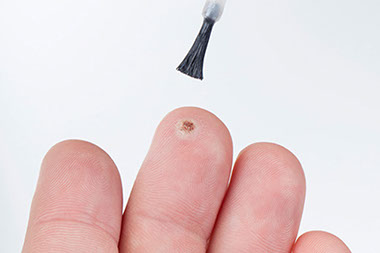
    Image of medication being applied to wart on finger.

    Warts are small skin growths. Most are harmless and painless. They can appear on any part of the body.

    Signs & Symptoms

    *  Common warts. These are firm and often have a rough surface. They are round or have an irregular shape. They are found on places subject to injury, such as the hands, fingers, and knees. Common warts are flesh-colored to brown. They may spread, but are not cancer.

    *  Flat warts. These are smooth and flesh-colored. They are found mainly on the hands and face and may itch.

    *  Plantar warts. These occur on the soles of the feet. They look like corns or calluses and may have little black dots in the center. They can be painful.

    *  Digitate warts. These threadlike warts grow on the scalp.

    *  Filiform warts. These are long, narrow, small growths. They appear mainly on the neck, eyelids, or armpits.

    *  Genital warts. SeeSexually Transmitted Infections (STIs) – Human Papillomavirus (HPV).

    Causes

    Warts are caused by human papillomaviruses. One of these viruses may enter the body through a cut or nick in the skin. Scratching or picking at warts may spread them to other sites. Some persons are more prone to getting warts than others. People who cannot fight off disease are also more at risk for warts. You cannot get warts from frogs or toads.

    Treatment

    Treatment for warts depends on their location, type, and severity and how long they have been on the skin. About 50% of warts go away in 6 to 12 months without treatment.

    Self-care measures can be used for warts not on the face or genitals. Medical treatment includes liquid nitrogen, chemical injections, topical medicines, laser surgery, and minor surgery.

    Questions to Ask

    Self-Care / Prevention

    *  Don’t touch, scratch, or pick at warts.

    *  Never cut or burn a wart off.

    *  Try an over-the-counter wart remover with salicylic acid. This can be a liquid or it can be in a medicated wart pad or patch. {Note: Do not use these wart removers on the face or genitals.} Follow package directions. A pumice stone helps remove the dead skin during this treatment.

    *  Ask your doctor about Retin A for flat warts.

    *  During treatment for plantar warts, put pads or cushions in your shoes. This can help relieve the pain when you walk.

    To Prevent Warts

    *  Don’t touch, scratch, or pick at warts.

    *  Wear plastic sandals or shower shoes in locker rooms and public swimming pool areas.

    *  Change shoes often to air them out.

    Resources

    Skinsight

    www.skinsight.com

    Healthier at Home book by the American Institute for Preventive Medicine. www.HealthyLife.com. All rights reserved.

    © American Institute for Preventive Medicine

  • Wash Hands For Health

    General Health Conditions

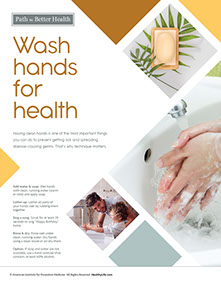
    Bar of soap.

    Having clean hands is one of the most important things you can do to prevent getting sick and spreading disease-causing germs. That’s why technique matters.

    Add water & soap:Wet hands with clean, running water (warm or cold) and apply soap.

    Lather up:Lather all parts of your hands well by rubbing them together.

    Sing a song:Scrub for at least 20 seconds or sing “Happy Birthday” twice.

    Rinse & dry:Rinse well under clean, running water. Dry hands using a clean towel or air-dry them.

    Option:If soap and water are not available, use a hand sanitizer that contains at least 60% alcohol.

    Health at Home Lifetime book by the American Institute for Preventive Medicine. www.HealthyLife.com. All rights reserved.

    © American Institute for Preventive Medicine
  • Wash It Off

    General Health Conditions

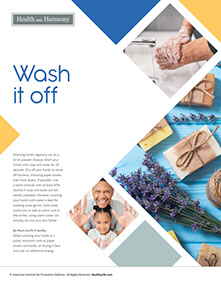
    Father and young daughter washing their hands.

    Washing hands regularly can do a lot to prevent disease. Wash your hands with soap and water for 20 seconds. Dry off your hands to stave off bacteria, choosing paper towels over hand dryers, if possible. Use a hand sanitizer with at least 60% alcohol if soap and water are not readily available. However, washing your hands with water is best for washing away germs. Cold water works just as well as warm, and in the winter, using warm water can actually dry out your skin faster.

    Be More Earth-Friendly

    When washing your hands in a public restroom, and no paper towels are handy, air drying is best and uses no additional energy.

    Health at Home Lifetime book by the American Institute for Preventive Medicine. www.HealthyLife.com. All rights reserved.

    © American Institute for Preventive Medicine
  • West Nile Virus

    General Health Conditions

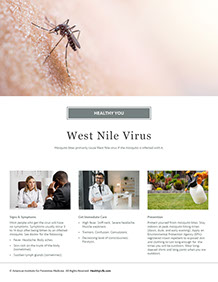
    Mosquito bites cause West Nile virus if the mosquito is infected with it.

    Signs & Symptoms

    Most people who get the virus will have no symptoms. About 1 in 5 persons will get mild ones (West Nile fever). Symptoms usually occur 3 to 14 days after being bitten by an infected mosquito. See doctor for the following:

    *  Fever.

    *  Headache.

    *  Body aches.

    *  Skin rash on the trunk of the body (sometimes).

    *  Swollen lymph glands (sometimes).

    About 1 in 150 persons get symptoms of a severe infection (West Nile encephalitis or meningitis). Get Immediate Care for the following:

    *  High fever.

    *  Stiff neck.

    *  Severe headache.

    *  Muscle weakness.

    *  Tremors. Confusion.

    *  Convulsions.

    *  Decreasing level of consciousness.

    *  Paralysis.

    Prevention

    Protect yourself from mosquito bites. Stay indoors at peak mosquito biting times (dawn, dusk, and early evening). Apply an insect repellent with DEET to clothing and exposed skin to last long enough for the times you will be outdoors. Wear long-sleeved shirts and long pants when you are outdoors.

    Resources

    Centers for Disease Control and Prevention

    www.cdc.gov

    Student Self-Care book by the American Institute for Preventive Medicine. www.HealthyLife.com. All rights reserved.

    © American Institute for Preventive Medicine