Author: AIPM

  • Find Out If You’re Overweight Or Overfat

    Weight Control

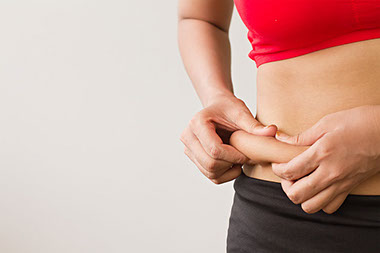
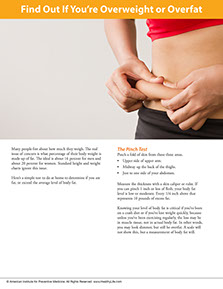
    Image of person doing the pinch test.

    Many people fret about how much they weigh. The real issue of concern is what percentage of their body weight is made up of fat. The ideal is about 16 percent for men and about 20 percent for women. Standard height and weight charts ignore this issue.

    Here’s a simple test to do at home to determine if you are fat, or exceed the average level of body fat.

    The Pinch Test

    Pinch a fold of skin from these three areas.

    *  Upper side of upper arm.

    *  Midway up the back of the thighs.

    *  Just to one side of your abdomen.

    Measure the thickness with a skin caliper or ruler. If you can pinch 1 inch or less of flesh, your body fat level is low or moderate. Every 1/4 inch above that represents 10 pounds of excess fat.

    Knowing your level of body fat is critical if you’ve been on a crash diet or if you’ve lost weight quickly, because unless you’ve been exercising regularly, the loss may be in muscle tissue, not in actual body fat. In other words, you may look slimmer, but still be overfat. A scale will not show this, but a measurement of body fat will.

    Page from A Year of Health Hints book by the American Institute for Preventive Medicine. www.HealthyLife.com. All rights reserved.

    © American Institute for Preventive Medicine

  • Pedal For Fitness

    Fitness

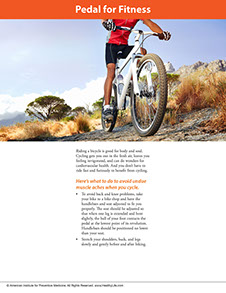
    A closeup image of a bike tire while a cyclist rides through a trail.

    Riding a bicycle is good for body and soul. Cycling gets you out in the fresh air, leaves you feeling invigorated, and can do wonders for cardiovascular health. And you don’t have to ride fast and furiously to benefit from cycling.

    Here’s what to do to avoid undue muscle aches when you cycle.

    *  To avoid back and knee problems, take your bike to a bike shop and have the handlebars and seat adjusted to fit you properly. The seat should be adjusted so that when one leg is extended and bent slightly, the ball of your foot contacts the pedal at the lowest point of its revolution. Handlebars should be positioned no lower than your seat.

    *  Stretch your shoulders, back, and legs slowly and gently before and after biking.

    Page image from A Year of Health Hints book by the American Institute for Preventive Medicine. www.HealthyLife.com. All rights reserved.

    © American Institute for Preventive Medicine

  • Reward Yourself For Weight Loss

    Weight Control

    When a behavior is followed by a reward, the behavior is more likely to be repeated. So the more you are rewarded for your weight-loss efforts, the more likely you’ll continue to succeed.

    But you don’t have to wait until you lose weight to reward yourself Rewards should begin the very first day of your diet. (Of course, food should not be a reward.)

    Here are just a few examples of the kinds of rewards that can help you to adhere to your weight-control plan.

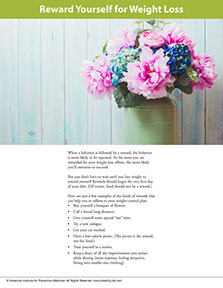
    *  Buy yourself a bouquet of flowers.

    *  Call a friend long-distance.

    *  Give yourself some special “me” time.

    *  Try a new cologne.

    *  Get your car washed.

    *  Have a low-calorie picnic. (The picnic is the reward, not the food.)

    *  Treat yourself to a movie.

    *  Keep a diary of all the improvements you notice while dieting (more stamina, feeling attractive, fitting into smaller-size clothing).

    Page from A Year of Health Hints book by the American Institute for Preventive Medicine. www.HealthyLife.com. All rights reserved.

    © American Institute for Preventive Medicine

  • Reduce Outdoor Air Pollution To Breathe Cleaner Air

    Stress Management

    Looking up at a forrest of trees.

    *  Plant trees and other greenery to add oxygen and help lower carbon dioxide in the air. Replace some lawn with shrubs and trees that shade the house to save on cooling and heating costs.

    *  Create a garden and maintain it. Use manual tools for lawn and garden work, if possible. If not, use electric equipment. If you use gas powered equipment, avoid spilling gas at the gas station and when pouring it into the mower.

    *  Combine errands and reduce trips. Limit engine idling.

    *  Drive green to lower emissions of pollutants from your car. Obey the speed limit. Don’t accelerate hard and brake hard. Get regular tune-ups. Keep tires inflated. Open windows and use the vents to cool off before you turn on the air conditioner. When buying a new car, choose a low-polluting vehicle.

    *  Get air conditioners and heat pumps serviced by technicians who are EPA-certified to handle refrigerants. If you buy these items new, choose ones that use non-ozone-depleting refrigerants.

    Page from HealthyLife Weigh book by the American Institute for Preventive Medicine. www.HealthyLife.com. All rights reserved.

    © American Institute for Preventive Medicine

  • Recognize Addiction

    Substance Use & Abuse

    How to tell if you have a drinking or drug problem.

    If you are addicted to alcohol or drugs, craving the substance can be as strong as the need for food or water. You are unable to stop using the substance even though it causes or worsens problems for you, family, friends, and coworkers. Your drinking or drug use may put you and others in danger or cause legal problems.

    Signs You Have a Problem:

    Signs depend on the substance. Common ones include:

    *  Your use and tolerance of alcohol or a drug has increased. You need more of the substance to get “high.”

    *  You hide alcohol or drugs at home or at work.

    *  You often carry drugs and/or items such as glass pipes, straws and needles used to take the drugs.

    *  You get withdrawal symptoms when you stop using the substance. Examples are:

    – Anxiety

    – Being very edgy

    – Blackouts

    – Chills or sweating

    – Delirium

    – Depression

    – Feeling “spaced out”

    – Hallucinations

    – Panic

    – Seizures

    – Tremors of the hands or face

    Behavioral Changes:

    *  You develop a pattern of being absent or late for work.

    *  You have mood swings.

    *  You have temper flare-ups.

    *  You keep asking family and friends for money.

    *  You develop a habit of stealing to support your habit.

    *  You become very secretive about your life.

    *  You have a new group of friends who drink a lot or  use drugs.

    *  You have problems dealing with others.

    Action Step

    The first step to recovery is admitting that you have a problem. You may not recognize it at first, but the people around you do. Listen to them. Then ask for help.

    Page from Ways to Well-Being book by the American Institute for Preventive Medicine. www.HealthyLife.com. All rights reserved.

    © American Institute for Preventive Medicine

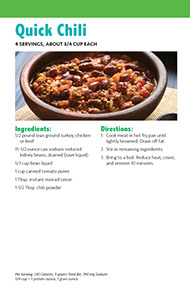
  • Quick Chili

    Nutrition

    4 Servings, about 3/4 cup each

    Ingredients:

    1/2 pound lean ground beef

    15-1/2 ounce can kidney beans, drained (save liquid)

    1/3 cup bean liquid

    1 cup “no-salt-added” canned tomato puree

    1 Tbsp. instant minced onion

    1-1/2 Tbsp. chili powder

    Directions:

    1.  Cook beef in hot fry pan until lightly browned. Drain off fat.

    2.  Stir in remaining ingredients.

    3.  Bring to a boil. Reduce heat, cover, and simmer 10 minutes.

    Per Serving:

    Calories – 230

    Total fat – 9 grams

    Sodium – 390 mg

    Page from HealthyLife Weigh Recipe book by the American Institute for Preventive Medicine. www.HealthyLife.com. All rights reserved.

    © American Institute for Preventive Medicine

  • Prevent In-Flight Ear Pops

    Healthy Travel

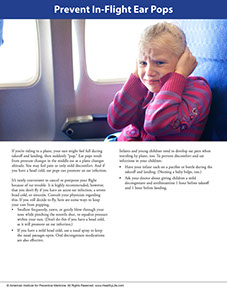
    Image of young girl on plane covering her ears.

    If you’re riding in a plane, your ears might feel full during takeoff and landing, then suddenly “pop.” Ear pops result from pressure changes in the middle ear as a plane changes altitude. You may feel pain or only mild discomfort. And if you have a head cold, ear pops can promote an ear infection.

    It’s rarely convenient to cancel or postpone your flight because of ear trouble. It is highly recommended, however, that you don’t fly if you have an acute ear infection, a severe head cold, or sinusitis. Consult your physician regarding this. If you still decide to fly, here are some ways to keep your ears from popping.

    *  Swallow frequently, yawn, or gently blow through your nose while pinching the nostrils shut, to equalize pressure within your ears. (Don’t do this if you have a head cold, as it will promote an ear infection.)

    *  If you have a mild head cold, use a nasal spray to keep the nasal passages open. Oral decongestant medications are also effective.

    Infants and young children tend to develop ear pain when traveling by plane, too. To prevent discomfort and ear infections in your children:

    *  Have your infant suck on a pacifier or bottle during the takeoff and landing. (Nursing a baby helps, too.)

    *  Ask your doctor about giving children a mild decongestant and antihistamine 1 hour before takeoff and 1 hour before landing.

    Page image from A Year of Health Hints book by the American Institute for Preventive Medicine. www.HealthyLife.com. All rights reserved.

    © American Institute for Preventive Medicine

  • Portion Control

    Weight Control

    Size matters.

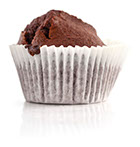
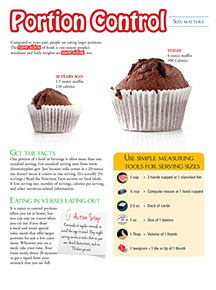
    Image of a small muffin size from 20 years ago.
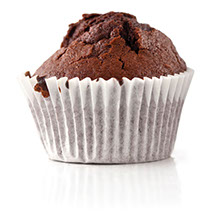
    Image of large muffin served today.

    Compared to years past, people are eating larger portions. The super-sizing of foods is one reason people’s waistlines and body weights are super-sizing , too.

    20 years ago:

    1.5 ounce muffin

    210 calories

    Today:

    4 ounce muffin

    500 Calories

    Get the facts

    One portion of a food or beverage is often more than one standard serving. Get standard serving sizes fromwww.choosemyplate.gov. Just because soda comes in a 20-ounce size doesn’t mean it counts as one serving. (It’s actually 2½ servings.) Read the Nutrition Facts section on food labels. It lists serving size, number of servings, calories per serving, and other nutrition-related information.

    Eating in verses eating out

    It is easier to control portions when you eat at home, but you can stay on course when you eat out if you share a meal and avoid special value meals that offer larger portions for just a few cents more. Wherever you eat a meal, take your time. Your brain needs about 20 minutes to get a signal from your stomach that you are full.

    Use simple measuring tools for serving sizes:

    1 cup = 2 hands cupped or 1 clenched fist

    ½ cup = Computer mouse or 1 hand cupped

    2-3 oz. =  Deck of cards

    1 oz. = Size of 1 domino

    1 Tbsp. = Volume of 1 thumb

    1 teaspoon = 1 die or tip of 1 thumb

    Action Step

    Eat meals at regular intervals to avoid the urge to snack. Buy single-serving snacks or make them on your own. Avoid distractions, such as TV when you eat.

    Page from Ways to Well-Being book by the American Institute for Preventive Medicine. www.HealthyLife.com. All rights reserved.

    © American Institute for Preventive Medicine

  • Plan Your Meals

    Nutrition

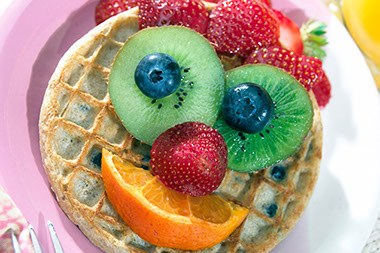
    Image of a face made out of fruit on a waffle.

    Did you know that about 70% of adults in the U.S. wait until 4:00 p.m. to decide what they’ll eat for dinner that day? Planning foods to eat for a day, a week, etc. is very helpful, because it:

    *  Saves time and effort. It means fewer trips to the grocery store. It also helps you make good use of leftovers which can be called “planned overs.”

    *  Saves money. Pre-planned, quick meals can replace more costly convenience items and restaurant meals.

    *  Saves calories. It helps keep you from impulse buying, especially high calorie snacks. It also helps with portion control.

    *  Saves you from eating the same foods over and over again. Eat a variety of foods so you get a variety of nutrients. Variety can also make eating more enjoyable.

    When You Plan Your Meals, Refer to These Items

    *  Your calendar, weekly planner, etc. These can help you know who will be home at mealtimes, whether you are eating out in a restaurant or at a relative’s or friend’s house, if you need to pack lunches, etc.

    *  Your grocery store ads which advertise weekly specials. Buy special items that fit in with your food budget and eating plan. It is not wise to buy ice cream that is “buy one” “get one free.” You’d be better off saving the fat and calories than buying a half-gallon of ice cream. Also, only use manufacturers’ “cents-off” coupons when the item is on your list and works within your eating plan.

    *  Make a grocery list from your menus. This includes the menus you use from this book and menus you plan on your own.

    Plan Breakfast

    Breakfast Is Important!

    *  It “breaks the fast” from sleeping.

    *  It helps give you energy to start your day.

    *  It is a way to get dietary fiber.

    *  It doesn’t take a lot of time.

    What To Eat

    *  When you plan your own breakfast, choose whole grain cereals and breads, fresh fruits, fruit juices, frozen, and canned fruits (in water or its own juice), skim, nonfat, or low-fat milks (regular or soy) and yogurts made from these. Add calorie-free items, such as coffee, tea, seasonings, spices (e.g., cinnamon for hot cereal).

    Breakfast Menu Makeover

    A breakfast of eggs, meat, hash browns, and toast and butter…should be eaten only occasionally. If eaten every day, the calories, fat, and cholesterol add up.

    Plan Lunch

    Suggestions For “Brown Bagging It”

    *  Fresh fruits

    *  Fresh vegetables or vegetable juices

    *  Whole wheat breads

    *  Lean meat, poultry, fish, dry beans, peas, lentils, hard-cooked eggs (especially egg whites), low-fat cheeses (2 to 6 grams of fat per ounce)

    *  Skim milk, low-fat (1%) milk, or nonfat or low-fat yogurt (regular or soy)

    *  Minimal fats, including margarine or salad dressings. Opt for low-fat or fat-free salad dressings, “butter”-type sprinkles and other no fat condiments, such as mustard, ketchup, or fat-free margarines

    Suggestions for Vegetables

    *  Large green salad with a mixture of greens and raw vegetables, such as cucumbers, green pepper, onions and broccoli. These could be “planned overs” from last night’s dinner salad.

    *  Raw vegetables, such as carrot sticks, celery sticks, broccoli, cauliflower, cucumbers, tomato slices, and/or beets. Keep these cut up and ready-to-eat in your refrigerator. They will be easy to grab when making your lunch.

    *  Ready-to-eat vegetables, such as peeled baby carrots; fresh, bagged salads, spinach, etc.

    *  Chopped raw vegetables for sandwich garnishes or stuffed in pita bread

    *  Soup or casserole dishes with vegetables. These could be “planned overs” from last night’s dinner.

    Suggestions for Fruits

    *  Keep fresh fruit in a fruit basket on the table or counter at home. Eat the fruit with the skin, if edible. This adds dietary fiber.

    *  Buy individual fruit cups (packed in water or in fruit juice) or buy larger cans and portion out the fruit in “keep cold” containers.

    Suggestions for Sandwiches

    *  Choose breads with dietary fiber, such as whole-wheat, multi-grain, Boston brown, rye, oatmeal, and pumpernickel.

    *  Choose from many shapes, such as pita (pocket), sub roll, bagel, soft tortilla, rice cakes, and lavash.

    *  Make a sandwich with lettuce leaves in place of bread.

    For Sandwich Fillings, Choose

    *  “Planned over” roast meats, turkey, chicken, or pork loin

    *  Lean deli and pre-packaged meats, such as turkey and chicken breast, or ham

    *  Flaked, cooked fish, or water packed tuna mixed with chopped, cooked, or raw vegetables and plain low-fat or fat-free dressings

    *  Mashed, cooked beans flavored with: A creole sauce made with tomatoes, onions, celery, green peppers

    *  Chopped onion and parsley, garlic powder, rosemary, thyme, and pepper

    *  Chopped cooked lean pork, celery, onions, and plain nonfat yogurt

    *  Low-fat cheeses that list no more than 6 grams of fat per ounce

    Other Bagged Lunch Suggestions

    *  Large salad with greens, chopped vegetables, lean meats, low-fat cheese, beans, such as garbanzo and kidney. Use a nonfat, no-oil, low-fat or regular salad dressing. Use serving sizes allowed in your food budget.

    *  Soup, such as vegetable or reduced fat cream of broccoli, with a whole grain muffin, fruit, and nonfat yogurt.

    *  “Planned overs” from the previous night’s dinner (e.g., lean meat, vegetable, rice, a casserole serving, chili, etc.)

    Plan Dinner

    *  Plan foods that you and your family and/or guests enjoy eating and that can be made in the time you have to prepare the meal.

    *  Choose foods that vary in flavor, color, texture, and temperature. The combination of foods should blend well together and look appealing.

    *  Make efficient use of your kitchen equipment. (For example, make baked potatoes with a roasted entree.)

    *  Focus on entrees that have whole grains and vegetables and less meat. Examples are stir-fry dishes, pasta dishes, chilis, soups, and stews.

    *  Add items to the entree (if they are not already part of it). Examples are potatoes, rice, pasta, couscous, and beans. Opt for whole grain products (bread, pasta, brown rice, etc. instead of white, enriched products), whenever possible.

    Lean (Fresh) Meat Suggestions

    *  Beef – round, sirloin, flank, lean tenderloin

    *  Veal – all trimmed cuts, except commercially ground

    *  Pork – tenderloin, leg (fresh), shoulder (arm or picnic), lean ham

    *  Lamb – leg, arm, loin

    *  Poultry – turkey, chicken, cornish hens

    *  Fish and shellfish – all, except fried

    *  Meat counter pre-portioned items – shish-kebobs or skewers of city chicken

    Meatless Main Dish Suggestions

    *  Dry beans, kidney beans, black beans, pinto beans, peas, lentils, garbonzo beans (chick peas), split peas, and lentils in soups, stews, and pasta sauces

    *  Vegetarian burgers and entrees

    *  Low-fat cheeses

    *  Tofu (soy bean curd)

    Convenience Food Items Suggestions

    *  Frozen dinners – Choose ones with less than 300 calories and less than 1000 mg of sodium.

    *  Frozen entrees – Look for ones with 15 grams of fat or less per serving.

    *  Prepared entrees in the meat section – Examples are pre-roasted, heat and serve chicken or turkey.

    *  Deli pre-cooked items – Choose barbecued chicken, broasted chicken breasts, and baked fish (available at some supermarkets with fish counters, cooked while you shop).

    *  Fast-food items – Choose pizza (without extra cheese and fatty meats); broiled and rotisserie chicken and broiled chicken sandwiches; quarter pound or 2 oz. hamburgers without cheese and mayonnaise; regular or junior sized shaved roast beef sandwiches; broiled and baked fish; soft tacos, burritos, tostadas, and chili; plain baked potatoes and vegetables; salads and salad bar (omit high fat items like regular dressing, creamy dressed salads, such as potato salad, etc.).

    *  Items usually served at breakfast – Have bagels, pancakes, English muffins, juice, fruits, fat-free muffins, cereal, skim and 1% milk, etc.

    Vegetable Suggestions

    Vegetables add color, texture, fiber, vitamins and minerals without adding a lot of calories. Choose good sources of carotene and vitamin C, often.

    Good Sources of Carotene

    (the form of vitamin A found in fruits and vegetables)

    *  Apricots

    *  Broccoli

    *  Cantaloupe

    *  Carrots

    *  Collard greens

    *  Peas

    *  Spinach

    *  Sweet potatoes

    *  Tomatoes

    *  Turnip greens

    *  Winter squash

    Tips for Vegetables

    *  Steam vegetables, cook them in the microwave or in a small amount of water to the “tender-crisp” stage. More nutrients will be retained.

    *  Add herbs, spices, wine, or de-fatted chicken stock to the water when steaming vegetables. These will add flavor.

    *  Use the liquid that the vegetables are cooked in to sauté foods or in soups and stews.

    *  Keep a supply of cut-up vegetables in the refrigerator. Cut vegetables into serving-sized snack pieces when you bring them home from the store. You will be more likely to eat them when they are ready-to-eat. Add them to fast-food meals that you bring home.

    *  Add imitation butter sprinkles or lemon juice and herbs to steamed vegetables instead of butter, margarine, honey, salt, and soy sauce. This will keep down the extra calories, fat, sugar, and sodium.

    Good Sources of Vitamin C

    *  Broccoli

    *  Brussels sprouts

    *  Cabbage

    *  Cantaloupe

    *  Citrus fruits & juices

    *  Strawberries

    *  Cauliflower

    *  Collard greens

    *  Green and red peppers

    *  Kiwi fruit

    *  Peas

    *  Tomatoes

    Plan Snacks

    Snacks can be part of healthy eating. Count them in your daily eating plan, not as “extras.” With planning, you can be prepared for “snack attacks.” This could help keep you from getting high fat, high salt items from vending machines, etc. Keep items that won’t spoil in a desk drawer at work, in your purse, briefcase, locker, etc.

    What to Eat

    *  Free items listed on page 18 and raw vegetables from the vegetable group.

    *  Foods from breakfast, lunch, or dinner menus. For example, save your serving of fruit from lunch and eat it between lunch and dinner.

    *  Any item(s) that total your daily “Extra Calories” budget. Read food labels for information. See the lists below for examples.

    Other Tips

    *  If it is hard for you to avoid eating high fat, high salt and high sugar snacks, don’t buy them. If you have a hard time stopping at one small serving, buy single-serving items.

    *  Eat snacks slowly. Use utensils to eat them.

    *  After you eat your planned snack, drink water and/or brush or floss your teeth.

    Sample 60 Calorie Snacks

    *  1 small apple, orange, or pear

    *  3 cups “light” microwave popcorn

    *  2 Tofutti fudge treat bars

    *  5-6 animal crackers

    *  2 fortune cookies

    *  1 fruit roll snack

    *  2 gingersnaps

    *  24 thin pretzel sticks

    *  1 Jell-O gelatin bar

    *  1 Dole Fruit ‘n Juice bar

    *  1-1/4 cups V-8 juice

    *  1/2 cup sorbet

    *  4 small shrimp

    *  4 ounces “lite” wine

    Sample 90 Calorie Snacks

    *  1 cup nonfat, plain yogurt

    *  1/2 cup fat free ice cream

    *  1/2 cup nonfat frozen yogurt

    *  2 ounces fat-free cheddar cheese

    *  1/2 cup fat-free pudding

    *  1 cup sugar-free yogurt with fruit

    *  1 Rice Krispies Treats bar

    *  1 thin slice banana bread

    *  1 rice cake with 1/2 Tbsp. peanut butter

    *  Low fat fruit smoothie drink

    *  8 ounces sugar-free hot cocoa

    *  4 ounces regular wine or 12 ounces “lite” beer

    Sample 120 Calorie Snacks

    *  1 cup nonfat, plain yogurt + 1/2 cup strawberries

    *  1 ounce dry roasted soy nuts

    *  4 mini Chips Ahoy cookies or 7 mini Oreo cookies

    *  2/3 cup Chex Mix

    *  3 rice cakes or 2 rice cakes with 1/2 Tbsp. peanut butter

    *  6 cups “lite” microwave popcorn

    *  11 animal crackers

    *  2 plain donut holes

    *  12 ounces regular beer

    Behavior Change Tip

    If you don’t have time to make a lunch in the morning, make it the night before. Put “planned overs” in controlled serving sizes in portable containers. Refrigerate items as needed. The next morning, your lunch is ready-to-go.
    Page from HealthyLife Weigh book by the American Institute for Preventive Medicine. www.HealthyLife.com. All rights reserved.

    © American Institute for Preventive Medicine