Category: Healthylife® Weigh

  • Relaxation Reflex

    Healthylife® Weigh

    Part 6

    Man stretching at desk.

    This skill relaxes four basic muscle groups. Tightening and relaxing these muscles produces a soothing effect that helps you relax. Take slow, deep breaths, drop your head, and place your shoulders forward to add to the effect.

    Practice every day for about 5 to 10 minutes. Divide the body into 4 muscle groups. Tense each group for 5 seconds, then release.

    1.Arms and Hands– Lift your arms, bending them at your wrists and elbows. Make fists and tighten your upper arms.

    2.Face and Neck– Squinch your eyes, nose, cheeks, and brow. Stretch your mouth and grit your teeth. Point your chin down toward your chest.

    3.Middle Torso– Push your shoulders back. Tighten your stomach and the middle of your back.

    4.Legs and Feet– Lift your legs off the floor and hold them straight out. Point your toes toward your face. Tighten your thighs.
    © American Institute for Preventive Medicine

  • Stages Of Change

    Healthylife® Weigh

    Part 1

    Man expressing his success to lose weight.

    This guide does not assume you are ready to change. Or, you may be ready to make certain changes but not others. Other changes you may not have even thought of yet! The tools and strategies in this guide are designed to help you move forward through the stages of change. Using the diagram below, consider which stage you are at.

    1. Not Ready

    *  Unaware or in denial about behavior – “No, not me!”

    *  Unsure about changing

    2. Maybe

    *  Aware of problem

    *  Not quite ready

    *  Weighing pros and cons of change

    3. Yes, Let’s Go!

    *  Forming a plan

    *  Addressing strengths and barriers

    *  Set to take action

    4. Go! Doing It

    *  Putting the plan into action

    *  Bringing champions on board

    5. Keep it Going

    *  Change becomes part of habits

    *  Reflecting on change

    *  Facing challenges to new habit

    © American Institute for Preventive Medicine
  • Use The L.A.D.D.E.R. Technique

    Healthylife® Weigh

    Part 4

    Group of friends enjoying a meal outdoors.

    This is a step-by-step way to become more assertive.

    L – Look at your needs, wants, rights, and feelings about the situation.

    A – Arrange a meeting that is convenient for you and the other person to talk.

    D – Define the problem clearly to the other person.

    D – Describe your feelings using “I messages.” I message statements let you take charge of your feelings.

    E – Express your needs and desires in an assertive manner using a few clear sentences. Be aware of your eye contact, hand gestures, posture, voice, and facial expression.

    R – Reinforce your remarks by saying what positive outcomes will occur for you and the other person.

    Example:

    L – I wish my partner would stop stocking the pantry with a food I tend to over-eat when it is available.

    A – I’ll plan to talk with him or her after dinner tomorrow.

    D – Tell your partner, “When cookies are in the pantry, it is hard for me to have just one. I appreciate the treat, but this makes it harder for me to stick with my goal.”

    D – “I feel I could stick with my goals with your help.”

    E – “Let’s keep cookies off the grocery list. I am starting to enjoy fruit as a sweet treat. Let’s get that instead! Also, a hug would be a wonderful treat from you!”

    R – “This change would help me to reach my goal. As I lose weight, I am able to do more physical activity comfortably. Let’s plan a hike together this weekend!”

    © American Institute for Preventive Medicine

  • Avoid Injury

    Healthylife® Weigh

    Part 5

    Senior couple streching before workout.

    Learn how to do an exercise before you try it. Watch someone demonstrate it, either in person or in a video. If possible, do the exercise with someone who can correct poor form.

    Warm up before moderate or intense exercise. Start slowly. You should gradually start breathing harder and feel your heart rate increasing.

    Cool down after moderate or intense exercise. Cool down slowly. Do the activity that you were doing (e.g., walking, biking), but more slowly.

    Possible Cool Down

    *  Brisk walking: Walk around slowly

    *  Swimming: Walk in shallow end of pool

    *  Cycling: Cycle slowly on flat surface or walk

    *  Aerobics: Walk or stretch slowly

    © American Institute for Preventive Medicine
  • Connect Attitude To Your Values

    Healthylife® Weigh

    Part 1

    Happy woman drinking water with fresh lemon, lime, and mint.

    Look for ways to align your attitudes with your values. How will managing your weight display your values? Consider these two approaches:

    View A: Reducing how much soda I drink is going to be terrible. I want to drink whatever I feel like, whenever I want.

    View B: I value connecting with my family, being a good role model for my kids, and being adventurous. Reducing how much soda I drink may be a challenge, but I really want to manage my weight so I can keep up with my kids. I want to be a role model for making changes. I also want to take a hiking trip and not have to sit out because I’m too out of shape.

    How you frame a challenge matters. Try it out.

    *  List one excuse you’ve given for not managing your weight.

    *  Choose one or two of the values you identified.

    *  Managing my weight may be a challenge, but I want to try so I can.

    © American Institute for Preventive Medicine

  • The “Everything In Moderation” Trap

    Healthylife® Weigh

    Part 4

    Chocloate covered strawberries.

    This may be the most common dietary advice today: everything in moderation. However, there are many reasons why this is really hard for most people and downright dangerous for others.

    1.May Be Dangerous:Certain ingredients may harm your body or could make managing a medical condition difficult. Or, you may be sensitive to a food that leads to discomfort, like an artificial sweetener triggering a headache. Moderation does not work in this case.

    2.Risk of Overeating:Second, moderation is a very vague term. How often are you having this food in “moderation”? A small amount daily? A large amount once weekly? Even what you think is a small amount may actually take up a large portion of your daily calorie budget. Also, having this small amount could lead to overeating, especially if the food is high in sugar.

    3.Negotiation Trap:Eating foods in moderation can lead to negotiations and planning to “make up for it” later. “If I eat this cake tonight, I’ll run an extra mile tomorrow.” “If I go out drinking this weekend, I won’t have any alcohol next weekend.” It seems easy in the moment to seize instant gratification. However, if you use the “everything in moderation” excuse too often, you may find yourself negotiating your health away.

    © American Institute for Preventive Medicine
  • Have Fun With Fruits And Vegetables

    Healthylife® Weigh

    Part 2

    A mix of colorful vegetables.

    Color

    *  Have color theme nights and plan a meal with foods of that color.

    *  Combine two brightly colored vegetables together (like vibrant red peppers and deep green broccoli).

    Shapes

    *  Cut fruits and vegetables into different shapes. Use a knife, cookie cutters, or a melon baller to cut stars, hearts, and other fun shapes into fruit.

    *  Use a knife or spiralizer to cut vegetables into strings, coins, or another shape.

    Texture & Temperature

    Serve fruits and vegetables at different temperatures and at different levels of “crunch.” Have raw carrots for lunch but soften celery in a soup at dinner. A salad can be hot. A soup can be cold.

    Pick a new way to prepare a vegetable this week. What best describe(s) how you plan to prepare it:

    *  Crunchy

    *  Soft

    *  Smooth

    *  Rough

    *  Jagged

    *  Al dente (firm in the middle)

    *  Hot

    *  Cold

    Toppings

    Add toasted nuts (flaked almonds, pine nuts, hazelnuts, or cashews), roasted garlic, crispy shallots, toasted seeds, or parmesan cheese to a vegetable-based salad, soup, or stir fry. Other flavorful additions include olives, chili, capers, anchovies, low-sodium soy sauce, and crumbled turkey bacon.

    Make it yours! Food can express your uniqueness.

    © American Institute for Preventive Medicine

  • When “Just A Little” Doesn’T Work

    Healthylife® Weigh

    Part 4

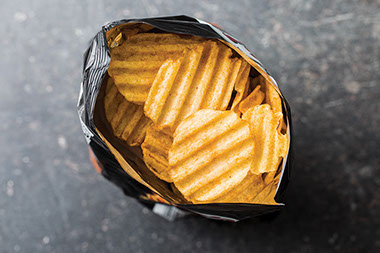
    Open bag of potato chips.

    Sugar, fat, certain chemicals, and other parts of foods can trigger addiction responses in the brain. Once this desire for additional rewards is activated, it can be very difficult to stick with your healthy goals.

    Fill in the blank: Once I start eating _________________________, it is difficult for me to stop eating it or to not overeat.

    *  If you have this food in your house, keep it hidden and in an inconvenient location (like a closet or in the basement).

    *  If possible, avoid places and store aisles that sell this item.

    *  Try to understand why you have this craving. Is it due to stress, boredom, or another emotion? Read more in Part 6 on tackling emotional eating.

    *  Only eat this item around people who have healthy habits. You may find yourself less likely to binge on a food if others around you are eating healthy portions.

    *  If you do buy a trigger food, buy the smallest amount you can.

    – A small, single-serving bag of chips may keep you from buying the large, family-size bag and eating too many chips.

    – If you buy a larger bag, portion the contents into smaller bags as soon as you can.

    – Get a child-size or small fountain drink to satisfy a craving for soda. Re-fill your cup with water immediately and sip until your craving goes away.

    © American Institute for Preventive Medicine

  • Map Your Meal Plan

    Healthylife® Weigh

    Part 3

    Chalk drawing of shopping cart with fresh fruit above.

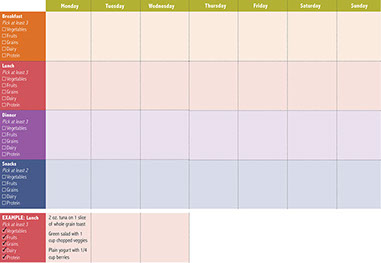
    Print this page or download the “Print on Demand” to map your meal plan.

    Chart to map your meal plan.

    © American Institute for Preventive Medicine

  • Connect To Your Values

    Healthylife® Weigh

    Part 1

    Healthy lifestyle concept with food in heart and sports fitness accessories.

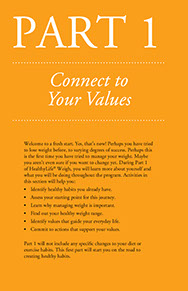
    Welcome to a fresh start. Yes, that’s now! Perhaps you have tried to lose weight before, to varying degrees of success. Perhaps this is the first time you have tried to manage your weight. Maybe you aren’t even sure if you want to change yet. During Part 1 of HealthyLife® Weigh, you will learn more about yourself and what you will be doing throughout the program. Activities in this section will help you:

    *  Identify healthy habits you already have.

    *  Assess your starting point for this journey.

    *  Learn why managing weight is important.

    *  Find out your healthy weight range.

    *  Identify values that guide your everyday life.

    *  Commit to actions that support your values.

    Part 1 will not include any specific changes to your diet or exercise habits. This first part will start you on the road to creating healthy habits.

    HealthyLife® Weigh

    QUICK LINKS: PART 1

    Track Your Daily Food Intake & Physical Activity

    Maintaining a Healthy Weight is Important

    Healthy Body Clues

    Causes of Weight Gain

    Survey Your Starting Point

    Stages of Change

    Identify Your Values

    What Values Do You Display?

    Connect Attitude to Your Values

    Practice Self-Compassion

    Weight Management is a Lifestyle

    Balance of Choice

    What is My Healthy Weight?

    Set a Weight Loss Goal

    Review and Prepare

    © American Institute for Preventive Medicine