Category: Healthylife® Weigh

  • Be Persistent

    Healthylife® Weigh

    Part 7

    Man at gym holding a water bottle and apple.

    You may be reading this page well before you reach your goal. That’s okay. Understand that weight loss takes time. Continue to build on what you do each day. Remember, it isn’t a single healthy meal or workout that will get you to your goal. It’s also not a single poor choice or skipped workout that will derail you.

    *  Build trends of healthy choices.

    *  Know and live your values.

    *  Treat your thoughts and actions with compassion.

    *  Don’t settle with just what you know now. Keep learning.

    *  Create a web of support.

    © American Institute for Preventive Medicine

  • Dairy

    Healthylife® Weigh

    Part 2

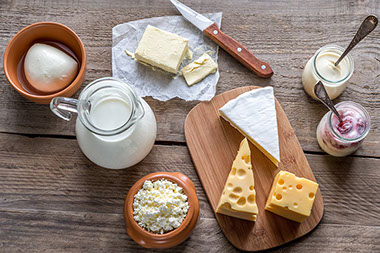
    Dairy products.

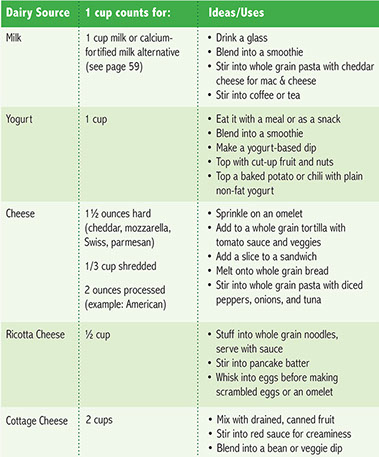
    The dairy group includes milk and foods made from milk. Dairy provides calcium, vitamin D (milk), healthy fats, and protein. Milk alternatives (such as those made from soy) are included if they are fortified with calcium.

    Chart showing dairy sources and ideas.

    Dairy Alternatives

    Many people avoid lactose-containing milk due to an intolerance or preference. Lactose is the sugar in milk that causes digestive problems if you are lactose intolerant. You can obtain many of the nutrients found in milk by eating or drinking lactose-free dairy or fortified dairy alternatives.

    Tips for Reducing Problems with Lactose

    You may be able to consume dairy by having it a different way.

    *  Choose smaller servings of dairy at each meal or snack.

    *  Consume dairy with other foods to slow the digestive process.

    *  Experiment with different dairy products. You may have problems with milk, but are okay with cultured milk products like yogurt.

    *  Take lactase enzyme tablets or drops to help you digest the lactose.

    Dairy alternatives include soy milk, almond milk, rice milk, cashew milk, oat milk, and coconut milk. These milks and products made with them (like yogurt) count toward your daily needs if they are fortified with calcium.

    Calcium

    Calcium is needed for strong bones and teeth. It is also needed for your:

    *  Heart to beat

    *  Nerves to react

    *  Blood to clot

    *  Muscles to flex

    *  Body cells to stick together

    If you cannot tolerate dairy, you can also obtain calcium from these foods:

    *  Calcium-fortified juices, cereals, and breads

    *  Tofu, tempeh, and other fortified soy products

    *  Small bones in canned fish (sardines, salmon with bones)

    *  Leafy greens (collard and turnip greens, kale, bok choy)

    Calcium-fortified foods and beverages may not provide the other nutrients found in dairy products. Try to fulfill your dairy group needs from dairy most of the time.

    © American Institute for Preventive Medicine

  • Fast-Food Restaurants

    Healthylife® Weigh

    Part 3

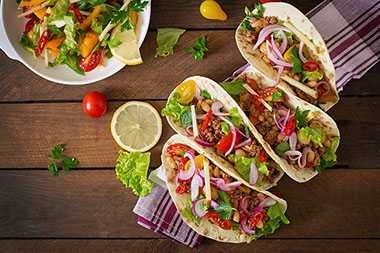
    Mexican tacos with meat, beans and salsa.

    Fast-food restaurants can be very convenient, especially if they have a drive-thru window. Look for the healthier choices on the menu, though they may not be the biggest or most colorfully advertised.

    If you are getting a meal, use the MyPlate guidelines. Choose from at least two food groups, like protein + fruit or protein + vegetable + dairy. Count these toward your goals for the day.

    Tips

    *  Choose grilled options over fried. This reduces saturated fat.

    *  Look for lower-sodium options.

    *  Order the smaller portions on the menu.

    *  Order water instead of 100% fruit juice. Order 100% fruit juice instead of soda.

    *  If you are treating yourself, choose a small portion, like a small ice cream.

    *  Eat half a portion and save the other half for later. Or, split a meal or menu item with a friend.

    Healthier Choices

    *  Regular burger, skip the fries and add a side salad with a vinaigrette dressing

    *  Grilled chicken wrap with apple slices and a side salad

    *  4-piece chicken nuggets, small fries, apples, yogurt

    *  Salad with chicken and a clementine

    *  Chili with a small salad

    *  Baked potato with plain yogurt

    A menu item may be prepared differently at a specific location, which affects nutrition. For example, an extra scoop of cheese or dash of salt can add extra saturated fat or a lot of sodium to a food. Take posted nutrition information with a grain of salt!

    © American Institute for Preventive Medicine

  • Help! I Just Ate Half A Cake!

    Healthylife® Weigh

    Part 6

    Cheesecake dessert with chocolate and coffee.

    Recover from Overeating

    1. Be kind to yourself. Practice self-care right away, both in what you say to yourself and what you do.

    Say something kind to yourself now. Write it down here:

    2. Drink water and get enough sleep. This supports your kidneys and liver, two organs in your body that help keep digestion going smoothly and filter out toxins.

    3. Get up and move. Perhaps go for a slow walk today. Then, get your heart pumping more tomorrow with a faster walk or an exercise class.

    4. Start the next day with a healthy breakfast. Get your metabolism revved and running early. This will help you use the extra energy you consumed the day before. Choose a food high in fiber for breakfast. This will help your body clear your digestive system of waste, especially from a large meal high in fatty and salty foods. Choose plant-based sources of protein to give your body extra fiber.

    5. Continue to follow your healthy eating plan. Avoid the “I blew it” approach that can cause one “off” meal or snack to spiral out of control.

    6. Plan for the future. Without a plan, this is likely to happen again.

    – Am I eating enough? Do I feel like I’m starving all the time?

    – Am I getting enough from each food group? Your body may need a nutrient that it isn’t getting.

    – Am I being too tough on myself? Making a lot of changes at once can be hard to stick with. Create a realistic plan for you to make changes gradually. Allow yourself some treats.

    – Learn healthy ways to cope with emotions in this section.

    © American Institute for Preventive Medicine

  • Limit Added Sugars 2

    Healthylife® Weigh

    Menus & Recipes

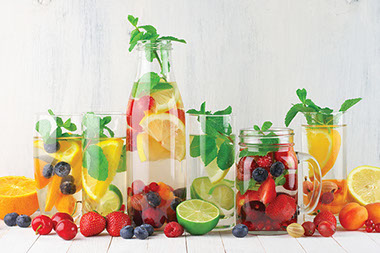
    A variety of flavored water.

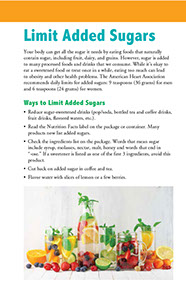
    Your body can get all the sugar it needs by eating foods that naturally contain sugar, including fruit, dairy, and grains. However, sugar is added to many processed foods and drinks that we consume. While it’s okay to eat a sweetened food or treat once in a while, eating too much can lead to obesity and other health problems. The American Heart Association recommends daily limits for added sugars: 9 teaspoons (36 grams) for men and 6 teaspoons (24 grams) for women.

    Ways to Limit Added Sugars

    *  Reduce sugar-sweetened drinks (pop/soda, bottled tea and coffee drinks, fruit drinks, flavored waters, etc.).

    *  Read the Nutrition Facts label on the package or container. Many products now list added sugars.

    *  Check the ingredients list on the package. Words that mean sugar include syrup, molasses, nectar, malt, honey and words that end in “-ose.” If a sweetener is listed as one of the first 3 ingredients, avoid this product.

    *  Cut back on added sugar in coffee and tea.

    *  Flavor water with slices of lemon or a few berries.

    © American Institute for Preventive Medicine

  • Meal And Snack Ideas

    Healthylife® Weigh

    Part 3

    Family eating dinner together at home.

    Below are ideas for basic meals and snacks. Use these ideas to start building your meal plan.

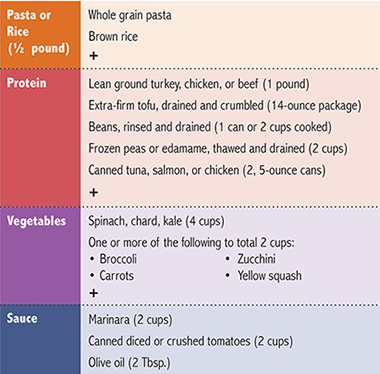
    Meal Idea: Pasta or Rice Dinner

    Choose ingredients from the chart below. This recipe makes four servings.

    Chart of meal ideas, pasta or rice dinner.

    Directions:

    1. Cook pasta or rice according to package directions and drain.

    2. Cook protein choice as needed.

    3. Cook veggies by steaming, grilling, roasting, sautéing, or adding to boiling pasta water in the last few minutes of cooking.

    4. In a large pot, heat sauce over medium heat. If using spices, add them now. Add protein and veggies to heat through. Toss with hot cooked pasta or rice and serve.

    For a casserole, follow the directions above. Then, pour into a 9 x 13-inch baking pan and bake for 40-60 minutes until the top is golden brown.

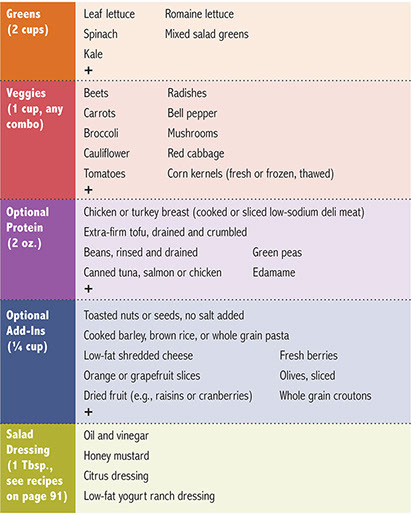
    Meal Idea: Salad

    Choose ingredients from the chart below. This salad recipe serves one person.

    Chart of meal ideas, salad.

    Directions:

    Toss ingredients together when ready to eat. Or, prepare a salad ahead of time in a container, keeping very moist ingredients (like tomatoes and dressing) separate. When you are ready to eat, toss and empty onto a plate or in a large bowl.

    Salad Dressing

    Salad dressing can be a healthy choice for your salad. Use healthy, unsaturated fats in salad dressing to:

    *  Help you feel full and more satisfied.

    *  Help your body get the benefits of other vitamins in your salad, like fat-soluble vitamins A, D, E, and K.

    *  Add flavor. Dressings are a great place for herbs, spices, and other powerful flavors to make your salad POP!

    *  Help you eat vegetables that you don’t like plain.

    Tips for Selecting a Dressing at a Restaurant:

    *  Ask for oil-based dressings, such as olive oil and balsamic vinegar.

    *  Ask for dressing on the side. Toss your salad with half the dressing provided and put the rest to the side. Most restaurants offer much more dressing than you need for your salad.

    *  If you are worried you may use too much dressing, ask for a half-size salad or order another vegetable as a side dish.

    *  On bottled dressings, look for ones made without added sugars.

    Make Your Own Salad Dressing

    Use 1-2 Tbsp. of the dressing on your salad. Store leftovers in a sealed jar.

    *  Oil and vinegar dressing: 3 Tbsp. olive oil, 2 Tbsp. red wine vinegar,  1/8 tsp. salt (a dash), ¼ tsp. black pepper. Serving size: 1 Tbsp.

    *  Honey mustard dressing: 6 Tbsp. mustard, ½ Tbsp. fresh lemon juice or cider vinegar, 1½ Tbsp. honey, 1 tsp. olive or canola oil, 1/8 tsp. salt  (a dash), ¼ tsp. black pepper. Serving size: 2 Tbsp.

    *  Citrus dressing: 2 Tbsp. lime, lemon, or orange juice; 3-4 Tbsp. canola or olive oil, 1/8 tsp. salt (a dash), ¼ tsp. black pepper. Serving size: 1 Tbsp.

    *  Creamy low-fat ranch dressing: 1 (6-ounce) container plain nonfat or  low-fat yogurt, 1/3 cup low-fat mayonnaise, 2 Tbsp. white vinegar, 1 Tbsp. dried dill, ¼ tsp. garlic powder, 1/8 tsp. salt (a dash). Serving size: 2 Tbsp.

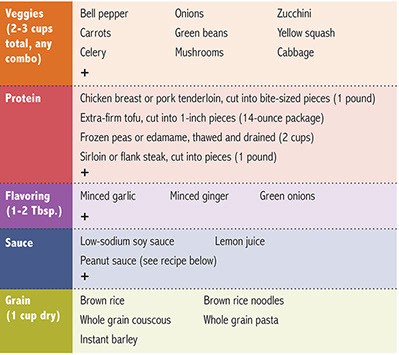
    Meal Ideas: Stir-Fry

    Choose ingredients from the chart below. This recipe makes four servings.

    Chart of meal ideas, stir-fry.

    Peanut Sauce:In a small bowl, stir together ¼ cup peanut butter, 1/3 cup water, ¼ cup low-sodium soy sauce, 2 Tbsp. cider vinegar, and 4 tsp. sugar.

    Directions

    1. Cook grains. Follow package directions and set aside.

    2. If using meat: In a large skillet over medium heat, cook meat or poultry in 1 tablespoon canola or olive oil. Set aside.

    3. Add veggies to skillet, starting with harder veggies (these take longer to cook). Cook to desired softness. Add flavoring (garlic, ginger, or green onions). If adding tofu, peas, or edamame, add that now.

    4. Add sauce and cook for 1-2 more minutes. Stir in cooked meat.

    5. Serve over cooked grains.

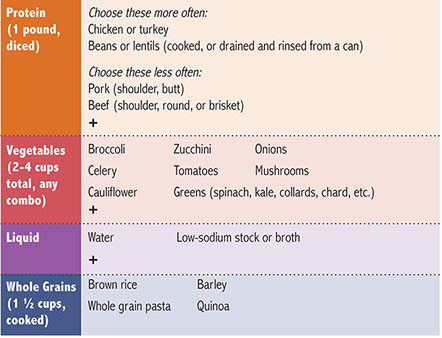
    Meal Ideas: Soup

    Choose ingredients from the chart below. This recipe makes four servings.

    Chart of meal ideas, soup.

    Directions

    1. If using meat: Heat 1 Tbsp. of canola or olive oil in a soup pot. Add meat and cook for 5 minutes. If not using meat, skip this step.

    2. Add chosen vegetables and sauté for 5 minutes. If using frozen vegetables, thaw in the microwave first.

    3. Add liquid and beans or lentils (if using) and bring to a boil. Once boiling, reduce heat and simmer for 25-30 minutes. Stir occasionally.

    4. Add grains and seasonings. Cook for an additional 5 minutes.

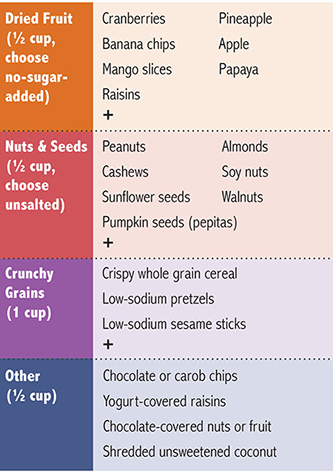
    Snack Ideas: Trail Mix

    Choose ingredients from the chart below. This recipe makes four servings.

    Chart of snack ideas, trail mix.

    © American Institute for Preventive Medicine

  • Make A Plan

    Healthylife® Weigh

    Part 3

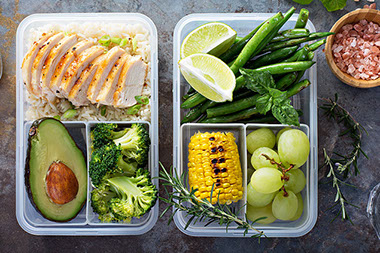
    Healthy green meal prep containers with rice and vegetables.

    You have learned how to make healthy choices within each food group. Now it’s time to form your personal plan of action. This section will help you:

    *  Strengthen your reasons for managing your weight.

    *  Plan your snacks and meals for a day.

    *  Design a week-long meal plan and grocery list.

    *  Modify recipes to match what you like and have available.

    *  Choose healthy foods at the grocery store, buffet, restaurant, and other places you eat.

    HealthyLife® Weigh

    QUICK LINKS: PART 3

    Changing is Your Choice

    Set Goals

    Meal Planning Basics

    MyPlate Choices for One Day

    Plan MyPlate

    Plan Time to Plan Meals

    Plan Your Week

    Modify Ingredients in Recipes

    Meal and Snack Ideas

    Picky Eaters

    Map Your Meal Plan

    Write a Grocery List

    Grocery Shop with Confidence

    Grocery Shopping with Kids

    Use Food Labels

    A Changing Food Label

    Ingredients List: What’s in This?

    Look Past Advertising

    Sodium in Packaged Foods

    Limit Artificial Sweeteners

    Sweet Sips, a Healthier Way!

    Master Food Prep

    Keep Food Safe

    Improve a Packaged Meal

    A Case for More Time in the Kitchen

    Eating at a Restaurant

    Fast-Food Restaurants

    Pack Travel Snacks

    Air Travel

    Avoid Drowsy Driving

    Coffee and Tea

    Sporting Events and Concerts

    Drink Water

    Limit Alcohol

    Quit Smoking

    Get Enough Sleep

    Review and Prepare

    © American Institute for Preventive Medicine

  • Plan Problem-Solving

    Healthylife® Weigh

    Part 6

    Problem, think, idea, solution diagram.

    Your worries and concerns take up time in your day. Many issues cannot simply be ignored or brushed aside. To avoid letting these thoughts trigger unhealthy eating habits, plan time to address them.

    Steps to Address Your Worries

    1. Write a worry at the top of a piece of paper.

    2. Divide the paper into three columns:

    a. What I can’t do. Recognize what is out of your control.

    b. What I can do. List possible actions that are within your control. Write things you know how to do and that are realistic actions for you to take.

    c. What I will do. Decide which action you are ready to take first. This action may not solve every part of the problem, but is a small step toward a solution. Write when you will do this.

    Mind Dump

    Use this tool when you feel you have too many thoughts to juggle and aren’t sure where to start. Use small pieces of paper or index cards to “mind dump” thoughts that come to mind. Write down concerns, ideas, and things you need to remember. Pull one card and use the steps above to address this worry. Don’t pull another card until you are satisfied with your plan to deal with the first worry.

    © American Institute for Preventive Medicine

  • Resistance Training

    Healthylife® Weigh

    Part 5

    Fit senior man in gym working out with weights.

    Make resistance training part of your exercise routine. Resistance training:

    *  Builds endurance. Your muscles can work longer before getting tired.

    *  Builds muscle. Muscle increases your resting metabolism. This means that even when your body is at rest, you are burning more fuel.

    *  Improves bone density. This helps prevent osteoporosis and fractures.

    *  Makes your body look more toned.

    *  Reduces the chance of injury while exercising.

    Tips for Resistance Training:

    *  Use free weights, a stretch band, or your body weight. Use the Dyna® Band and Exercise Guide if you received these with HealthyLife® Weigh.

    *  Follow guidelines on resistance machines for proper form. Ask a personal trainer to make sure you are doing exercises correctly.

    *  Work out with a friend. Have someone spot you.

    *  Warm up with 15 repetitions, using ½ to ¾ of your usual weight.

    *  Rest your muscles for a day in between workouts. If you want to work out every day, do the upper body one day; the lower body the next.

    *  Move slowly. Don’t jerk the weights up or drop them too fast.

    *  Breathe out when you are at the hardest part of the exercise. Breathe in when you return to the starting position. Don’t hold your breath.

    *  Work opposing muscles. For example, after you work the front of the arm (biceps), work the back of the arm (triceps).

    Examples of Resistance Training:

    Knee Push-Up: Rest on your knees and on the palms of your hands, about shoulder width apart. Push up. Keep your body straight from knees to shoulders. Push up and down slowly to the count of 4.

    Calf Raises: Stand with your feet about hip distance apart. Rise onto your toes. Hold for 1 count and lower. Try it on the edge of a step and let your heel drop below your toes for a wider range of motion.

    © American Institute for Preventive Medicine

  • Sweet Sips, A Healthier Way!

    Healthylife® Weigh

    Part 3

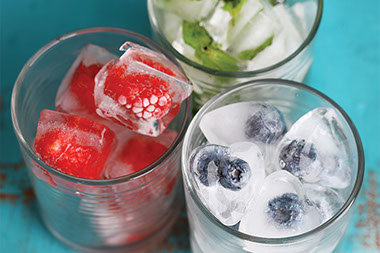
    Glasses of water with ice cubes that have berries frozen in them.

    Sugar-sweetened beverages can be a major source of added sugar. Cut back or eliminate these beverages from your everyday lifestyle. Save pop or soda for a once-in-a-while treat. As you reduce sugar in your diet, especially artificial sweeteners, you may find these drinks are too sweet for your new tastes!

    Make your own flavored water

    You can consume flavored beverages without added sugars AND get a few extra nutrients along the way! You will need:

    *  1-quart jars or a large pitcher

    *  Water

    *  Wooden spoon (or another long, sturdy spoon)

    Fruit and/or Fresh Herbs:

    You can start with just one cut-up fruit, but for a flavored water that will really pop, try combining at least two fruits or a fruit and an herb. Here are a few suggestions, but don’t be afraid to try your own combinations! For a single-serving, use less. For a whole pitcher, use more!

    Pineapple, Orange, & Ginger

    *  ½ cup cubed pineapple

    *  ½ an orange, sliced

    *  1 Tbsp. freshly-grated ginger

    Minty Cucumber Lime

    *  ½ a cucumber, sliced

    *  ½ a lime, sliced

    *  ¼ cup fresh mint leaves

    Orange and Blueberry

    *  1 Mandarin orange, broken into wedges

    *  Small handful of blueberries

    Strawberry, Lemon, & Basil

    *  ½ cup sliced strawberries

    *  ½ a lemon, sliced

    *  ¼ cup fresh basil leaves

    Watermelon Mint

    *  1 cup cubed watermelon

    *  ¼ cup fresh mint leaves

    Rosemary & Grapefruit

    *  ½ grapefruit (or ¼ grapefruit & ¼ orange)

    *  A few sprigs of rosemary

    Citrus with Cilantro or Mint

    *  2 large oranges, sliced

    *  1 lemon, sliced

    *  ½ large cucumber, sliced

    *  1 handful of fresh mint or cilantro

    Time to Build!

    1. Place the fruit, herbs, and any other ingredients in the bottom of a glass jar or pitcher. Or, using a wooden spoon, mash the ingredients to bring out the flavor. You can also scrunch the herbs in your hands before adding them to the jar. This helps bring out the flavor.

    2. Fill the jars with water and ice as desired. You can also add unsweetened carbonated/seltzer water if you are craving fizzy bubbles!

    3. The flavor will be more enhanced after the water sits for an hour. Or, refrigerate the water overnight. If you want to drink it right away, squeeze the fruit a little before you drop it in to help bring out the flavors faster.

    Other Sweet Beverage Ideas:

    Freeze ice cubes with fruit. Drop a few cubes of different colored fruits into a tall glass of cold water.

    Blend whole fruits in a smoothie with spinach, kale or other de-stemmed, leafy green vegetables.

    Diet or regular soda? Limit both.

    Most diet sodas contain artificial sweeteners. Studies have shown drinking diet soda is not any better at helping you manage your weight. Gradually cut back on soda.

    Even if you add a teaspoon of sugar to your coffee, this 4g of sugar is far less than the sugar found in the average soda. The average soda contains 39g of sugar in a 12-ounce can. In a 16-ounce bottle, a soda may contain 52g of sugar.

    © American Institute for Preventive Medicine